
The myth that only academic superstars become medical directors is lazy, outdated, and flat‑out wrong.
I keep hearing the same story from physicians: “I’m not a big name researcher, so I could never be a medical director.” Meanwhile, the people actually sitting in those roles? Often mid‑career clinicians who were never once called “rising academic star” on a conference podium.
Let’s dismantle this properly.
What “Medical Director” Actually Means (And Why the Myth Won’t Die)
Part of the confusion is that people treat “medical director” like one job. It isn’t. It’s a messy umbrella covering very different roles with very different entry points.
You’ve got:
- Hospital service line medical directors (ED, ICU, hospitalist, surgery)
- Quality and safety medical directors
- Health plan/insurance medical directors (UM, population health)
- Medical directors in pharma/biotech and medtech
- Medical affairs / MSL leadership roles titled “medical director”
- Hospice, SNF, home health, urgent care, telehealth medical directors
- Digital health and startup medical directors
Some of these roles care a lot about your CV. Some barely care at all as long as you’re board‑certified, licensed, and not a walking HR complaint.
The myth survives because people conflate three different things:
- Highly visible academic leadership (chiefs, chairs, national society leaders)
- Research‑heavy roles tied to grants, trials, and publications
- Operational medical directorships that run the day‑to‑day machine
Only #1 and parts of #2 really lean hard on the “academic superstar” profile. Most physicians who hold “medical director” titles are closer to #3.
Let me show you what the data and hiring patterns actually look like.
Who’s Really Getting Hired as Medical Directors?
Look at any mid‑size hospital’s leadership directory. You’ll see a pattern. The ICU medical director who’s beloved by nursing. The ED medical director who quietly fixed door‑to‑needle times. The hospice medical director who’s constantly juggling staffing and family expectations.
They’re not all from Harvard with 120 PubMed hits.
To make this concrete, let’s compare what actually tends to matter across sectors.
| Sector / Setting | Typical Profile Hired |
|---|---|
| Community hospital service line | Solid clinician, reliable, some QI projects |
| Academic hospital program | Mix of clinical + some research/teaching |
| Health plan / payer | Clinician with utilization/quality interest |
| Pharma / biotech | Clinical + research or trial experience |
| Digital health / startup | Clinician with product or ops mindset |
| Hospice / SNF / home health | Clinician with communication + systems skill |
Notice what’s not in that table: “Top 1% of CVs in the country.”
I’ve sat in medical director search committee meetings where the conversation sounded like this:
- “Who can actually get other physicians to show up and not revolt?”
- “Who does nursing trust?”
- “Who understands the EMR enough not to break it?”
- “Who will answer email and not disappear for weeks?”
Meanwhile, the person with 60 publications but a reputation for being impossible to work with? They don’t even make the shortlist.
What the Few Hard Numbers We Have Show
Formal studies on “who becomes medical director” are limited, but there are some useful signals:
- Surveys of hospitalist and ICU medical directors consistently show that most were internal hires who evolved into the role after leading projects or informally “being the person who fixes stuff,” not external recruitment of big‑name academics.
- In payer/health plan medical director roles, HR and recruiter reports show their minimum bar is usually: board certification, clinical experience (often 3–5+ years), and basic communication/leadership skills. High‑impact research is “nice to have” at best.
- In pharma/biotech, medical director roles at the science‑heavy end do skew toward candidates with PhDs, fellowships, and trial experience. But even there, you see plenty of people without “celebrity” CVs—just a tight fit between their clinical background and the therapeutic area.
Put differently: the “elite academic or bust” narrative just doesn’t match the hiring patterns.
The Credentials That Actually Move the Needle
You do not need to be an academic rockstar. But you also can’t just be a warm body with a license. There’s a middle ground where most real hiring decisions happen.
Let’s separate reality from fantasy.
Baseline Non‑Negotiables
These are almost universal:
- Board certification in your specialty
- Active, clean license(s) in relevant state(s)
- A track record of competent, reasonably efficient clinical care
- No glaring professionalism disasters
Notice: none of that involves R01 grants or NEJM papers.
The Real Differentiators (Across Most Settings)
What gets you out of the pile and into “we should interview this person” territory are patterns like:
- You’ve led something. A sepsis bundle roll‑out. A stroke protocol redesign. A throughput initiative. Not as “chair of twelve committees,” but as the person who actually moved the metric.
- You understand systems. You know how your EMR works, how your hospital gets paid, why prior auths get denied, where data comes from—and you’re curious about improving it.
- You can talk to non‑physicians like a human. Nursing leaders, case managers, coders, actuaries, product managers. If you can walk into a conference room and leave with people actually understanding you and not wanting to kill you, that’s gold.
- You show up and follow through. Boring but brutal truth: half of “leadership” is reliably doing the unsexy tasks that everyone else lets drop.
Academic fireworks can help in some niches, but those four bullets get more physicians hired as medical directors than any citation count.
Where Academic Stardom Actually Matters
Let’s be fair. There are roles where being a heavy‑hitting academic is not just helpful but expected:
- Division chief/chair roles in research‑intense departments
- Medical director of a major cancer center, transplant program, or national trial network
- High‑profile medical society leadership integrated with your institutional role
- Certain pharma roles (especially early‑phase oncology, rare diseases, or where you’re essentially the scientific face of a product)
In those corners, your h‑index and grant portfolio can be the deciding factor. But those jobs are a very specific slice of “medical director” roles, not the whole pie.
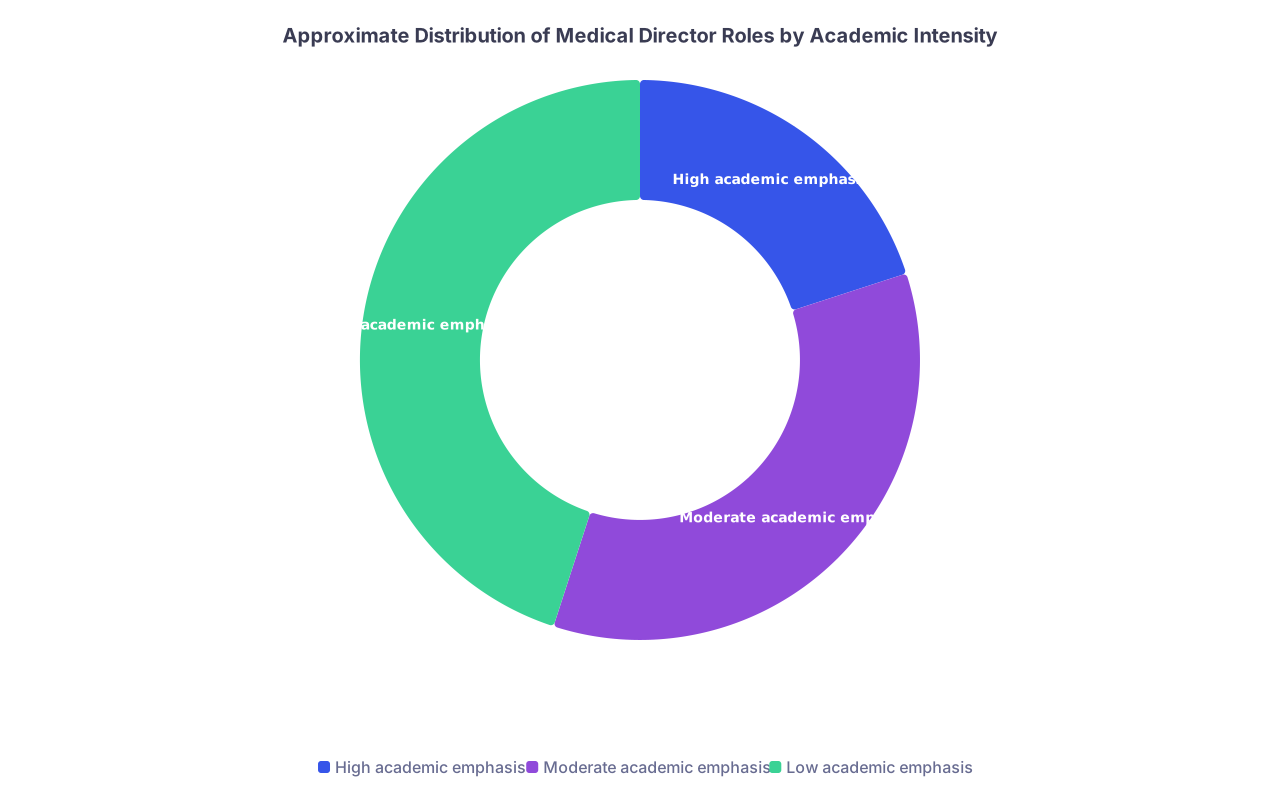
| Category | Value |
|---|---|
| High academic emphasis | 20 |
| Moderate academic emphasis | 35 |
| Low academic emphasis | 45 |
The majority fall into moderate or low emphasis on traditional academic stardom. That’s the part no one tells residents, because “you must be world‑class elite or you’re nothing” is a cleaner story than “learn to run a meeting and read a financial statement.”
How People Actually End Up in Medical Director Roles
The pipeline is more accidental than glamorous. I’ve watched this same pattern repeat in multiple hospitals and companies.
It usually goes something like:
- You complain about something that’s broken.
- Someone says, “If you care so much, why don’t you lead the fix?”
- You begrudgingly do it. You do not burn the place down. Outcomes improve.
- Leadership notices. Suddenly you’re on every email about that topic.
- The current medical director burns out, leaves, or gets promoted.
- Your name comes up as “the person already basically doing the job.”
This is much more common than the fantasy of someone being “handpicked” straight out of fellowship because they had a Nature paper.
To visualize the reality:

| Step | Description |
|---|---|
| Step 1 | Clinician Role |
| Step 2 | Lead Small Project |
| Step 3 | Visible Results |
| Step 4 | More Committees or Tasks |
| Step 5 | Informal Leadership Reputation |
| Step 6 | Interim or Assistant Medical Director |
| Step 7 | Formal Medical Director Title |
Nowhere in that flowchart: “Win national awards in research.” It can help at some stages, but it’s not the default path.
Common False Beliefs That Keep People Out
I’ve heard variations of these from dozens of physicians:
“I’m just a community doc, no one will take me seriously.”
Reality: community hospitals and regional systems are desperate for physicians who can speak both clinical and operational language.“I don’t have any real leadership experience.”
Reality: if you’ve ever built a schedule, run a call pool, started a clinic, set up an EHR template, or led a QI project, you already have raw material. You just haven’t named it and sharpened it.“I’m not a ‘political’ person.”
Reality: the best medical directors I’ve seen were not slick politicians. They were direct, fair, and predictable. Politics exists, but basic emotional intelligence beats back‑room games in the long run.
How to Make Yourself Competitive Without Becoming an Academic Celebrity
If you actually want these jobs, here’s the unromantic, practical approach. No fairy dust, no magic pedigree.
1. Get One Foot in the Non‑Clinical World
You don’t need another degree, but you do need exposure.
- Join your hospital quality committee and actually show up.
- Volunteer to be the clinical lead on an EMR project or guideline update.
- For payers or pharma, do small projects first: chart review, advisory boards, part‑time UM work, medical consulting for a startup.
The bar is not “found a national center.” It’s “has done something concrete outside of pure shift work.”
2. Learn to Speak Outcomes, Not Opinions
Medical directors live and die by metrics. Readmissions, LOS, cost per member per month, time to treatment, adherence, NPS, whatever your sector cares about.
You don’t need to be a biostatistician. But you do need to be able to say things like:
- “We reduced average LOS by 0.4 days without increasing readmissions.”
- “Our prior auth overturn rate dropped from 35% to 18% after changing criteria.”
- “Our telehealth no‑show rate decreased by 20% once we changed scheduling windows.”
If your entire argument is always “because I’m the doctor and I said so,” you will not last long in a director role.
3. Build a Reputation Inside Your Own Building First
Most physicians try to “network” out in the ether before they’ve actually built trust where they work.
That’s backwards.
The easiest way to become a medical director is still:
- Become the go‑to person for solving a recurring problem.
- Make nursing leadership’s life easier, not harder.
- Deliver on one or two high‑visibility projects.
- Be the physician administrator wants in the room when stuff hits the fan.
Once that’s true, titles have a way of finding you.
4. If You Like Academics, Use It Strategically
If you happen to enjoy research or teaching, great. Use it, but don’t assume it’s the whole game.
For most medical director roles, these are the high‑yield “academic” activities:
- QI publications tied to real operational change
- Clinical guidelines or pathways that your institution actually uses
- Involvement in registries or collaborative networks that benchmark performance
- Teaching that clearly improves frontline practice (procedural workshops, simulation, cross‑disciplinary education)
That niche NEJM case report? Fun ego boost. Not moving the needle much on a payer medical director application.
Where This Myth Actually Hurts You
The “only superstars get these roles” myth is not just wrong; it’s harmful.
It leads to:
- Self‑elimination. Physicians who would be excellent medical directors never apply because they assume they’re unqualified.
- Title chasing instead of skill building. People obsess over degrees and “fancy” CV lines instead of learning to manage budgets, interpret metrics, or run projects.
- Burnout by stagnation. Clinicians who are bored and frustrated in full‑time clinical roles don’t realize there’s a whole ecosystem of hybrid and leadership positions that do not require them to become “famous.”
You don’t have to love politics. You don’t have to become a professional meeting‑attender. But if you like fixing broken systems, influencing care at scale, and using your brain for more than throughput, medical directorships are not reserved for the anointed few.
They’re mostly held by doctors who:
- Showed up.
- Took ownership.
- Learned enough about business and systems to be dangerous—in a good way.
The Bottom Line
Three takeaways and you’re done:
- Most medical director roles do not require academic superstardom; they require credible clinical experience plus visible system‑level contributions.
- The real selection criteria are leadership behavior, reliability, and the ability to work across disciplines—not how many papers your name is on.
- If you want in, stop worshipping titles and start leading small, measurable changes where you already are; that’s the actual on‑ramp to these jobs.