
Industry experience is not mandatory for MSL roles. The belief that it is has kept a lot of qualified clinicians and scientists stuck where they are, polishing CVs for jobs they could already be competitive for.
Let me be blunt: “You need prior pharma experience to become an MSL” is mostly gatekeeping, lazy recruiting, and outdated folklore. Not reality.
Does industry experience help? Of course. Is it a hard requirement? No. And if you wait to apply until you magically “have industry experience,” you may never move.
Let’s walk through what the data, job postings, and actual hiring patterns show—rather than what frustrated applicants repeat to each other on Reddit.
What MSLs Actually Do (And Why This Myth Exists)
An MSL is not a sales rep with a fancier title. It’s a field-based medical role focused on scientific exchange with key opinion leaders (KOLs) and other healthcare professionals. You are the medical face of a product, portfolio, or therapeutic area.
If we strip away the corporate jargon, the core tasks look like this:
- Build and sustain relationships with clinicians and researchers in a specific disease area
- Discuss clinical data, real‑world evidence, and guidelines at a high level
- Provide medical and scientific support for internal teams (medical, commercial, access)
- Support investigator-initiated studies, advisory boards, and educational events
- Gather structured field insights and relay them back into the company
None of that requires prior industry employment. It requires three things:
- High-level scientific or clinical competence
- Communication skills with peers who do not have time for fluff
- The ability to operate in a corporate, metrics-driven environment
So why does “no industry, no MSL” feel so pervasive?
Because companies, recruiters, and even many current MSLs confuse “strongly preferred” with “mandatory,” and candidates read job descriptions like legal contracts instead of like wish lists.
And because people who failed to break in often retcon the story: “They only hire people with experience” is a comforting narrative. It shifts the blame off strategy, interviewing, or fit. But it’s not accurate.
What the Job Data Actually Shows
You don’t have to guess. Just look at the postings and who gets hired.
Across major regions (US, EU, UK, Canada), MSL job descriptions from big pharma and mid-size biotechs tend to say versions of:
- “PhD, PharmD, MD, or other advanced degree required/preferred”
- “MSL or relevant industry experience preferred”
- “Previous MSL experience highly desirable”
Notice the verbs: preferred, desirable. Not “non-negotiable.”
When you track actual hires—yes, the people who land the roles—three clear trends show up:
First-time MSLs with zero prior industry roles are hired every single quarter
Often they’re clinicians (MD/DO, specialist nurses, pharmacists) or PhDs/postdocs with strong publications and KOL exposure.Smaller or emerging companies are more rigid; large pharma is often more flexible
Big companies can afford to train. Young biotechs under pressure often want “plug-and-play” MSLs who can go live in 4 weeks.Therapeutic area expertise often outweighs “years in pharma”
A cardiologist stepping into a CV/metabolic MSL role can beat a generalist MSL with 3 years of experience in vaccines. Depth matters.
To make this concrete, here’s how things usually line up in reality:
| Candidate Type | Hired As First-Time MSL? | Typical Situation |
|---|---|---|
| MD/DO with relevant specialty | Very often | No industry; strong KOL exposure |
| PharmD with residency/fellowship | Often | Academia or managed care background |
| PhD with TA-aligned postdoc | Often | Publications, conferences, networking |
| MSc/RN/PA with niche expertise | Sometimes | Smaller markets, rare diseases, devices |
| Sales rep with no advanced degree | Rarely | Only in highly commercial cultures |
Notice what is not mandatory in any row: prior pharma title.
Industry Experience: What It Actually Buys You
Let’s not romanticize this. Having industry experience does give you advantages. But they’re specific, and they’re not magical.
The real value of prior pharma/biotech experience is:
- You already speak the language: compliance, fair balance, off-label boundaries, med vs commercial firewalls
- You know the workflows: CRM systems, field metrics, medical-legal review, cross-functional meetings
- You understand how “medical strategy” really plays out between PowerPoint and reality
That means you ramp faster, need less hand-holding, and make fewer rookie mistakes like saying the wrong thing in front of a community cardiologist who sits on the payer’s P&T committee.
From the company’s perspective, those benefits translate into lower risk and quicker field impact. So they prefer it.
But preference is not requirement. Companies repeatedly trade “prior industry” for:
- Stronger scientific credibility
- Better existing relationships with target KOLs
- Evidence the person can speak to peers as equals, not as a salesperson
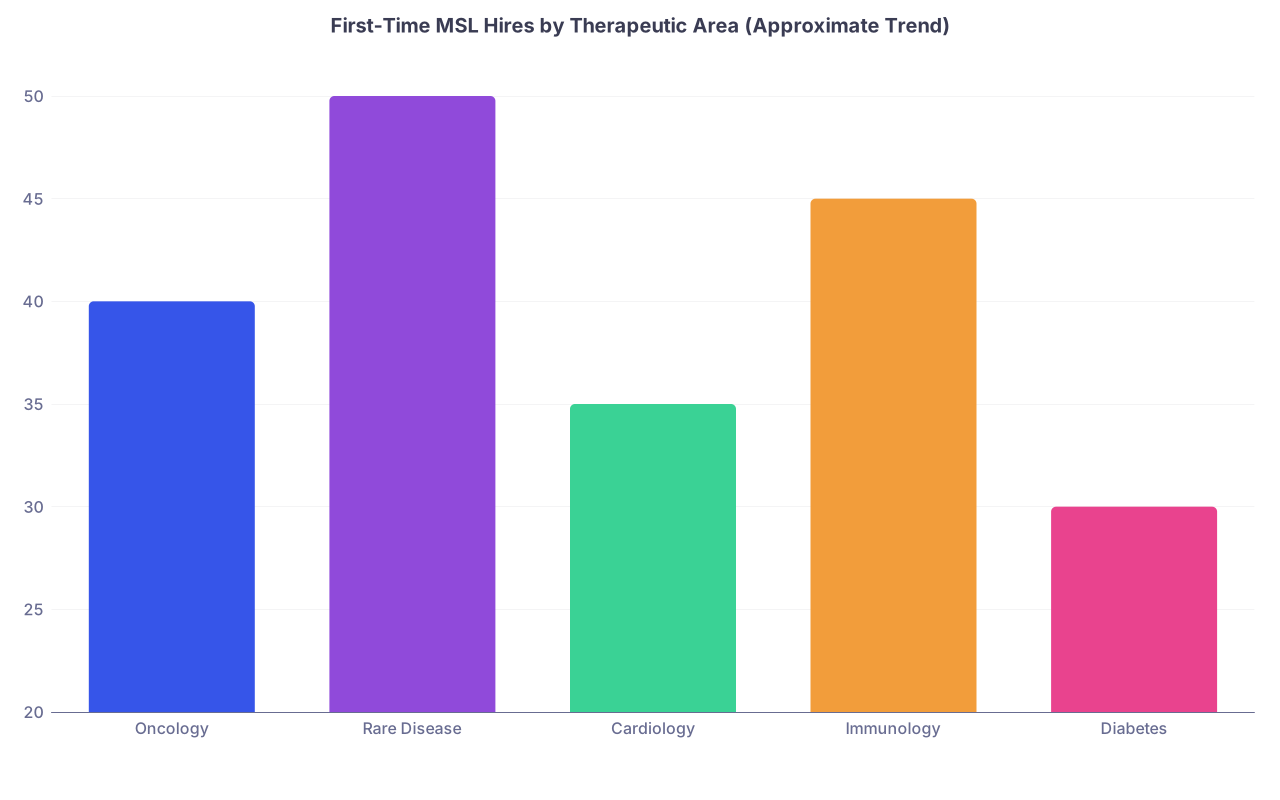
This trade-off becomes obvious when you look at certain therapeutic areas.
| Category | Value |
|---|---|
| Oncology | 40 |
| Rare Disease | 50 |
| Cardiology | 35 |
| Immunology | 45 |
| Diabetes | 30 |
Those percentages aren’t exact (companies don’t publish this), but they reflect what you see if you track LinkedIn role changes and backgrounds over a few cycles: new-to-industry hires are common in complex, specialist diseases where clinical depth is scarce.
I’ve seen:
- An academic hematologist-oncologist with no industry background become an oncology MSL at a top-10 pharma
- A PhD immunologist straight from a postdoc land an MSL role in rheumatology after presenting at the right congresses
- A clinical pharmacist in a transplant center move into a rare disease MSL role with zero previous industry employment
What did they all have? Not “years in pharma.” They had something more valuable: undeniable subject-matter weight plus visible engagement with the medical community.
Where the Myth Feels True (And Why)
So why are you, and thousands of others, hearing “We went with someone who has industry experience”?
Because in some contexts, the myth behaves like truth.
Three scenarios where the bias is strongest:
Ultra-competitive geographies
Major metro areas like Boston, NYC, London, Toronto, Basel are flooded with candidates. When a recruiter has 200 CVs, “prior MSL” becomes a lazy screening filter.Mature, crowded therapeutic areas
Diabetes, primary care, general internal medicine—any area with a huge existing MSL pool. If they can get both MSL experience and TA fit, they will.Companies in crisis or high-pressure launches
If a small oncology biotech is 3 months from launch with one asset and one shot at survival, they’re going to be extremely risk-averse.
In those pockets, you will hear “industry experience required” a lot. But that’s context, not universal law.
The problem is applicants generalize from a narrow slice of the market. They take 5 rejections in Boston in immunology and turn it into a career rule: “It’s impossible without industry.” That’s not evidence, it’s pattern-matching driven by frustration.
What Actually Predicts MSL Hiring for First-Timers
Strip away the noise and you see a consistent pattern in who breaks in without prior industry:
Advanced degree with real depth
- MD/DO, PharmD, PhD are the most common.
- But niche expertise (e.g., transplant pharmacist, MS nurse specialist) can compensate for not having a doctorate.
Clear therapeutic area alignment
You want oncology MSL? Show oncology. Not “I’m interested in cancer.” Actual work: patients, trials, publications, case discussions, tumor boards, or at least deep, structured self-study with proof.Evidence of external-facing communication
- Grand rounds, conference talks, continuing education sessions
- Teaching roles, KOL collaborations, advisory participation
The hiring manager wants to know you can hold your own with experts without crumbling or overcompensating.
Understanding of the MSL function and compliance
This is where many smart candidates blow it. They interview like academics or sales reps. They talk about “promoting” data, “convincing physicians,” or “pushing the product.” Immediate red flag.Network validation
A director who hears, “Oh yes, I know her from the ASCO panel, she’s solid,” thinks very differently about taking a risk on a first-time MSL.
That’s what gets people over the “no industry” hump. Not some magical internship. Not padding a CV with “advisory work” that was really a single dinner.
Where Industry Experience Does Become Essentially Mandatory
Let’s be honest: there are corners of the MSL world where prior industry is practically required, especially if you’re trying to jump several levels.
If you’re aiming for:
- Senior MSL / Principal MSL with leadership or mentoring responsibilities
- Medical Manager / Field Medical Director roles that oversee teams
- Strategic launch roles where the company is sinking millions into a new asset
Then yes, at that point prior success as an MSL or in a closely related industry medical role is almost always required. They want a track record of:
- Navigating med-legal constraints
- Building territory strategy and KOL tiers
- Driving cross-functional projects without blowing up compliance
But that’s not what most people asking this question mean. They’re asking about their first MSL role.
For that first role, the door is much less rigid than the folklore claims. Harder than applying to a generalist hospital job? Sure. Impossible? No.
If Industry Isn’t Mandatory, Why Are So Many People Stuck?
Because “qualified on paper” and “hireable as an MSL” are not the same thing.
Most clinically or academically strong candidates make three predictable mistakes:
They send generic, academic-style CVs into black-hole portals
Three pages of publications, no clear therapeutic focus, no translation of their experience into field-medical language. To a recruiter, that looks like: “high maintenance, low field-readiness.”They interview like it’s a fellowship or faculty job
They talk about their research in exquisite detail, but can’t clearly explain:- How they’d structure a first KOL visit
- How they’d handle an off-label question
- How they’d report back a negative KOL reaction internally
They chase every MSL posting instead of being strategically narrow
“Oncology, cardiology, neurology, vaccines—I’ll take anything!” That screams desperation, not expertise. Companies hire specialists, not “I’ll do anything you want” generalists.
The people who actually get hired without industry do almost the opposite.
They:
- Pick 1–2 therapeutic areas that map tightly to their current expertise
- Tailor CV and LinkedIn around that specific niche, not around “I’m a PhD/MD”
- Learn the language of MSL work: scientific exchange, insight gathering, compliant communication, field strategy
- Use networking and targeted visibility (conferences, webinars, local HCP talks) so they’re not just a random name in a portal queue
Realistic Odds vs. Defeatist Myths
Let me put this in clear terms.
If you:
- Have a relevant advanced degree or genuinely deep niche expertise
- Know your target therapeutic area cold
- Can communicate like a peer to specialists
- Learn and speak MSL language and mindset
- Apply strategically and interview well
Your lack of prior industry experience is a hurdle, not a wall.
Are your odds worse than someone who is already a successful MSL in that same TA and geography? Yes. Sometimes much worse.
But you’re not competing against only them. You’re competing against a mixed pool—some overqualified but misaligned, some underqualified, some who interview terribly, some who do not understand compliance at all.
Across a full job market cycle, first-time MSLs without prior industry are consistently hired. The people who insist otherwise are usually:
- Looking at only one geography or one over-saturated TA
- Relying solely on cold applications
- Interviewing like academics or salespeople, not as future MSLs
The data—job postings, LinkedIn backgrounds, and actual hires—simply does not support the narrative that “industry experience is mandatory.”
It supports a more annoying truth: it is easier with industry experience, but still very possible without it if you’re willing to get specific, strategic, and uncomfortable.
What This Means If You’re Considering the MSL Path
Stop treating “no industry” as a disqualifier and start treating it as a variable you must compensate for.
That compensation does not mean faking experience or taking unpaid “advisory” gigs that are glorified surveys. It means:
- Tightening your therapeutic focus
- Translating your current work into MSL-relevant terms
- Learning the compliance and field-medical landscape before the interview
- Letting the market tell you where you’re competitive by watching which roles actually move you to interviews
And yes, it means tolerating rejection without rewriting reality into a comforting myth.
You don’t need to worship the industry, but you do need to understand how it thinks.
Because years from now, you won’t be remembering how many times someone told you “we went with a candidate with more industry experience.” You’ll remember the one hiring manager who took a “risk” on you—and how ready you actually were when that door finally opened.