
What if I told you the biggest factor in your non-clinical career is not whether you chose dermatology or family medicine, but something far more boring that most residents completely ignore?
Let me be blunt: medical culture has built a weird mythology that your specialty either opens or closes doors forever. “If you want pharma, do heme/onc.” “If you ever want admin, you must do internal medicine.” “Psychs can’t be CMOs.” I’ve heard all of this. In resident lounges. On Reddit. In semi-bitter attending rants.
Most of it is garbage.
Specialty does matter. But not the way you’ve been told. And not nearly as much as your skills, your track record, and how early you start behaving like someone who can operate outside the exam room.
Let’s dismantle the myths and get to what the data and actual hiring patterns show.
The Big Myth: “Some Specialties Are Non-Clinical Dead Ends”
The story people love to tell:
- Radiology, pathology → “You’re stuck in the dark room”
- Primary care → “You’ll never be competitive for industry”
- Surgery → “Too specialized, no one cares outside the OR”
- Psychiatry → “Soft skill, not portable to corporate roles”
- Pediatrics → “Nice, but no power jobs”
Here’s what actually shows up when you look at leadership bios in health tech, insurers, pharma, and hospital C-suites:
You see everything. IM, EM, peds, psych, anesthesia, radiology, surgery, FM, even OB/GYN. Over and over, in all kinds of roles: Chief Medical Officer, VP of Clinical Strategy, Medical Director, Head of Provider Experience, Product Lead, Safety and Risk, Medical Affairs.
So no—there is no such thing as a “non-clinical dead-end specialty.”
There are, however, specialties that naturally pipeline you into certain non-clinical areas if you layer the right experience on top.
Let’s map that honestly.
What Employers Actually Care About (Hint: Not Your Board Certification)
When non-clinical employers look at physicians, specialty is a filter, not the decision point. It signals your baseline domain, but it rarely decides the final outcome.
What they actually care about:
Domain relevance
- For oncology drug development? Oncologists and heme/onc IM docs have an edge. Not because they’re “better doctors,” but because they understand trials, endpoints, adverse events, referral patterns.
- For pediatrics digital health? Peds and FM/IM with a peds focus look good.
- For mental health startups? Psych, FM, EM, and even IM if you’ve actually practiced in that space.
Demonstrated non-clinical skills
Not your theoretical interest. Your track record.- Have you led a quality project that changed something measurable?
- Served on a committee and actually shipped a protocol, guideline, or new workflow?
- Published outcomes work, participated in trials, built a small analytics pipeline in Excel/R?
- Helped evaluate or implement an EHR change or clinical decision support tool?
Communication and cross-functional work
- Can you talk to engineers without losing them?
- Can you explain a clinical workflow to a product manager who’s never been on rounds?
- Have you presented to a board, leadership team, or payer?
Basic business literacy
You do not need an MBA. I’ll repeat that because people hate hearing it: you do not need an MBA for most non-clinical roles. You do need to understand:- Revenue vs margin
- Payer mix
- Value-based care basics
- How a P&L roughly works
Specialty is background noise compared to those.
Where Different Specialties Actually Have Edge (And Where They Don’t)
Here’s where the pattern is real: some specialties give you credible storylines into certain industries. But it’s “easier,” not “only.”
| Specialty | Natural Edge Areas |
|---|---|
| Internal Med | Pharma, payer, health systems |
| Family Med | Primary care startups, payers |
| Emergency Med | Digital health, operations |
| Psychiatry | Mental health, policy, digital |
| Pediatrics | Child health tech, NGOs |
| Surgery | Devices, hospital leadership |
| Anesthesia | Devices, periop operations |
| Radiology | Imaging AI, health tech |
| Pathology | Diagnostics, lab industry |
Notice something? Every specialty has at least two natural on-ramps.
But here’s the twist: I’ve seen family med doctors in pharma, surgeons in payer leadership, and psychiatrists as CMOs of general telehealth companies. Why? Because once you’re in the door and you’re competent, nobody obsessively cares whether your residency badge said “IM” or “EM.”
They care if you can:
- Think in systems
- Understand risk
- Make decisions under uncertainty
- Translate clinical realities into business or product decisions
MD/DO training does that across the board. Specialty just flavors your story.
The Real Constraints: Not Specialty, But These 4 Things
You want to know what actually limits non-clinical options? It is almost never the specialty. It’s this:
1. How Narrow You Let Yourself Become
If you spend 15 years doing only robotic colorectal surgery in a private hospital, no committee work, no QI, no teaching, no research, no care redesign—yes, you’ll have a hard time marketing yourself outside the OR.
But that’s not a “surgery problem.”
It’s a hyper-narrow-career problem. I’ve seen the same with outpatient-only internists who never touched a committee or project. On paper, they look identical to 5,000 other “just saw patients” CVs.
Employers don’t know what to do with that.
2. Whether You Ever Touch Data, Projects, or Systems
You’re not hired to “be a doctor” in a non-clinical role. You’re hired to:
- Improve metrics
- Decrease risk
- Increase revenue
- Build or refine products
- Influence behavior at scale
If your resume says “did my clinic hours and went home,” you’ve given them zero evidence you can do any of that.
Here’s the pattern in people who transition successfully (across all specialties):
- They led or contributed meaningfully to:
- QI projects with actual before/after numbers
- Clinical trials or observational studies
- EHR/IT initiatives (order sets, documentation templates, CDS)
- New service lines or programs
That’s the currency, not your specialty name.
3. Your Willingness to Start “Too Early”
Medical culture tells you to focus on boards, RVUs, procedures. And sure, you have to be competent.
But the people who glide into non-clinical roles in their 30s did not wait until they were 42 and burned out to “start thinking about options.” They:
- Joined committees as residents or early attendings
- Presented posters on QI, informatics, or implementation, not just basic science
- Learned basic SQL/Excel/R or at least became the “data-friendly doc” on their team
- Networked with industry folks at conferences instead of huddling only with co-residents complaining about call
And—again—they’re from every specialty.
4. Your Geography and Flexibility
You want to be remote from a small town, never travel, and earn a high corporate salary in a hyper-specific niche? That’s your constraint, not neurology vs OB.
Certain roles cluster:
- Pharma / biotech → major hubs (Boston, SF Bay Area, NJ/NY, some EU)
- Big tech health divisions → Seattle, Bay, some NYC, some remote
- Large payers / health plans → decent national spread, but C-level in big metros
- Health systems / ACOs → wherever the systems are
If you’re flexible on:
- Location
- Hybrid/remote mix
- Taking an initial pay cut for advancement potential
Your specialty quickly stops being the bottleneck.
Where Specialty Does Make a Noticeable Difference
I’m not going to pretend specialty is irrelevant. It’s just not the jail people think it is.
1. Pharma & Biotech
This is where specialty routing is real:
- Oncology drugs → Oncologists and heme/onc IM
- Rheum drugs → Rheumatologists
- Neurodegenerative → Neurologists, sometimes psychiatrists
- Rare genetic pediatric diseases → Peds subspecialists
But that’s at the deep-medical-affairs / development level.
Zoom out:
- Safety and pharmacovigilance
- Real-world evidence and HEOR
- Medical education
- Clinical strategy
These roles are full of IM, FM, EM, peds, psych, and others who learned the therapeutic area over time. I’ve seen a general internist become a senior leader in dermatology-focused pharma—because he got in, learned the space, and delivered.
So yes, some niches favor certain specialties early on. They do not own the whole industry.
2. Devices and Diagnostics
- Interventional cardiologists, surgeons, orthopods, anesthesiologists, and proceduralists get a natural boost for device roles—because they literally use them.
- Radiologists and pathologists have a strong edge in imaging AI, diagnostics, and lab medicine companies.
But again, there are FP docs in medtech commercial roles, EM docs in device safety, IM docs in diagnostic strategy. Once you build expertise, your original specialty fades in importance.
3. Policy and Population Health
I see a lot of:
- IM, FM, EM, peds → in public health, policy, value-based care roles
- Psych → in mental health policy, addiction, criminal justice reform
- OB/GYN → in maternal health policy and global health
Is that because other specialties “can’t”? No. It’s because these specialties are forced to live in population-level thinking sooner. Panel management. Preventive care. Social determinants. It just connects more cleanly to what policy and pop health folks care about.
If you’re an orthopedic surgeon who actually did community health work and led a system-wide falls-prevention initiative, you have a perfectly valid story into policy or pop health. You’ll just be more of an outlier—and that can be an advantage.
Data Reality Check: How Many Physicians Go Non-Clinical?
Let’s ground this a bit.
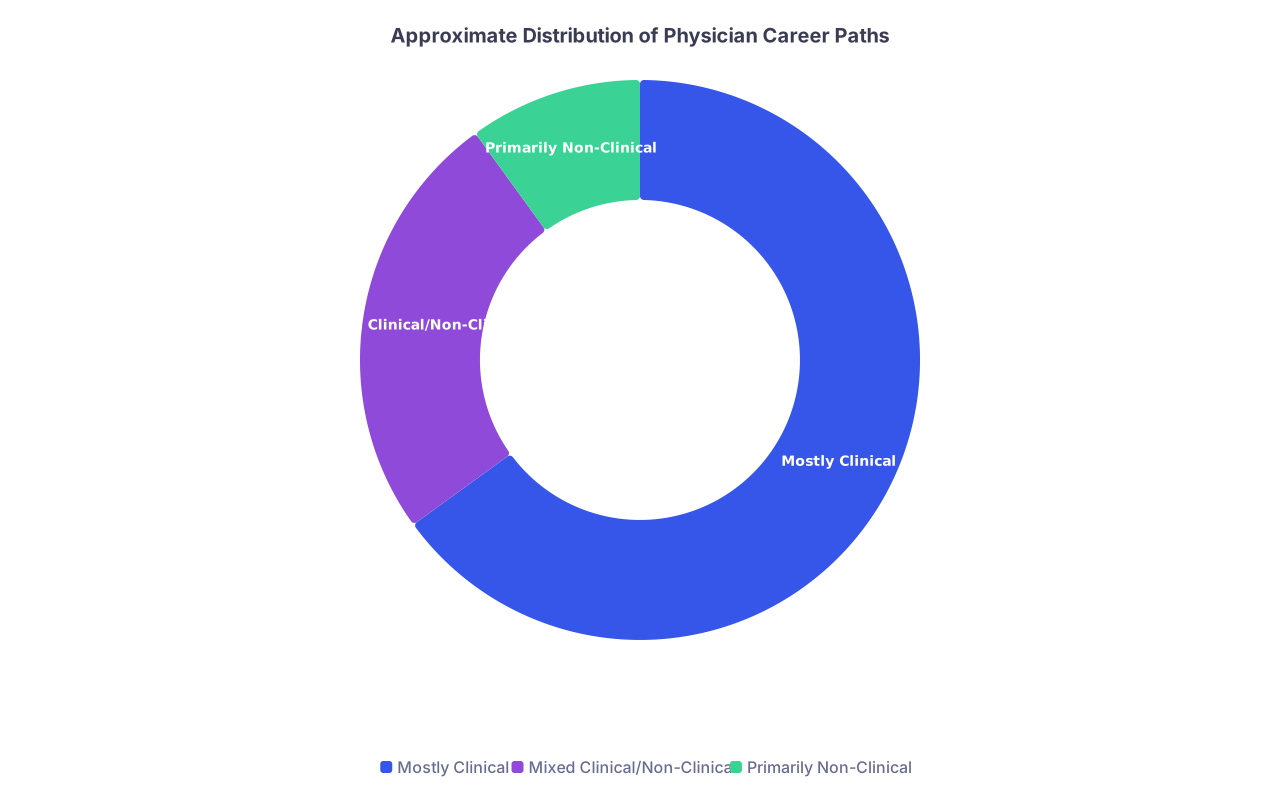
Studies and surveys over the last decade (AMA, Medscape, some state medical boards) converge on a rough pattern:
- Most physicians stay predominantly clinical.
- Somewhere around 10–20% end up in substantially non-clinical or mixed roles over time.
- Specialty is less predictive of going non-clinical than:
- Burnout level
- Interest in leadership, systems, or business
- Exposure to alternative careers early on
| Category | Value |
|---|---|
| Mostly Clinical | 65 |
| Mixed Clinical/Non-Clinical | 25 |
| Primarily Non-Clinical | 10 |
Notice what’s not in that chart: specialty.
Why? Because the data we have simply doesn’t show “dermatology = always clinical, IM = mostly non-clinical” or anything that clean. Reality is messy and driven by personality, opportunity, and system exposure more than the letters after your residency.
If You’re Early: How To Future-Proof Regardless of Specialty
You want to keep non-clinical doors open whether you’re picking a specialty or already stuck in one? Do this—whatever field you chose:
Own a measurable project every year
Not “attended meetings.” Led something with:- A baseline metric
- An intervention
- A follow-up outcome
- A slide deck or poster summarizing it
Learn to read (and lightly use) data
No, you don’t need to be a data scientist. But if:- You’re comfortable with Excel or basic SQL,
- You can interpret a run chart and a regression table,
- You know what confounding and bias look like,
You’re already ahead of half the applicant pool for many roles.
Build cross-functional relationships
Talk to:- Your IT/informatics team
- Quality and safety staff
- Case management and utilization review
- Finance/operations leaders
These are the people who later become your references for non-clinical jobs.
Stop waiting for permission
There’s always someone who says, “Focus on the medicine first.” They’re not wrong about competence. They are very wrong about you needing to postpone everything else for a decade.
If You’re Mid-Career and Worried You’re “Trapped”
You’re 8–15 years out. You picked a specialty thinking you’d be clinical for life. Now you’re burned out or just bored. You Google “non clinical jobs for doctors” at 2am and see the usual laundry list.
You are not trapped by specialty. You are constrained by signal.
Non-clinical employers are asking, “What evidence do I have that this person can operate in our world?” If right now your CV says:
- 12 years of [insert specialty] practice
- Maybe some teaching
- No obvious systems, data, business, or project work
You don't need a new residency. You need:
- 1–2 roles or projects that translate (medical director of something, QI leadership, committee chair, informatics liaison)
- One concrete story you can tell about impact at scale
- A couple of people outside your specialty who will vouch for you as more than “a good clinician”
That’s fixable in 12–24 months without changing specialty. I’ve watched hospitalists move into pharma, surgeons into quality leadership, and psychiatrists into chief medical officer roles following exactly that playbook.
A Simple Mental Model: Specialty as Accent, Not Native Language
Think of your specialty as an accent. It shapes how you talk about problems, where you’re most fluent, and which rooms you’re naturally invited into at first.
But if you live in a new country long enough, people stop noticing your accent and care more about what you’re saying.
Same with non-clinical work.
For the first few years:
- A pediatrician may fit more naturally in child health focused orgs
- A radiologist may fit imaging AI or diagnostics
- An EM doc may fit triage, urgent care, digital front door roles
Stay long enough. Deliver. Learn the adjacent fields. And suddenly you’re not “that psych doc we hired.” You’re “our VP of Clinical Strategy who happens to be a psychiatrist.”

| Step | Description |
|---|---|
| Step 1 | Choose Specialty |
| Step 2 | Develop Clinical Competence |
| Step 3 | Lead Projects and QI |
| Step 4 | Build Data and Systems Skills |
| Step 5 | Take Formal or Informal Leadership Roles |
| Step 6 | Network Outside Your Department |
| Step 7 | Apply for Non Clinical or Hybrid Role |
Notice: nowhere on that path does it say “switch specialty.”
FAQ (Exactly 4 Questions)
1. Is there any specialty that’s truly bad for non-clinical careers?
No. There are specialties with fewer obvious on-ramps, especially in very small or procedural fields, but none are “bad.” What is bad is a career with no projects, no leadership, no systems work, and no data exposure. That profile is hard to market in any specialty.
2. Do I need an MBA or extra degree to be competitive?
Usually not. Extra degrees are signaling tools, not magic keys. Employers care more about whether you’ve actually influenced operations, metrics, or strategy. If a degree helps you do that (or gives you a network), fine. But getting an MBA to compensate for an empty CV is an expensive way to delay the real work.
3. Does doing a subspecialty fellowship help or hurt non-clinical options?
It helps if you want deep-domain roles (e.g., oncology trials, interventional device companies). It can hurt only in the sense that it may narrow your clinical identity if you never touch systems or generalist work. From a non-clinical perspective, more years of training without non-clinical signal is not an advantage. Fellowship plus clear project/leadership work is powerful; fellowship alone is just more letters.
4. If I already chose a specialty and regret it, should I re-train?
Almost never for the sake of non-clinical work alone. Re-training is a nuclear option: costly, long, and often unnecessary. In most cases, it’s far more efficient to build non-clinical skills and experience where you are—committees, QI, informatics, admin, research—then pivot. Re-training might make sense if you also want a different clinical life, but it’s not required to escape the clinic.
Years from now, you will not remember the anxiety you felt over whether EM vs IM would “ruin” your non-clinical chances. You’ll remember whether you quietly stayed in your lane—or started acting like someone whose value was never limited to a billing code.