
The biggest mistake doctors make picking between medical writing and medical affairs is pretending it’s just about salary or “industry vs freelance.” It’s not. It’s about personality fit. And if you ignore that, you’ll be miserable in either one.
Let’s cut through the fluff and actually match who you are to what these jobs demand.
Quick Snapshot: How These Careers Feel Day to Day
Forget the HR descriptions. Here’s the real-world vibe:
- Medical writing: You’re the brain in the background, turning chaos into clear, accurate documents. Lots of solo time. Deep focus. Deadlines. Minimal politics if you pick the right setup.
- Medical affairs: You’re the bridge between science, marketing, and the real world. Constant people time. Meetings. Strategy. Trade-offs. Stakeholder management.
If you hate long stretches of focused quiet work? Pure medical writing will probably drain you.
If you hate meetings, corporate slides, and internal politics? Medical affairs will eat you alive.
Core Personality Differences: Writer vs Connector
Here’s the blunt version.
| Trait/Preference | Better Fit – Medical Writing | Better Fit – Medical Affairs |
|---|---|---|
| Introversion vs Extroversion | Introverts / ambiverts | Extroverts / ambiverts |
| Loves deep solo work | Yes | Rarely |
| Enjoys frequent meetings | No | Yes |
| Comfort with ambiguity | Moderate | High |
| Need for predictable schedule | High | Moderate / Low |
| Interest in business/strategy | Optional | Core part of role |
Now let’s break it down in human terms.
You’re likely a better fit for medical writing if:
- You love taking messy information and polishing it into something clean and precise.
- You get satisfaction from finishing a document and knowing it’s airtight and accurate.
- You prefer Slack/email over back-to-back Zoom calls.
- You value autonomy and would rather be “told the scope” than invent the whole strategy.
- You’re okay being behind the scenes; you don’t need your name on the slides or strategy.
Typical day: You’re reviewing source materials, drafting, revising based on feedback from a couple of stakeholders, tracking deadlines, and maybe juggling 2–5 projects. You might not talk to another human for half the day. And that’s fine with you.
You’re likely a better fit for medical affairs if:
- You genuinely enjoy talking to people—and you don’t just mean “once in a while.”
- You like influencing decisions: product strategy, evidence gaps, positioning.
- You can hold firm on scientific integrity while sitting in a room with marketing, sales, safety, and legal.
- You’re okay with gray areas, changing priorities, and partial information.
- You like being close to the “action” in industry: launches, indications, strategy decks.
Typical day: Internal meetings, calls with KOLs, planning advisory boards, aligning on scientific narratives for a product, preparing decks, responding to medical information escalations, working with field MSLs. Your calendar runs your life.
Work Style: Deep Work vs Constant Collaboration
Here’s where people get shocked after they switch.

| Category | Value |
|---|---|
| Medical Writing | 70 |
| Medical Affairs | 30 |
That rough 70/30 split (solo vs collaborative) can flip in medical affairs.
Medical Writing – Work Style
Medical writing is essentially professional, high-stakes, scientific storytelling plus documentation.
You’ll like it if you:
- Appreciate structure: outlines, templates, style guides.
- Can tolerate multiple review cycles and detailed comments (“change this comma,” “move this clause”).
- Don’t mind that success is: “This manuscript passed journal review” or “This CSR survived QA with minimal findings.”
You won’t like it if:
- You need constant verbal feedback or social interaction to feel engaged.
- You get bored reworking the same 30-page report for the fourth time.
- You think you’re “above” tedious details like reference formatting. (You’re not. Nobody is.)
Medical Affairs – Work Style
Medical affairs is like being the scientific adult in a room full of competing priorities.
You’ll like it if you:
- Can track 10 moving pieces in your head and keep the whole map straight.
- Naturally summarize conversations into key actions and decisions.
- Don’t panic when tomorrow’s agenda changes… again.
You won’t like it if:
- You resent “non-productive” time in meetings, even when that’s where decisions get made.
- You need clear, fixed deliverables to feel productive.
- You hate pushback and negotiation.
Communication Style: Written Precision vs Verbal Influence
Both careers live and die on communication, but the type is different.
Medical Writing: Precision Nerd Heaven
You need to be okay with:
- Being edited. A lot. By people who aren’t better writers than you.
- Changing phrasing repeatedly to align with compliance or client preferences.
- Explaining data accurately but understandably for different audiences (HCPs, regulators, payers, patients depending on niche).
If you get a small thrill when you finally condense a messy paragraph into one sharp sentence, that’s a clue you’re in the right lane.
Medical Affairs: Verbal Judo and Relationship Management
Your communication skills need to extend beyond “clear” into “influential without being salesy.”
Real examples I’ve watched play out:
- You’re on a call with marketing who wants to push a borderline claim. You have to anchor on the data, offer alternatives, and keep the relationship intact.
- A KOL subtly trashes your product on a call. You need to ask probing questions, acknowledge their concerns, and steer back to evidence calmly.
- Senior leadership wants a yes/no answer where the science is gray. You have to say, “Here’s what we actually know,” without sounding obstructive.
If that kind of verbal sparring exhausts you, medical affairs will be punishing.
Structure, Risk Tolerance, and Lifestyle
Here’s where personality and life stage collide.
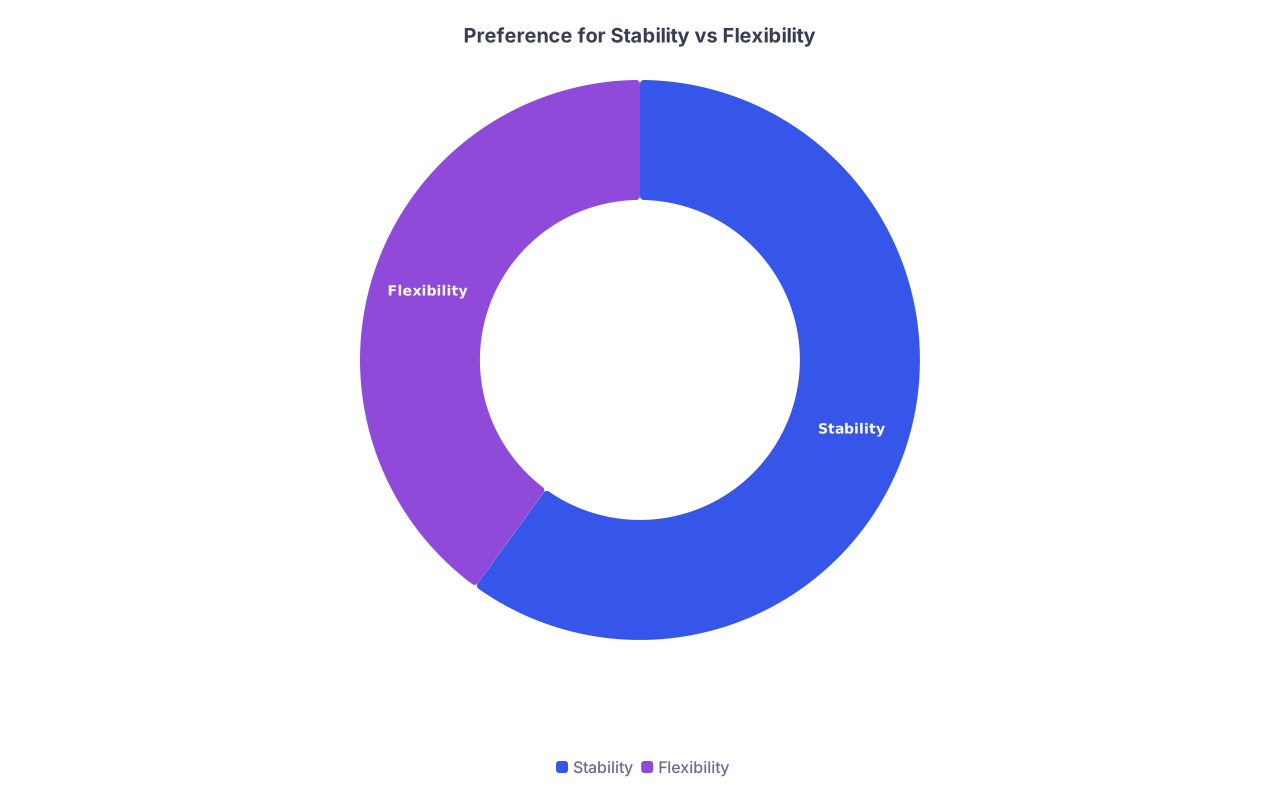
| Category | Value |
|---|---|
| Stability | 60 |
| Flexibility | 40 |
Most physicians I’ve seen move nonclinically want some stability, just not the chaos of call schedules and EMR hell.
Medical Writing
Can be:
- Full-time in pharma, med comms, or CROs (salary, benefits, corporate structure).
- Freelance/contract (your own clients, your own chaos).
Personality fit:
- If you crave control over your schedule and you’re comfortable hunting for work → freelance is viable.
- If you want predictable income and a team structure → in-house or agency roles.
Lifestyle:
- Often remote.
- Fewer meetings.
- Deadlines can spike stress, especially with overlapping projects.
- Pretty compatible with parenting, side gigs, or gradual transition out of clinical medicine.
Medical Affairs
Almost always:
- Full-time.
- Corporate.
- You’re part of a larger org machine with layered approvals and processes.
Lifestyle:
- Heavier meeting load.
- Some roles require travel (especially field-based MSL roles).
- Your hours might be “9–5 on paper, 8–6 in reality,” plus launch periods where it’s just busier.
Personalities who do well:
- People who like being on a team and don’t mind their day being shaped by calendars.
- Folks okay with “I had 8 meetings and no clear deliverable but moved 5 things forward.”
How Much Do You Care About Business and Strategy?
This is where a lot of former clinicians secretly lean one way without realizing it.

Medical Writing
You can be curious about business and still do medical writing, but it’s not required.
Your core value is: “I can communicate complex science clearly and compliantly.”
You’ll occasionally touch:
- Publication planning (strategy-ish).
- Messaging consistency across documents.
- Maybe advisory board summaries.
But you’re not usually the one making big strategic calls. You’re the one documenting or enabling them.
Medical Affairs
You’re closer to the business engine.
You’ll care about:
- Product positioning in the landscape.
- Evidence gaps that affect uptake.
- What KOLs are actually saying about your therapy.
- How real-world data and publications support strategy.
If you light up at the idea of being part of “where the product goes” instead of just writing about it, that’s a medical affairs clue.
Simple Self-Test: Which Career Fits You Better?
Answer these honestly. No “ideal self” nonsense.
Count your “A” vs “B.”
After a long day, you’d rather:
- A: Work quietly on something concrete and get it off your plate.
- B: Talk through ideas with smart people and shape a plan.
Feedback style you tolerate best:
- A: Written comments you can address on your own time.
- B: Live discussions, back-and-forth debate.
You feel more drained by:
- A: A day full of unbroken concentration on a 40-page document.
- B: A day of 7 meetings and a hundred small decisions.
You’re more excited by:
- A: Perfecting a manuscript or slide deck so the science is rock solid.
- B: Owning relationships with KOLs and influencing product strategy.
Your ideal schedule:
- A: Fewer meetings, more control over when you do deep work.
- B: Structured days with standing meetings and cross-functional projects.
If you’re mostly A → Medical writing is likely the better core fit.
If you’re mostly B → Medical affairs is probably where you’ll feel more alive.
If you’re mixed → You might land in hybrid roles: scientific communications within medical affairs, publication strategy, or med comms agency roles that are more client-facing.
Training and Background: Does Your CV Push You One Way?
Here’s how your past might nudge the decision—but doesn’t absolutely lock you in.
| Background Signal | Leans to Writing | Leans to Med Affairs |
|---|---|---|
| Lots of first-author publications | Strong | Moderate |
| Leadership roles / committees | Moderate | Strong |
| Enjoyed teaching and presentations | Moderate | Strong |
| Loved research methods and stats | Strong | Strong |
| Enjoyed patient-facing work | Weak | Strong |
The stronger the signals on one side, the easier your transition story. But I’ve seen introverted MSLs and extroverted medical writers do great—they just carved out the right niches.
How to “Try Before You Buy”
Don’t quit your job blind.

| Step | Description |
|---|---|
| Step 1 | Curious About Nonclinical Path |
| Step 2 | Try Small Writing Gigs |
| Step 3 | Shadow Med Affairs Pros |
| Step 4 | Online Courses or Mentorship |
| Step 5 | Informational Interviews |
| Step 6 | Decide Direction |
| Step 7 | Prefer People or Projects |
For medical writing:
- Take a structured course or mentorship program.
- Do 1–2 small paid or pro bono projects (e.g., patient education materials, CME outlines, small agencies).
- See if you can handle the focus and revision cycles without wanting to scream.
For medical affairs:
- Set up informational interviews with MSLs, medical directors, and MA leads.
- Ask to shadow calls or advisory boards if you have contacts.
- Pay attention to how you feel about the pace, the meetings, and the politics.
Your emotional reaction during these tests is your best data point.
FAQs
1. Can I start in medical writing and later move into medical affairs?
Yes, and people do it all the time—but you’ll need to intentionally build the “people-facing” side. That means volunteering for cross-functional projects, joining calls, learning the commercial context, and not hiding behind documents forever.
2. Is medical writing better for part-time or side work?
Generally yes. Freelance or contract medical writing is far easier to do part-time or alongside a slow clinical schedule. Medical affairs is usually full-time, salaried, and meeting-heavy—terrible as a “side gig.”
3. Which pays more in the long run: medical writing or medical affairs?
At the senior levels, medical affairs usually wins. Director-level and above in pharma can be very well compensated. High-end freelance writers can also do extremely well, but it’s less predictable and heavily dependent on your niche, speed, and business skills.
4. I’m an introvert. Does that automatically rule out medical affairs?
No, but it changes which roles fit. Field MSL roles or KOL-heavy positions may feel draining. More internal, strategy-focused medical affairs roles with fewer external meetings can work fine for quieter personalities—if you’re okay with some collaboration and politics.
5. Do I need a PhD or fellowship to do either of these?
Not necessarily. Many physicians go into both fields with just an MD/DO and strong clinical experience. For medical affairs, subspecialty expertise can help. For writing, a strong publication record and good samples matter more than extra letters.
6. What’s the biggest red flag that I’m choosing the wrong one?
For writing: You dread long, quiet blocks of focused work and find documents mind-numbing.
For medical affairs: You feel immediate resistance to recurring meetings, organizational politics, and the idea of “influencing without authority.” If you’re already rolling your eyes at those, don’t force it.
If you remember nothing else:
- Medical writing suits the thoughtful, detail-obsessed builder who loves deep solo work.
- Medical affairs suits the scientifically grounded connector who likes people, strategy, and messy problems.
Pick the one that matches how you actually like to spend your hours, not the one that just looks impressive on LinkedIn.