
You’re a med student, resident, or practicing doc staring at your CV and thinking:
“I’ve got a couple of posters and a QI project… but no big-name publications. Is this going to tank my chances at pharma or consulting?”
Let me give you the short answer first, then we’ll get into the nuance.
You do not need publications to break into pharma or consulting.
They can help in specific situations, but they’re not the golden ticket people think they are.
Now let’s unpack how this really works.
1. How Much Do Publications Actually Matter?
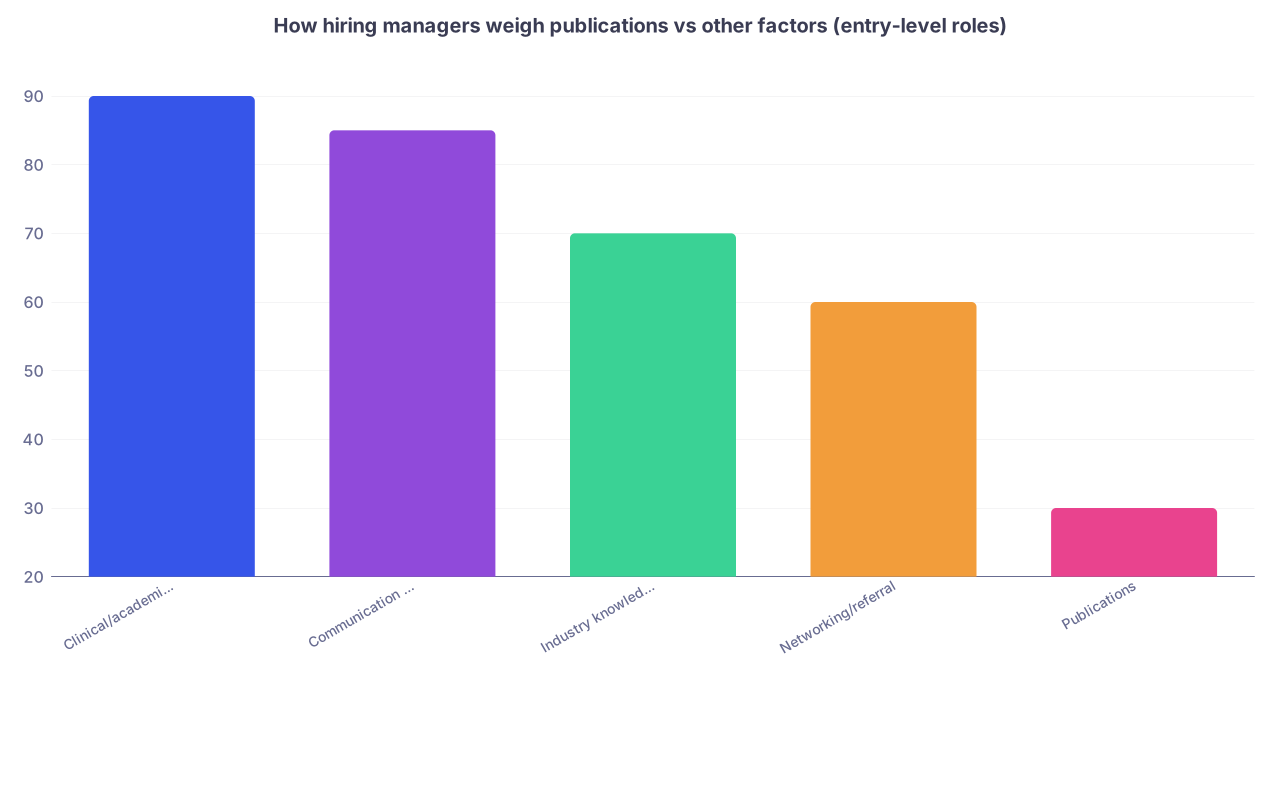
Here’s the hierarchy of what hiring managers in pharma and consulting care about, based on what I’ve seen sitting on real hiring discussions and from candidates who actually got the jobs:
For pharma (medical affairs, clinical development, safety, etc.):
- Clinical background and degree (MD/DO/PharmD/PhD)
- Communication skills (can you explain complex stuff clearly?)
- Industry understanding (trials, regulatory, real-world evidence, stakeholders)
- Professional experience (fellowship, prior pharma, relevant rotations)
- Networking and referrals
- Everything else (including publications)
For consulting (MBB, healthcare boutiques, internal strategy):
- Problem-solving and structured thinking
- Case interview performance
- Overall profile (school, grades, test scores if early-career)
- Communication and presence
- Demonstrated interest in business/healthcare systems
- Publications = optional bonus, not core
Publications are basically:
- A proxy signal for “can handle complex information and finish long projects”
- More relevant for research-heavy roles (e.g., early clinical development, R&D strategy)
- Mostly irrelevant for pure strategy or operations roles
Where they matter more:
- Academic-style pharma roles (e.g., translational research, early development)
- Senior roles where you’re expected to act as a KOL-level expert
- Very specialized niches (oncology, gene therapy, rare disease) where scientific credibility is currency
Where they matter very little:
- Entry-level consulting roles (generalist, health vertical)
- Medical affairs roles focused on communication and stakeholder engagement
- Internal strategy roles at hospitals, insurers, payers
So no, a lack of publications isn’t the wall you think it is.
2. Pharma: When Publications Help and When They Don’t
Let’s split pharma into the main buckets you’re probably looking at: medical affairs, clinical development, and drug safety / PV.
Medical Affairs
This is the most common “first pharma job” for physicians.
Key question hiring managers ask:
“Can this person talk credibly with KOLs, understand data, and not embarrass us?”
Publications help if:
- You’re going for a scientifically heavy therapeutic area (oncology, heme, immunology)
- You’re expected to speak at congresses or lead advisory boards as a data expert
- You’re positioning yourself as a future thought leader in a niche disease area
But they are not required if:
- You have strong clinical experience in that specialty
- You can talk intelligently about clinical trials, endpoints, and practical use of drugs
- You have other signals of expertise: speaking at local CME, guideline committee work, resident teaching, etc.
I’ve seen MDs get medical affairs jobs with:
- 0 first-author publications
- 1–2 posters and maybe a review article
- Or literally just “participated in clinical trial recruitment” plus solid interviewing
Clinical Development
This is more research-oriented: designing and running trials, working with CROs, interpreting data.
Here, publications help more, but still aren’t an absolute must at entry level, especially if:
- You’re transitioning via a pharma fellowship (e.g., industry fellowships for MDs/PharmDs)
- You’ve been an investigator or sub-investigator on meaningful trials
- You can talk through protocol design, endpoints, safety vs efficacy, etc.
Where publications really do matter:
- Senior clinical development roles (Director and above)
- Roles with a heavy translational research component
- Super competitive TA teams (oncology at big-name companies)
Early-career? They’re a nice-to-have, not a gatekeeper.
Drug Safety / Pharmacovigilance
For PV roles:
- Strong clinical judgment > publications
- Ability to interpret safety signals > academic prestige
If you’ve done:
- ICU, oncology, psych, or any high-risk-med rotation
- Morbidity & mortality conferences
- Chart review-heavy QI or case series
…you’re already speaking their language. Publications are again, just seasoning.
| Category | Value |
|---|---|
| Clinical/academic background | 90 |
| Communication skills | 85 |
| Industry knowledge | 70 |
| Networking/referral | 60 |
| Publications | 30 |
3. Consulting: Do Publications Move the Needle?
Consulting firms do not care about your publication record the way academic medicine does.
What they’re screening for:
- Can you break down a complex problem logically?
- Can you do math quickly and not panic under pressure?
- Do you sound like someone they can put in front of a client?
Publications might help in exactly three ways:
- Show you can manage a long, messy project to completion
- Give you something substantial to talk about on your resume
- Support a “healthcare expert track” narrative if you’re joining a healthcare-focused practice
But they won’t:
- Compensate for weak case interview performance
- Override a lack of basic business understanding if you’re mid-career
- Be the deciding factor between you and another candidate with stronger problem-solving skills
I’ve seen people with:
- Zero publications crush case interviews and get MBB offers
- Extensive publication lists get rejected repeatedly because they couldn’t structure a case if their life depended on it
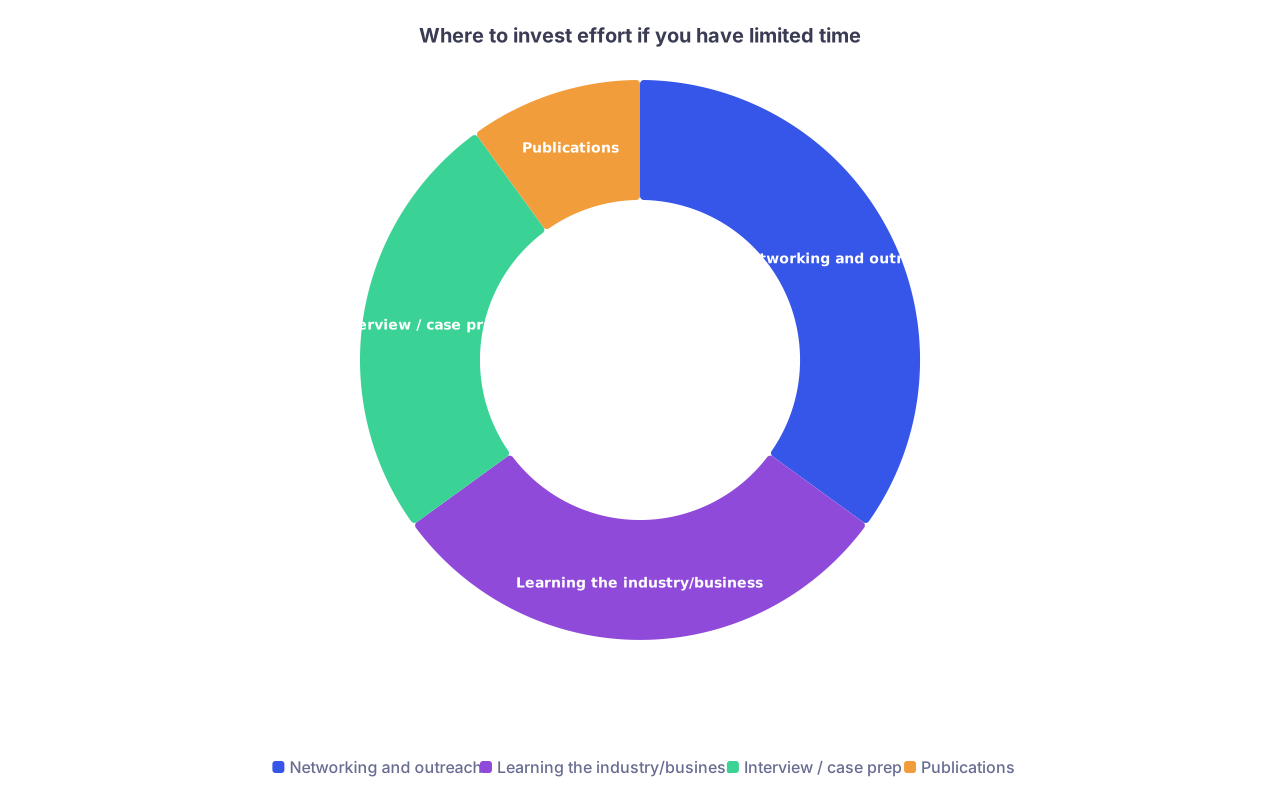
So if your goal is consulting, and you have limited time/energy:
- Put that energy into case practice and networking, not scrambling to force out a quick paper.
4. What Actually Matters More Than Publications (Concrete Signals)
Here’s what you should be building instead of panicking over your missing PubMed record.
For Pharma
Focus on becoming someone who:
- Understands clinical trials: phases, endpoints, inclusion/exclusion, safety vs efficacy, real-world vs RCT
- Can speak clearly and confidently about data to different audiences
- Knows the basics of regulatory (FDA/EMA language, labels, indications, post-marketing)
Very practical moves:
- Volunteer as a sub-investigator or co-investigator on trials at your institution
- Join or lead QI projects with metrics and outcomes you can quantify
- Present at local or regional conferences – even if they’re not big-name
- Take a short industry-focused course (e.g., drug development, regulatory science, medical affairs foundations)
For Consulting
You want to show:
- Structured thinking: you can break things into pieces and not ramble
- Comfort with numbers: basic mental math, charts, simple modeling
- Real interest in systems, operations, or strategy
Practical steps:
- Join a consulting club (if still in school) or case practice group
- Take on a non-clinical project: operations improvement, cost-savings initiative, new clinic workflow, etc.
- Learn case frameworks, and then learn to not sound like a robot using them
- Do 30–60 mock cases with peers or coaches, not just reading case books

| Step | Description |
|---|---|
| Step 1 | Clinical training |
| Step 2 | Pharma fellowship or MSL role |
| Step 3 | Consulting interviews |
| Step 4 | Medical affairs or clinical dev |
| Step 5 | Generalist or healthcare practice |
| Step 6 | Senior pharma roles |
| Step 7 | Preferred path |
5. If You Have No Publications: How to Frame Your Experience
You might be underestimating what you already have.
Things that are often better than a random case report on your CV:
- A QI project where:
- “Reduced average length of stay by 0.5 days in X unit”
- “Cut no-show rates by 15% over 6 months”
- Any role where you:
- Standardized a protocol
- Created a new reporting structure
- Built or improved a dashboard, pathway, or workflow
- Teaching and communication:
- Led resident teaching sessions or journal clubs
- Created educational materials for patients or staff
For your resume, translate everything into:
- Problem → Your role → What you did → Quantified result
Example (pharma-leaning): “Participated as sub-investigator in phase 3 trial for biologic in moderate to severe asthma; responsible for patient screening, AE documentation, and protocol adherence.”
Example (consulting-leaning): “Led 3-person resident team to redesign pre-op clinic workflow; reduced average patient wait time by 22% and increased daily throughput from 18 to 23 patients.”
Those kinds of bullets do more for you than “co-author on retrospective chart review, Journal of Whatever, 2021” with no clear story.
| Path / Goal | Publications Value | Better Priority |
|---|---|---|
| Entry-level medical affairs | Moderate | Clinical insight, communication |
| Entry-level clinical development | Moderate-High | Trial experience, fellowship |
| Drug safety / PV | Low-Moderate | Clinical judgment, safety experience |
| MBB generalist consulting | Low | Case skills, structured thinking |
| Healthcare-focused consulting | Low-Moderate | Industry knowledge, operations projects |
6. When You Should Push for Publications
There are cases where I’d tell you: yes, go finish that paper.
You should push harder if:
- You’re applying to research-heavy pharma fellowships where they explicitly ask for publications
- You’re going into highly competitive, science-heavy therapeutic areas (oncology, immunology, gene therapy)
- You’re planning to stay close to academia or want the option to jump back later
- You already have near-complete work that just needs a realistic push to get submitted
Translation:
If your project is 80% done and just needs you to sit down for a few focused weeks? Finish it.
If it’s at 10% and you’re trying to start from scratch just for the line on your CV? Usually not worth it.
For most people trying to leave clinical medicine:
- Your time is much better spent understanding the industry, networking hard, and sharpening your story than grinding out one more marginal paper.

7. How to Talk About Your Lack of Publications (Without Sounding Defensive)
If someone asks about your publication record in an interview, don’t get weird about it.
Here’s a clean, confident way to handle it:
Pharma-style answer:
“Most of my work has been focused on direct patient care and implementation-type projects rather than traditional academic publications. For example, I led a project to [brief result]. That said, I’m very comfortable reading and interpreting the literature, and I’ve consistently been the person translating new evidence into practical changes in our clinic.”
Consulting-style answer:
“I don’t have much in the way of formal publications. My academic focus was more project-based: improving workflows and outcomes in real clinical settings. That’s where I found I could have more impact, and it’s what pushed me toward problem-solving roles like consulting rather than academic medicine.”
You’re not apologizing. You’re reframing.
| Category | Value |
|---|---|
| Networking and outreach | 35 |
| Learning the industry/business | 30 |
| Interview / case prep | 25 |
| Publications | 10 |
8. If You Already Have Publications: How to Use Them Well
If you do have publications, don’t just list them as dead weight.
Use them to:
- Tell a story: “I like long, messy problems with unclear answers, and I see that same challenge in drug development/strategy work.”
- Show ownership: emphasize what you did—methods, analysis, writing, coordination—not just that your name is 7th on a paper.
- Bridge to business: “Working on that project showed me how broken X process is, which is why I’m interested in roles where I can fix systems, not just diagnose patients.”
The best use of publications in interviews isn’t “Look how smart I am.”
It’s: “This is where I discovered I like the kind of work your job is built around.”

FAQ: Publications and Breaking Into Pharma or Consulting
Do I absolutely need publications to get into pharma as a physician?
No. For most entry-level roles (especially medical affairs and PV), you don’t need them. Strong clinical experience, communication skills, and some exposure to trials or QI work will carry more weight. Publications become more important for research-heavy clinical development roles and senior positions, not for your first step in.Will not having publications hurt my chances at MBB or top consulting firms?
Almost never. Consulting screens for problem-solving, case performance, communication, and general academic rigor. A publication might be a small plus, but a weak case interview will sink you far faster than an empty PubMed search. If you’re choosing between more case prep and chasing a paper, choose case prep.I have only posters and abstracts, no full papers. Is that enough?
Yes, that’s usually plenty as a proof-of-effort signal. Posters and abstracts show you can participate in research and present results. On your resume, highlight your role (data collection, analysis, presenting) and any impact. Don’t obsess over the “full paper” vs “abstract” distinction; hiring managers often don’t.Should I delay applying to pharma/consulting until I get something published?
Generally no. Waiting a year just to add a minor publication almost never makes sense if you’re already ready to leave. Apply now. If you have a near-finished project you can reasonably wrap up in parallel, do it—but don’t hold your entire career transition hostage to the academic timeline.I’m mid-career with lots of clinical work but no research. Am I sunk?
Not at all. In many pharma roles, especially safety and medical affairs, your clinical judgment and real-world experience are a huge asset. You’ll just need to translate that experience into industry language (trials, safety, outcomes) and show you can think beyond the bedside. For consulting, your operational and systems experience is probably more valuable than a dusty publication list anyway.If I want to maximize my chances, where should I spend my time: publications, networking, or learning the industry?
If you’re starting from scratch:- First priority: Networking (informational interviews, referrals, talking to people already in pharma/consulting)
- Second: Understanding the industry/business (how pharma makes money, what medical affairs does, how consulting engagements work)
- Third: Interview prep (case practice for consulting, behavioral and pharma-specific prep for industry)
Publications come fourth, and only if the opportunity is relatively low-friction or directly relevant.
Key Takeaways:
- No, you don’t need publications to break into pharma or consulting, especially for entry-level roles.
- Time spent on networking, industry understanding, and interview prep usually beats time spent chasing one more marginal paper.
- Whatever you’ve actually done—QI, trials, teaching, operations—can be reframed into a strong story. That story matters a lot more than your PubMed search results.