
The org chart in Medical Affairs is a lie—and everyone inside knows it.
On paper, it’s clean. Director > Senior Manager > Manager > MSL > Coordinator. Simple. Fair. Meritocratic. In reality, the hierarchy that runs Medical Affairs has almost nothing to do with titles and everything to do with three things: scientific credibility, commercial usefulness, and political protection.
If you’re thinking about jumping from residency, academia, or clinical practice into Medical Affairs and you don’t understand that hidden structure, you’re walking into a game where everyone else knows the rules and you don’t.
Let me walk you through how it really works.
The Two Parallel Ladders: Official vs. Actual Power
Every Medical Affairs department has two ladders running side by side.
One is the formal ladder: Associate Director, Director, Senior Director, VP, SVP, and so on. HR controls this one. Job descriptions, competencies, pay bands. This is the ladder you see on job postings and LinkedIn updates.
The other ladder is the real one: who people actually listen to, who gets pulled into critical calls with the CMO, whose name gets mentioned when promotions and reorgs are being drawn up on whiteboards behind closed doors.
They do not match.
I’ve watched a “Senior Medical Director” get quietly sidelined while a sharp, politically savvy MSL two levels down was the real engine for a launch. The org chart said one thing. The launch war room told a different story.
Here’s the rough truth: title gives you permission to be in the room; actual influence decides whether anything you say matters once you're there.
The informal hierarchy in Medical Affairs is built on four layers that cut across titles:
- The Scientific Authority
- The Commercial Fixer
- The Ops Gatekeeper
- The Politically Protected
You can be any title and still fall into one or more of these categories. That’s what actually drives who has power.
Layer 1: The Scientific Authority (Not Always the MD at the Top)
Everyone assumes the highest title MD is the scientific alpha. Often wrong.
The real scientific authority is the person everyone goes to when something is on fire:
- A pivotal trial signal looks ugly and the launch team is panicking.
- A thought leader is shredding the company’s data at a congress.
- Regulatory sends back a question that the clinical team should have seen coming—but didn’t.
In those moments, people don’t care about headcount budgets or job grades. They care about one thing: who can give an answer that won’t embarrass the company when it hits an FDA reviewer, KOL, or EU HTA body.
Sometimes that’s the Vice President of Medical. Sometimes it’s a Principal MSL who happens to know the literature cold and has spent five years in the field listening to heavy-hitting thought leaders rip the data apart.
The profile of the real scientific authority usually looks like this:
- They know the full development story of the product: why certain endpoints were chosen, why that phase 2b was designed “wrong,” which subgroups are landmines.
- They can tell you off the top of their head which key publications are weak, which are bulletproof, and which KOLs hate your mechanism.
- They’re blunt behind closed doors. They’ll tell commercial “This positioning won’t survive a single serious discussion with a top-tier oncologist.”
I sat in a launch team once where the official “Therapeutic Area Head” had joined company 8 months earlier from another pharma. Fancy CV. Impressive slide deck skills. But every time we had a truly hard question, the room would go quiet and someone would say, “Let’s ask Maya.” Maya was a Principal MSL. PhD, not MD. Zero direct reports. But she’d been there since phase 2 and knew every bump in the clinical program.
Her title never caught up with her influence. Nobody made a serious scientific move without running it by her.
The unspoken rule: your timeline in that asset and your depth of understanding almost always outrank your title when it comes to real influence.
Layer 2: The Commercial Fixer (The One Execs Actually Call)
The second power base in Medical Affairs is what I’d call the Commercial Fixer.
These are the people senior commercial leaders call directly when they’re stuck, usually with some version of:
- “Can we say this?”
- “Why are KOLs pushing back on our value prop?”
- “We’re losing formulary to a weaker product—what’s the real story scientifically?”
On paper, Medical Affairs is independent and non-promotional. In real life, the people who know how to support commercial without crossing the line are gold. And everyone knows it.
The Commercial Fixer:
- Knows the label like scripture and understands exactly how close to the line you can go without getting regulatory in cardiac arrest.
- Can translate “marketing wishful thinking” into medically and legally defensible claims.
- Has enough credibility with KOLs that when they say, “Look, here’s how thought leaders are thinking about this,” people listen.
Titles here are extremely misleading. Sometimes the fixer is a Medical Director who used to be in sales. Sometimes it’s a senior MSL with a Rolodex of KOLs who will pick up the phone at 10 pm. Sometimes it’s someone in Medical Information who quietly rewrites garbage drafts into usable responses.
You’ll know who the fixer is by the calendar: they’re “double-hatted” on every brand team, pulled into pricing discussions, copay strategy, even sales training. People send them decks late at night with “Can you sanity-check this before legal sees it?”
They don’t advertise it, but they’re the ones smoothing tension between Medical and Commercial every day.
If you’re coming from pure academia and want real influence inside Medical Affairs, developing even basic commercial literacy moves you up this hidden layer fast. Knowing how your drug is actually sold—payer constraints, competitive landscape, field force pressure—makes you instantly more relevant.
Layer 3: The Ops Gatekeepers (Quiet but Ruthless Power)
The least appreciated, but often most dangerous, layer of the hierarchy: the operational gatekeepers.
People love to dismiss them. “They just schedule things.” That’s naïve. The ones who understand their leverage can quietly make or break careers.
I’m talking about:
- Medical operations leads who manage congress presence, advisory boards, and budgets
- The people who own the publication plan and control which data sees daylight when
- Project managers who own timelines for medical review, MLR (medical-legal-regulatory) routing, and content approvals
In theory, they’re support staff. In reality, they decide:
- Whose projects actually move through the system
- Which “great ideas” die under the weight of process
- Whose congress symposia get submitted on time and resourced
- Whether your cross-functional initiative hits the key governance meeting this month or “gets pushed to next quarter”
You think that’s minor? It isn’t. Medical Affairs careers live and die on visible wins. A high-impact symposium at ASCO. A well-run advisory board with the right KOLs. A crucial real-world evidence project pushed through before a competitor publishes.
If the ops lead knows you as “someone who gives clear direction, hits deadlines, and respects process,” your projects will always oddly seem to find a slot.
If they know you as “that disorganized MD who sends slides at 11 pm and screams when things aren’t approved instantly,” your stuff will quietly slide to the bottom. No malice needed. Just a thousand small choices in prioritization.
This is one of the ugliest unspoken truths: assistants, coordinators, and project managers often influence outcomes far more than a new Medical Director realizes. They’ve outlasted three VPs, know every backdoor, and can tell you which senior people are bluffing.
Treat them as “admin” and they’ll fold their arms and watch you crash.
Layer 4: The Politically Protected (The Ones You Don’t Touch)
Every Medical Affairs group has a small set of people who are shielded. Sometimes deserved, sometimes not. But you need to recognize them quickly.
These are the folks who:
- Were brought in personally by a powerful VP or franchise head
- Are designated “successors” in talent calibration sessions
- Just moved from a critical global role or another business unit as part of some larger political deal
You’ll see the pattern:
- They make mistakes and nothing happens. “Learning opportunity.”
- They miss deadlines but their projects still get budget.
- Their pet initiative survives reorgs that kill more rational programs.
Are they always incompetent? No. Some are legitimately strong operators. But the rules are different for them. Push back on them the way you’d push back on anyone else, and you may suddenly find yourself “out of alignment with leadership culture.”
I watched a junior but sharp Medical Manager get crushed because he kept openly challenging a favored Director’s shaky strategy in cross-functional meetings. Scientifically he was right. Politically he was dead. The Director had been airlifted in from global, tagged as “future TA head.” Untouchable.
Nobody told the junior manager this outright. He pieced it together after being left off key projects and told his “style wasn’t collaborative enough.”
Your job isn’t to suck up to these people. But you do need to recognize who they are and how far you can realistically push.
How Background Shapes Your Place in the Hierarchy
Not all MDs and PhDs start in the same spot in this unspoken structure. The background you bring from the outside stamps you with assumptions the minute you walk in.
Here’s how it usually breaks down inside the heads of leadership:
| Background Type | Initial Credibility | Path to Power |
|---|---|---|
| Academic KOL | High scientific | Scientific authority |
| Community clinician | Moderate | Commercial fixer |
| Former MSL | High practical | Field influence |
| Pure PhD (no clinical) | Variable | Data / publications |
| Former marketer/sales | High commercial | Cross-functional |
Let me decode how these play out.
The ex-academic KOL
If you’ve been a PI on trials, sat on guideline committees, and have a PubMed page that needs scrolling, you walk in with instant scientific authority. But… you may be written off as “too academic” if you don’t show any understanding of commercialization.
Top move for you: quickly learn the payer and market access landscape, and volunteer for projects that sit at the interface of evidence and strategy (HEOR, RWE, label expansion).
The community clinician
You don’t have major publications? You’ll never be the pure research authority. But if you’ve actually prescribed five different biologics and fought with insurers for prior auths, your perspective is priceless in launch planning and field strategy.
Your power move: become the person who can translate “real world clinic reality” into what Medical and Commercial teams are trying to do. That moves you fast into the Commercial Fixer lane.
The ex-MSL
You already understand the field reality and KOL psyche. Ironically, you may be under-titled compared to your impact. That’s common. But your network is a weapon.
Play it right and you become critical for advisory boards, congress presence, and message testing. Don’t let yourself get stuck only in logistics; push into strategy by bringing back patterns from the field, not just anecdotes.
PhD without clinical background
Inside Medical Affairs, you can either end up as a glorified editor or as the spine of the evidence strategy. It depends on how you position yourself.
If you can synthesize complex data sets, run publications, and speak confidently in front of tough KOLs, you become one of those behind-the-scenes scientific authorities people rely on. If you can’t, you drift into “slide maker” territory. That’s a career cul-de-sac.
The Real Reporting Lines: Who You Actually Serve
Another lie of Medical Affairs is that you “report to” your line manager.
On Workday, yes. In reality, you’re serving three masters:
- The brand team (commercial)
- The clinical development / safety side
- The governance bodies (MLR, compliance, legal)
Who you align with most closely shapes your unwritten status.
If you become the unofficial extension of marketing, you’ll be loved by sales and distrusted by compliance. If you bunker down as “the voice of science” and oppose every promotional instinct, you’ll be respected in theory and bypassed in practice.
The people with real staying power know how to:
- Say “no” in ways that give viable alternatives
- Anticipate regulatory and ethics landmines before legal has to police them
- Help commercial achieve business goals within the guardrails instead of hiding behind those guardrails
There’s a reason some Medical VPs are in every major strategy discussion while others are wheeled out only when a KOL is visiting. One group chose to live inside the business. The other chose to live above it. The business rewards the first.
KOL Access: The Shadow Currency of Medical Affairs
Inside Medical Affairs, there’s a shadow currency nobody talks about on performance reviews: who can actually get top-tier KOLs to answer their emails.
Titles open doors to some extent, but you’d be amazed how often a senior MSL or mid-level Medical Director has more practical influence with KOLs than the VP presenting at advisory boards.
KOL access does three things for your internal hierarchy:
- It gives you leverage in strategy discussions. When you can say, “I spoke to three of the top five prescribers and here’s what they’re actually doing,” people shut up and listen.
- It makes you useful to senior leadership. When they need a KOL dinner covered or a high-stakes one-on-one, they call the person who has credibility in that circle.
- It protects you in reorgs. People who can keep thought leaders warm are kept around.
I’ve seen a quiet, not-especially-political MSL survive three reshuffles because she owned relationships with three critical investigators in a rare disease space. Firing her would have set the program back by a year.
If you enter Medical Affairs and ignore KOL relationship building—thinking you’ll just “do internal strategy”—you’re voluntarily giving up one of the main currencies of power in this world.
The Dark Side: Burnout, Golden Handcuffs, and Quiet Exits
From the outside, Medical Affairs looks like an escape hatch from clinical burnout. Better hours, good pay, no night shifts. That’s only half the story.
The hidden hierarchy has some ugly downstream effects:
- Mid-level Medical Directors doing all the work of global strategy with none of the authority to say no.
- Brilliant scientists stuck under politically protected but mediocre bosses, slowly giving up on pushing better ideas.
- Former clinicians realizing too late they’ve forgotten how to practice and are now financially trapped at a level where switching back would mean a 50% income hit.
I’ve watched ex-residents and attendings walk into Medical Affairs thinking they were reclaiming their life. Some did. Others just traded pager anxiety for slide-deck anxiety and governance fatigue.
The ones who survive and actually thrive understand the game. They don’t become cynical, but they’re not naive about where decisions really get made and who actually gets to make them.
How to Climb the Unspoken Ladder Without Losing Your Soul
If you’re serious about an alternative medical career in Medical Affairs and you don’t want to be just another functionary in the machine, you need to play the quiet hierarchy intelligently.
Three practical levers:
Become undeniably strong at one core thing.
Scientific depth in your asset. Congress and KOL engagement. Medical operations and governance. You don’t need to be everything. But you need to be the obvious go-to person somewhere. Generalist Medical Directors with no clear superpower are replaceable.Tie yourself to critical business moments.
New indication launch. Major label expansion. Safety scare. Payer pushback. If you’re peripheral when those things happen, you’ll stay peripheral. Volunteer. Ask for a slice of the work. Deliver flawlessly on that slice.Build alliances down as much as up.
Respect the MSLs. Listen to the ops people. Give credit to the Med Info writer who rescued your garbage draft. These are the people who will decide whether working with you is painless or punishment. You’d be surprised how fast “everyone hates working with him/her” surfaces at promotion discussions.
And yes, watch the politics. You can’t hide from them in Medical Affairs. But you don’t need to become a caricature of a pharma politician either. You just need to know who’s protected, who actually pulls which levers, and where your credibility really comes from.
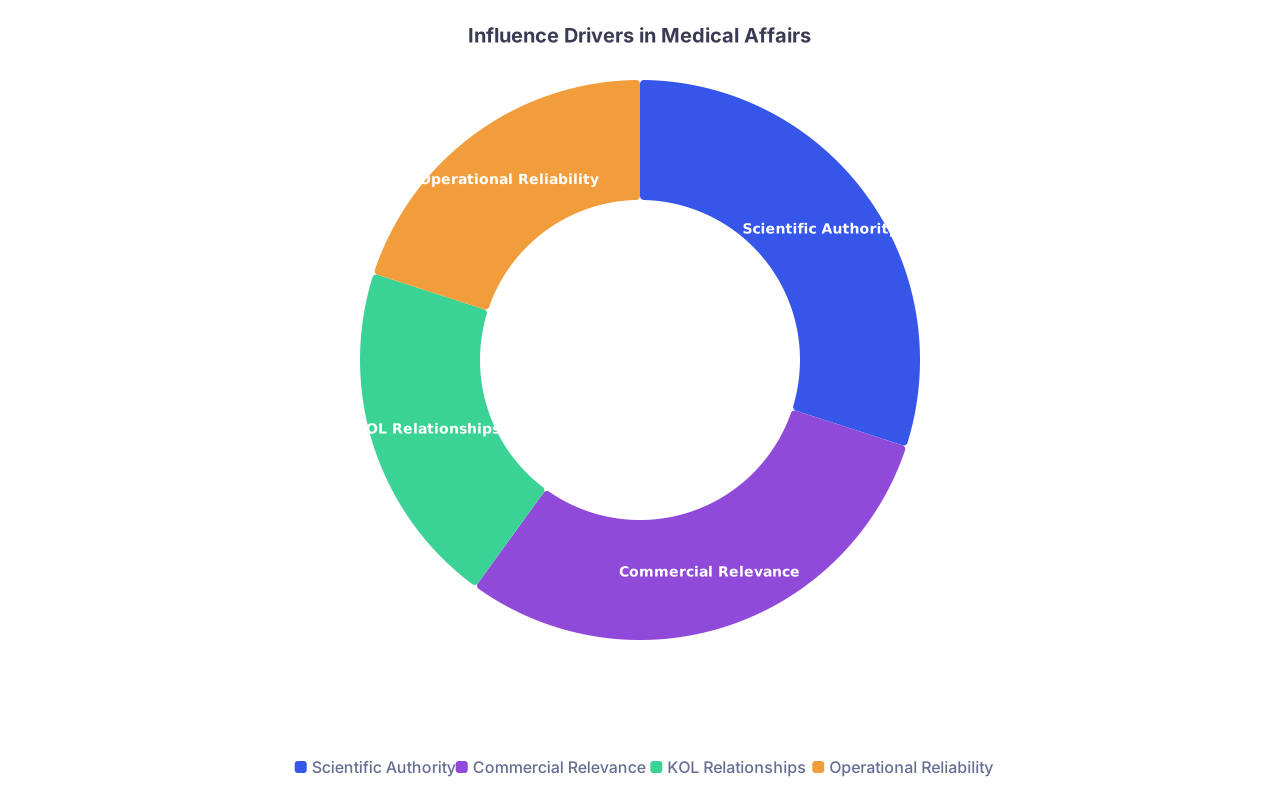
| Category | Value |
|---|---|
| Scientific Authority | 30 |
| Commercial Relevance | 30 |
| KOL Relationships | 20 |
| Operational Reliability | 20 |

| Step | Description |
|---|---|
| Step 1 | Scientific Expert |
| Step 2 | Brand Strategy |
| Step 3 | Commercial Fixer |
| Step 4 | Ops Gatekeeper |
| Step 5 | Leadership Decisions |
| Step 6 | KOL Network |

Where This Fits Into the Future of Medicine
Medical Affairs is quietly becoming more central, not less.
Regulators are more aggressive. Payers are more demanding. Patients are more informed and louder on social media. The days of “just have the reps sell it” are dying.
That shifts power toward the people who can:
- Make sense of complex evidence
- Have credible scientific conversations externally
- Protect the company from doing something stupid and expensive
The catch? As Medical Affairs becomes more visible, the internal politics around it will get sharper. The hidden hierarchy becomes even more important. Those who understand it will have massive influence on how new therapies are introduced and used in real practice.
If you’re thinking about an alternative medical career that still touches patients—just at scale—Medical Affairs is one of the few places where that’s genuinely true. But you need to walk in with your eyes open.

The Bottom Line
Three things to keep in your head if you’re serious about Medical Affairs:
- The org chart is for HR. The real hierarchy runs on scientific authority, commercial usefulness, KOL access, and operational gatekeeping.
- Your background doesn’t fix your fate. You can be an ex-resident, academic, PhD, or MSL and still end up at the center of power—if you deliberately build one visible superpower and tie it to the business.
- Influence in Medical Affairs is earned in messy launch rooms, congress back corridors, and late-night “can we say this?” calls—not in performance review templates.
Understand that, and you’re not just taking an alternative career path. You’re stepping into the control room of how modern medicine actually gets used.