
The worst time to “start” a medical writing portfolio is after you need it.
You build it while you are still in training, or you do not really build it at all—you just scramble later and hope someone overlooks the gap.
You want an alternative medical career path, or at least you want the option. Medical writing is one of the most realistic, flexible, and well-paid options. But almost everyone makes the same mistake: they wait until fellowship applications, burnout, or a nonclinical job search to think about a portfolio.
Let’s fix that.
Below is a step‑by‑step, no‑nonsense system to build a real medical writing portfolio while you are still a student, resident, or fellow, without blowing up your schedule or violating any policies.
Step 1: Decide What Kind of Medical Writer You Want To Look Like
You do not need your “forever niche” today. But you do need a direction. Otherwise your portfolio looks like a random pile of PDFs.
Think in terms of what will be marketable and what fits your level of training.
Here are four main buckets:
Academic / scholarly
- Case reports, review articles
- Guideline summaries
- CME modules
- Grants and manuscripts
Clinical education
- Patient education handouts
- Blog posts for clinics or hospitals
- Resident teaching scripts, slide decks
- Board review questions
Healthcare content marketing
- SEO blog posts for health websites
- White papers for health tech or med device companies
- Email newsletters for practices or startups
Regulatory / pharma / med‑legal
- Drug monographs, protocol synopses
- Clinical study reports (CSR) sections
- Safety summaries
- Med‑legal summaries, chart reviews
As a trainee, you do not have instant credibility in all of these. That is fine. You just need a plausible profile.
Pick one primary lane and one secondary lane. For example:
- Primary: Clinical education
- Secondary: Academic / scholarly
or
- Primary: Content marketing
- Secondary: Patient education
Then you aim your early pieces accordingly.
If you are early clinical (M3/M4 or PGY‑1), I recommend:
- Primary: Clinical education / patient education
- Secondary: Academic
If you are research‑heavy (MD/PhD, research year, strong publications):
- Primary: Academic / regulatory
- Secondary: Clinical education
Make a decision. Write it down. Your later choices (what to write, who to pitch) need to reinforce that story.
Step 2: Inventory What You Already Have (Yes, You Have More Than You Think)
Before you chase new projects, strip‑mine your existing work. You probably have portfolio material sitting in forgotten folders.
Go through:
- Old coursework (undergrad, med school, MPH, etc.)
- Posters and abstracts
- Presentations (PowerPoints, lecture notes)
- Quality improvement projects
- Research protocols and IRB applications
- Patient education materials you helped revise or create
- Rotations where you wrote “educational handouts” or FAQs
What you are looking for:
- Anything where you explained medical content in writing
- Anything that required structuring information for others
- Anything with your name attached that is public or sharable
Now classify each piece:
- “Usable as‑is”
- “Could be adapted”
- “Internal / confidential (needs anonymizing or cannot use)”
- “Trash”
Do this in one sitting. 60–90 minutes. No perfection.
Then make a simple spreadsheet or note with columns:
- Title / topic
- Type (case report, blog, handout, slide deck)
- Audience (patients, clinicians, lay public, regulators)
- Date
- Status (published, internal, draft)
- Portfolio‑ready? (Yes / Needs revision / No)
You now have a starting corpus. You are not starting from zero.
Step 3: Choose 3 Core Writing Types to Build First
Your goal in the first 6–12 months is not to become “the person who has written everything.” It is to have a tight set of highly relevant samples.
For most trainees, a strong early portfolio has at least:
One patient‑facing or public‑facing piece
Shows you can avoid jargon and still be accurate.One clinician‑facing or academic piece
Shows you can handle nuance, citations, and structure.One piece built for a specific client “use case”
For example:- SEO blog article
- Patient education handout
- Slide deck for teaching
- Brief white paper for a startup
That trinity covers a lot of future job asks.
If you want a clearer view of how these map to career directions:
| Target Direction | Piece 1 (Public) | Piece 2 (Professional) | Piece 3 (Applied/Client-Style) |
|---|---|---|---|
| Academic / CME | Patient blog post | Case report or review | CME-style Q&A or summary |
| Content marketing | Health blog article | Clinician explainer post | SEO article or email newsletter |
| Regulatory / pharma | Patient drug explainer | Structured drug monograph | Protocol summary or mock CSR intro |
| Med education | Patient handout | Teaching note / mini-review | Slide deck or question bank items |
Pick your three. If you already have something close, great—revise it. If not, you will create them over the next few sections.
Step 4: Build a Repeatable Writing Workflow That Fits Training
If you try to “write when you have time,” you will not write. Training will always expand to fill the available hours.
You need a simple, rigid system.
A. Time block realistically
You can do a surprising amount with 2 focused hours per week.
Break it into:
- 1 × 60–90 minute deep work block (out of the hospital)
- 1 × 30 minute admin block (organize drafts, track submissions, update spreadsheet)
Protect the deep work block like an OR case:
- No phone
- No pager if possible (or hand it off if on a team)
- Headphones, single tab, one document open
If nights and weekends are crushed, consider:
- One post‑call afternoon where you are useless clinically but could write something short
- Early morning once a week before rounding, if you are that kind of person
B. Use a strict template for each type of piece
Do not reinvent structure. Have a skeleton you drop content into.
For example, a patient education article template:
- Title: Question‑based (“What Is Heart Failure?”)
- Short intro (2–3 sentences: what this is and why they care)
- Sections:
- What it is (plain English)
- Symptoms
- Causes / risk factors
- Diagnosis (what to expect)
- Treatment options
- When to get urgent help
- Key takeaways
- 1–3 references from trusted orgs (CDC, NIH, specialty societies)
A clinician‑facing mini‑review template:
- Clinical question
- Short background (1 paragraph)
- Pathophysiology (if relevant)
- Evidence summary (grouped by trial / guideline)
- Clinical bottom line (what you actually do)
- References
For a short white paper / startup blog:
- Problem statement
- Why current solutions fail
- The proposed solution / product category (not just features)
- Evidence or rationale
- Implications for patients / payers / clinicians
Write your three favorite templates out and keep them in a folder. Every new piece starts from one of them.
Step 5: Capture Real‑World Opportunities (Without Being Annoying)
The cleanest portfolio pieces often come from work you are already doing. You just need to recognize and shape them.
Here are places to look:
Case reports: Every interesting zebra, odd presentation, or rare complication is a candidate.
- Ask the attending: “Would this work as a short case report? I would be happy to draft it.”
- Use your hospital’s standard case report template or the target journal’s.
Teaching notes → articles: If you made a strong teaching session for your team:
- Turn your notes into a 1,000–1,500 word clinician explainer.
- Strip out PHI.
- Submit to an online education platform (like in‑house blogs, specialty society blogs, or open access education websites).
Patient handouts: If your clinic uses terrible, ancient handouts:
- Offer to draft a better one.
- Get attending approval.
- Ask if you can list yourself as author on the internal document and potentially re‑use a de‑identified version later.
Student/resident newsletters: Many med schools and residencies have newsletters, blogs, or social media accounts starving for content.
- Pitch short clinical explainers, wellness pieces, or research spotlights.
Local orgs and nonprofits: Free clinics, disease‑specific support groups, community health orgs often need:
- Blog posts
- One‑page handouts
- Email updates
Do not say, “I want to build a portfolio.” Say, “I can help by drafting X.” Then keep rights to your de‑identified drafts.
Step 6: Create a Simple, Professional Portfolio Site
Your writing is useless if it is scattered across attachments and SharePoint links.
You need a single URL that:
- Shows who you are
- Demonstrates what you can write
- Makes it easy for someone to contact you
Use something low friction:
- Notion public page
- Google Sites
- Wix, Squarespace, or Carrd
- A simple WordPress site if you are comfortable
Key sections:
Landing section (top of page)
- Name, training level, specialty interest
- One sentence positioning:
- “Internal medicine resident with a focus on evidence‑based patient education and clinician content.”
- Optional small headshot
Selected writing samples
- 6–10 pieces max to start
- Mix of:
- Published links (journals, blogs, newsletters)
- PDF uploads (case reports, posters)
- Short excerpts for anything not fully sharable
About
- 2–3 short paragraphs:
- Your training path
- Your writing focus and interests
- Any distinctive experiences (research, patient advocacy, tech, MPH)
- 2–3 short paragraphs:
Contact
- Professional email
- Optional LinkedIn
- A one‑line note like: “Open to freelance medical writing, educational projects, and collaboration.”
Do not overcomplicate the design. The words are the product, not animations.
If you want an example layout flow:

| Step | Description |
|---|---|
| Step 1 | Landing - Name and Tagline |
| Step 2 | Section - Writing Samples |
| Step 3 | Section - About |
| Step 4 | Section - Contact |
Step 7: Learn Just Enough SEO and Structure to Look Like a Pro
If you are aiming at any online content work, you need to show you understand basic reader behavior and search.
You do not need to become an SEO consultant. But you should:
- Write with clear headings (H1, H2, H3) and logical sections.
- Use short paragraphs and bullet points for scannability.
- Include meta‑style elements (even in your doc):
- Title (under ~60 characters)
- Meta description style summary (1–2 sentences)
- Integrate keywords naturally, e.g.:
- If writing about migraines, phrases like “migraine symptoms,” “migraine treatment,” “migraine triggers” appear in headings and text.
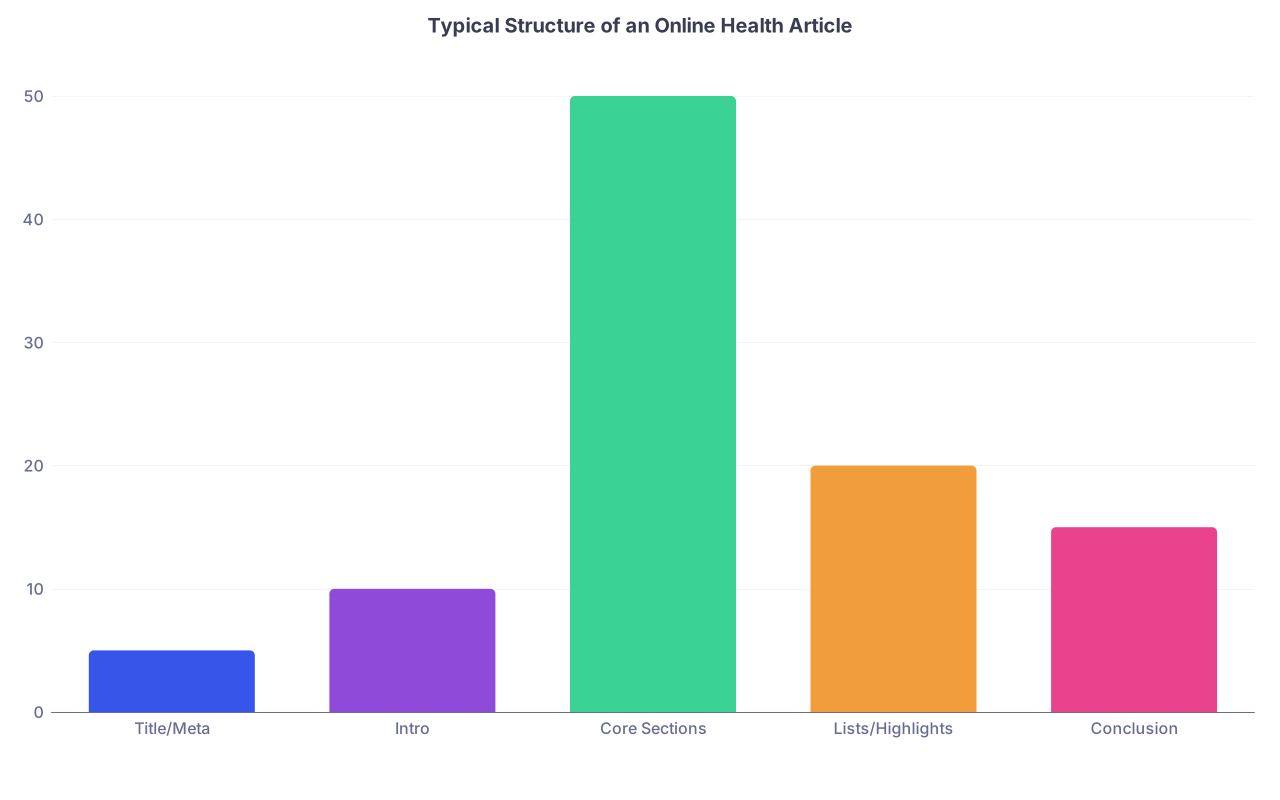
To visualize what a balanced structure looks like:
| Category | Value |
|---|---|
| Title/Meta | 5 |
| Intro | 10 |
| Core Sections | 50 |
| Lists/Highlights | 20 |
| Conclusion | 15 |
Numbers are approximate percentages of word count. The message: most content lives in well‑structured core sections, not rambling intros or fluffy conclusions.
You do this consistently, and even a casual editor will see you know how web content works.
Step 8: Avoid HIPAA, Conflicts, and Academic Landmines
This is where many trainees get burned. They put something online, and suddenly a program director is involved.
Here is the short version of staying safe:
No PHI. At all.
- No ages with rare conditions that make a case identifiable
- No specific dates, locations, or unique circumstances
- Aggregate, anonymize, or fictionalize
Ask before you publish anything clearly derived from your institution’s materials.
- If you took an internal protocol and turned it into a blog post, remove:
- Institutional names
- Logos
- Workflows that are unique and proprietary
- If you took an internal protocol and turned it into a blog post, remove:
Respect journal rules.
- If something is under review, do not post the full text online.
- You can still mention “Manuscript submitted to [Journal] on [topic].” or “Under review.”
If in doubt, create “mock” pieces.
- Write a de‑identified case that is a composite of multiple patients.
- Draft a drug monograph based on a publicly available drug label.
- Create sample content for a fictional telehealth company or clinic.
A simple rule: if your PD or legal office saw it, you should be able to defend it as de‑identified, educational content.
Step 9: Start Getting Real‑World Signals (Small but Valid)
Your portfolio becomes exponentially stronger when someone besides you has said “yes” to your writing.
You do not need NEJM. You need traction.
Here is a realistic ladder for trainees:
Internal publications
- Med school blog
- Residency newsletter
- Hospital website (health tips, specialty pages)
Specialty society and student group blogs
- Many have “resident corner” or “student voice” sections.
- Content is often lighter: explainers, reflections, brief reviews.
Patient advocacy orgs and nonprofits
- Disease‑specific organizations love:
- Simple explainers
- “Clinician answers common questions” posts
- Good names to have on your site.
- Disease‑specific organizations love:
Small health blogs / startups
- Some will not pay. Some will.
- For your first 2–3 pieces, you may accept unpaid, but only if:
- You keep your byline
- You can link from your portfolio
- The site is not sketchy
Paid freelance platforms (once you have 5–10 solid samples)
- LinkedIn outreach
- Cold emails to small health tech or telehealth companies
- Occasionally curated job boards for medical writers
A simple diagram for progression:

| Step | Description |
|---|---|
| Step 1 | Internal Projects |
| Step 2 | School or Hospital Blogs |
| Step 3 | Specialty Societies and Nonprofits |
| Step 4 | Small Health Companies |
| Step 5 | Paid Freelance and Formal Roles |
Do not jump straight to E. Build through A → B → C → D. That is how you look credible instead of desperate.
Step 10: Track Your Output Like a Researcher
If you do not track it, you will forget it. And when you finally need a CV line, portfolio update, or job application, you will not remember half your work.
Create a simple tracking sheet:
- Date started
- Date completed
- Title
- Type (blog, case report, handout, etc.)
- Client / outlet (hospital site, nonprofit, self‑published)
- Link or storage location
- Status (Drafting, Submitted, Published, Archived)
- Notes (editor feedback, performance metrics if known)
Over time, you can use this to:
- See your real output rate
- Identify which types of content get accepted fastest
- Prove consistency to future clients/employers
It also gives you a psychological edge. You can literally see your portfolio growing.
Step 11: Level Up Your Skills Without Wasting Time
Do not bury yourself in endless writing courses. You are already busy.
Here is a focused skill‑building plan that works:
Model 5–10 strong examples in your target lane.
- If you want to write for patient education, read top pages from:
- Mayo Clinic
- Cleveland Clinic
- UpToDate patient pages
- If you want academic review style, read 5 short reviews from:
- NEJM Clinical Practice
- BMJ “Practice” articles
- Specialty society guidelines summaries
- If you want to write for patient education, read top pages from:
Break them down.
- How do they open?
- What headings do they use?
- How long is each section?
- How often do they use bullet points?
Copy structure, not words.
- Use a similar heading pattern.
- Match approximate word count per section.
- Adopt their “laddering” of complexity (simple first, nuance later).
Get at least one serious editor.
- A research mentor
- An attending who publishes
- A medical writer on LinkedIn willing to critique one piece
Ask them specific questions:
- “What would stop this from being publishable?”
- “Is there anything that sounds naive or ‘student‑ish’ in the writing?”
- “What would you cut to make this more concise?”
That is how you get from “good for a trainee” to “good, period.”
Step 12: Position Your Portfolio for Future Alternative Careers
You are not just collecting pretty PDFs. You are building optionality.
Here is how different future directions shape what you should emphasize.
A. If you might want academic medicine / education
Emphasize:
- Review articles, case reports
- Teaching materials
- CME‑style content
On your site and CV, highlight:
- “Author of X patient education handouts used in Y clinic.”
- “Developed and delivered regular teaching sessions on Z topics.”
B. If you might want industry / pharma / med tech
You need to show:
- Comfort with data
- Understanding of products and trials
- Ability to explain mechanisms and outcomes
Build:
- 1–2 mock drug monographs based on real labels
- 1 mock “clinical study summary” from a published trial
- 1–2 white paper style pieces on digital health, telemedicine, or device space
C. If you might want full‑time freelance or agency medical writing
Show:
- Volume and consistency
- Range of audiences
- Reliability
On your portfolio:
- Organize by audience (“For Patients,” “For Clinicians,” “For Industry”)
- Include a short “Services” blurb: “Available for blog posts, white papers, patient education, and clinician content.”
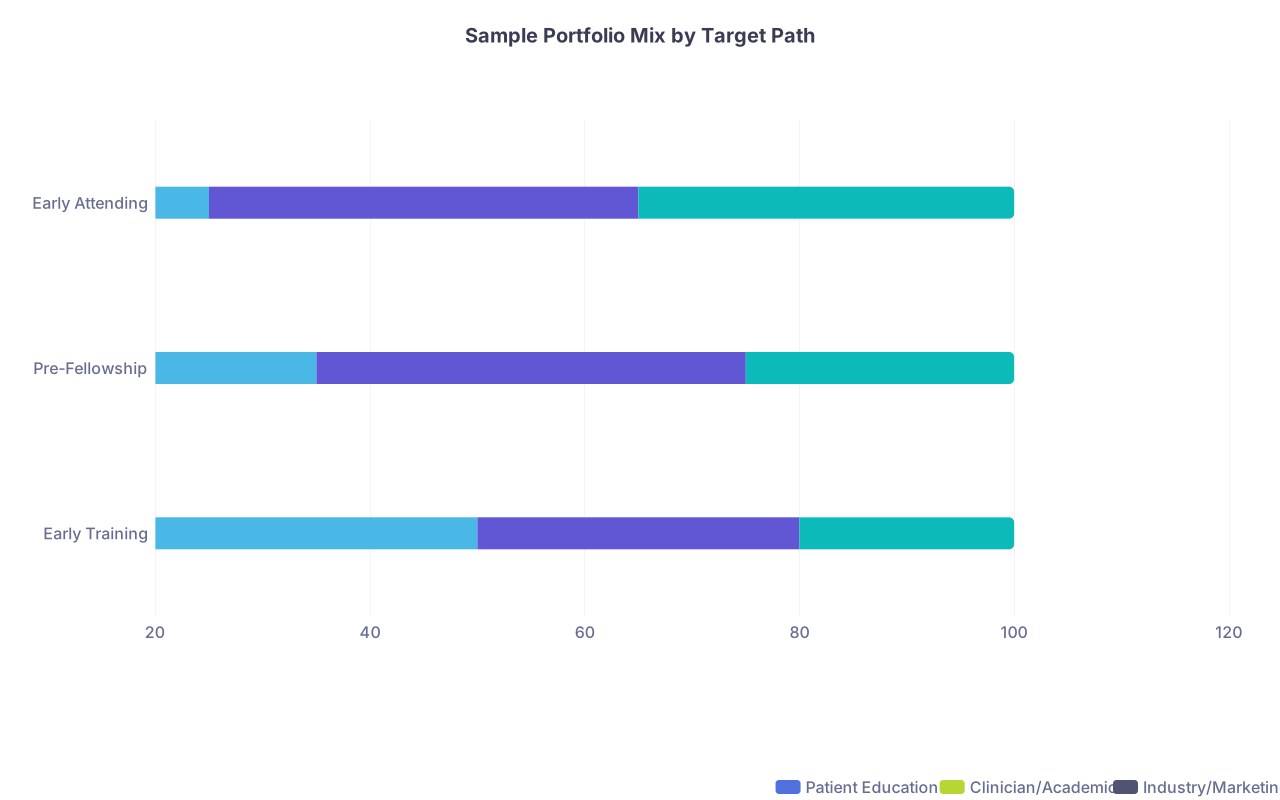
To visualize how your portfolio mix might shift as you move toward different paths:
| Category | Patient Education | Clinician/Academic | Industry/Marketing |
|---|---|---|---|
| Early Training | 50 | 30 | 20 |
| Pre-Fellowship | 35 | 40 | 25 |
| Early Attending | 25 | 40 | 35 |
The exact numbers are not the point. The point is you gradually shift emphasis toward where you might want to land.
Step 13: Use LinkedIn and a Simple Outreach Script
You are in training. You have a built‑in excuse to be “exploring” rather than “begging for work.” Use it.
Clean up your LinkedIn:
Headline:
“Internal Medicine Resident | Medical Writer – Patient and Clinician Content”
or
“MS4 | Aspiring Medical Writer – Patient Education and Academic Content”About section:
2–3 short paragraphs on:- Your clinical track
- Your writing focus
- Link to your portfolio
Then do low‑key outreach to:
- Medical writers in roles you want
- Content directors at small health tech companies
- Editors of online health publications
A short message you can adapt:
Hi [Name],
I am a [MS3/PGY‑2 in internal medicine] with a growing interest in medical writing, especially [patient education / digital health content / regulatory writing]. I have been building a small portfolio here: [portfolio link].If you are ever open to a quick 10–15 minute chat about your path into [their role], I would really appreciate any advice on how trainees can prepare for similar work.
You are not asking for a job. You are asking for information. Jobs and small projects often follow incidentally.
Step 14: Build First, Then Worry About Pay
Yes, medical writing can pay very well. But if you chase rates in month one of building a portfolio, you will:
- Write less
- Stress more
- Accept questionable gigs
The sensible order:
- 0–3 months: Build 3–5 quality pieces. Revise existing work.
- 3–9 months: Get 3–5 pieces accepted by some outlet (internal, nonprofit, small web).
- 9–18 months: Start taking small paid projects, even low rate, from reasonable clients.
- After that: Raise rates, specialize, or pursue formal roles.
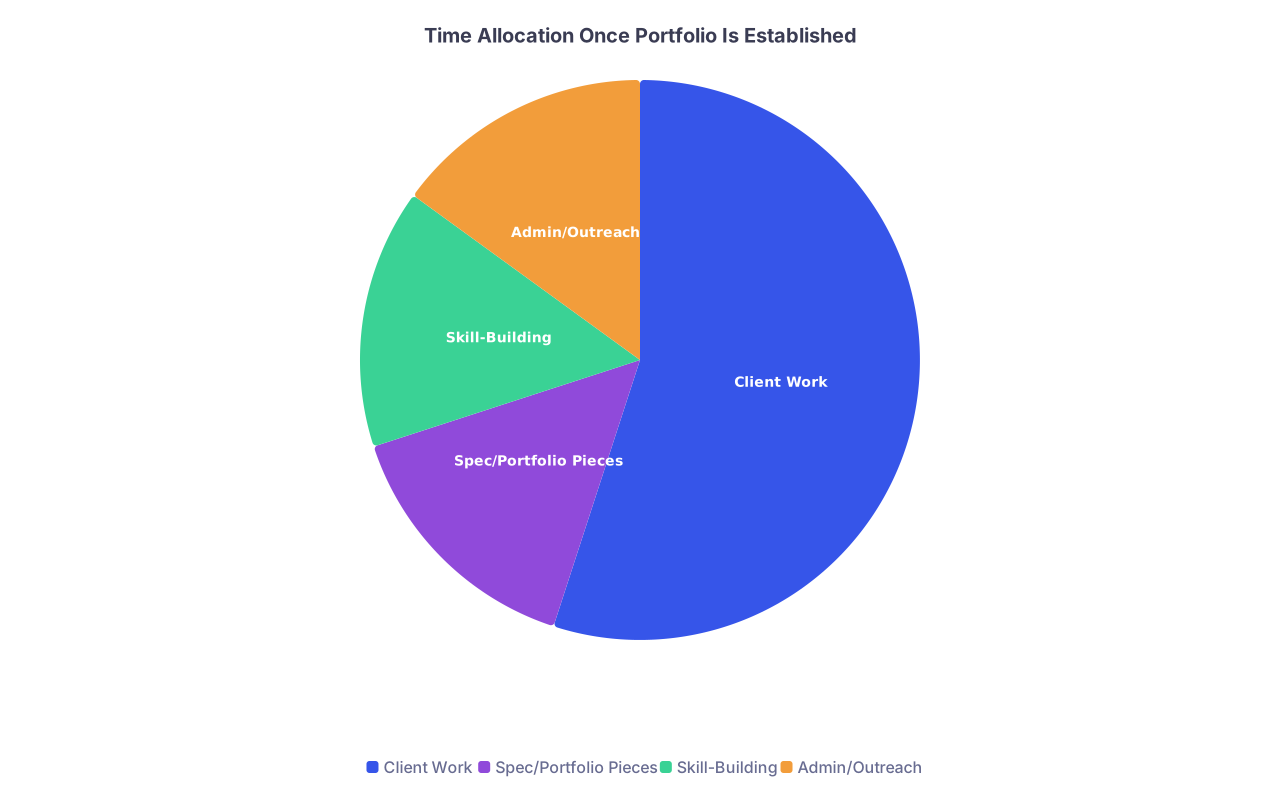
Once you reach the stage where you are taking paid work consistently, your time allocation looks more like this:
| Category | Value |
|---|---|
| Client Work | 55 |
| Spec/Portfolio Pieces | 15 |
| Skill-Building | 15 |
| Admin/Outreach | 15 |
But you earn the right to that spread by doing the early non‑glamorous building first.
Step 15: A Concrete 3‑Month Action Plan
If you want something you can literally follow, use this.
Month 1 – Foundation and First Drafts
- Inventory all existing writing.
- Choose your primary and secondary lanes.
- Set up a basic portfolio site (even if almost empty).
- Draft:
- 1 patient‑facing article
- 1 clinician‑facing short review
- Ask one mentor or writer for feedback on at least one piece.
Month 2 – Publish and Expand
- Revise and finalize the two pieces.
- Submit to:
- A school or hospital blog
- Or a disease nonprofit / local org
- Draft:
- 1 teaching‑style document (slide deck or longer explainer)
- 1 “mock” piece aligned with your future goals (drug monograph, white paper, etc.)
- Update your portfolio site with at least 2 samples (even if still “unpublished” drafts clearly labeled).
Month 3 – Signal and Network
- Secure publication of at least 1 piece (internal or external).
- Add published link(s) to your site.
- Update LinkedIn profile and headline.
- Reach out to:
- 3–5 medical writers
- 3–5 editors or small health organizations
- Ask for one new small project, even if unpaid but visible and bylined.
By the end of 3 months, while still in training, you can realistically have:
- 4–6 serious pieces
- 1–2 published somewhere
- A working portfolio site
- Initial networking threads with people doing this work full‑time
That is a real foundation. Not a fantasy.
Key Takeaways
- Direction first, volume second. Decide what kind of writer you want to look like, then build 3–5 targeted pieces that prove it.
- Leverage what you already do. Turn rotations, teaching, QI, and research into portfolio pieces instead of extra side projects.
- Make it visible and defensible. A simple portfolio site, clean de‑identification, and a few published pieces will put you far ahead of most trainees who “like writing” but cannot show anything concrete.