
Last fall, an intensivist with 15 years of practice sent me an email with a familiar subject line: “Editor said I’m ‘not quite a fit’—what does that actually mean?” He’d pitched multiple outlets, gotten interest, even a call with a publishing house for a book idea… then nothing. On paper he was perfect. In reality, he failed three tests he didn’t even know were happening.
Let me walk you through how editors really judge physician writers before anyone talks about a contract. Not the polite version you hear in webinars. The actual back‑room criteria editors and content directors use when they’re deciding whether to bet money, deadlines, and their own reputation on you.
The First Filter: You’re Being Judged Before They Read a Single Sentence
Let’s start where most physicians get blindsided: editors start evaluating you the second your name hits their inbox, before they open the attachment.
Here’s what they quietly check.
Your digital footprint: do you feel like a lawsuit or a partner?
If you think “the work should speak for itself,” you’re already behind. Editors—especially at health media companies, large blogs, and publishers—Google you immediately. I’ve been in those meetings. Browser, keyboard, your name. Three things get scrutinized:
Professional credibility pattern, not just credentials
They’re asking: “Is this person a practicing or recently practicing physician who looks stable and reliable, or are they a wild card?”
They scan for:
- Board certification and current or recent practice
- Affiliated institutions (yes, the Harvard–Mayo–Stanford halo is real)
- Any obvious professional red flags, lawsuits, or unhinged LinkedIn posts
One medical editor I know at a major consumer health site keeps a private list: “People who will make my legal team yell at me.” It includes physicians who:
- Post anti-vaccine nonsense
- Push fringe therapies without disclaimers
- Pick fights online with colleagues or patients
Online voice-match with their brand
They look at your Twitter/X, LinkedIn, Substack, Medium, sometimes even Facebook.
The unspoken question: “If this person writes for us, are they going to sound like the same human in public?” If your pitches sound sober and evidence-based, but your social feed is all ranting threads and political meltdowns, they walk away quietly.
Signals of being “editor-trainable”
They don’t phrase it that way, but that’s what’s happening. You get bonus points if they see:
- You’ve written for any recognizable outlets (KevinMD, Medscape, Doximity)
- You’ve collaborated (multi-author pieces, bylines with editors)
- You’ve handled complex topics without sounding like a textbook
If the Google pass fails, your file closes and you never hear why. It’s not about “censorship.” It’s risk management and time triage.
The Writing Sample Test: They’re Not Looking for What You Think
Now we get to your actual words. Most physicians think editors are checking for correctness and depth of knowledge. That’s the floor. You don’t earn points for “being right.” You get disqualified if you’re not.
Here’s what they’re actually scoring.
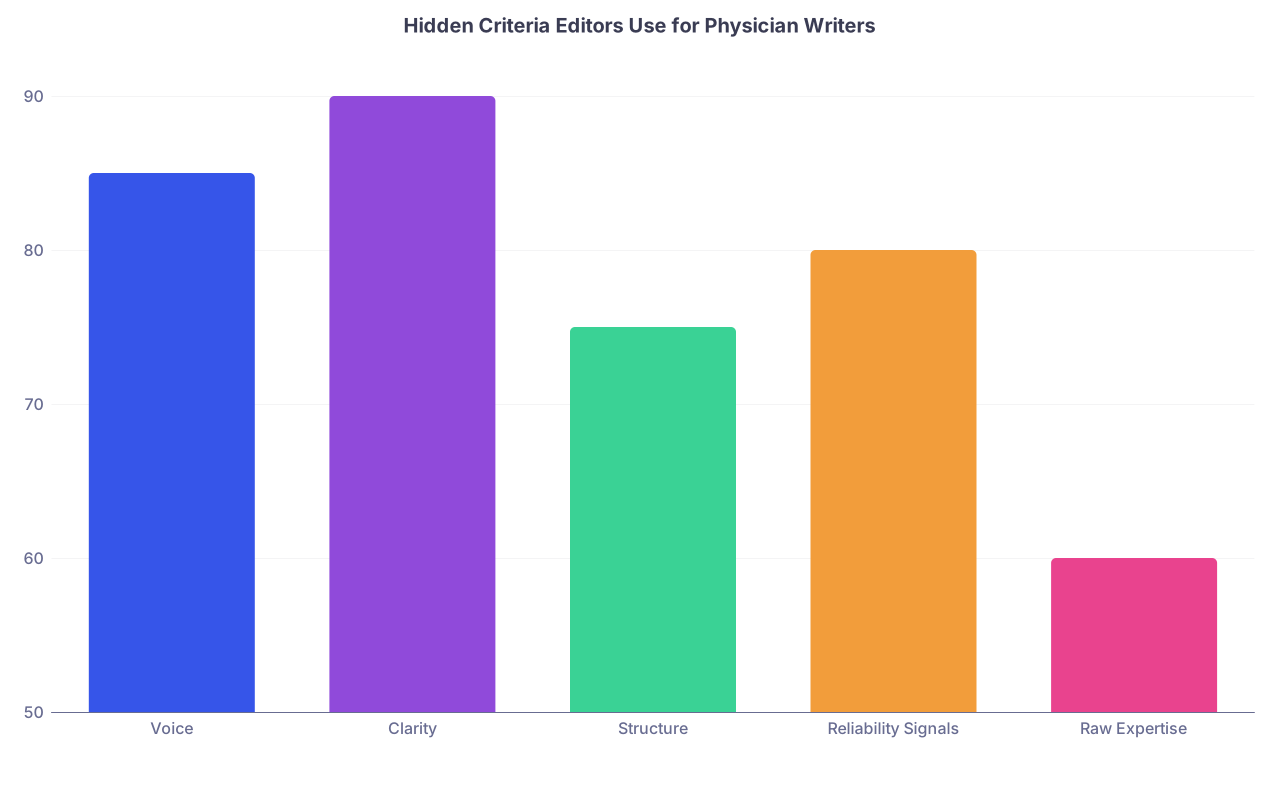
| Category | Value |
|---|---|
| Voice | 85 |
| Clarity | 90 |
| Structure | 75 |
| Reliability Signals | 80 |
| Raw Expertise | 60 |
Voice: can you stop sounding like UpToDate wearing a suit?
This is where most physician writers die.
I’ve sat with content leads scrolling through physician submissions. Their comments are brutal but honest:
- “This reads like a patient handout stapled to a review article.”
- “He writes like he’s afraid the attending is still grading him.”
- “Smart, but I’d rather read the package insert.”
What they want:
- A human voice. First person when appropriate, not afraid of “I.”
- Emotional awareness without melodrama.
- Authority without condescension.
If your sample sounds like a clinical note cleaned up for patient consumption, you’ll maybe land patient education copywriting gigs. You will not get contracts for essays, books, or big‑ticket content.
Clarity: can a smart but non-medical reader follow without effort?
Editors think in terms of cognitive load.
You lose points for:
- Parentheses every other sentence
- Disclaimer stacking (“While it is important to note that…” three times in a paragraph)
- Sentences that run like this one, with multiple clauses, half of them unnecessary, because that’s how you talk on rounds, and you never learned to cut.
They watch for places where they had to re-read. Each re-read is a mark in the “this person will be an editing headache” column.
The best physician writers?
- Explain a complex idea in two crisp sentences, then move on.
- Use concrete imagery, not abstract jargon.
- Know when to stop proving how smart they are.
Story instinct: do you understand narrative, or just information?
This is where physicians who want to write books or longform pieces are separated from those who’ll only ever ghostwrite CME blurbs.
Editors skim your sample for:
- A hook in the first paragraph that isn’t “In this article, I will…”
- A through-line—some tension or question sustained across the piece
- Specific, sensory details (the beeping of a monitor, the smell of chlorhexidine, the silence when a family realizes what you’re saying)
If everything you write is explanation and argument with no scene, no moment, no human anchor, you’re categorized as “content, not author.” That distinction matters. Content people get assignments. Authors get contracts.
The Behavior Test: How You Act in the Gray Zone Between “Interested” and “Offer”
Most physicians think the “evaluation” ends with the writing sample. That’s not how this game works.
Once an editor is lightly interested, they start testing you with small, deniable moves.
Micro-requests: your first unannounced audition
They might:
- Ask for “a short rewrite” of a section.
- Request a 500–800 word sample on a new angle.
- Give ambiguous instructions on purpose.
You’re being tested for:
- Turnaround time (are you a week person, a month person, or a “sorry, been on service” person?)
- Ability to take direction without getting defensive
- Whether the revision actually shows you heard the feedback, versus cosmetic changes
I sat on a call where a medical publisher reviewed a physician’s revised chapter. The editor said, “This is the same draft with a few synonyms.” That author never saw a contract, and nobody told him why.
Email tone: the secret professionalism bar
Every email you send is being silently scored. Here’s what kills a contract faster than a mediocre paragraph:
Over-apologizing. “So sorry for the delay!!! The hospital has been crazy.” Translation in editor-speak: this person will blow deadlines and give me drama.
Argument disguised as clarification. “I understand your concern, but as a board-certified specialist…” Instant red flag. They’re asking: “Will every edit turn into a debate?”
Boundary cluelessness. Oversharing about divorce, burnout, trauma, or hospital politics in early emails. Not because those topics are off-limits in writing—but because you’ve just shown them what working with you will feel like.
The physician writer who gets contracts sounds like this by email:
- Clear subject lines.
- Direct answers to questions.
- One or two sentences of context, no paragraph monologues.
They look for “pleasantly boring” in emails. Emotional stability sells.
The Risk Calculation: Contract = Money + Brand + Time
Let me be blunt: a contract means someone is choosing to spend real money and months of their life on you. So yes, there’s a judgment process, and yes, much of it is about risk control.
Here’s the quiet equation in editorial meetings.
Legal and factual risk: will you make us retract something?
For consumer-facing outlets, this is non-negotiable. The law team has been burned before.
You get bumped up the list if:
- Your sample and pitch show you understand what you can and cannot claim.
- You use hedging and data accurately. “Suggests,” “associated with,” “small randomized trial,” instead of throwing around “proves” and “cure.”
- You reference guidelines correctly (and recent ones).
You get bumped down or cut if:
- You casually trash other specialties or named drugs/hospitals.
- You make big absolute statements: “This is the only diet that works.”
- You clearly haven’t kept up with the literature in the area you want to write about.
Medical degrees don’t immunize you from being seen as a liability. I’ve watched editors kill promising projects because an author’s social media was full of aggressive takes that might age badly.
Brand and category fit: do you occupy a useful “box” in their catalog?
This part feels unfair, because it often has nothing to do with your talent.
Book editors, for example, are always thinking in categories:
- “We need a physician voice on aging.”
- “We already have three burnout memoirs.”
- “We don’t have a hospitalist explaining health systems for lay readers.”
You’re judged on:
- How cleanly your idea fits a box they know how to sell.
- How distinct you are from the last three cardiologists who pitched them heart‑disease explainers.
- Whether your background gives them an angle: “The rural ER doc,” “The ICU doctor during COVID,” “The psychiatrist writing about tech addiction.”
If your project doesn’t slot into an obvious lane, they may like you but pass. The smart ones then reposition the project to fit a lane. Most physicians miss that pivot.
Time and emotional labor: are you going to drain my calendar?
This one’s very real.
Editors trade war stories about “high‑maintenance doctors” the same way residents trade stories about impossible attendings.
You get downgraded if:
- You send long, meandering emails full of big philosophical questions when they asked for a yes/no.
- You nitpick contract language that’s standard (I’m not talking about getting an agent—that’s smart. I’m talking about three pages of revisions to boilerplate clauses you don’t understand).
- You’re slow to respond on simple logistics.
A physician-writer who gets repeat contracts:
- Hits deadlines more often than not.
- Flags problems early, not the night before.
- Accepts 80–90% of edits without a fight, and chooses carefully the 10–20% they push back on, with clear reasons.
That’s how you get labeled internally as “easy to work with.” That label is priceless.
The Unspoken “Marketability” Judgment: Are You More Than Just Content?
Here’s the part most doctors underestimate. Editors, especially in book publishing and large health media outfits, are half content evaluators, half talent scouts. They’re not just judging your words. They’re judging your platform.
And yes, they hate that term too. But they use it.
Are you bring-your-own-audience, or do-they-build-it-from-scratch?
I’ve heard this literally said in an editorial acquisitions meeting:
“Good writer. No platform. If we buy this, we’re building everything ourselves.”
Translation: maybe we’ll take a small risk if the idea is spectacular. Otherwise, pass.
They look at:
- Email lists (newsletter, practice mailing lists, communities)
- Follower count is nice, but engagement (comments, shares, replies) matters more
- Speaking history (grand rounds are fine; keynotes and public talks are better)
- Existing media appearances (podcasts, TV, print)
| Signal Type | What Editors Actually Care About |
|---|---|
| Social Media | Real engagement, not follower count alone |
| Newsletter | Consistent sending, open rates, clear niche |
| Speaking | Audiences beyond your own institution |
| Prior Publications | Recognizable outlets and repeat invitations |
| Professional Roles | Positions that confer authority, not just titles |
A physician with:
- 4,000 engaged newsletter subscribers
- Occasional NYT or Atlantic pieces
- A couple of podcast appearances
…is exponentially more attractive than a technically better writer with zero public footprint.
For content contracts (blogs, brand work, CME), platform matters less. For books and major essays, it matters a lot.
Are you a one-topic person, or a franchise?
Editors don’t use the word “franchise” out loud for physician writers, but they think in those terms.
You get mentally sorted into one of three buckets:
- Single-story memoirist. You had one big experience (illness, lawsuit, rural practice). Probably one book, maybe a few essays.
- Topical explainer. You can write across a domain (sleep, obesity, mental health). Good for columns, series, multiple projects.
- Franchise voice. You’re a perspective. People come for how you think, not just what you know. These are rare and get the fat contracts.
Editors test this implicitly by:
- Asking “what else would you want to write about after this?”
- Noting whether your pitches are all the same story with new clothes.
- Watching if you can spontaneously riff on adjacent ideas in conversation.
If your imagination stops at “my story of burnout,” you’ll get sympathy. You won’t get a multi‑book deal.
How to Make Editors’ Lives Easier (And Get the Contract)
Let me give you the part hardly anyone says out loud: editors are exhausted. Overcommitted. Drowning in pitches, bureaucracy, and Slack messages. They’re not trying to be gatekeepers; they’re just trying not to drown.
So the physician writer who consistently gets contracts is the one who quietly reduces their cognitive load.
Sharpen your sample to hit their real checkboxes
Before you send anything, ask:
- Does the first paragraph hook or just announce?
- Is there at least one specific scene or detail that only a clinician could write?
- Have I stripped out the academic hedging and throat-clearing?
- Could a smart non-medical friend read this in one pass without stopping?
You want the editor to feel: “This will be easy to shape.”

| Step | Description |
|---|---|
| Step 1 | Receive Pitch |
| Step 2 | Pass Quietly |
| Step 3 | Read Sample |
| Step 4 | Test with Small Assignment |
| Step 5 | Assess Risk and Fit |
| Step 6 | Consider Low Stakes Work |
| Step 7 | Offer Contract |
| Step 8 | Digital Footprint OK |
| Step 9 | Voice and Clarity Strong |
| Step 10 | On Time and Coachable |
| Step 11 | Marketability Acceptable |
Behave like a colleague they wish they worked with clinically
Think of your favorite attending. Calm, reliable, doesn’t waste words, gives clear direction. Be that person, in reverse.
You don’t need to be brilliant in every email. You need to be:
- Predictable.
- Low-drama.
- Respectful of their time.
One acquisitions editor at a big nonfiction house told me bluntly: “If I feel like I’d dread a Zoom with this person every month for a year, I don’t buy the book. I don’t care how strong the proposal is.”
Take that seriously.
Stop thinking “I’m the product.” You’re actually a partnership.
This stings for doctors used to being the center of the universe.
When an editor considers offering you a contract, they’re thinking:
- Can I sell this upstairs?
- Can I defend this choice a year from now when numbers come in?
- Will working with this person make my job easier or harder?
Your job is to make it very easy for them to say: “Yes, this is worth the risk.”
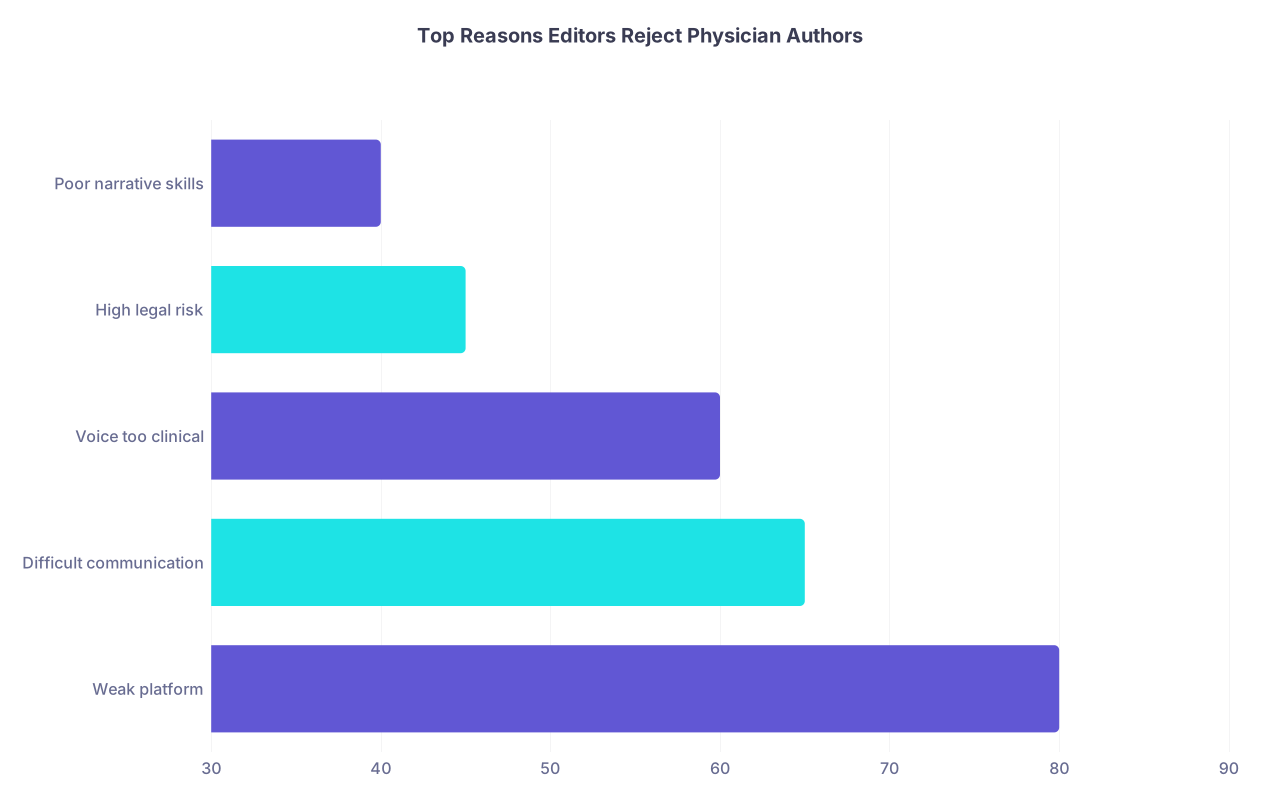
| Category | Value |
|---|---|
| Weak platform | 80 |
| Difficult communication | 65 |
| Voice too clinical | 60 |
| High legal risk | 45 |
| Poor narrative skills | 40 |
FAQs
1. Do I really need a big social media following to get any kind of writing contract?
No. For smaller content contracts—blog posts for health sites, CME writing, branded medical content—your clinical expertise and clear writing matter more than your follower count. Where platform becomes critical is for trade books and high-visibility essays in major outlets. There, a modest but engaged presence (newsletter, some prior pieces, active talks) often makes the difference between “we love this but can’t justify it” and “let’s move forward.”
2. How many samples should I have before approaching editors?
Have at least three strong, polished pieces that represent different aspects of what you can do: perhaps one narrative essay, one explanatory piece for lay readers, and one more “service” or practical article. Editors don’t need a portfolio site with 20 pieces; they need proof you can hit the tone and audience they care about. Quality over quantity. And don’t send everything—select strategically based on the outlet’s style.
3. What’s the fastest way for a physician to become more “editor-friendly”?
Two things: get edited, and respond like a professional. Take a class or workshop where an experienced editor marks up your work and then train yourself to implement edits with minimal ego. Then, when you start working with real editors, reply promptly, accept most changes, and ask concise questions about the few you disagree with. That combination—coachability plus responsiveness—moves you from “risky newcomer” to “someone I can trust with bigger assignments.”
4. Should I get an agent before I approach editors or publishers?
For books, yes, in most cases. Agents know how to translate your expertise into something editors can sell, and they protect you from signing weak contracts. Many large publishers won’t even look at unagented submissions. For articles, essays, and content work, you typically don’t need an agent. Build relationships directly with editors there; if a book project emerges, that’s when you start talking to agents.
Remember the intensivist from the beginning? Once he understood these hidden tests, he didn’t suddenly become a better clinician. He became a cleaner, easier bet. Three strong samples. Tight, professional emails. A clarified platform. Six months later, he had a contract with a mid-size publisher and a recurring column. Same brain. Different signal.
Editors are not guessing. They’re running a quiet checklist: voice, clarity, reliability, risk, marketability. If you want the contract, write well—but also, make it brutally obvious you’re someone they won’t regret betting on.