
Copy‑pasting your CV into LinkedIn is one of the fastest ways to kill your non‑clinical job chances before anyone even talks to you.
If you’re trying to leave clinical medicine—or even just open doors to pharma, health tech, consulting, informatics, utilization management, or medical affairs—and your LinkedIn looks like a glorified PubMed bibliography plus your residency ERAS, you are silently telling recruiters: “I do not understand this world.”
Let me unpack the specific ways this goes wrong and how to fix it before your next opportunity scrolls right past you.
1. The Core Mistake: Treating LinkedIn Like an Online CV Dump
A CV is an academic document.
LinkedIn is a marketing asset.
Confuse those two, and you lose.
Your academic CV is designed to signal:
- Depth in one specialty
- Longevity in training and promotion
- Grant history, authorship order, poster volume
- Teaching, committees, and service work
Non‑clinical employers do not care about most of that. At least not in the way it’s formatted.
Copying your CV into LinkedIn usually leads to five visible problems:
- A headline that says something like “Attending Physician at X Hospital” (weak, generic, and clinically pigeonholing).
- A “About” summary that’s either missing or reads like a third‑person mini‑bio for Grand Rounds.
- Experience sections that are just job titles, dates, and generic clinical duties.
- A “Publications” or “Research” section that looks like a citation list, not an asset.
- Skills that are all clinical procedures and EMR names, not business‑relevant capabilities.
Recruiters scrolling through thousands of profiles are not going to decode your PGY‑3 leadership role into “project management” or “stakeholder alignment.” They will just move on to the ex‑pharmacist or ex‑RN who already speaks their language.
You are asking them to do the translation work. They will not.
2. The Visibility Trap: Why CV‑Style Profiles Stay Hidden
Here’s the part most physicians miss: you are not just hurting how you look; you are hurting whether you get seen at all.
Recruiters don’t search LinkedIn by “exhaustive call schedule survivor” or “best bedside manner.” They search by specific non‑clinical keywords.
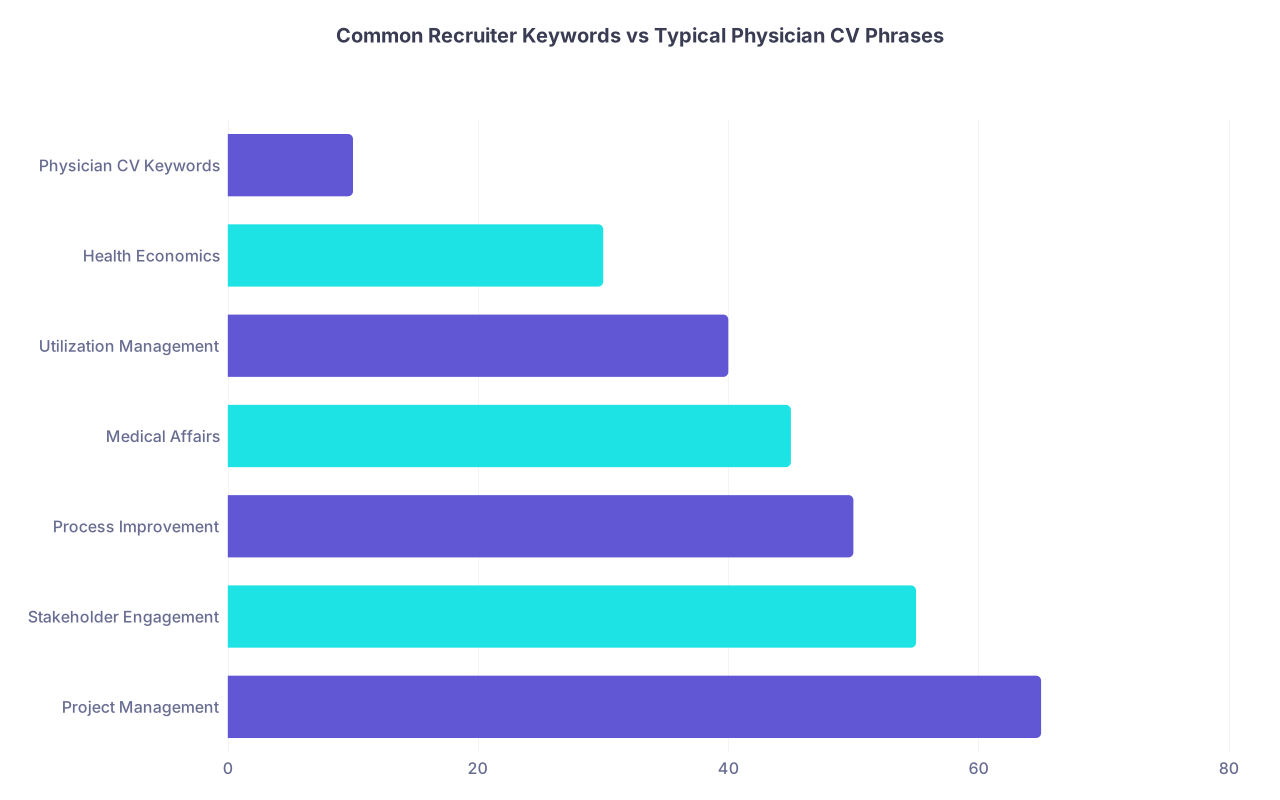
| Category | Value |
|---|---|
| Project Management | 65 |
| Stakeholder Engagement | 55 |
| Process Improvement | 50 |
| Medical Affairs | 45 |
| Utilization Management | 40 |
| Health Economics | 30 |
| Physician CV Keywords | 10 |
On a CV‑dump LinkedIn, you’ll see:
- “Internal Medicine Attending”
- “Board Certified in…”
- “Chief Resident 2017–2018”
- “Extensive experience in inpatient and outpatient care”
What’s missing?
Words like:
- “Cross‑functional collaboration”
- “Process optimization”
- “Data analysis and interpretation”
- “Product lifecycle”
- “Clinical operations”
- “Quality improvement initiatives”
If your LinkedIn does not contain those non‑clinical keywords, you simply do not appear in many searches. It’s not personal. It’s algorithmic.
So you think, “Nobody’s interested in me for non‑clinical roles.”
Reality: The system literally cannot see you.
You did this to yourself by treating LinkedIn like a PDF hosting service.
3. Headline & About: The Two Places You Cannot Afford to Get Wrong
If you copy your CV, your headline usually defaults to your current clinical role. That is the digital equivalent of walking into a pharma networking event wearing your white coat and badge.
Yes, you’re proud of it. But it screams “still fully inside the hospital world.”
The Wrong Way (CV Copy)
- “Pediatrician at Children’s Hospital of X”
- “Cardiologist | Assistant Professor of Medicine”
- “Hospitalist at Y Medical Center”
These lock you in clinically and give zero hint of direction.
The Right Way (Transition Signal)
Try building a headline with three components: your credibility, your target direction, and your value.
Examples:
- “Board‑certified Internist | Aspiring Medical Affairs Physician | Translating Clinical Evidence into Product Strategy”
- “Emergency Physician | Health Tech & Clinical Operations | Improving Patient Flow with Data‑Driven Solutions”
- “Pediatrician | Utilization Management & Quality | Reducing Unnecessary Care While Protecting Outcomes”
See the difference? You’re still a physician. But now you’re a physician moving toward something concrete.
Now the About section. This is where the “I pasted my academic bio” mistake really hurts.
Typical CV‑style About:
Dr. Smith is a board‑certified internist who completed residency at X, served as Chief Resident, and has authored multiple peer‑reviewed publications in the field of…
That’s fine for a conference brochure. It is useless for a hiring manager who wants to know: “Can this person solve our business problem?”
You need:
- A clear target: the type of roles you’re open to
- A translation of your clinical career into business outcomes
- A few relevant keywords (not buzzword salad, actual signals)
Example of a stronger non‑clinical About:
I’m a board‑certified internist with 8+ years of frontline clinical experience and a track record of improving workflows, building consensus across disciplines, and translating complex evidence into clear decisions.
After leading multiple hospital quality initiatives—reducing readmissions, redesigning discharge processes, and piloting EMR‑based order sets—I’m now focused on roles at the intersection of clinical care and strategy: medical affairs, clinical operations, and health tech product work.
I enjoy partnering with non‑clinical teams (product, data, operations) to pressure‑test ideas against real‑world clinical reality and regulatory constraints. I’m especially interested in organizations working on care delivery innovation, population health, and value‑based care.
That doesn’t look like a CV. It looks like a person non‑clinical teams can work with.
4. Experience: Duties vs Outcomes (and Why CV Language Fails)
The worst thing you can do is copy CV lines like:
- “Managed inpatient and outpatient panels of diverse patients”
- “Participated in multidisciplinary rounds”
- “Supervised residents and medical students”
Those are duties, not outcomes. Every physician in your specialty could write the same thing.
For non‑clinical hiring managers, “I saw a ton of patients” is irrelevant. They want to see proof you can:
- Lead projects
- Design processes
- Use data
- Influence peers
- Communicate clearly to different audiences
You’ve probably done all of that. You just never wrote it that way.
Let’s take a specific example.
CV line:
- “Chief Resident, Department of Internal Medicine, 2017–2018”
On LinkedIn for non‑clinical roles, that should not just sit there naked. Flesh it out with business‑style bullets. Not epic paragraphs. Actual impact.
Instead of:
- “Responsible for making schedules, teaching residents, and coordinating conferences”
Try:
- “Led 60+ resident physicians, coordinating schedules, conflict resolution, and program communication while maintaining ACGME compliance.”
- “Redesigned call schedule process, reducing last‑minute changes by 30% and improving resident satisfaction scores on annual survey.”
- “Created new M&M conference structure and tracking system that increased reported safety events and near‑miss learning cases.”
This is what non‑clinical eyes understand: leadership, redesign, metrics, satisfaction, reporting.
Most physicians have these stories. They just bury them under vague language like “participated in,” “involved in,” and “responsible for.”
That language belongs on ESY forms and old‑school CVs. Not on LinkedIn if you want a non‑clinical job.
5. Publications & Research: Quit Listing, Start Positioning
Dumping your full publication list into LinkedIn is a classic self‑sabotage move.
Why?
Because:
- It consumes visual space without context.
- It signals “I care about academic promotion,” not “I understand product, strategy, or operations.”
- It overwhelms non‑clinical readers who can’t tell which 3 papers actually matter.
You do NOT need to erase your research. You need to curate it.
Pick 3–5 of your most relevant projects and reframe them around skills:
- “Designed and led a multi‑site observational study on [X], coordinating IRB approvals, data collection, and cross‑functional communication.”
- “Analyzed [N] patient records using [tool or method], presenting findings to hospital leadership and influencing protocol updates.”
- “Contributed clinical expertise on a study that informed [guideline, product design, or policy change].”
You can still link to the full publication. Just do not make your LinkedIn read like the tail end of a grant application.
Remember: for non‑clinical roles, your research is evidence of transferable skills (data, communication, project leadership), not of your h‑index.
6. Skills, Keywords, and the Silent Filter Blocking You
Most physicians treat the “Skills” section as an afterthought. Or worse, they copy clinical skills straight from their CV:
- “Central line placement”
- “Intubation”
- “ACLS”
- “Cardiac catheterization”
For non‑clinical paths, this is almost useless. And it actively steals space from the skills that matter.
You need the skills that map to the jobs you want:
- For medical affairs: “Clinical trial interpretation, KOL engagement, scientific communication, slide deck development, medical education”
- For utilization management/insurance: “Chart review, medical necessity assessment, guideline development, peer to peer communication, policy review”
- For health tech/product: “Workflow analysis, user feedback collection, requirements gathering, stakeholder management, clinical content creation”
- For consulting/strategy: “Problem structuring, stakeholder interviews, data synthesis, presentation development, change management”
If your Skills list doesn’t contain these, the algorithm won’t connect you to those roles. A recruiter running a Boolean search for “medical affairs AND KOL” will literally never see you, regardless of how many CME talks you’ve given.
This is not about gaming the system. It’s about not pretending you only know how to use a stethoscope.
7. Story & Direction: How CV Copying Makes You Look Confused
Non‑clinical employers are wary of one thing above almost everything else: a physician who looks like they’re just “trying something” because they’re burned out or angry.
When your LinkedIn is a direct CV copy, this is exactly how you look:
- All clinical experience
- All clinical skills
- All clinical identity
- Zero narrative about why you’re moving and where
They see someone who might:
- Bail and go back to clinic as soon as they miss procedures
- Resist learning non‑clinical tools and methods
- Struggle with corporate hierarchy and culture
- Expect to be treated like “the doctor in the room” rather than a team member
You avoid that perception by building a clear directional story:
- What parts of your clinical work you actually enjoyed (systems, quality, teaching, data).
- How you already operated in cross‑functional ways (IT projects, EMR committees, QI projects, policy work).
- How those experiences logically connect to the roles you’re targeting.
This belongs in:
- The About section
- Your Experience bullets
- Even your Featured content (presentations, articles, projects)
Copying your CV skips this step. It shows your past, but not your trajectory.
Non‑clinical teams hire for trajectory.
8. Engagement & Network: Why “Set It and Forget It” Is Another CV Reflex
Academic CVs are static. You update them once or twice a year for promotion packets or grant applications.
LinkedIn punishes that mentality.
If your pattern is:
- Copy CV to LinkedIn,
- Add a headshot,
- Vanish for 11 months,
then:
- You don’t comment on industry posts
- You don’t connect with people doing the jobs you want
- You don’t share anything that reflects your new interests
You stay “the clinician who might be mildly curious,” not “the clinician who is obviously moving toward X field.”
Non‑clinical recruiters check activity. I’ve heard them say outright:
“They say they’re interested in health tech, but they have zero connections in tech and haven’t engaged with anything remotely related. Hard pass.”
Again: your CV did not prepare you for this because in academia, you’re told to “keep your head down and produce.” Online, that mindset just makes you invisible.
You don’t need to post daily thought leadership. But you do need:
- A few targeted comments each week on relevant posts
- Periodic shares of articles with your quick take
- Connection requests with short, human notes to people in roles you want
This shows direction and seriousness. Your CV‑dump profile shows neither.
9. Before & After: How a Physician Profile Should Actually Change
Let’s make this real. Here’s a simplified contrast.
| Element | CV-Dump Version | Non-Clinical Ready Version | |
|---|---|---|---|
| Headline | Hospitalist at City Medical Center | Hospitalist | Clinical Operations & Quality Improvement |
| About Section | Third-person academic bio | First-person narrative, clear target roles | |
| Experience Text | Duties-focused, generic clinical tasks | Outcome-focused, metrics, cross-functional work | |
| Publications | Full citation list | 3–5 curated projects with skills and impact | |
| Skills | Procedures, EMR names | Business/operational/strategy skills |
If your profile looks more like the left column than the right, you’re handicapping your own transition.
10. A Simple Fix Sequence: How to Stop Making This Mistake
You do not need a personal brand consultant charging $3,000 to fix this. You do need to stop treating LinkedIn like free CV hosting.
Use this rough order of operations:

| Step | Description |
|---|---|
| Step 1 | Decide Target Roles |
| Step 2 | Rewrite Headline |
| Step 3 | Rewrite About Section |
| Step 4 | Translate Experience to Outcomes |
| Step 5 | Curate Research and Projects |
| Step 6 | Update Skills with Keywords |
| Step 7 | Add 5-10 Targeted Connections Weekly |
| Step 8 | Engage with Relevant Content |
You’ll notice “upload full CV” is nowhere on that flowchart.
You can still keep a PDF of your CV attached under “Featured” if you really want. But your profile itself needs to speak in the language of the jobs you want, not the world you’re leaving.
FAQs
1. Do I need to hide or delete my clinical experience to look serious about non‑clinical work?
No. Deleting your clinical history is a mistake. The clinical years are your credibility. What you need to delete is the academic framing. Keep the jobs, but rewrite the bullets to emphasize leadership, systems thinking, communication, data use, and project work. Show how you used your clinical role to drive change, not just see patients.
2. I don’t have formal non‑clinical titles. How do I show I’m qualified?
Every seasoned physician has done non‑clinical work; you’ve just never labeled it correctly. Examples you can reframe:
- Leading a QI project
- Being the EMR “super user” during a rollout
- Creating new clinic workflows or protocols
- Running M&M, journal club, or teaching curricula
- Participating in hospital committees or task forces
Translate those into project‑style bullets with outcomes and stakeholders. That’s how a hiring manager sees you as more than “just a clinician.”
3. Should I pay for LinkedIn Premium during my non‑clinical job search?
Premium is optional. Many people land non‑clinical roles without it. Do not assume paying for Premium will fix a broken, CV‑dump profile. Fix your headline, About, Experience, and Skills first. If you’re actively doing outreach and want InMail or better search visibility, then Premium can be useful. But it’s a force multiplier, not a band‑aid.
4. How different should my resume be from my LinkedIn profile?
They should align but not match word‑for‑word. LinkedIn is broader and more narrative. Your targeted resume is tailored to a specific role description with sharper bullets. If your resume says one thing and your LinkedIn screams “lifelong academic clinician,” hiring managers will trust LinkedIn. It’s the more “real‑time” signal. So fix LinkedIn first, then tune resumes to each application.
5. What’s one concrete sign my LinkedIn still looks like a CV dump?
Here’s a quick test: look at your profile and ask, “If I covered my name and photo, would this look identical to every other physician in my specialty?” If yes, that’s a CV dump. A non‑clinical‑ready profile clearly signals direction (target roles), shows outcomes (not just duties), and uses language someone in pharma/tech/consulting/UM would recognize. If a non‑clinician couldn’t tell what you’re aiming for in 10 seconds, you still have work to do.
Open your LinkedIn profile right now and highlight your headline and About section. If they read like your academic bio or ERAS application, rewrite them today—before another recruiter decides you’re “too clinical” and moves on.