
What if you finally escape the call schedule, hand in your badge… and realize you just torched a career, your income, and your identity with no real plan?
If you’re thinking about leaving clinical medicine—or already halfway out the door—the danger isn’t that you’ll fail. The danger is that you’ll succeed at quitting, but in exactly the wrong way.
Let’s walk through the biggest mistakes I see doctors make when they step away from practice, and how you can avoid turning a necessary pivot into a preventable disaster.
1. Quitting Reactively Instead of Strategically
Most physicians don’t calmly “transition” out of practice. They snap.
The story is depressingly familiar:
- Another unsafe patient load
- One more admin email about “productivity”
- A complaint because you didn’t respond to a portal message in 4 minutes
And then you think: “I’m done. I’ll just find something else.”
That’s the first big mistake.
Leaving clinical work out of pure escape mode creates three predictable problems:
- You don’t know what you’re going to — only what you’re running from
- You underestimate timelines and financial impacts
- You compromise on bad non-clinical roles just because they’re “out”
Here’s how to avoid this:
Name the real problem first
Is it:- Your current employer or the profession?
- The schedule? The culture? The compensation model?
I’ve seen people quit medicine who actually just needed to quit that one toxic group.
Set a transition horizon, not a meltdown date
Tell yourself: “I’m leaving clinical in 12–24 months,” then work backward:- 3–6 months: skill-building and networking
- 6–12 months: targeted applications/conversations
- 12–24 months: execute exit with notice, financial buffer ready
Test before you jump
If you think you want:- Medical communications → do some paid freelance work first
- Utilization review → try per-diem chart review
- Industry / pharma / medtech → advisory boards, consulting, or small projects
Do not make the mistake of going from “I hate this” to “I quit” in 3 weeks without a tested plan. That’s how you trade burnout for panic.

| Step | Description |
|---|---|
| Step 1 | Clinical Dissatisfaction |
| Step 2 | Try Fixes or New Job |
| Step 3 | Plan 12 to 24 Month Exit |
| Step 4 | Test Nonclinical Options |
| Step 5 | Build Skills and Network |
| Step 6 | Apply to Target Roles |
| Step 7 | Negotiate Exit and Start New Role |
| Step 8 | Employer or Profession? |
2. Ignoring the Brutal Financial Reality
Here’s a painful truth most doctors don’t want to hear: your clinical income is likely the highest base salary you’ll ever see again, at least for a while.
Nonclinical roles can absolutely pay well. Some pay better long-term. But the timing and path look nothing like residency-to-attending.
Common money mistakes:
Assuming “I’ll easily make my attending salary elsewhere”
You might. But:- Many entry-level nonclinical jobs pay $80k–$180k, not $300k+
- Leadership-track or industry roles that hit $250k–$400k often require:
- Geographic flexibility
- Corporate skills you haven’t built yet
- Years of progression
Burning the bridge before building the runway
That means:- Quitting clinical work before:
- Paying down high-interest debt
- Building 6–12 months of expenses
- Understanding benefit differences (health insurance, retirement, bonuses)
- Quitting clinical work before:
Not modeling realistic scenarios
You need actual numbers, not vibes. At least three scenarios:- Best-case: land a $220k+ role in 6 months
- Likely-case: $140–$180k in 6–12 months
- Worst-case: underemployment, consulting, or partial clinical for 12–18 months
, Health Tech Medical Director](https://cdn.residencyadvisor.com/images/articles_svg/chart-typical-income-ranges-clinical-vs-common-nonclinic-9298.svg "Typical Income Ranges: Clinical vs Common Nonclinical Roles")
| Category | Value |
|---|---|
| Hospitalist | 260000 |
| Outpatient IM | 240000 |
| Utilization Review | 140000 |
| Medical Writing | 90000 |
| [Pharma MSL](https://residencyadvisor.com/resources/alternative-medical-careers/behind-closed-doors-how-msl-teams-actually-use-mds-day-to-day) | 180000 |
| Health Tech Medical Director | 220000 |
How to not blow up your finances:
- Build a runway:
- 6–12 months of bare-minimum expenses in cash
- Stop pretending your lifestyle can’t shrink. It can.
- Drop or refinance high-interest debt before you leave
- Understand:
- Are there non-compete clauses impacting moonlighting?
- What happens to your retirement match?
- COBRA vs marketplace health insurance costs?
Don’t make the mistake of treating your nonclinical pivot like a vacation. Treat it like a high-risk startup phase. Because that’s what it is.
3. Letting Your Professional Identity Collapse
This one destroys people quietly.
You don’t just lose call. You lose:
- The “Doctor” badge in the hallway
- The instant social status at parties
- The feeling that you’re obviously doing something important
Doctors underestimate how much their self-worth is welded to patient care. Then they’re blindsided when the emails stop, the pager is gone, and they’re just… them.
Common identity mistakes:
Defining yourself only as “I’m a doctor”
When you remove patient care, you feel like nothing. This is not a moral failure; it’s a predictable psychological crash.Hiding your transition out of shame
“I’m just taking a break.”
No. You’re making a career decision. If you treat it like failure, others will too.Clinging to the past instead of re-framing
You are not “no longer a real doctor.”
You are a physician using medical training in a different way. But you have to believe that first, or nobody else will.
How to protect yourself:
Write a new professional story, in plain language
Example:“I’m a board-certified internist who now focuses on improving care quality and reducing physician burnout through system redesign and consulting.”
Keep some visible connection to medicine initially
Options:- Limited per-diem shifts
- Teaching residents or students
- Volunteering at a free clinic a few times a year
Not because you “have to prove” anything. Because it softens the landing psychologically.
Build a peer group of people who already left
People still in full-time clinical work will often:- Not understand your reasons
- Defend their own choices by criticizing yours
- Question your “wasted training”
Talk to those a few years ahead of you. They’re your future, not the ones still on 1:3 call.

4. Underestimating How Different Nonclinical Hiring Really Is
This one surprises almost every physician.
In medicine, your path was structured:
- MCAT → med school → residency → job
- Exams + training + board certification = job offers
Outside of clinical practice, nobody cares about your CV the way you think they do. They care about:
- Specific skills
- Outcomes you’ve driven
- How you speak the language of their world
Big mistakes:
Sending a 17-page CV instead of a focused 2-page resume
HR and hiring managers in nonclinical spaces don’t want your med school grades. They want:- Measurable accomplishments
- Relevant projects
- Demonstrated understanding of their industry
Applying like a new grad instead of like a professional
You’re not a 22-year-old looking for “exposure.” You’re an experienced professional who needs to articulate transferable value, not just training.Not learning the industry’s language
In:- Pharma / biotech → “clinical development,” “protocol design,” “KOL engagement,” “regulatory strategy”
- Health tech → “product-market fit,” “user research,” “clinical validation,” “workflow integration”
- Insurance / utilization review → “cost containment,” “medical necessity criteria,” “inter-rater reliability”
If you sound like an outsider, they’ll treat you like one.
| Feature | Clinical CV | Nonclinical Resume |
|---|---|---|
| Length | 8–20 pages | 1–3 pages |
| Focus | Training, publications, lectures | Achievements, impact, skills |
| Format | Chronological, exhaustive | Targeted, customized |
| Language | Academic, clinical | Business / industry-oriented |
| Metrics | Rarely highlighted | Quantified wherever possible |
How to avoid the trap:
Rewrite your experience in outcome language
Not: “Responsible for QI committee”
Instead: “Led QI initiative that reduced readmissions by 12% over 9 months.”Learn one industry deeply, not five shallowly
Don’t say, “I’m open to anything: pharma, consulting, tech, writing, admin.”
That screams: “I don’t understand any of these.”Do informational interviews—then tailor your profile
Talk to:- One MSL (pharma)
- One medical director (insurer or health tech)
- One medical writer
- One consulting physician
Notice the language. Steal it. It’s how you get past HR filters.
5. Burning Bridges on the Way Out
You’re exhausted. You feel mistreated. You might be right.
But if you go scorched-earth on your way out, you’ll regret it later. I’ve seen it.
Mistakes here are loud and permanent:
Quitting suddenly without proper notice
Yes, they’d replace you in a week if they could. But:- Colleagues will remember if you vanish mid-schedule
- Credentialing committees will see your abrupt exit
- Future employers (even nonclinical) may call your old CMO “informally”
Sending the “truth-telling” 4-page email to admin
They don’t care. They’ll archive it, maybe forward it, and you’ll look unhinged, not heroic.Trashing your employer publicly
Online rants, LinkedIn drama, private “this place is unsafe” blasts that mysteriously circulate. Those screenshots outlive your burnout.
Protect yourself instead:
Give professional notice even if they don’t deserve it
60–90 days is reasonable in many settings. More if your contract specifies it and you’re not in immediate danger.Keep your explanation simple and boring
Use phrases like:- “Pursuing nonclinical opportunities better aligned with my long-term goals.”
- “Transitioning to a role focused on [education/research/industry].” No one needs your full essay.
Leave colleagues, not just a job
Personally thank:- Nurses and staff who supported you
- Therapists, pharmacists, or colleagues who had your back
Many “alternative medical career” opportunities arrive later through those human connections, not official channels.
6. Forgetting About Licensure, Insurance, and Paperwork
Here’s a nasty one that bites people two years after they leave.
They stop practicing, assume everything fades away, and then:
- A credentialing body asks for a reference or timeline
- A malpractice claim arises from an old case
- They want to do one day a week of telehealth and realize they let their license lapse
Common administrative landmines:
Letting your license completely expire too soon
Renewing from scratch can be a multi-month nightmare. You may want:- One active license in your home state
- Controlled substance registration only if needed
- Clean CE/CME records
Dropping malpractice tail coverage without understanding risk
If you were in claims-made coverage and you leave, you may need:- Tail coverage from your old group, or
- Written proof they’re covering you for past acts
Do not assume “they must be covering me.” Verify.
Losing track of documentation
Keep copies (digital, secure) of:- Contracts and amendments
- Separation agreement or resignation letter
- Malpractice policy and tail coverage letters
- Board certification and license info

Do not make the mistake of emotionally checking out and then administratively sabotaging your future options. Even if you think you’ll never touch a stethoscope again, keep one door legally open for a while.
7. Assuming Nonclinical Automatically Means “Less Stress”
Here’s the lie a lot of burned-out physicians tell themselves:
“I just need to get out of direct patient care. Anything else will be easier.”
Not necessarily.
Different, yes. Automatically better? No.
You trade:
- Call → Meetings
- RVU pressure → KPIs, metrics, and sometimes shareholder pressure
- Patient expectations → Executive expectations
Common fantasy mistakes:
Believing corporate jobs are 9–5, low-pressure
I’ve seen pharma medical directors working late nights before regulatory deadlines. Health tech leaders on calls across time zones. Stress is still there—just dressed in a blazer instead of scrubs.Thinking “no patients” means “no emotional load”
Instead, you may feel:- Politically constrained
- Frustrated by slow change
- Disconnected from the impact of your work
Ignoring your own work style
If you hate:- Meetings
- Slides
- Emails
- Long-term projects with slow feedback
Some nonclinical paths will be worse, not better.
How to sanity-check a role:
- Ask specific questions in interviews:
- “What does a typical week look like in hours and meetings?”
- “What are the primary metrics for success in this role?”
- “Tell me about someone who failed in this position. Why?”
- Talk to someone actually doing that job, not just the recruiter
- Notice if the role actually removes the things burning you out—or just swaps them for new ones
8. Neglecting Skill Gaps You Don’t Want to Admit You Have
You’re smart. You work hard. You learn fast.
That still doesn’t mean you’re automatically qualified for a senior industry role. I’ve seen physicians blow great opportunities because they assumed “being a doctor” translated into instant nonclinical seniority.
Typical skill gaps:
Business literacy
You might not understand:- P&L (profit and loss)
- Market segmentation
- Product lifecycle
- Basic financial modeling
And you don’t need an MBA, but you do need functional understanding.
Communication for non-medical audiences
Explaining:- To payers what “value” is
- To engineers how workflow actually functions
- To executives why clinical nuance matters without 40 slides of jargon
Project and stakeholder management
In clinics, you gave orders. Outside, you often:- Influence without authority
- Negotiate timelines
- Handle conflicting priorities diplomatically
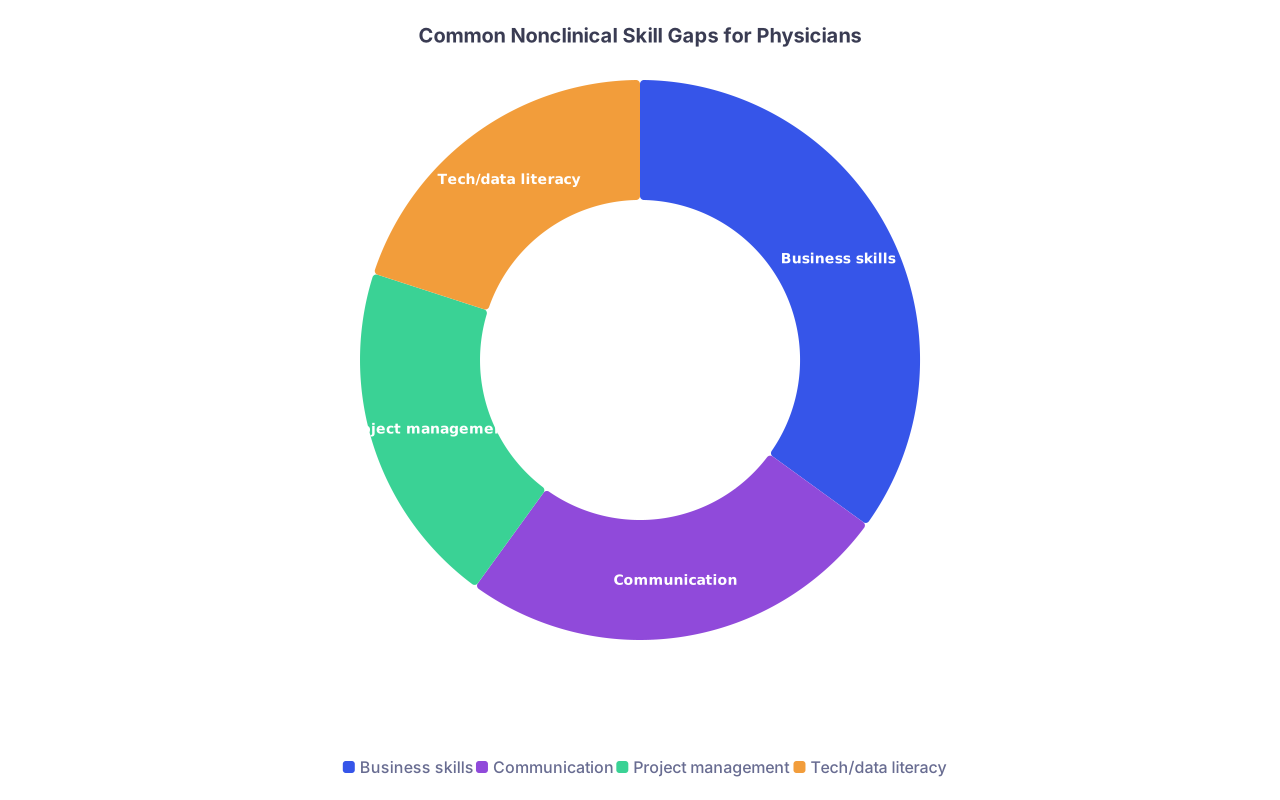
| Category | Value |
|---|---|
| Business skills | 35 |
| Communication | 25 |
| Project management | 20 |
| Tech/data literacy | 20 |
Avoid the arrogance trap:
Do a blunt self-assessment:
- Can you read a basic financial report?
- Can you explain a clinical concept clearly to a smart non-medical person in 2 minutes?
- Can you manage a project with milestones, stakeholders, and deadlines?
Invest in targeted learning:
- Short courses (business fundamentals, product management, health economics)
- Tutorials for tools: Excel, basic analytics, maybe some data visualization
- Toastmasters or presentation coaching if you struggle with public speaking
Take roles that stretch you, not just use you
If a job wants you only as a “face” or “credential checker,” be careful. You want roles that grow your nonclinical muscles, not ones that keep you medically impressive but replaceable.

9. Treating This as Irreversible (When It Isn’t)
One last mistake: acting like leaving clinical practice is a binary, forever decision.
It isn’t always.
But if you assume it is, you:
- Make choices from fear instead of strategy
- Over-identify with being “done with medicine,” and close doors you might want later
- Avoid low-volume clinical roles that could actually give you an ideal hybrid life
Smarter approach:
Think in phases, not absolutes:
- Phase 1 (0–2 years): Hybrid or partial clinical while you test nonclinical
- Phase 2 (2–5 years): Mainly nonclinical, minimal or no clinical work
- Phase 3 (5+ years): Based on what you actually like and what pays
Keep the option—if not the intention—open
Maintain:- One active license
- Some CME
- A small amount of clinical or teaching if you can stand it
That way you’re leaving by choice, not by self-sabotage.
FAQs
1. Is it a mistake to leave clinical medicine before paying off all my student loans?
Not automatically, but leaving without a clear strategy for your debt is. If your loans are large and your likely nonclinical starting salary is lower than your current clinical income, you need to:
- Recalculate payoff timelines and monthly cash flow
- Look at income-driven repayment or refinancing
The mistake is pretending your loan burden disappears just because your burnout is severe.
2. How long should I plan for a transition to a nonclinical role?
For most physicians, a 6–24 month horizon is realistic. Under 3 months usually means you’re:
- Taking something random
- Accepting a poor fit
- Leaving money and options on the table
The safer move is to prepare quietly, build skills, and test options well before you hand in your resignation.
3. Will leaving clinical practice hurt my reputation among other doctors?
With some, yes. Some colleagues will judge you. That’s their issue. The mistake is letting that imagined judgment control your decisions. Protect your reputation by:
- Leaving professionally and calmly
- Avoiding public trashing of your employer
- Staying competent and engaged in whichever work you choose next
4. Do I need another degree (MBA, MPH, etc.) before leaving clinical work?
Usually, no. The common mistake is collecting degrees as a way to delay hard decisions. In many nonclinical paths, you can:
- Start with your MD/DO and clinical background
- Add short, targeted courses or certificates
Additional degrees make sense only if they clearly unlock a specific role or promotion path you already understand.
5. What’s the single most dangerous mistake doctors make when they leave clinical practice?
Quitting reactively, without a financial runway or a tested plan for what comes next. That’s how you go from burned out but employed to burned out, underemployed, and panicking.
If you remember nothing else, remember this:
- Plan your exit like a high-stakes procedure
- Stabilize your finances
- Test your options before you cut the cord
Key takeaways:
- Don’t leave clinical practice as an emotional escape; build a deliberate, tested transition plan with realistic financial assumptions.
- Protect your identity, relationships, and licenses on the way out—this is a pivot, not a disappearance.
- Respect the nonclinical world: learn its language, close your skill gaps, and leave doors open instead of slamming them behind you.