
What happens when a brilliant clinician discovers nobody wants to pay them to “just write what they know”?
That’s the hard slap most doctors feel when they step into medical writing for the first time. You go from being the expert everyone defers to… to having pitches ignored, drafts shredded, and clients ghosting you after one project.
Not because you’re not smart enough. Because you’re walking into a different profession and making the same predictable mistakes almost every physician makes.
Let me walk you through the traps—so you do not waste 12–18 months flailing while less qualified writers pass you.
Mistake #1: Thinking “clinical expertise = instant credibility (and high rates)”
This is the foundational error. If you get this wrong, everything else collapses.
You’ve probably said or thought some version of:
- “I’m an attending; of course they’ll pay me well to write.”
- “There’s so much misinformation online—my MD will stand out immediately.”
- “Content mills are beneath me; I’ll go straight to big-name clients.”
And then:
- Your Upwork proposal gets undercut by a non-clinical writer.
- A pharma agency says, “We went with someone who has more writing samples.”
- A digital health startup gives you a “test article” and never calls back.
Here’s the reality: in the medical writing world, your degree is a filter, not a golden ticket. It gets you past trash-level gigs, but it does not replace:
- Proven writing samples in the exact niche they need
- Ability to hit deadlines without hand-holding
- Understanding of audience (HCP vs patient vs payer vs regulator)
- Command of style and structure (not just “accurate information”)
Do not make the mistake of leading with “I’m a cardiologist” and stopping there. Lead with:
- “I write regulatory summaries for cardiovascular devices”
- “I create patient-friendly heart failure content that passes health literacy checks”
- “I develop CE modules for internists on new lipid guidelines”
Your MD/DO is the bonus line at the bottom, not the entire pitch.
How to avoid this mistake today:
Write a 2–3 line positioning statement that does not start with your degree. Force yourself to lead with what you deliver as a writer.
Mistake #2: Writing like a journal article instead of a human being
This one is brutal. You’ve been trained to write in the exact style that kills most medical content:
- Passive voice: “It has been shown that…”
- Endless hedging: “may be associated with a reduction in…”
- Paragraphs that look like walls of text
- References stacked like a meta-analysis
Fine in NEJM. Deadly in:
- Patient education pieces
- Health tech blogs
- CME modules that need to keep a tired hospitalist awake at 10 p.m.
I’ve seen oncologists submit “blog posts” with:
- No headings
- One 400-word paragraph
- No clear call to action
- A conclusion that just trails off into “further research is needed”
Clients do not want a mini-review article. They want something:
- Structured: clear headings, bullets, short paragraphs
- Skimmable: subheads that tell the story if you only read those
- Direct: active voice, clear statements
- Tuned to the audience: a patient doesn’t need hazard ratios
You’re not “dumbing it down.” You’re removing the academic bloat.

Classic red flags your writing is still too academic:
- You feel physically uncomfortable writing a sentence that doesn’t include “may” or “appears to.”
- You think in PICO format when asked to summarize a study for patients.
- Your “introduction” is four paragraphs of background history.
Fix it:
Take one of your old abstracts. Rewrite it as:
- A 600–800 word article for patients with bullet points and headings, and
- A 600–800 word article for busy PCPs focusing on “what changes on Monday?”
Compare. If they read almost the same? You’re still stuck in academic mode.
Mistake #3: Ignoring that there are different types of medical writing
“Medical writing” is not one thing. And assuming you can “do it all” on day one is a fast way to:
- Look naive to clients
- Take on projects that are way over your head (regulatory especially)
- Miss the better-paying specialties within the field
Broad buckets:
| Type | Typical Audience | Complexity | Entry-Friendly? |
|---|---|---|---|
| Consumer health content | Patients/public | Low-Med | Yes |
| HCP education (CME) | Clinicians | Med-High | Yes, with effort |
| Regulatory writing | Regulators (FDA/EMA) | Very High | No (specialized) |
| Medical communications | Pharma/Med Affairs | High | Possible |
| Marketing copy | HCPs/patients | Medium | Yes, if coached |
If you tell a hiring manager, “I do medical writing” without specifying which kind, you sound like a premed saying “I like science and helping people.”
Common mis-match errors:
- Taking on regulatory writing when you’ve never seen a Clinical Study Report template.
- Pitching a pharma med affairs agency with only wellness blog posts as samples.
- Applying for “medical copywriter” roles with nothing but case reports as proof.
Each subfield has its own:
- Document types
- Style expectations
- Review processes
- Jargon (CSR, IB, PI, AMCP dossier, slide decks, MOA scripts, etc.)
Do this instead:
Pick one or two areas to start. Not five. Go deep enough to speak the language.
Example:
- “Consumer health content” + “HCP-facing clinical explainers”
OR - “CME/CE modules” + “Medical education slide decks”
Trying to be a generalist from day one screams “newbie.”
Mistake #4: Assuming your schedule is “busy” and underestimating deadlines
Clinicians are used to being busy. But clinical busy and writing busy are different animals.
In medicine:
- You’re constantly interrupted, but the work is shared across a team.
- Most things have a buffer (someone picks up if you’re in a code).
- Documentation is often “good enough” and fixable later.
In professional writing:
- Missed deadlines kill trust fast.
- A delay from you can stall design, regulatory, legal review, or launch.
- There is no intern or colleague to “take the patients” while you finish.
I’ve watched physicians accept:
- A 10,000-word CME project
- Due in 2 weeks
- While on a 60-hour call-heavy schedule
They think, “I’ll squeeze it in nights and weekends.”
Reality: sleep-deprived draft, missed deadline, burned bridge.
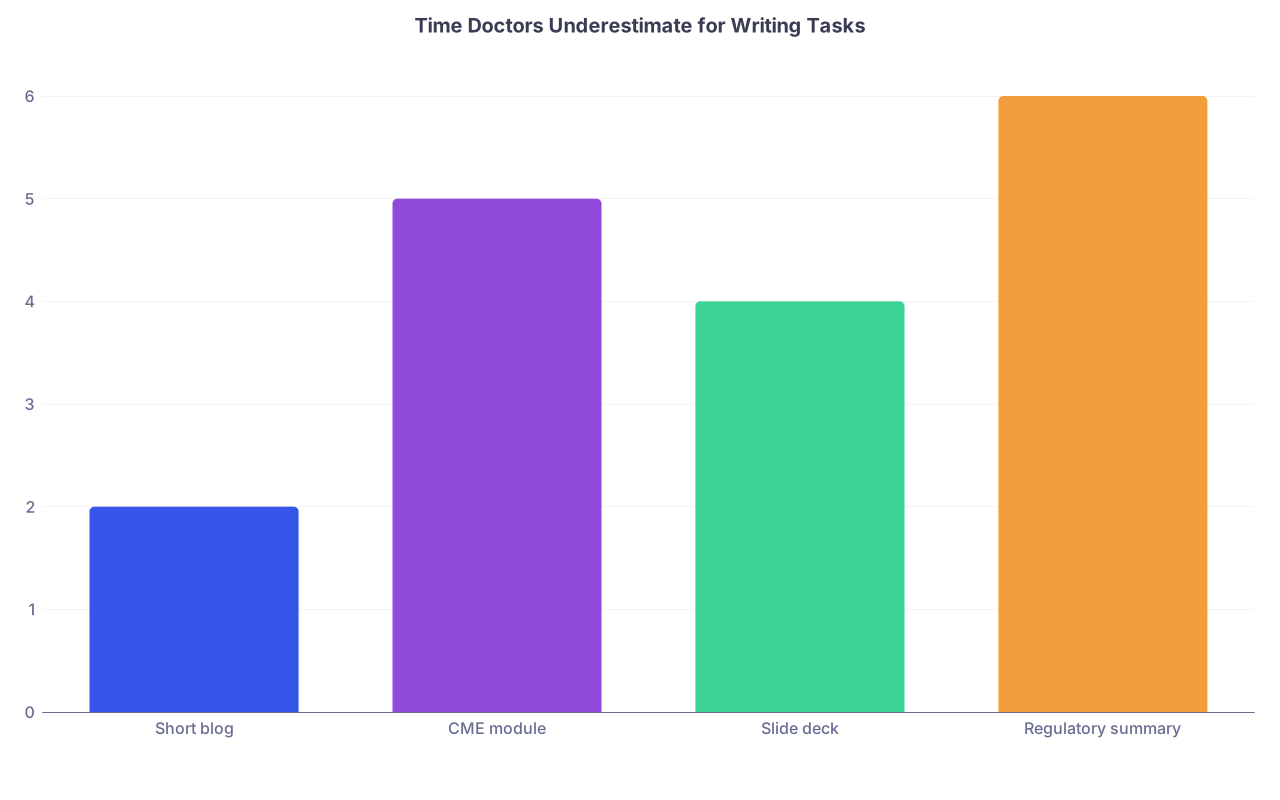
| Category | Value |
|---|---|
| Short blog | 2 |
| CME module | 5 |
| Slide deck | 4 |
| Regulatory summary | 6 |
(Values above = average hours underestimated per task by new physician writers—yes, I’ve literally timed this with people.)
Signals you’re doing this wrong:
- You say “I can probably get that done” instead of giving a clear, realistic date.
- You haven’t actually tracked how long a polished 1,000-word article takes you (hint: not “an hour”).
- You deliver good medical content but the client complains about “project management issues.”
How to not blow this:
- Time yourself honestly on 2–3 different writing tasks. From blank page to final proofread.
- Add 30–50% buffer when quoting timelines, especially early on.
- If you realize you’ll be late, tell the client the moment you know. Not the night before.
Mistake #5: Clinging to your “voice of God” tone instead of learning brand voice
In clinical work, you’re the authority. You decide. Patients adjust to your style.
In medical writing, especially for companies, the brand decides. And nothing screams “new doctor writer” like ignoring a style guide or pushing your personal tone over theirs.
I’ve seen:
- Docs rewrite a brand’s simple, friendly language into something that sounds like an UpToDate chapter.
- Writers “correct” brand terminology because “that’s not how we say it in clinic.”
- Authors fight with editors over word choice as if it’s a peer-review argument.
You’re not the attending on these projects. You’re more like a consultant assigned to attend their rounds and follow their protocols.
Common missing pieces:
- Not reading the content style guide (or pretending it doesn’t matter).
- Ignoring banned words (e.g., “cure,” “safe,” “guarantee” in regulated content).
- Using inconsistent capitalization, abbreviations, and tone.
Simple test:
Take three existing blog posts or materials from a client you want. Study:
- Sentence length and complexity
- Use of second person (“you”) vs third person
- How much they explain vs assume
- Whether they sound formal, conversational, or playful
Then write your sample in that exact tone. Not your “academic best self.”
Mistake #6: Underpricing—or worse, price swinging wildly—because you’re scared
Doctors moving into medical writing tend to do one of two dumb things:
- Charge peanuts because “I’m new to writing,” or
- Charge executive consulting rates because “I’m a specialist.”
Both backfire.
Underpricing:
- Attracts bad clients who abuse scope and nitpick everything.
- Makes good clients suspicious (“Why is this cardiologist cheaper than a generalist writer?”).
- Burns you out when you realize you’re making half your resident hourly rate.
Overpricing without proof:
- Gets you quietly rejected.
- Gets you labeled as “arrogant MD who doesn’t understand the market.”
- Makes it hard to negotiate later.
You don’t need to be perfect, but you do need to be coherent.
| Work Type | Early Reasonable Range (USD) |
|---|---|
| Consumer blog (per word) | $0.30 – $0.60 |
| HCP article (per word) | $0.40 – $1.00 |
| Slide deck (per slide) | $75 – $200 |
| CME module (fixed fee) | $1,500 – $5,000 |
| Regulatory doc (per hour) | $80 – $200 |
Are there exceptions? Of course. But if you’re at $0.05/word “to build experience” or demanding $2/word with no portfolio, you’re sabotaging yourself.
Better approach:
- Start mid-range for your market and experience.
- Raise slowly as your speed, quality, and client list improve.
- Keep a private record of: hours per project, total fee, and effective hourly rate.
If you’re consistently falling below what you’d accept per hour, you adjust the scope or the price—not your sleep.
Mistake #7: Treating feedback like an attack instead of a normal part of the process
You’re used to being evaluated on being “right.”
In medicine, if someone questions your management, it can feel personal.
In writing, revision isn’t an insult. It’s the job.
The mistake doctors make is reading every tracked change as:
- “They think I’m incompetent.”
- “They don’t value my expertise.”
- “This client is unreasonable.”
I’ve watched physician writers:
- Argue point-by-point with a copyeditor over commas and semicolons.
- Refuse to tone down language after legal/regulatory review.
- Ghost a client because “they changed everything I wrote.”
You will be edited. Sometimes heavily. Sometimes badly. There’s a skill in deciding when to push back and when to say “Got it” and move on.
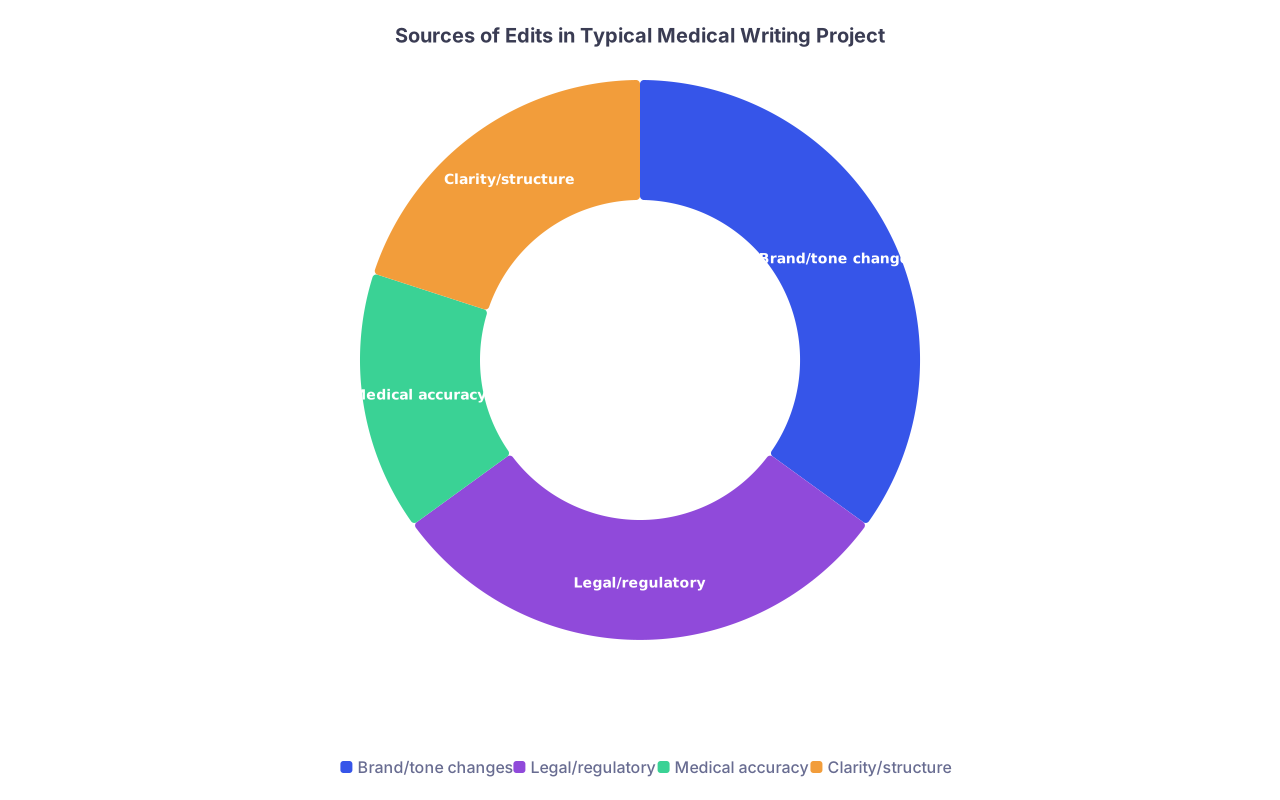
| Category | Value |
|---|---|
| Brand/tone changes | 35 |
| Legal/regulatory | 30 |
| Medical accuracy | 15 |
| Clarity/structure | 20 |
Most edits are not about your medical knowledge. They’re about:
- Brand consistency
- Legal risk
- Word count constraints
- Internal politics
How to avoid the “defensive doctor” trap:
- On your first few projects, ask for feedback patterns: “Anything I can adjust to make future drafts closer to what you want?”
- Separate factual disputes (worth pushing back) from style preferences (often not worth it).
- If you disagree, offer options: “Medically, I would phrase it this way; if that’s too strong for legal, here’s a softer version we could use.”
Mistake #8: Trying to build a writing career in stealth mode
Too many doctors play it like this:
- Secretly take one small gig.
- Do nothing else for 6 months.
- Complain “there’s no work” or “I guess I’m not cut out for this.”
They’re waiting for a magical full-time medical writing job to appear that:
- Pays well
- Is remote
- Respects their clinical experience
- Trains them from scratch
These exist. They’re just not handed to people with no visible track record.
You don’t need fancy branding. But you do need:
- A basic portfolio (even self-initiated pieces).
- Some public proof you can write for a real audience.
- Visible engagement in the writing world, not just medicine.

| Step | Description |
|---|---|
| Step 1 | Clinician |
| Step 2 | Learn basics of med writing |
| Step 3 | Create 3 to 5 niche samples |
| Step 4 | Do 2 to 3 small paid projects |
| Step 5 | Refine niche and raise rates |
| Step 6 | Targeted applications to better clients |
If you skip straight from A to F, you’ll get “thanks but no thanks” on repeat.
Stop hiding. Start small but public:
- Write 3–5 solid sample pieces in your desired niche.
- Put them on a minimalist site, Medium, or LinkedIn articles.
- When you reach out to clients, link to those, not your case reports.
Mistake #9: Forgetting about compliance, conflicts, and boundaries
Here’s a uniquely physician trap: you know way more about drugs, devices, and patients than most writers. That’s good… until it isn’t.
Ways this blows up:
- Using real patient details (even “de-identified”) in stories for public content.
- Mixing your clinical role with sponsored content in a way that looks like endorsement.
- Violating your institution’s policies by moonlighting in industry without disclosure.
- Posting clinical anecdotes on social media to “build an audience” that your hospital finds out about.
You’re not just any freelancer. You’re a licensed professional with:
- HIPAA obligations
- Institutional policies
- Potential conflict-of-interest issues
You’d be surprised how fast a “harmless example” can become a complaint.
Minimum defenses:
- Strip patient stories of anything remotely traceable (and usually, just fictionalize).
- Clarify employment policies about outside work and industry relationships.
- Keep a clean separation between clinical documentation and any writing samples.
If you’d feel queasy seeing your piece screen-shared at M&M with your name on it, fix it now.
Mistake #10: Assuming this is a linear, “apply → get job” process like residency
Residency spoiled you. It’s chaotic, but it’s structured chaos.
- You apply once a year.
- There are clear timelines.
- There’s a formal matching mechanism.
Medical writing is the opposite. It’s messy:
- You might do 5–10 tiny projects before one solid recurring client shows up.
- A single contact at an agency can change your year.
- Jobs get filled from networks before they’re posted.
If you treat it like ERAS—apply to 30 jobs, wait, get sad, repeat—you’ll quit early, convinced “there’s no path.”
The more realistic version looks like this:
- 3–5 cold emails or LinkedIn messages per week to targeted companies.
- 1–2 small projects per month at the beginning.
- Quality improving every project; portfolio getting tighter.
- After 6–12 months, a few core clients and clearer direction.

The mistake is thinking: “If it doesn’t click in 3 months, it’s not for me.”
Reality: you’re building an entirely new career capital stack.
The meta-mistake: Treating medical writing as a backup, not a profession
If you walk into this like:
- “I’ll do a bit of writing until I figure out my real plan.”
- “This is just easy side money.”
- “It can’t be as demanding as clinical work.”
You’ll telegraph that attitude in every interaction. Clients can smell it.
The writers who succeed—especially physicians—are the ones who respect that:
- Writing is a craft.
- Strategy (audience, purpose, outcomes) matters as much as fact-checking.
- Communication skills, not just content knowledge, are billable.
You’re not “dropping down” from doctor to writer. You’re changing arenas. If you insist on standing at the door saying “But I was an attending,” nobody’s impressed.
When you come in saying, “I’m a physician who has deliberately trained and retooled to write high-impact, accurate content for [specific audience],” that’s different.
Your next step today
Do this right now. No overthinking.
- Open a blank document.
- Write three headings:
- “My niche”
- “My 3 starter samples”
- “My no-go boundaries”
- Under “My niche,” commit to one or two areas of medical writing you’ll focus on for the next 6 months.
- Under “My 3 starter samples,” list three concrete article or project ideas you’ll complete—before you pitch anyone else.
- Under “My no-go boundaries,” write down what you will not do: underprice, miss deadlines, share patient details, or take projects you’re unqualified for.
Then schedule 60 minutes this week to draft the first sample.
If you skip this and just “look at job boards” again, you’re already repeating the same mistakes every other doctor makes in this transition. Don’t be that person.