
The biggest mistake residents make when “branding” themselves for consulting is pretending consulting is impressed by generic doctors. It is not.
Consulting firms are drowning in smart, overachieving, medically trained applicants. Your white coat is not a brand. Your MD is not a brand. Your residency badge is not a brand. They are table stakes. If you build your consulting story on those alone, you will get ignored.
This is the part where people usually say, “But I’m a physician, that must count for something.” It does. It counts as: interesting background, now prove you think like a consultant. Let me walk you through where residents sabotage themselves and how to stop doing that.
1. Calling Yourself a “Healthcare Strategy Expert” When You Are Not
This is the most common — and most damaging — branding error: overinflated titles and buzzword soup.
You were a PGY-2 on nights. You were not a “Healthcare Strategy Leader driving cross-functional transformation.” Consultants know the difference. They read thousands of CVs a year. Over-claim once and they will not trust anything else you say.
Typical offenders I see on resident LinkedIns and CVs:
- “Healthcare strategy expert”
- “Operational excellence leader”
- “Digital health innovator”
- “Data-driven transformation specialist”
Then I read the bullets and see:
- “Created sign-out template for night float team”
- “Led QI project to reduce CLABSI rates”
- “Participated in EMR optimization committee”
Those are fine. Useful, even. But they are not what your headline says. That disconnect kills you.
How to avoid this:
Brand yourself based on what you have actually done that maps cleanly to consulting skills:
- Problem structuring
- Data analysis
- Stakeholder management
- Change implementation
Not based on what sounds good on LinkedIn.
Bad: “Healthcare strategy leader optimizing patient outcomes at scale.”
Better: “Internal medicine resident with experience leading data-driven quality improvement and cross-disciplinary clinical projects.”
Then, in bullets, show concrete outcomes:
- “Led a multidisciplinary QI project that reduced 30-day readmissions for HF patients by 18% over 9 months using root-cause analysis and PDSA cycles.”
- “Analyzed 2 years of ED throughput data to identify process bottlenecks, informing a change that cut median door-to-disposition time by 22 minutes.”
Those read like consulting work. They signal: I know how to define a problem, get data, act on it.
If you are tempted to exaggerate your role or impact, stop. Consulting partners have an excellent radar for “inflation.” It is a fast track to a silent rejection.
2. Leaning on “Clinical Excellence” as Your Entire Pitch
Your chairman’s letter about how you are “one of the best residents in the last ten years” means almost nothing to McKinsey, BCG, or Bain. Harsh, but true.
Clinical excellence is expected. Every physician who applies believes they are a strong clinician. The firms assume baseline competence. What they do not assume is that you:
- Think in hypotheses instead of just differential diagnoses.
- Care about cost, operations, and workflow, not only clinical outcomes.
- Can structure ambiguous business problems, not just clinical ones.
The error: 80% of your branding is about your clinical skill, research output, and patient satisfaction scores.
I see CVs with sections like:
- “Exceptional clinical performance”
- “Top percentile in In-Training Examination”
- “High Press Ganey scores”
Good for residency promotion. Weak for consulting.
How to avoid this:
Translate your clinical achievements into business-relevant outcomes and skills. Use a mental converter: “Why would a hospital CEO or payer care?”
Instead of:
- “Managed high-acuity patients efficiently in the MICU.”
Use:
- “Coordinated care for 8–12 high-acuity MICU patients per shift, integrating input from 5+ disciplines, prioritizing limited resources, and making time-sensitive decisions under uncertainty.”
Instead of:
- “Ranked in top 10% on in-training exam.”
Use:
- “Consistently ranked in top 10% on national in-training exams, reflecting rapid synthesis of large information sets and application to novel scenarios under time pressure.”
You are still telling the truth. You are just telling it in a language that sounds like consulting, not residency brag sheet.
3. Presenting a Sloppy, CV-Like LinkedIn Profile
Another big mistake: residents treat LinkedIn as an afterthought or a PDF CV copy-paste. Consulting recruiters do not.
McKinsey and others absolutely check your LinkedIn. When they see:
- A blank About section
- No headline tailored to consulting
- “Doctor at Hospital” as your description
- A random selfie as your photo
- No projects, no outcomes, no structure
…they assume you are not serious about this pivot.
Here is a rough breakdown of how residents present themselves when they think they are “on LinkedIn” versus when they are actually competitive:
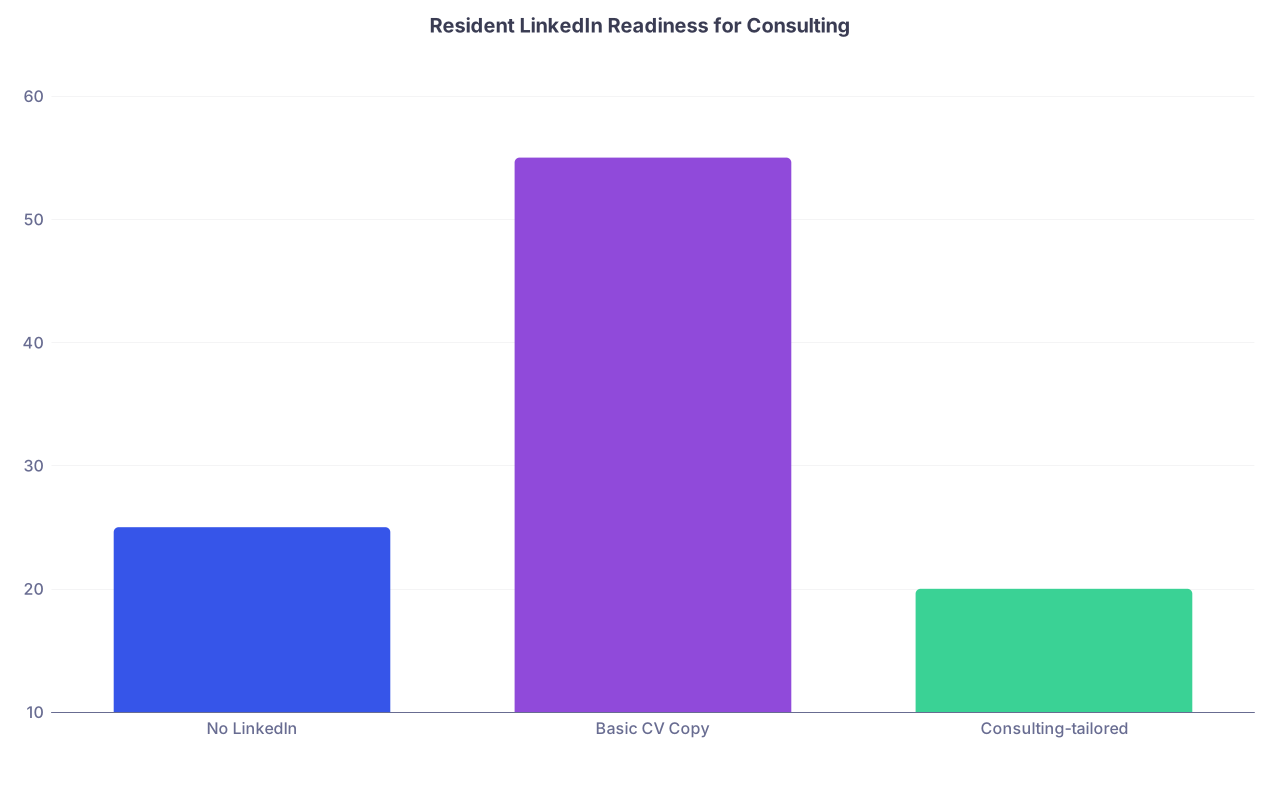
| Category | Value |
|---|---|
| No LinkedIn | 25 |
| Basic CV Copy | 55 |
| Consulting-tailored | 20 |
You want to be in that last group.
How to avoid this:
Treat your LinkedIn like a one-page marketing site for your consulting candidacy.
Minimum standard:
Professional, neutral headshot. No white coat in front of an OR door with stethoscope drama. Just clean and simple.
Headline that combines your current role with consulting-relevant positioning:
“Internal medicine resident | Data-driven quality improvement | Interested in healthcare strategy and operations”
About section (3–6 short paragraphs) that covers:
- Who you are (resident, specialty, institution)
- The consulting skills you have actually demonstrated
- 2–3 specific examples of impact (metrics included)
- Your explicit interest in consulting (healthcare focus is fine)
Experience section that:
- Breaks residency into roles/projects, not just “Resident 2021–2024”
- Uses bullets focused on outcomes, not duties
If your LinkedIn looks like a med student trying to impress a PD, you are telegraphing the wrong thing to consulting.
4. Filling Your Story with Jargon Residents Love and Consultants Hate
Residents live in a world of acronyms and clinical shorthand. When they carry that directly into consulting branding, it backfires.
You know who does not care about your mastery of:
- CLABSI
- CAUTI
- LOS
- RVUs
- PECARN
- MELD
Consulting partners who are not in healthcare, for one. And even the healthcare ones care far more about financial and operational implications than your comfort with alphabet soup.
A bad mistake: describing everything in residency language and assuming it transfers.
Example from an actual resident cover letter (lightly anonymized):
“I led a multidisciplinary QI initiative to reduce CAUTI rates in our SICU by implementing new bundle elements, updating nursing documentation, and conducting weekly huddles.”
To a consulting screener, that might as well say: “I fixed a clinical quality metric with some process changes.” They have to translate. Most will not bother.
How to avoid this:
Translate jargon into outcomes and business language.
- “CAUTI rates” → “device-associated infection rates, with implications for patient safety, length of stay, and financial penalties”
- “QI initiative” → “structured improvement project with defined baseline, targets, and tracked results”
- “Bundle elements” → “standardized care processes”
Rewritten:
“Led a structured improvement project to reduce ICU catheter-associated infections by 35% in 6 months, through standardizing care processes, updating documentation workflows, and running weekly front-line feedback huddles. Reduced average length of stay for affected patients by 0.8 days and avoided projected financial penalties under value-based purchasing.”
That is something a consultant can use in a client pitch deck. That is what you want.
5. Branding Yourself as “Willing to Do Anything” Instead of Focused
Another resident trap: desperate generalism.
The profile or cover letter that says:
- “Open to management consulting, pharma, startups, hospital administration, anything in healthcare.”
- “Passionate about improving healthcare in any capacity.”
It reads as unfocused and frankly, a bit lost. Consulting firms are not career counselors. They do not want to guess what to do with you.
You may think you are being flexible. You are actually making yourself unmemorable.
How to avoid this:
Pick a clear primary story, even if you would accept related roles.
Examples:
- “I am an IM resident with a strong interest in healthcare operations and payer-provider strategy.”
- “I am an EM resident focused on emergency care access, digital triage tools, and system throughput.”
- “I am a surgical resident interested in OR efficiency, value-based care, and service line strategy.”
You are not signing a 10-year commitment in your LinkedIn headline. You are just giving recruiters a mental box to put you in.
Then your projects and bullets should all reinforce that focus:
- Throughput, operations, and cost if you say “operations”
- Product, data, and digital tools if you say “digital health”
- Network, value-based care, and contracts if you say “payer-provider”
Scattershot branding screams: “I just want out of residency, someone hire me.” Firms sense that a mile away.
6. Ignoring Quantifiable Impact and Talking Only in Activities
Consulting is obsessed with measurable impact. Residents are trained to report activities and roles.
So they write:
- “Participated in hospital readmission committee.”
- “Developed a new triage protocol.”
- “Led weekly teaching sessions for interns.”
That tells me nothing about whether you made anything better. Committees can be giant time sinks. Protocols can be ignored. Teaching can be boring.
The error: not forcing yourself to quantify what changed because of you.
You do not need perfect randomized trial-level numbers. You need directional, honest, defensible metrics.
How to avoid this:
For every bullet, force three questions:
- What baseline problem existed (how big)?
- What did I actually do (my role, not the group’s existence)?
- What changed (numbers, percentages, time, cost, satisfaction)?
Then compress into one or two sharp bullets.
Weak:
- “Member of QI committee improving sepsis order sets.”
Stronger:
- “Co-led a QI project to streamline sepsis order sets, reducing median antibiotic time-to-administration by 28 minutes across 3 medical units and increasing protocol adherence from 63% to 87% over 4 months.”
Another example:
Weak:
- “Improved resident workflow on night float.”
Stronger:
- “Redesigned night float workflow and sign-out structure for a 24-resident program, reducing average cross-coverage pages per shift by 18% and self-reported burnout scores on internal survey by 0.7 points (scale 1–5).”
Consultants live and breathe numbers. You need some in your story.
7. Underestimating How Late You Are Starting
Residents often “get interested in consulting” 6–9 months before they want to jump. They underestimate how early serious candidates start shaping their brand.
Here is what I see across residents who actually land consulting roles versus those who never get traction:
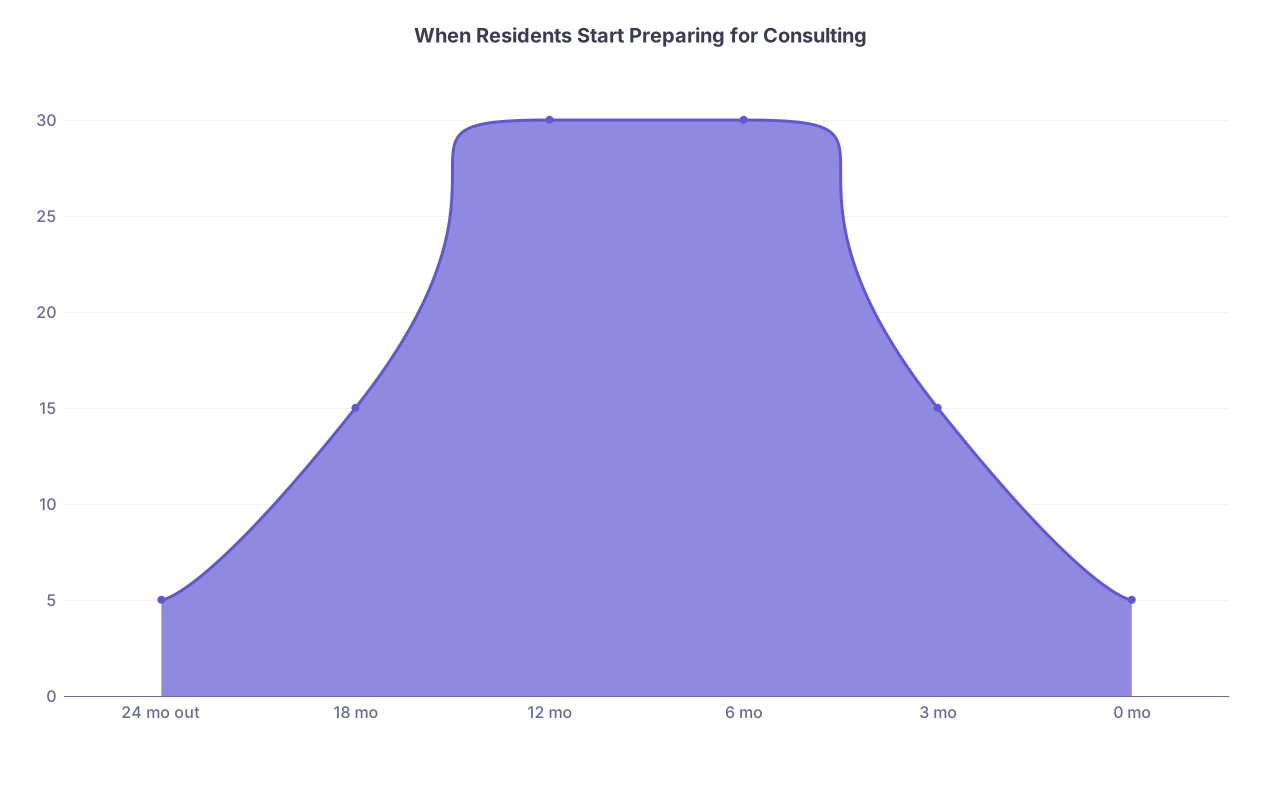
| Category | Value |
|---|---|
| 24 mo out | 5 |
| 18 mo | 15 |
| 12 mo | 30 |
| 6 mo | 30 |
| 3 mo | 15 |
| 0 mo | 5 |
Most who succeed start thinking about their brand a year or more ahead. They pick projects and roles that create a consulting-friendly narrative instead of just accepting whatever falls on the call schedule.
The mistake is assuming you can slap a consulting label on your CV at the end and be done. You cannot. Partners can smell last-minute pivots.
How to avoid this:
If you are 12–24 months out and even thinking about consulting:
- Volunteer for QI projects with clear, system-level impact.
- Get involved with committees that touch operations, cost, or throughput, not just “education” and “morale.”
- Ask to own a data analysis piece for any initiative rather than just being a warm body in meetings.
A simple timeline helps keep you from kidding yourself.
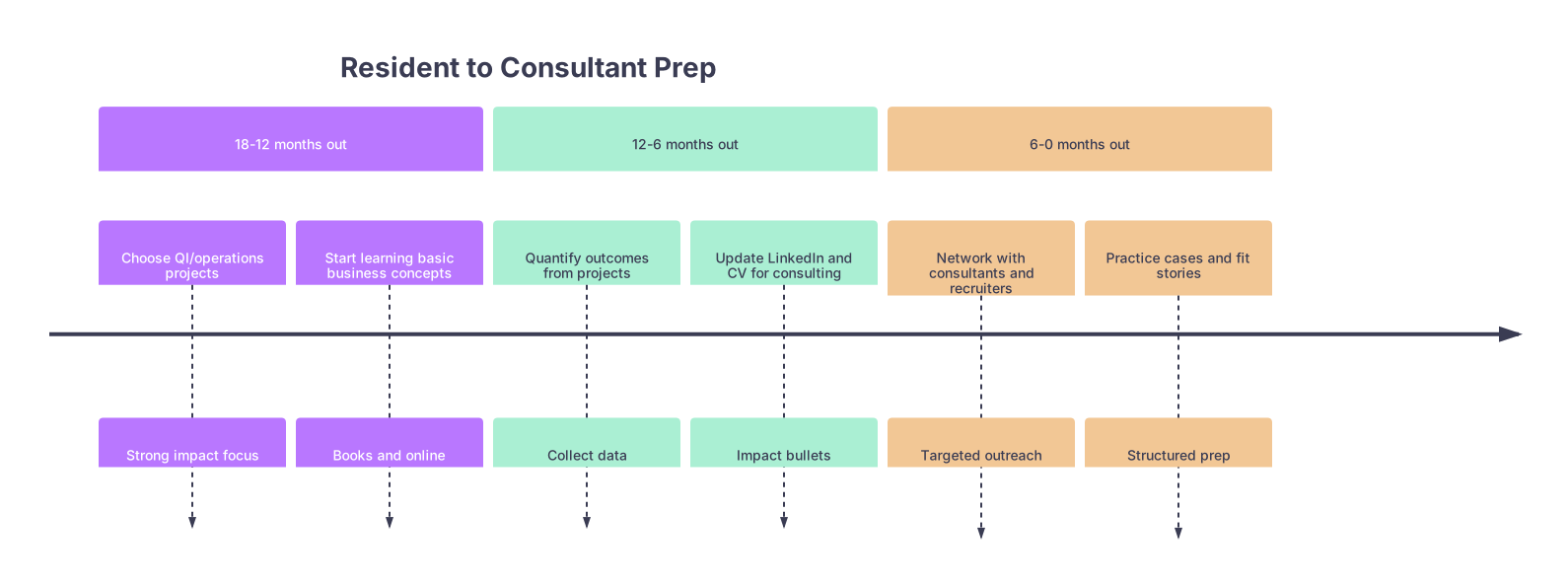
| Period | Event |
|---|---|
| 18-12 months out - Choose QI/operations projects | Strong impact focus |
| 18-12 months out - Start learning basic business concepts | Books and online |
| 12-6 months out - Quantify outcomes from projects | Collect data |
| 12-6 months out - Update LinkedIn and CV for consulting | Impact bullets |
| 6-0 months out - Network with consultants and recruiters | Targeted outreach |
| 6-0 months out - Practice cases and fit stories | Structured prep |
If you are 3 months from graduation and just now thinking about this, fine. But be realistic: your “brand” is mostly fixed. You can polish, not reinvent.
8. Sending Mixed Signals: “I Love Clinical Medicine… But Hire Me to Leave It”
Another branding disaster: trying to convince everyone you want a full-time clinical career and also desperately want to leave for consulting. You cannot run both stories at full volume.
I see:
- Personal statements for fellowship talking about “lifelong commitment to patient care.”
- LinkedIn About sections talking about “transitioning my skills to the consulting space.”
- Twitter full of #medtwitter rants about call schedules and generational burnout.
Consulting recruiters see this mess and think: risk. Someone who might bounce right back to fellowship. Or someone whose story falls apart in a fit interview.
How to avoid this:
You need a coherent narrative that does not contradict itself.
Acceptable versions:
- “I value clinical medicine, but I am most energized by system-level work and see my long-term career primarily in healthcare consulting and strategy.”
- “After deep exposure to ward-level care, I want to move upstream to work on problems of access, cost, and delivery at scale.”
If you are still applying to fellowship and consulting, do not advertise that everywhere. Choose which path each audience sees.
This is not about lying. It is about not broadcasting mutually conflicting priorities and then hoping interviewers will not notice.
9. Neglecting How You Come Across in Actual Conversations
Branding is not only written. You can have a well-manicured LinkedIn and CV and then torpedo your whole brand in a 20‑minute coffee chat with a consultant.
Common resident missteps when they finally talk to someone in the field:
- Spending 15 minutes on their med school and Step scores.
- Oversharing about burnout and toxicity in training (yes, it is real; no, this is not therapy).
- Asking ultra-vague questions like “So, what is consulting like?” or “How do I break in?”
You think you are building rapport. They see red flags: lack of business curiosity, unclear motivation, emotional volatility.
How to avoid this:
Treat every interaction as brand reinforcement:
Introduce yourself in 1–2 sentences that mirror your written brand:
“I am a PGY-3 in pediatrics at X, and over the last year I have led several QI and data projects focused on ED throughput and access. I am exploring healthcare consulting because I want to work on those system-level problems full-time.”
Have 2–3 specific examples ready that align with consulting-style work.
Ask targeted questions:
- “How does your firm measure success for associates coming from clinical backgrounds?”
- “Which types of healthcare projects value physician experience most?”
- “What skills did you have to build fastest coming from residency?”
And do not unload all your frustrations with medicine. You can be honest, but if your story is 80% escape narrative and 20% curiosity about the work, you hurt your brand.
10. Forgetting That Physicians Are a Tiny, Not Special, Niche
Final and subtle mistake: assuming that being a doctor automatically makes you special in consulting.
Here is the reality: To consulting firms, you are one flavor of “advanced degree hire,” competing with PhDs, MBAs, and experienced industry folks.
| Background | Default Assumption | Risk Perception |
|---|---|---|
| MD/DO | Smart, clinical, may lack business context | May miss Excel/PowerPoint rigor |
| PhD | Analytical, data-oriented | May struggle with pace / client presence |
| MBA | Business fluent, polished | May be light on hard analysis |
| Industry | Practical, execution-focused | May resist consulting lifestyle |
You are not automatically above these groups. You are just different.
So when residents brand themselves as if the MD alone is the product — “Doctor transitioning to consulting” and nothing more — they are missing the point.
How to avoid this:
Brand yourself on the intersection:
- Physician + clear analytical and project skills
- Physician + operations/strategy comprehension
- Physician + evidence you actually understand what consulting does
Examples of stronger brand statements:
“Internal medicine resident with 3+ system-level QI projects completed, focused on throughput and cost, now pursuing healthcare consulting roles.”
“Emergency medicine resident with experience analyzing ED capacity constraints and piloting digital triage tools; interested in strategy and operations work at the intersection of care delivery and technology.”
You are not selling “doctor.” You are selling “consultant who happens to speak fluent clinical.”
Key Takeaways
- Do not inflate your title or hide behind clinical excellence. Translate your real projects into consulting language with quantifiable impact.
- Stop being vague, scattered, and last-minute. Build a focused, consistent story across your CV, LinkedIn, and conversations that points toward specific types of consulting work.
- Remember: your MD opens the door; your structured thinking, data-driven impact, and coherent narrative are what get you hired.