
The myth of the “non-clinical resume” is killing your career pivot.
Everyone trying to leave clinical medicine thinks they need a “non-clinical resume.” That phrase alone tells me why recruiters are skipping you. It screams: “I still see myself as clinical, and I’m not speaking your language.”
Let me be blunt: recruiters are not ignoring you because you’re a doctor, nurse, PA, or pharmacist. They’re ignoring you because your resume looks like it was written for a hospital credentialing committee, not for a business hiring manager.
You’re not being rejected. You’re being filtered out before a human ever sees you.
Let’s fix the mistakes that make your resume invisible in alternative medical careers like:
- Medical affairs
- Health tech / digital health
- Pharma / biotech
- Consulting
- Utilization management
- Population health / quality
- Clinical informatics
- Insurance / payer roles
If you do not address these, it won’t matter how “qualified” you are. You’ll keep sending applications into a black hole.
1. You’re building a “non-clinical” resume around the wrong audience
The first major mistake: you’re still writing for physicians, department chairs, and credentialing staff — not for recruiters and hiring managers in business, tech, or pharma.
Recruiters skim. They do not carefully read. They’re looking for pattern matches and keywords that align with the job description.
Here’s what I see constantly on “non-clinical” resumes from clinicians:
- 80%+ of the content is:
- “Managed 18–20 patients per day”
- “Performed X procedures”
- “Precepted residents”
- “Led M&M conferences”
- Section headers like:
- “Clinical Experience”
- “Hospital Appointments”
- “Licensure and Board Certification” front and center
- A full page of publications and posters… for roles that never asked for them
To you, this feels like: “Look how accomplished I am.”
To recruiters, it reads: “I’m still in my clinical identity and haven’t translated anything.”
What to do instead
Stop thinking “non-clinical resume.” Think “role-specific resume.”
If you’re applying to:
- Medical Affairs → Your resume must scream: cross-functional collaboration, scientific communication, KOL engagement, evidence synthesis.
- Health Tech Product → Your resume must highlight: requirements gathering, user feedback, workflow design, iteration, cross-functional teams.
- Utilization Management → Your resume must show: guideline-based review, documentation quality, payer interaction, cost-conscious decision-making.
The audience is not “non-clinical.”
The audience is: “Someone hiring for a specific business problem.”
If your resume does not immediately answer: “How does this person solve my business problem?” you lose.
2. Your clinical work is described as tasks, not business value
This is the classic “I worked hard, why doesn’t anyone care?” trap.
Most clinicians write bullet points like:
- “Saw 20–25 patients per day in busy outpatient clinic”
- “Performed colonoscopies and EGDs”
- “Supervised residents and medical students”
- “Participated in quality improvement initiatives”
Recruiters don’t care about your tasks. They care about outcomes and transferable skills.
Here’s the translation mistake:
- You: “I saw 25 patients per day.”
- Recruiter: “So what? What did that do for revenue, throughput, patient access, quality?”
You’re describing activity, not impact.
How to fix this (without making things up)
Turn everything into: action + business or measurable impact.
Bad clinical bullet:
- “Managed complex ICU patients including ventilator management.”
Better for non-clinical roles (e.g., utilization management, quality, medical affairs):
- “Led multidisciplinary management of high-acuity ICU patients, applying evidence-based protocols to reduce length of stay and complications.”
Even better if you have numbers:
- “Implemented standardized sepsis pathway in ICU, contributing to 15% reduction in average length of stay and improved adherence to evidence-based bundles.”
You’re still doing medicine. But now you’re signaling:
- Process improvement
- Guideline adherence
- Data awareness
- Systems thinking
That’s what non-clinical recruiters recognize.
3. Your resume screams “I don’t understand this industry”
This is the resume version of showing up to interview for a tech job wearing OR scrubs.
I see it constantly with alternative medical careers:
- Applying to health tech with:
- Zero mention of:
- “workflows”
- “stakeholders”
- “requirements”
- “user experience”
- “EMR integration”
- Zero mention of:
- Applying to pharma medical affairs with:
- No:
- Regulatory language
- Mention of “cross-functional”
- Real evidence of scientific communication to external stakeholders
- No:
- Applying to utilization management with:
- Resume full of:
- Procedures
- Call coverage
- Case volumes
- And nothing about:
- “medical necessity”
- “documentation quality”
- “payer policies”
- Resume full of:
Recruiters read that and think: “They’re still a clinician trying to escape, not someone who understands our world.”
Translate your clinical reality into non-clinical language
You probably have done relevant work. You just named it wrong.
Examples:
You say: “Participated in EMR implementation”
- Translate to:
- “Provided frontline clinical input during EMR implementation, identifying workflow bottlenecks and collaborating with IT to optimize order sets and documentation templates.”
- Translate to:
You say: “Worked with case management and social work”
- Translate to:
- “Collaborated with case management and social work to coordinate safe, cost-effective discharges and reduce readmission risk.”
- Translate to:
You say: “Gave lectures to residents”
- Translate to:
- “Developed and delivered targeted educational sessions to multidisciplinary learners, simplifying complex topics and aligning with current evidence and guidelines.”
- Translate to:
You’re still being honest. You’re just speaking the language of the industry you’re trying to enter.
4. You’re ignoring keywords and ATS filters (and getting auto-rejected)
I’ve watched people send 100+ applications and get 1–2 interviews. When I review their resume, I can see why. The content is fine. The language is not.
Many companies use ATS (Applicant Tracking Systems) that filter resumes based on keyword matching with the job description.
If the JD says:
- “Medical review of claims”
- “Collaborate with cross-functional teams”
- “Utilization management policies”
- “Prior authorization criteria”
…and your resume says:
- “Reviewed charts”
- “Worked with multidisciplinary team”
- “Followed hospital protocols”
- “Managed approvals”
The system does not see a match.
You get filtered out before a recruiter ever reads your experience.
Minimal-effort way to fix this
No, you don’t need to “keyword stuff.” But you do need to speak their dialect.
- Take the job description.
- Highlight:
- Key responsibilities
- Repeated phrases
- Required skills and competencies
- Without lying, mirror that language in:
- Your summary
- Your skills section
- Relevant bullets under each job
Example for utilization management / payer roles:
If the JD mentions:
- “medical necessity review”
- “prior authorization determinations”
- “evidence-based guidelines”
- “documentation quality”
Your clinical bullets could become:
- “Performed peer-to-peer discussions with payers to justify medical necessity for high-cost imaging and procedures using evidence-based guidelines.”
- “Improved documentation quality in hospitalist group by standardizing language to better align with payer requirements and medical necessity criteria.”
You were doing these things. You just weren’t calling them what the industry calls them.
5. Your resume structure looks academic or CV-like, not business-ready
This one gets more clinicians than you’d think.
You send what you call a “resume,” but it’s actually:
- A 6–10 page academic CV
- With:
- Every poster from 2012
- Every committee
- Every local talk
- Full citation list
Recruiters won’t read it. Half of them won’t even open something over 3 pages.
Common structural red flags:
- Personal info at the top: full address, multiple phone numbers, credentials list that takes three lines
- Objective statement like: “I am seeking a non-clinical role that will allow me to use my skills…”
(vague, self-focused, useless) - Education before experience if you’re more than 3–5 years out of training
- Massive “Publications” section for roles that don’t ask for it
Structure your resume like a business professional, not a physician
For most alternative medical careers, aim for:
- Length:
- 1–2 pages (1 if <10 years experience, 2 if >10 or very complex transitions)
- Order:
- Name + contact + credentials (very clean, 1 line if possible)
- Professional summary (3–5 lines, tightly focused on target role)
- Core skills / competencies section (keyword-rich, aligned to target industry)
- Professional experience (with business-focused bullets)
- Education & certifications
- Optional: selected projects, selected publications (only if relevant)
What NOT to lead with if you’re pivoting:
- “Board Certification, Licensure, NPI, DEA” as your main intro
- A laundry list of clinical procedures and call schedules
You’re selling yourself for a different market now. Your resume has to look like you know that.
6. You’re hiding the few non-clinical things you’ve actually done
This one almost makes me yell.
I’ll look at someone’s resume and think, “No non-clinical experience at all.” Then I talk to them and find out:
- They helped implement a new EMR module
- They piloted a telehealth program
- They built a new clinic workflow
- They chaired a QI committee
- They helped a startup with clinical content once
None of that is clear on the resume. It’s buried in vague bullets or stuck under “Other.”
Recruiters are not detectives. They won’t dig.
Pull your non-clinical-leaning work to the surface
If you did anything like:
- EMR configuration
- Pathway development
- Policy writing
- Committee leadership
- Data / quality dashboards
- Clinical content for apps or websites
- Presentations to non-clinical stakeholders
- Collaboration with pharma / device reps beyond lunch talk
That’s gold. Do not hide it.
You can:
- Create a short “Selected Non-Clinical Projects” section
- Or reframe your job bullets so those aspects are front and center, not afterthoughts
Example:
Instead of:
- “Hospitalist, XYZ Medical Center
- Managed 15–20 patients daily
- Participated in sepsis QI initiative
- Supervised residents”
Try:
- “Hospitalist, XYZ Medical Center
- Led clinical input for design and rollout of sepsis QI protocol, collaborating with nursing, IT, and administration to standardize workflows and EMR order sets.
- Used real-time data dashboards to monitor adherence and outcomes, contributing to measurable improvements in time-to-antibiotics and mortality.
- Managed 15–20 complex inpatients daily and supervised residents in evidence-based decision-making and documentation.”
Same job. Completely different signal to a non-clinical recruiter.
7. Your summary is vague, needy, or centered on escaping clinical work
Your first few lines are prime real estate. And I routinely see:
- “Physician looking to transition out of clinical medicine into a non-clinical role.”
- “Burned out nurse seeking opportunities outside bedside care.”
- “Experienced clinician open to any non-clinical positions.”
You might as well write: “I don’t know what I’m doing; please rescue me.”
Recruiters are not in the business of career counseling strangers. Their job is to fill a specific role quickly, with someone who looks like they can do it.
Your summary should:
- Be about what you bring, not what you want to escape
- Be specific enough to align with the role category
- Contain core, role-relevant keywords
Bad summary:
“Board-certified internist seeking non-clinical role that will allow me to use my clinical experience in a new setting.”
Better for UM / payer roles:
“Board-certified internist with 10+ years of hospital medicine experience, specializing in evidence-based, cost-conscious care and complex discharge planning. Experienced in peer-to-peer discussions with payers, documentation optimization, and application of clinical guidelines to determine medical necessity.”
Better for health tech product / clinical informatics:
“Clinician with 8+ years of frontline experience and 4+ years partnering with IT to design and optimize EMR workflows, clinical decision support, and telehealth programs. Skilled at translating between clinical users and technical teams to create usable, adoption-ready digital health solutions.”
You’re telling them: “I already live halfway in your world.”
8. You’re applying way outside your lane and your resume shows it
This one is uncomfortable but necessary.
I see clinicians apply for:
- Senior product manager roles
- Director of medical affairs
- Principal consultant
- VP of clinical strategy
…with zero prior non-clinical experience.
Then they’re surprised they’re ignored.
The mistake isn’t ambition. It’s ignoring where your starting point actually fits in these industries and failing to shape your resume for an appropriate entry point.
| Target Area | Realistic Entry Role | Overreaching Role (Too Soon) |
|---|---|---|
| Pharma / Biotech | MSL, Associate Medical Dir | Senior Medical Director |
| Health Tech | Clinical Advisor, PM Associate | Senior Product Manager |
| Consulting | Associate, Consultant | Principal / Partner |
| Payer / UM | Medical Director (Associate) | VP Medical Management |
| Medical Affairs | MSL, Associate Med Affairs | Head of Medical Affairs |
If your resume doesn’t show any experience resembling the responsibilities of the overreaching roles, you don’t look ambitious. You look unrealistic.
How to avoid this trap
- Aim one level above “individual contributor” but not five.
- Show in your resume:
- Leadership potential backed by concrete leadership experience (committees, projects, workflows)
- Cross-functional influence, even if informal
- Ownership of initiatives, not just participation
Stop applying only to lofty-sounding titles. Target roles that are plausible translations of your real history.
9. You’re sending one generic resume for 30 different types of roles
Another classic “I’m working hard but going nowhere” move.
You:
- Apply to:
- UM roles
- Health tech roles
- MSL roles
- Consulting firms
- With:
- The exact same resume
So your document ends up a mush of:
- Some patient care
- Some research
- Some teaching
- Some maybe-tech stuff
- Some maybe-quality stuff
Result: no single recruiter clearly sees themselves in your resume.
I’ve seen people cut their success rate in half by trying to write a “universal” non-clinical resume.
Do this instead
Build 2–3 targeted versions, for example:
- Payer / UM / insurance-focused resume
- Pharma / medical affairs-focused resume
- Health tech / informatics-focused resume
Each with:
- Different summary
- Different top 8–12 skills
- Reordered bullets emphasizing what matters most for that track
You’re not reinventing from scratch each time. You’re re-weighting and re-framing. But this is the difference between “occasionally lucky” and “consistently shortlisted.”
10. You’re still signaling that clinical identity is your main identity
This is subtle but deadly.
You front-load:
- “MD, FACP, FCCP, XYZ” in 20-point font at the top
- Then:
- A whole section about:
- Licensure
- Board certs
- Clinical society memberships
- A whole section about:
That’s normal in academia or healthcare. Outside that world, it can read as:
- “I’m not sure I actually want this non-clinical path.”
- “I might go back to clinical at any time.”
- “I see myself as a doctor first, everything else second.”
A hiring manager who’s investing in training you for a non-clinical path doesn’t want to be your backup plan.
You don’t need to erase your clinical identity. But you do need to re-balance it.
Practical tweaks:
- Keep credentials, but:
- Don’t make them half the page
- Move:
- Detailed license numbers
- DEA
- NPI To a tiny, single-line mention or remove them entirely if irrelevant
- Add:
- Non-clinical identity markers high on the page
- “Clinical informatics”
- “Health tech”
- “Medical affairs”
- “Population health and quality”
- Non-clinical identity markers high on the page
You’re not just “MD who wants out.” You’re “MD who already thinks like [target industry persona].”

11. You underestimate how different this game is
Final mistake: treating this like residency applications, fellowships, or academic jobs.
In those worlds:
- Prestige names matter a lot
- Publication lists are currency
- Length isn’t as punishing
- Everyone speaks “clinical” or “academic”
In alternative medical careers:
- Clarity beats prestige
- Relevance beats volume
- Metrics beat vague hard work
- Translation beats titles
You can have:
- Ivy League MD
- Top fellowship
- Dozens of publications
…and still get ignored because you never answered the only question that matters to a recruiter:
“Can this person do this job in this industry, starting this year?”
Your resume, right now, might be answering: “I was very good at being a clinician.”
That’s not the question they’re asking.
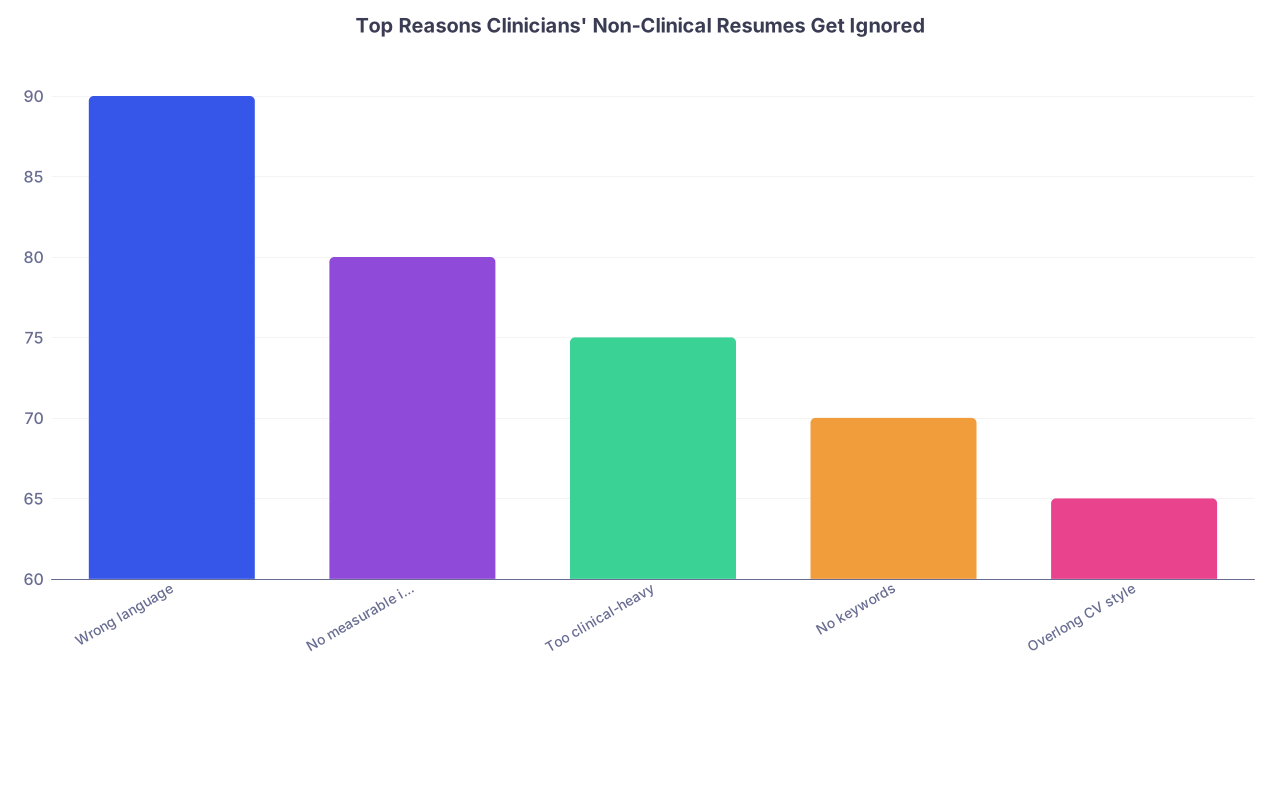
| Category | Value |
|---|---|
| Wrong language | 90 |
| No measurable impact | 80 |
| Too clinical-heavy | 75 |
| No keywords | 70 |
| Overlong CV style | 65 |

What you should do today
Do not write another cover letter. Don’t send another “just checking in” email. Those are band-aids.
Open your resume and a recent job posting for a role you actually want in an alternative medical career. Then do this:
- Rewrite your summary so it speaks directly to that type of role, not to “non-clinical” in general.
- Highlight 8–12 keywords from the job description and integrate them (honestly) into:
- Your skills section
- Your top 2–3 roles’ bullets
- Take one current job entry and:
- Delete 2–3 task-based bullets
- Replace them with impact-based, business-sounding bullets that show outcomes, not just activity
If, after that, the first half of page one still looks more appropriate for a hospital credentialing packet than for the job description in front of you, you’re not done.
Start with that first sentence of your summary. Does it tell a recruiter, in this industry, “You’re in the right place”?
If not, fix that line today.