
The way most physicians try to “convert” a residency CV into a non-clinical resume is wrong. They tweak a few bullet points, delete a couple of publications, and hope for the best. That approach gets ignored by recruiters in about ten seconds.
You are not doing a light edit. You are performing a full rewrite with a different purpose, different audience, and different rules.
Let me walk you through this as a process, step by step, so you end up with something that can actually compete in industry, consulting, tech, pharma, med ed, or whatever direction you are aiming at.
Step 1: Accept That Your Residency CV Is Not a Resume
Your residency CV is built for committees. Your non-clinical resume is built for scanners and hiring managers who are not impressed by your PGY level.
That means three big changes:
- From chronological academic record → to targeted, results-focused marketing document
- From “show everything” → to “only show what sells you for this role”
- From “MD is the headline” → to “I create value doing X, here is proof”
If you skip this mindset shift, you will keep trying to “fit” your CV into resume format and it will look like exactly what it is: an academic document dressed up for a party it does not belong at.
So we are going to:
- Strip your CV for usable parts.
- Translate those parts into business language.
- Rebuild them in a structure that non-clinical recruiters expect.
Step 2: Gather Your Raw Material (and Ruthlessly Trim)
Pull up your full CV. The bloated one you used for residency or fellowship.
You are going to mine it, not copy it.
Create three columns in a separate document:
- Column A: Experience type
- Column B: What you actually did (actions)
- Column C: What changed because of you (outcomes)
Go section by section in your CV and list only entries that can support a non-clinical skill:
- Leadership (chief resident, committee roles, project lead)
- Quality improvement / systems work
- Data / analytics / research
- Teaching / curriculum development
- Administrative work (scheduling, policy, EMR optimization)
- Innovation (app, pathway, protocol, workflow redesign)
- Writing / communication (presentations, patient ed, manuscripts)
Skip:
- Every single line of “responsible for managing X patients per day” unless you can angle it toward operations, throughput, or process improvement.
- Long lists of case presentations that do not show impact.
- Ancient shadowing and irrelevant volunteer work.
If an entry does not connect to one of these categories, you probably do not need it on a non-clinical resume.
Step 3: Choose a Clear Target Before You Write a Single Line
A generic “non-clinical resume” is useless. You need a target lane.
Some common paths:
- Clinical operations / medical director (health systems, telehealth, virtual care)
- Pharma / biotech (MSL, safety, clinical development, medical affairs)
- Health tech / digital health (product, clinical strategy, informatics)
- Consulting (healthcare consulting, strategy firms)
- Medical communications / education (CME, medical writing, content lead)
- Utilization management / payer roles (medical director, reviewer)
Pick one primary direction for now. You can make variants later.
Now, pull 3–5 actual job descriptions in that lane. Do not skip this. Your resume will be built against these.
Skim every posting and highlight:
- Repeated phrases (“stakeholder management,” “cross-functional teams,” “data-driven decisions,” “process improvement,” “KPI tracking”)
- Required skills (project management, SQL, Excel, Epic, Power BI, statistics, presentation skills)
- Typical deliverables (build programs, design studies, implement pathways, manage launches, drive adoption)
These phrases become your:
- Section headings
- Bullet point verbs
- Skills section content
- Keywords for ATS (applicant tracking systems)
Step 4: Build the Correct Non-Clinical Resume Structure
You are aiming for a tight, 1–2 page resume. Not 6 pages. Not 12.
Use this template as a starting point:
- Header
- Targeted professional headline + summary
- Key skills / competencies
- Relevant experience (grouped and labeled strategically)
- Education & training
- Selected projects / publications (optional, curated)
- Certifications / tools / tech (if applicable)
4.1 Header: Strip It Down
- Name, credentials (e.g., “Jane Smith, MD, MPH”)
- City, State (no full address)
- Email, phone
- LinkedIn URL (and portfolio link if relevant)
No “Curriculum Vitae” title. No date of birth. No photo.
Step 5: Rewrite Your Headline and Summary for Industry
Your current headline (if any) is probably something like “Internal Medicine Resident” or “PGY-3, Department of Surgery.”
That is dead weight in non-clinical recruiting.
Replace it with a value-focused headline aligned with your target.
Examples:
- “Physician Leader | Quality Improvement and Clinical Operations”
- “MD with Data-Driven Healthcare Strategy and Outcomes Research Experience”
- “Physician Scientist | Clinical Development and Medical Affairs”
- “Emergency Physician Transitioning to Health Tech Product and Clinical Strategy”
Then write a 3–5 line summary that does three things:
- States who you are in business language.
- Signals the lane you are targeting.
- Front-loads evidence: scale, scope, concrete wins.
Example for someone targeting clinical operations / quality:
Board-certified internist with 5+ years of experience leading multidisciplinary teams, redesigning care pathways, and implementing data-driven quality initiatives. Led a sepsis bundle project across a 400-bed hospital that reduced mortality by 18% and improved door-to-antibiotic time by 22 minutes. Experienced in EMR optimization, KPI tracking, and translating clinical needs into operational workflows. Now pursuing clinical operations or medical director roles in integrated delivery or digital health.
Notice what is missing: irrelevant publications, residency awards, exam scores. Those can show up later if they help, but they do not belong in the summary.
Step 6: Translate Your Clinical Work into Business Outcomes
This is where most physicians fail. They simply write:
- “Managed inpatient and outpatient care for diverse patient population.”
- “Supervised interns and medical students.”
That language is invisible to non-clinical hiring managers.
You must translate your experience into:
- Process improvement
- Risk reduction
- Cost or time savings
- Growth, scale, adoption
- Stakeholder management
- Data-driven decision making
Formula for each bullet:
Action verb + scope + method + measurable or concrete outcome
Use numbers wherever you can. If you do not have exact numbers, estimate conservatively and phrase appropriately (“approximately,” “more than,” “over”).
Example transformations:
Original CV bullet (resident):
- “Participated in quality improvement committee.”
Non-clinical resume bullet:
- “Co-led a multidisciplinary QI initiative analyzing 18 months of readmission data, identified three high-yield intervention points, and helped design a discharge checklist that reduced 30-day readmissions for CHF by approximately 12% over 9 months.”
Original:
- “Supervised residents and medical students on inpatient service.”
Non-clinical:
- “Led daily rounds for a team of 4–6 trainees, prioritizing a 20+ patient census, coordinating with nursing, pharmacy, and case management to improve discharge efficiency; consistently completed >80% of discharges before noon.”
You are the same person. Different language. Different impact.
Step 7: Reorganize Experience to Match Your Target
Stop listing everything purely chronologically if that buries the good stuff.
For non-clinical roles, I often recommend splitting “Experience” into two sections:
- Relevant Experience (to the target role)
- Clinical Experience (shortened, combined if needed)
For example, if you are applying to pharma:
Relevant Experience
- “Sub-Investigator, Phase II/III Oncology Trials, XYZ Cancer Center”
- “Outcomes Research Fellow, ABC Institute”
- “Consultant (Part-time), Market Access Project, DEF Pharma”
Clinical Experience
- “Attending Physician, Hematology/Oncology, XYZ Cancer Center”
- “Fellow, Hematology/Oncology, University of Whatever”
- “Internal Medicine Resident, Big City Hospital”
For each role in Relevant Experience, you give 3–6 strong, business-oriented bullets. For Clinical Experience, you can use 1–3 bullets focused on:
- Scale (patients per day, beds, programs)
- Leadership (chief roles, committees)
- Systems work (protocols, EMR, throughput)
You do not need 12 bullets describing your ICU nights for a med affairs role.

Step 8: Build a Skills and Tools Section That Actually Matters
Your current CV might list:
- “Skills: patient care, communication, teamwork”
That is fluff. Every clinician has that.
For non-clinical roles, your Skills section should be a curated list of:
- Hard skills
- Tools / platforms
- Methodologies
- Business-relevant competencies
Examples by lane:
Clinical Operations / Quality
- Process mapping, PDSA cycles, Lean/Six Sigma (even if informal)
- KPI design and monitoring
- EMR optimization (Epic, Cerner, etc.)
- Change management
- Project management (Asana, Trello, MS Project if applicable)
- Data analysis (Excel, basic SQL, basic R/Python if true)
Pharma / Medical Affairs
- Clinical trial design and execution
- GCP, ICH guidelines
- KOL engagement
- Publication planning
- Safety signal evaluation
- Regulatory awareness (FDA, EMA basics)
Health Tech / Product
- User story writing / requirements gathering
- A/B testing interpretation
- Workflow design
- Agile / Scrum exposure
- Dashboard or analytics tools (Tableau, Power BI, Looker)
- API / interoperability awareness (HL7, FHIR – if legitimate)
List 8–14 items. Group if needed (e.g., “Data & Analytics,” “Project & Operations,” “Clinical / Regulatory”).
Step 9: Convert Research and QI into “Projects” (Mini Case Studies)
Your residency CV probably has a long, dense list of abstracts, posters, and papers.
Industry does not care about 90% of them.
Instead, pick 3–6 projects that show you can:
- Identify a problem
- Work with stakeholders
- Use data
- Execute and deliver a result
Create a Selected Projects or Selected Research & Quality Projects section and structure like this:
Project Title | Role | Institution | Year
- One sentence on the problem.
- One sentence on what you actually did (methods).
- One sentence on the outcome (data, decisions, adoption).
Example:
Reducing ED Door-to-Needle Time for Stroke | Project Lead | City Hospital | 2022
- Identified delays in tPA administration for ischemic stroke patients via review of 14 months of ED throughput data.
- Facilitated mapping sessions with neurology, radiology, nursing, and ED leadership to redesign activation and imaging workflows.
- Implemented new protocol and dashboard tracking; reduced median door-to-needle time from 54 to 34 minutes within 6 months.
That one entry sells you better for operations, analytics, or product roles than five posters ever will.
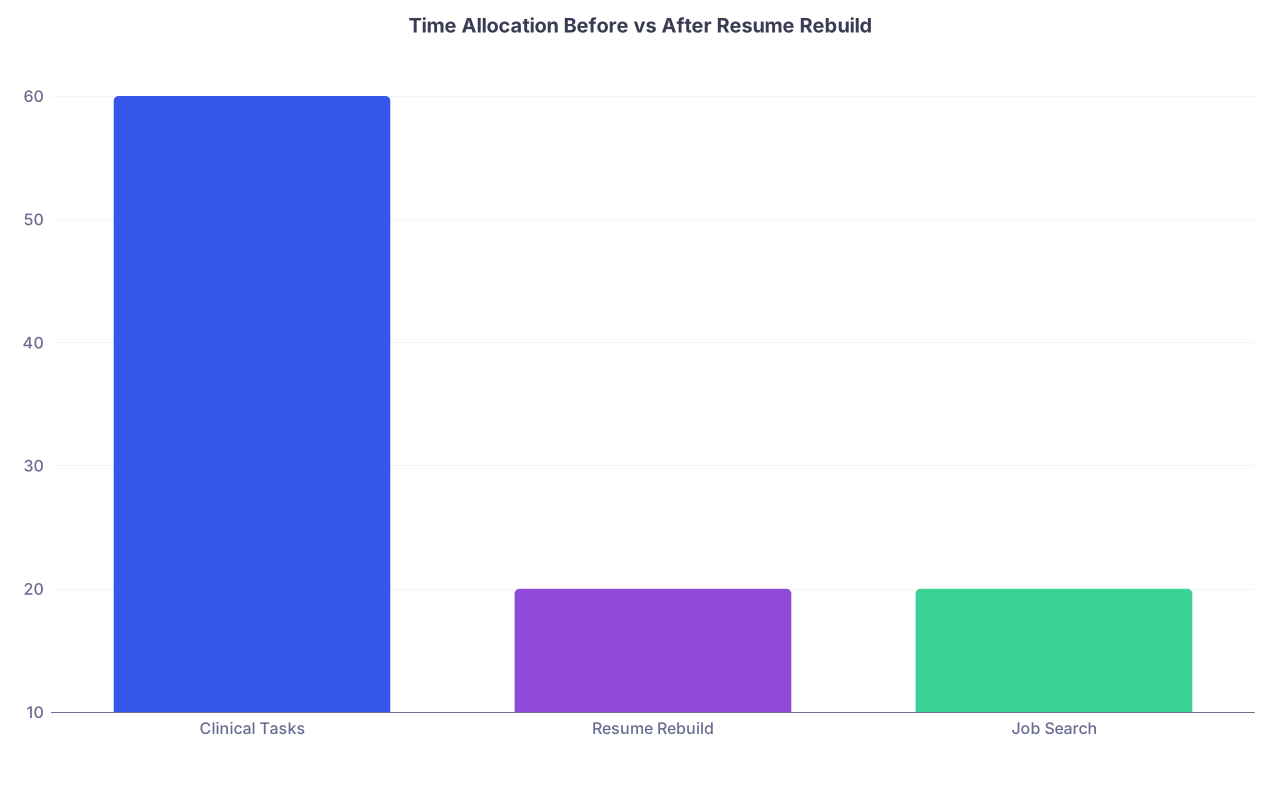
| Category | Value |
|---|---|
| Clinical Tasks | 60 |
| Resume Rebuild | 20 |
| Job Search | 20 |
Step 10: Reframe Teaching and Leadership as Management Experience
You probably have more management experience than you think. You just call it “teaching” or “supervising” or “coordinating.”
Translate it.
Examples:
Original CV:
- “Resident preceptor for 3rd year medical students.”
- “Chief resident, 2022–2023.”
Non-clinical resume:
- “Managed day-to-day workflow and priorities for rotating teams of 3–6 learners, balancing educational needs with service requirements while maintaining safety and throughput.”
- “As chief resident, co-managed scheduling for 40+ residents, optimizing coverage across 3 sites, reducing last-minute shift changes by ~30%, and coordinating with departmental leadership during pandemic-related surges.”
Suddenly you sound like someone who can:
- Manage people
- Allocate resources
- Handle competing priorities
…which is exactly what a lot of non-clinical hiring managers are looking for.

| Step | Description |
|---|---|
| Step 1 | Full Residency CV |
| Step 2 | Identify Target Role |
| Step 3 | Highlight Relevant Experience |
| Step 4 | Translate to Business Language |
| Step 5 | Rebuild Resume Structure |
| Step 6 | Customize to Job Descriptions |
| Step 7 | Final Non Clinical Resume |
Step 11: Cut Aggressively (Page Count and Detail)
This is the part physicians fight the most.
Your non-clinical resume is not your professional autobiography. It is a filtered sales brochure.
Guidelines:
- 0–5 years post-training: One page is usually enough.
- 5–15 years: One to two pages, but closer to one and a half. No third page.
- Academic monsters with massive portfolios: Two pages, tightly curated.
What to cut:
- Full citation lists for every paper and poster. Keep only those that:
- Relate directly to the target role, or
- Show rare depth (e.g., NEJM, JAMA, major guideline authorship)
- Rotations and short-term observerships from early training.
- Detailed descriptions of routine clinical duties that do not tie to business results.
- Personal sections (“Hobbies: running, reading, travel”). If you keep one, it should be a single line with something distinctive.
Think of every line as “renting space.” If that line is not actively helping you get this job, it does not get to stay.
Step 12: Convert “Clinical Speak” into “Business Speak”
You need to train your language as much as your structure.
Here is a simple translation table to keep beside you:
| Clinical Phrase | Business-Oriented Translation |
|---|---|
| Rounds | Daily team huddles / workflow review |
| Attendings / Fellows | Senior leaders / subject-matter experts |
| Residents / Students | Direct reports / junior team members |
| Patients | Clients / end users / customers |
| Clinic / Ward | Service line / operational unit |
| Protocol / Order set | Standard operating procedure (SOP) |
Use the business versions where they make sense. Do not overdo it to the point of absurdity (“clients with pneumonia” sounds ridiculous), but lean toward language a non-clinician can understand without translation.
Concrete example:
Bad:
- “Led stroke rounds and coordinated with neurology attendings and fellows.”
Better:
- “Led daily interdisciplinary huddles for acute stroke cases, coordinating with senior neurology leaders to streamline decision-making and reduce delays.”

Step 13: Optimize for ATS and Human Skim at the Same Time
Most mid-to-large employers run resumes through an ATS. Your beautiful prose does not matter if the keywords are missing.
Use the job descriptions you collected earlier and:
- Mirror critical phrases verbally in your:
- Summary
- Skills section
- Experience bullets
For example, if every posting mentions:
- “Stakeholder management”
- “Cross-functional collaboration”
- “Data-driven decision making”
Then your resume should include exact or very close versions of those phrases — but where they are true.
At the same time, format for human skim:
- Consistent bolding for roles and institutions.
- Plenty of white space.
- Bullets no longer than 2 lines if you can help it.
- Section headings that make sense: “Clinical Operations Experience,” “Research & Analytics Experience,” etc.
Avoid:
- Text boxes, columns, or fancy graphics that break ATS parsing.
- Tiny fonts or huge margins to cram content.
Step 14: Build Variant Versions, Not Completely Different Resumes
Once you have a strong “master” non-clinical resume, create 2–3 variants for adjacent roles rather than rewriting from scratch.
For example:
- Version A: “Clinical Operations / Quality Focus”
- Version B: “Health Tech / Product & Strategy Focus”
- Version C: “Medical Affairs / Pharma Focus”
Differences between variants:
- Headline and summary
- Order of sections (e.g., “Research & Analytics” higher for pharma)
- Which projects are highlighted
- Some verbs and keywords in bullets
Core facts remain consistent. You are not lying; you are emphasizing different angles of the same experience.
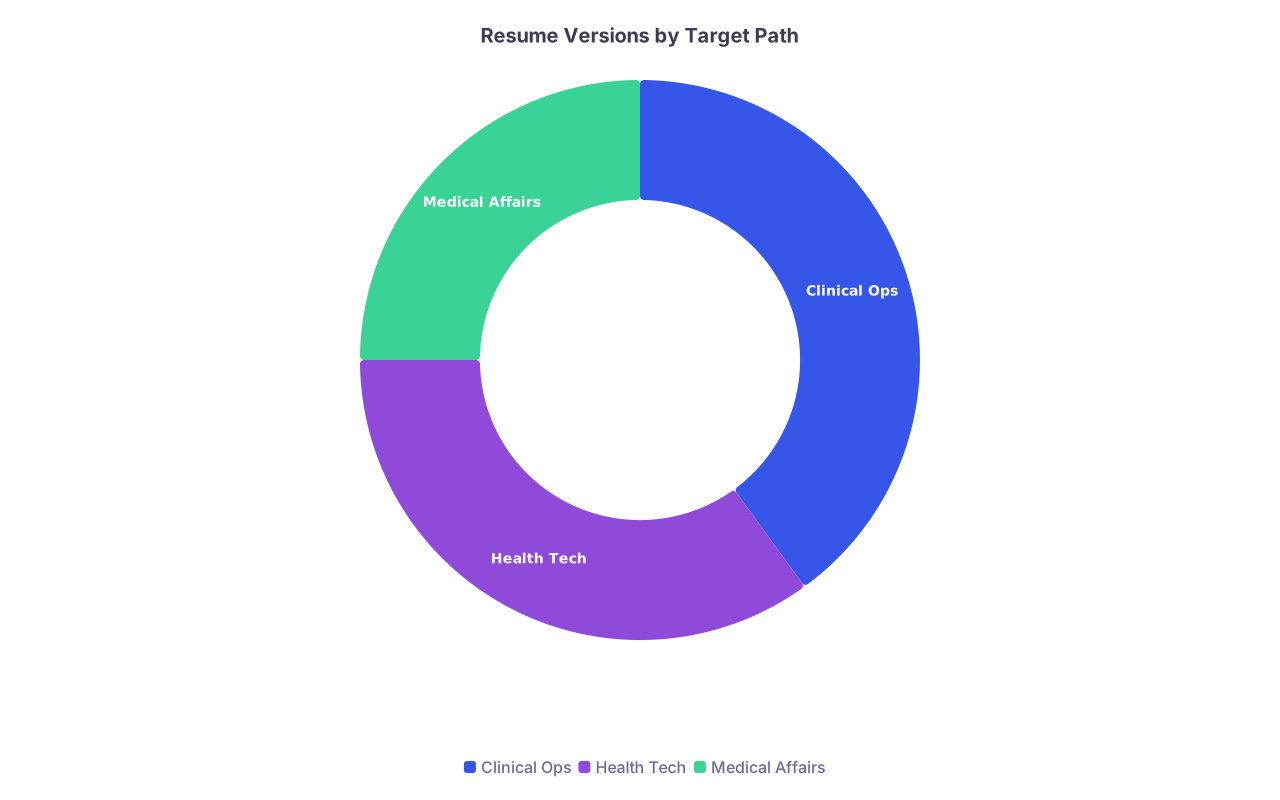
| Category | Value |
|---|---|
| Clinical Ops | 40 |
| Health Tech | 35 |
| Medical Affairs | 25 |
Step 15: Brutal External Review and Final Polish
You are too close to your own story. Get at least two other eyes on the final draft:
Someone in your target industry
- Asks: “Does this look like the resumes we see?”
- Flags jargon that does not land.
- Suggests missing keywords or competencies.
Someone who knows your clinical work
- Asks: “Is this accurate and not oversold?”
- Confirms your outcomes and numbers.
Run a final pass for:
- Consistent verb tense (current roles: present; past roles: past).
- No random tense shifts inside the same job.
- No jargon that a smart layperson could not follow.
- Email and phone number actually correct (yes, I have seen physicians send out resumes with wrong phone numbers).
Then lock the formatting in PDF for submission, unless a system explicitly requests Word.
Step 16: Do Not Stop at the Resume
Your non-clinical resume is one piece of a larger transition toolkit. Once the resume is in good shape, align:
- LinkedIn profile
- Same headline style
- About section that expands your summary
- Feature 3–5 key projects or publications
- Story for interviews
- Why you are leaving clinical or reducing it
- How your experience translates to this role
- 3–4 concrete examples (from your bullets) you can narrate as stories
The resume gets you in the door. Your narrative keeps you there.

Your Next Action Today
Do not try to “polish” your existing CV. That is a trap.
Instead, do this today:
- Open your residency CV.
- Open a blank document titled “Non-Clinical Resume – Draft 1.”
- Pick one target lane (clinical ops, pharma, tech, whatever).
- Copy over only:
- Your header
- A brand-new headline and 3–5 line summary aimed at that lane
- 3–5 experiences or projects that clearly support that target
Stop there. If those first 10–15 lines do not already sound like someone in your target industry, keep revising before you bring over anything else.
Once your headline, summary, and top entries feel right, the rest of the resume will build much faster.