
What if you finally admit to yourself that you’re burned out and want a non-clinical job… and the people you love most look at you like you’re throwing your life away?
The Fear Behind “Non-Clinical”
Here’s what no one ever says out loud: it’s not just about leaving clinical medicine. It’s about disappointing people who built their identity around you being “the doctor.”
Parents who brag at dinner parties. A partner who married “a physician,” not “a healthcare consultant.” In‑laws who only understand success if you’re in a white coat. Colleagues who make snide comments about “selling out to industry.”
And then there’s you, stuck in the middle, trying to figure out:
- Am I being selfish?
- What if they’re right and I regret this?
- What if I fail and have to crawl back?
- What if my partner actually loses respect for me?
The career part is scary, but honestly? The family judgment part is worse. You can tell yourself you’ll handle job uncertainty. Handling your mom’s “I just don’t understand… after everything we sacrificed” speech? That hits different.
Let me say this bluntly: wanting a non-clinical career does not make you weak, ungrateful, or broken. It makes you human in a system that’s been grinding you down for years.
But you’re not wrong to be anxious about the fallout.
Why Family Reactions Hurt So Much

Family disapproval lands in a way program directors or attendings never could. You can shrug off some random attending saying, “Everyone wants to go to industry now.” But if your father says, “So you’re just… quitting being a real doctor?” That gets stuck in your head for weeks.
Usually it’s a mix of these things:
They don’t understand what non-clinical medicine even is.
To them it’s binary: you see patients = real doctor. You don’t = failure / waste / midlife crisis. They’ve never heard of medical affairs, informatics, utilization management, or health policy beyond what’s on the news.They’re scared for you financially.
And fair enough—half the headlines are about doctors leaving medicine, burnout, shifting reimbursement. They assume non-clinical = huge pay cut = instability = disaster.They’re attached to the prestige.
This one’s ugly but real. Some parents love being able to introduce you as “my daughter the doctor.” Some partners like the social cachet. Losing the white coat feels, to them, like losing status.They feel their sacrifices are being “wasted.”
The years of tuition, childcare, visiting you on rotations, supporting you through Step exams. In their mind, it’s all justified by you being Dr. X in the clinic. Pull that away and they panic: “So what was all of that for?”They project their own fears onto you.
“What if you regret it?” often means “I’d be terrified to do what you’re doing, so I want you to stay where I understand the rules.”
None of this means they’re right. It just explains why their reaction is so intense—and why it cuts so deep.
The Worst-Case Scenarios You’re Playing in Your Head
Your brain is probably doing the greatest hits playlist of catastrophe:
- “My partner will think I’m less impressive and resent me.”
- “My parents will stop bragging about me and quietly be ashamed.”
- “My colleagues will think I couldn’t hack it clinically.”
- “If I hate the non-clinical job or get laid off, I’ll have ruined my career and my relationships.”
I’ve watched people stay in soul-crushing clinical roles for years purely because they were terrified of these conversations. I’ve also watched people switch, face the storm, and… the world didn’t end. It was awful for 3–6 months, then normal again.
Not easy. But survivable.
The brutal truth: you’re weighing other people’s temporary discomfort against your long-term wellbeing. That’s the actual tradeoff. Staying miserable so everyone else stays comfortable is not noble. It’s self-erasure.
Reality Check: Non-Clinical Roles Aren’t “Giving Up”
Let’s kill this idea that leaving clinic means you’re wasting your training.
| Role | Typical Use of MD/Clinical Experience |
|---|---|
| Medical Affairs (Pharma/Biotech) | Interpreting clinical data, educating HCPs |
| Medical Director (Utilization Management/Insurance) | Reviewing cases, applying guidelines |
| Clinical Informatics | Designing and optimizing EHR and workflows |
| Health Tech/Startup | Product design, clinical strategy, user needs |
| Medical Writing/Ed | Translating complex science for diverse audiences |
Most non-clinical roles exist precisely because medical knowledge is rare and valuable. You’re not “quitting being a doctor,” you’re shifting how you doctor.
But your family doesn’t see that. They see:
- Less stethoscope
- Less “Doctor So-and-so, room 4”
- More laptop, meetings, jargon
So from their vantage point: abandonment.
You might have to accept this uncomfortable fact: they may never fully “get it.” Some will, over time, once they see you stable and less miserable. Others will always think bedside = “real” medicine and anything else is side-quest nonsense.
Your job is not to rewire their entire belief system. Your job is to protect your life from being run by those beliefs.
Having the Conversation (Without Exploding)

| Step | Description |
|---|---|
| Step 1 | You decide to go non clinical |
| Step 2 | Plan talking points |
| Step 3 | Choose time and setting |
| Step 4 | Share more details |
| Step 5 | Set boundaries |
| Step 6 | Limit career debates |
| Step 7 | Ask for emotional support |
| Step 8 | Supportive response |
You don’t need a perfect TED Talk. But going in cold and emotional is how you end up yelling, “You don’t own my life!” over spaghetti.
Here’s a sane sequence:
Pick your audience and order.
Who’s highest impact? Partner first. Then maybe parents. Then everyone else. Don’t start with the most judgmental uncle just because he talks the loudest.Lead with your internal reality, not the job title.
“I’m burned out and not okay” lands differently than “I’m going to pharma.” People argue with decisions; they struggle more to argue with pain.For example:
“I’m at the point where I dread going to work every day. I’m anxious, not sleeping, and it’s changing who I am at home. I can’t keep doing this for the next 20 years.”Show you’ve done your homework.
Not in a defensive “I’ve prepared a PowerPoint” way, but calm and factual.“I’ve looked at medical director roles at [company types]. Typical salary ranges are X–Y. The hours are more regular. I’d still be using my clinical background to [brief explanation].”
Name their fear before they weaponize it.
“I know it might feel like I’m throwing away all the years of training and your support. I’ve thought about that a lot. This isn’t impulsive. It’s me trying to make sure that sacrifice actually leads to a sustainable life, not a breakdown.”Ask clearly for what you want from them.
People default to problem-solving and criticizing when they don’t know what you need.“I’m not asking for your permission. I’m asking for your emotional support while I make this transition. I need less ‘what if this fails’ and more ‘how can we help you make this work.’”
Will this magically fix it? No. Some will still say exactly the thing you feared. But at least you’ll know you were clear, honest, and not secretly asking them to validate you.
When They Still Don’t Support You
Sometimes you do everything “right” and still get:
- “You’re making a huge mistake.”
- “After everything we did for you…”
- “So you’re going to be a desk doctor now?”
- “I can’t support this.”
That’s the nightmare outcome you’ve been rehearsing in your head, right?
Here’s the part no one likes hearing: you may have to move anyway.
There’s this quiet line you eventually hit in adulthood: the point where you stop trying to earn unconditional support and start acting according to your own internal compass, even when people you love think you’re wrong.
A few things that can help you survive that stretch:
Separate love from approval.
Your parent can love you deeply and still hate your career choice. This is maddening, but real. If you make their approval the price of your wellbeing, you will never stop paying.
Limit the career debates.
You’re allowed to say, “I’m not discussing this with you anymore. I’ve made my decision. I’d love to talk about literally anything else.” If they push, you end the call or leave. Not to be dramatic—just to enforce reality: this is not up for continual re-litigation.
Build a different support system, fast.
If your family is shaky, you must have other anchors.
- One or two clinicians further along the non-clinical path
- A therapist who actually understands burnout and career transitions
- Online or local communities of physicians in alternative roles
You’re allowed to get your career validation from people who understand what you’re doing. Waiting for your cousin who works in accounting to suddenly grasp pharma med affairs is a losing game.
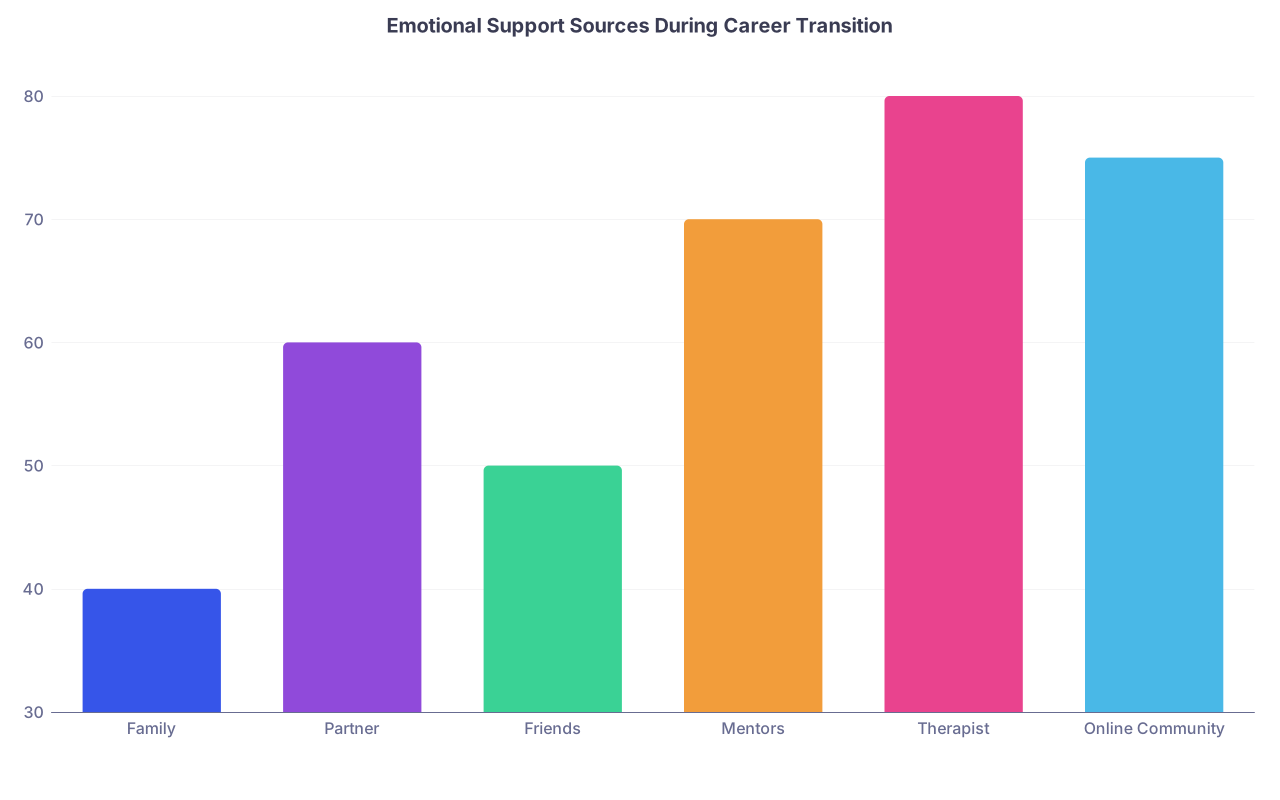
| Category | Value |
|---|---|
| Family | 40 |
| Partner | 60 |
| Friends | 50 |
| Mentors | 70 |
| Therapist | 80 |
| Online Community | 75 |
(And yes, sometimes the therapist and online peers are carrying 80% of the emotional load. That’s okay.)
Practical Damage Control: Money, Identity, And “What If I Fail?”
Your anxiety is probably not just “they’ll be mad.” It’s also, “What if they are right?”
So let’s hit the concrete stuff quickly.
Money.
Some non-clinical roles pay less initially. Some pay the same or more. Your family might assume you’re going from attending salary to “random entry-level admin.”
You should know your numbers before you talk to them:
- What’s your minimum viable income?
- What are realistic salary ranges for your target roles?
- How long can you afford a pay dip or a gap?
- What’s your backup plan if your first job is a bad fit?
If you can say, “I’ve budgeted for a possible 20–30% pay cut for the first year. Here’s how we’ll cover that. The long-term range for this path is actually similar to or higher than my current pay,” that undercuts a lot of their doom-saying.
Identity.
You might secretly agree with them: “If I’m not seeing patients, am I still a real doctor?” That’s your own internalized nonsense talking, amplified by theirs.
Your MD or DO doesn’t evaporate when you log into Zoom instead of Epic. You earned that degree the hard way. Clinical time isn’t the only measure of worth.
What if I hate it and want to go back?
This is the big one.
You can usually go back to clinical work in some form, especially if you don’t disappear for a decade and you keep your license and CME in reasonable shape. It might not be the exact same role or setting, but you’re not burning the entire house down.
If you tell family, “I’m giving this 2–3 years. I’ll maintain my license and keep the option of some clinical work open. I’m not locking myself out forever,” that calms some of their apocalyptic thinking.
And frankly, it should calm some of yours.

When the Unsupportive Person Is Your Partner
This one deserves its own quick section because it’s brutal.
If your spouse or long-term partner is deeply against your move, you’re not just debating career. You’re debating the kind of life you’ll have together.
Ask them explicitly:
- “Is your concern mainly financial, or is it identity/status?”
- “If the money ends up equal in a couple of years, would you still feel this strongly?”
- “Do you want me to stay in a job that’s making me miserable so our life looks a certain way from the outside?”
If the honest answer is, “I care more about you being Dr. X in clinic than I do about your day-to-day wellbeing,” you’ve uncovered a relationship problem, not a career problem.
That’s harsh. But better to know.
Couples do get through this. I’ve seen partners come around after they see the difference in mood, health, and presence at home. But it often requires you to hold your ground through a very tense period.
Therapy helps. Real talk helps. Avoiding the conversation and hoping they magically support you later does not help.
You’re Allowed To Choose Your Life
You would never tell a patient, “Stay in this abusive situation so your parents don’t get upset.” But that’s exactly how we treat ourselves.
You get one life. Not one for you and one for your family’s expectations.
It might be messy. There might be slammed doors, awkward holidays, snide comments at reunions. But five years from now, you could be in a sane job, sleeping, seeing your kids, not dreading Mondays.
And your family? Most of them will adapt. They’ll brag differently. “She works for this big healthcare company now.” “He’s doing something with technology and medicine.” The story changes. They adjust.
The only person who has to live with the actual day-to-day reality of your work is you. Everyone else just visits.
FAQ (exactly 5 questions)
1. What if my parents say I’m wasting all the money and sacrifice that went into my training?
You can acknowledge the sacrifice without making it a permanent cage. Try: “You’re right, we all sacrificed a lot to get me here. That’s exactly why I can’t spend the next 20 years miserable. I want that sacrifice to lead to a sustainable, healthy life, not burnout.” If they keep repeating the same line, stop justifying and end the loop: “I’m not going to keep defending this. I’ve made my decision, and I hope over time you’ll see why.”
2. How do I even explain my new non-clinical job to family who only understand ‘doctor in a hospital’?
Keep it simple and anchored to things they already respect. “I’ll be using my medical training to help design better systems/medications/policies so doctors and patients have safer, more effective care.” If they want more detail, you can add: “Think of it as being the doctor behind the scenes, making sure the front-line doctors have what they need.” They don’t need to understand every acronym; they just need a story that’s not “I gave up.”
3. What if I make the switch and really regret leaving clinical medicine?
You’re not sealing yourself in a vault. Many people do some version of boomerang: part-time clinic, different specialty setting, urgent care, telehealth. If you keep your license active and don’t disappear for a decade, you have options. It might not be a perfect reset, but you won’t be doomed. And honestly, staying in a job you already know is destroying you out of fear of a hypothetical future regret is a pretty bad trade.
4. Should I wait until I have a non-clinical offer before telling my family?
If your family is very reactive and anxious, yes, having something concrete helps. “I’ve been interviewing for X. I have an offer with Y salary, Z hours, start date in 2 months.” That turns “vague scary idea” into “specific plan.” If you’re already falling apart emotionally, you might need to loop in your partner earlier for practical reasons, but you’re not obligated to announce every interview to every relative. This is your life, not a committee project.
5. Is it selfish to prioritize my mental health and happiness over my family’s expectations?
No. It’s normal adulthood. Calling it “selfish” is how people keep you stuck. You taking a job that doesn’t wreck your nervous system is not you abandoning your family. You’re still their kid, partner, sibling. You’re just refusing to sacrifice your entire life to maintain their image of you. That’s not selfish; that’s sane.
Key points:
You’re not broken or weak for wanting a non-clinical role; you’re reacting to a system that’s often unsustainable.
Your family may never fully “get it,” but their misunderstanding doesn’t disqualify your needs.
You are allowed—actually required—to choose the version of your life you can stand to live, even if people you love loudly disagree at first.