
It’s 11:47 pm. Your Epic inbox is open on one screen, LinkedIn on the other. You’ve got a half‑finished pharmacovigilance job application in one tab and your last patient’s CT report in another. And this thought keeps looping in the back of your mind:
“What if I leave clinical medicine for pharma… and regret it for the rest of my life?”
That’s the fear, right? Not just “What if it’s hard?” but “What if I blow up everything I trained for and there’s no way back?”
You’re not crazy for thinking this. You’re just in that awful in‑between zone where medicine feels unsustainable, but leaving feels like betrayal.
Let’s walk through this like two residents whispering in the call room at 2 am, trying to figure out if they’re about to make a life‑wrecking decision.
The 3 Big Regret Nightmares (Let’s Actually Name Them)
You’re probably bouncing between a few worst‑case scenarios. Let me spell them out, because vague dread is always worse than concrete problems.
- “What if I hate pharma and can’t get back into clinical practice?”
- “What if I miss patient care so much it hurts every day?”
- “What if people think I failed or ‘sold out’ and I’m stuck defending my choice forever?”
Those are the core ones I hear over and over from people considering industry. Some extra bonus fears:
- “My skills will atrophy and I’ll be useless in both worlds.”
- “I’ll be the dumbest person in every industry meeting because I don’t know the lingo.”
- “I’ll make more money but feel completely empty.”
You can’t fix fear by pretending it doesn’t exist. So let’s tackle these directly.
How Reversible Is Leaving Clinical Medicine for Pharma… Really?
Short answer: it’s not “one step and the door slams behind you forever,” but it is a door that gets heavier to push open the longer you’re away.
The truth’s somewhere between “You can always come back!” (too optimistic) and “Once you leave, you’re dead to medicine” (too dramatic).
| Time Out of Clinical Work | Getting Back In | What It Usually Takes |
|---|---|---|
| < 1 year | Doable | Minimal refresher, networking |
| 1–3 years | Harder | CME, recent references, likely ramp-up period |
| 3–5 years | Challenging | Re-entry programs, maybe locums first |
| > 5 years | Very tough | Significant retraining, may need additional credentials |
I’ve seen people:
- Leave for pharma after residency, do 2–3 years in drug safety, then return part‑time outpatient in their original specialty. Doable, with hustle.
- Step out for 5+ years into medical affairs, then struggle to find anyone willing to hire them clinically without a structured re‑entry. Not impossible, but rough.
- Maintain a 0.2–0.4 FTE clinic while working industry, which made going back later way smoother.
The ugly part? You will be judged by some departments: “Why did you leave?” “Are you still current?” “Do you just want an easy outpatient job now?”
But if you keep your license active, do meaningful CME, and ideally keep some connection to patient care (even 4–8 hours a month), you massively reduce the regret‑risk.
Regret usually hits hardest when people:
- Cut ALL clinical ties immediately
- Let licenses lapse
- Don’t touch CME for years
- Look up five years later and realize returning would mean a massive, expensive, pride‑swallowing re‑entry process
So if you’re that worried about regret, you don’t have to do the “slam the door and set it on fire” version of leaving.
The Stuff People Actually Miss When They Leave (It’s Not What You Think)
You’re afraid you’ll miss “patient care.” That’s too vague. Let’s get specific, because that matters.
What people really miss:
- The identity hit: Being able to say “I’m a hospitalist/ED doc/surgeon” and have everyone instantly understand your role.
- Instant impact: Adjust a drip → blood pressure improves. Drain an abscess → pain relief. You see the benefit immediately.
- The team vibe: Joking with nurses at 3 am, consult banter, residents asking you questions and actually listening.
- Feeling clinically sharp: Knowing guidelines cold, handling unstable patients, feeling competent in a chaotic environment.
What they don’t miss as much as they thought they would:
- Charting until midnight.
- Arguing with insurance about prior authorizations.
- Productivity RVU pressure.
- Administrators sending emails about “efficiency metrics.”
- Being one bad outcome away from a lawsuit.
In pharma, you’ll gain things like:
- Predictable hours (for most roles).
- Actual vacation you can take without 47 messages piling up in your inbox.
- Being treated like your brain is valuable, not just your throughput.
- Impacting thousands or millions of patients instead of one at a time.
But yeah. You may lose some of that direct, human “I helped that person today” feeling. Some people are okay with that. Some are not. The regret usually comes when you didn’t realize how much that “one‑on‑one” part meant to you until it was gone.
What Pharma Regret Actually Looks Like
Let me be blunt: people do regret leaving clinical medicine sometimes. Not everyone. But enough that your fear isn’t imaginary.
Patterns I’ve seen in people who regret the switch:
They jumped from pure burnout, not from a clear pull toward something new.
Translation: “I just needed out,” not “I’m really drawn to drug development / safety / trials.”They went into the wrong kind of pharma job.
Example: An extroverted, teaching‑oriented physician takes a highly technical safety role with zero patient or KOL interaction and feels bored and isolated.They never made peace with losing the “I’m a front‑line doctor” identity.
They still introduce themselves as “a cardiologist who used to be in practice,” like they’re apologizing.They expected their first industry job to feel as meaningful as saving a crashing patient.
It won’t. At least not in the same acute, dramatic way.
On the flip side, people who don’t regret it:
- Were already curious about research, drug mechanisms, systems‑level impact.
- Spent time talking to 5–10 people in pharma before jumping and picked their role intentionally.
- Allowed themselves to grow a new identity instead of clinging to the old one like a life raft.
- Often found other ways to stay clinically adjacent: teaching, CME talks, a half‑day clinic here and there.
Testing Reality Before You Blow Up Your Life
If your brain is in full catastrophe mode—“What if I regret this so badly I end up depressed and broke and unemployable?”—you need data, not more spiraling.
Here’s what I’d do if I were in your shoes and terrified of regret:
Shadow or at least deeply interview 3–5 physicians in pharma.
Not the polished LinkedIn version. Ask them:- “What surprised you in a bad way the first year?”
- “What do you miss most from clinical?”
- “If you had to go back to practice tomorrow, how screwed would you be?”
Try a “toe in the water” move first.
Things like:- Consulting for a small biotech on the side.
- Doing some paid advisory board work or medical writing.
- Getting involved in an investigator‑initiated trial or DSMB. It gives you a feel for the culture and language before you sign a full‑time offer.
Design an exit that preserves optionality.
If regret is your nightmare, your job is to keep doors open:- Keep your license active.
- Maintain DEA (if feasible).
- Do real CME—things that would impress a future medical director or chief if you came back.
- Consider 0.1–0.2 FTE clinic work for at least the first 1–2 years, if humanly possible.
Write down your own non‑negotiables.
What do you actually need to feel okay?- Some direct contact with patients?
- Teaching trainees?
- A sense of intellectual challenge?
- Being home for dinner most nights? If pharma doesn’t give you at least a few of these, regret odds go way up.
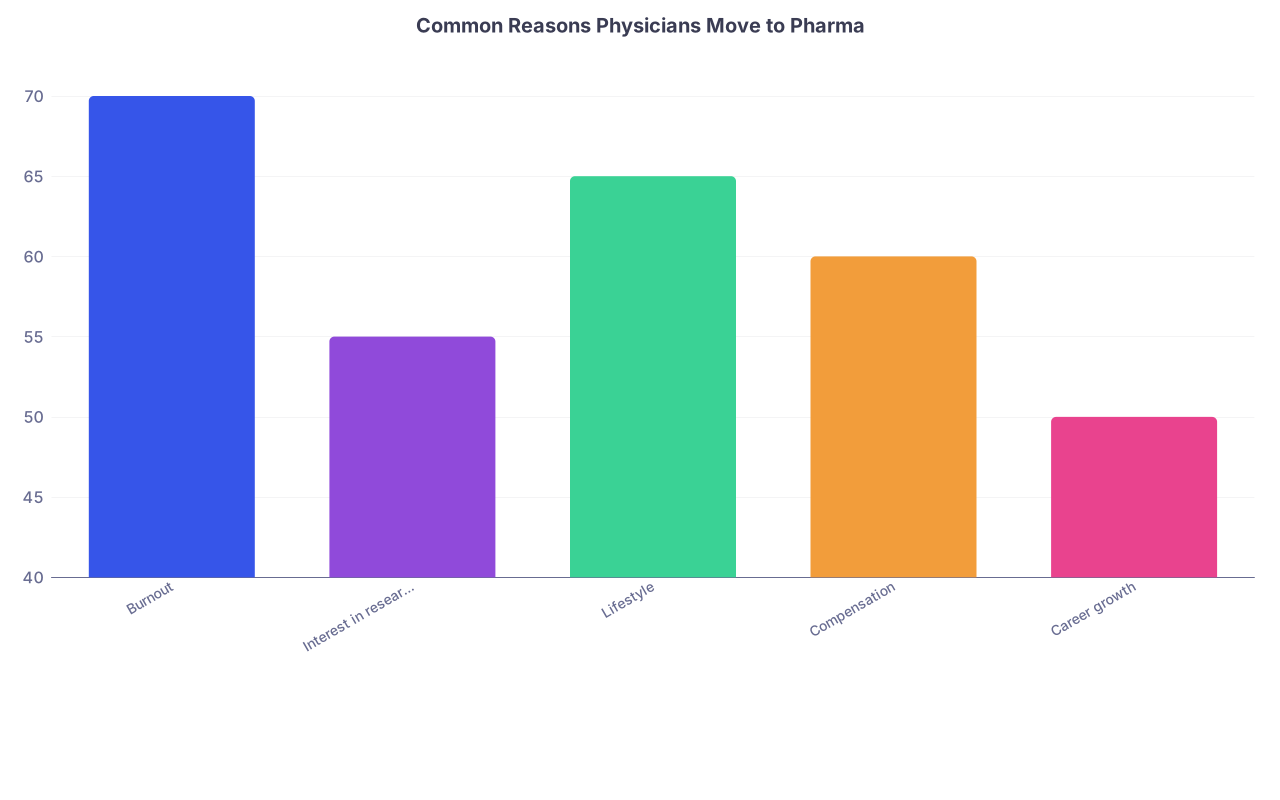
| Category | Value |
|---|---|
| Burnout | 70 |
| Interest in research | 55 |
| Lifestyle | 65 |
| Compensation | 60 |
| Career growth | 50 |
What If You Go to Pharma… and It Is a Mistake?
This is the core terror, right? “What if I jump and then wake up six months later thinking, ‘Dear God, put me back on nights, I was wrong.’”
Let’s say that happens. What are we talking about, worst‑case?
You spend 1–2 years in a job you dislike but that pays decently, gives you evenings, and doesn’t require you to run codes at 3 am.
That’s a bad outcome, but it’s not your life being ruined.You decide to go back clinically.
Will your ego take a hit? Probably. You’ll have to explain the gap. Some people will silently judge. But if you’ve:- Kept your license,
- Done CME,
- Maybe kept a minimal clinic, you’re not radioactive. You’re just “the doc who tried pharma and realized they missed patients.”
You pivot within pharma instead of running back to the hospital.
A lot of “regret” is actually “wrong role.”- Hate safety? Maybe you’d like medical affairs.
- Hate endless meetings? Maybe a smaller biotech fits better than a giant company. Correcting that is much easier than rebuilding a full clinical career from ashes.
Your view of yourself has to change.
And yeah, that hurts. But if the worst outcome of this experiment is “I learned my limits and what matters to me,” that’s not a tragedy, that’s data.
You’re not signing a blood oath. You’re making a career decision that can be course‑corrected, especially if you plan for that possibility in advance instead of pretending you’ll definitely love it.

| Step | Description |
|---|---|
| Step 1 | Clinical practice full time |
| Step 2 | Pharma role |
| Step 3 | Love pharma stay long term |
| Step 4 | Like pharma but miss patients |
| Step 5 | Hate pharma regret choice |
| Step 6 | Hybrid career clinic plus pharma |
| Step 7 | Return to clinical part time |
| Step 8 | Switch to different nonclinical role |
How to Reduce the Odds of Lifelong “What If” Regret
You can’t get regret risk down to zero. But you can stop it from being a 3 am horror movie in your head.
Do these, and you’ll at least know you made an informed, defensible choice:
Separate “running away” from “running toward.”
If all your pros list says is “no call, better pay, no weekends,” that’s a red flag.
You need at least one real pull:- Wanting to work on trials.
- Curiosity about drug development.
- Enjoying high‑level strategy discussions more than day‑to‑day visits.
Create a 2‑year experiment mindset.
Tell yourself: “I’m trying this for two years. During that time I’ll:- Keep my license,
- Do CME,
- Seriously evaluate what I miss and what I don’t.” Decisions feel less permanent when you frame them as experiments instead of life sentences.
Pre‑decide what “true regret” would look like.
Write it down.
For example: “I’ll consider this a real mistake if, after 18–24 months:- My mental health is worse than in clinical,
- I feel purposeless despite reasonable work conditions,
- I still daydream about being on rounds.” That way you’re not overreacting to the normal discomfort of change.
Accept that there’s no path with zero grief.
If you stay in clinical:- You may grieve the time you don’t have with family.
- You may grieve the career possibilities you never explore. If you leave:
- You may grieve the immediacy of patient care and the old identity. There’s grief either way. You just get to choose which loss you’re more willing to live with.
Quick Reality Check: How Many People Actually Regret It?
No one has perfect data, but anecdotally?
If I had to put numbers on the physicians I’ve seen or talked to who went into pharma:
- Maybe 10–20% have serious, persistent regret and work to get back clinically (or at least out of that role).
- Another 20–30% have mixed feelings—miss some aspects of clinical care, but not enough to undo the switch.
- The rest mostly feel relief. They may occasionally miss the hero moments, but not the day‑to‑day grind.
The loudest voices online are often the most extreme—either “Pharma saved my life, everyone should leave clinical!” or “Leaving was the worst mistake I ever made!”
Reality is boringly in the middle. Which your anxious brain hates, because it wants certainty. But you’re not going to get certainty. You’re going to get probabilities and trade‑offs.
If You’re Still Frozen… Read This Part Twice
You’re scared of picking the “wrong life.” That’s what this really is.
Medicine trained you to believe there’s one correct path: med school → residency → attendingship → grind → retire.
Leaving that feels like heresy.
But careers now are messy. Nonlinear. People do:
- 5 years hospitalist → 7 years pharma → back to part‑time clinic + advisory roles.
- Full‑time clinical → part‑time pharma consulting → full‑time pharma.
- Industry → academic clinical research → hybrid.
You’re not carving your epitaph. You’re choosing your next step with the information you have.
If, years from now, you look back and feel a twinge of “I kind of miss the old life”… that doesn’t automatically mean you made the wrong call. It means you’re human and you cared deeply about more than one possible version of yourself.
FAQ (Exactly What You’re Afraid to Ask Out Loud)
1. Will program directors or chiefs secretly think I failed if I try to come back after pharma?
Some will. Let’s not sugarcoat it. There are still plenty of old‑school physicians who think anything non‑clinical is selling out.
But plenty of others see it as:
- Proof you understand research, systems, regulatory issues
- Evidence you can handle cross‑functional work and big‑picture thinking
If you come back with a clear story—“I learned X, Y, Z in pharma, and now I want to apply that in clinical/academic practice”—you’ll be fine in the right environment. Your goal isn’t to convince everyone, just the people offering the jobs.
2. How long can I be out of clinical before it’s basically impossible to return?
“Impossible” is a big word. But reality:
- Under 2–3 years out: return is realistic with some hustle.
- 3–5 years: harder, you may need re‑entry support or to start with lower‑acuity roles.
- Beyond 5 years: you’re probably looking at a serious re‑training situation if you want anything beyond very limited roles.
If this freaks you out, build your plan around it: stay clinically active a little, keep licenses, and treat the first few years in pharma as a reversible phase, not a permanent exile.
3. What if I get used to the easier lifestyle and can never tolerate clinical again?
Honestly? That happens.
You might go from:
- 60–80 hour weeks, emotional rollercoaster, nonstop pager anxiety
to - 40–45 hours, weekends mostly free, fewer high‑stakes emergencies
And yeah, going back to full‑tilt hospital or ED life after that can feel impossible.
That’s not moral failure. That’s your nervous system finally realizing it doesn’t have to live on adrenaline and cortisol.
If that scares you, hold on to a smaller clinical role while you adjust. That way you’re not going from 0 to 100 again if you decide to go back.
4. How do I know if I’m running away from burnout vs. actually wanting an industry career?
A few clues:
- If you imagine a job with reasonable hours, decent admin support, and good colleagues in clinical and you’d stay—you might just be burned out, not done with medicine.
- If you’ve always been curious about research, trials, mechanisms, policy, or “how drugs get made,” and you light up when people talk about it—there’s probably genuine pull there.
- If you’re too tired to tell the difference, that’s a sign to slow down. Take a lighter schedule if you can. Talk to people in pharma. Don’t make a forever decision purely from the bottom of the burnout pit.
Years from now, you probably won’t remember the exact wording of the pharma job posting, or the specific night you cried over your EMR inbox. You’ll remember whether you honored the part of you that was scared and the part of you that wanted something different—and how brave it was to move, even without a guarantee.