
Last week, a former IM resident messaged me at 1:13 a.m. She’d left residency after intern year, found a solid medical writing job, and on paper everything looked better—steady hours, decent salary, no overnight calls. But her question was the same one you’re probably thinking: “What if my clinical skills just… disappear?”
Because that’s the fear, right? You wake up five years from now, realize you can’t remember how to manage a GI bleed, can’t interpret a troponin trend without Googling, and no hospital in their right mind will let you near patients again.
Let’s walk straight into that anxiety instead of dancing around it.
The Nightmare Scenario in Your Head
Here’s the mental movie that plays at 3 a.m.:
- You take a medical writing job “just for a year or two.”
- You stop seeing patients.
- You slowly forget basic stuff: antibiotic choices, insulin regimens, ACLS algorithms.
- One day you think, “I want to go back to clinical work.”
- Credentialing committees look at your gap, raise an eyebrow, and say, “No thanks.”
- You’re labeled “non-clinical” forever. Door slammed.
I’ve heard variations of this from:
- People who left residency before finishing
- Fully trained attendings who took a “temporary” pharma/med comms role
- Residents thinking about a research or writing year who are terrified it’s a one-way exit
Let me be blunt: the nightmare version is exaggerated, but the risk isn’t zero. If you treat medical writing like a black hole that sucks you away from all things clinical and you don’t plan ahead, you absolutely can make it harder to go back.
But “harder” is very different from “impossible.”
What Actually Atrophies (and What Doesn’t)
Your brain is not going to erase medical school. That’s not how this works. But some things do fade faster than others.
Things that get rusty fast
Procedural skills
Cannulating tough IVs, suturing, intubations, central lines, pap smears. If you’re not doing them, your comfort drops quickly. And hospitals care a lot about recency here.Pattern recognition in acute care
That instant gut feeling when a patient “looks sick.” Distinguishing the benign from the dangerous just walking into a room. This comes from volume and repetition. Stop seeing patients, it softens.Guideline-level recall
Exact BP thresholds, who gets this vs that anticoagulant, dosing from memory, when to start/stop something. You’ll still understand the logic, but the “autofill” in your brain weakens.Workflow and systems savvy
How to document efficiently, how to talk to consultants, how to manage a team on rounds, disposition planning. All that “how to move in a hospital” stuff dulls over time.
Things that stick much longer than you think
Core pathophysiology and mechanisms
Why heart failure exacerbates. How COPD works. What insulin actually does. Those frameworks don’t vanish; they just need resurfacing.Clinical reasoning structure
Differential diagnosis building, ruling in/out causes, thinking in probabilities. Even in medical writing, you’re often exercising similar muscles—just with less pressure and no 3 a.m. admits.Communication skills
You might not be breaking bad news to patients, but you’re explaining complex info to editors, pharma, regulators, or lay readers. That communication flexibility is deeply transferable.
So no, you’re not going to “forget how to be a doctor” like forgetting a language you learned in high school. But yes, specific applied skills, especially procedures and acute pattern recognition, will fade if untouched.
How Long Before Programs Start Side-Eyeing Your Gap?
This is the part no one gives you a straight answer on. Here it is.
| Time Away | How Programs Usually React |
|---|---|
| 0–1 year | Mostly fine if you explain it |
| 1–3 years | Questions, but very salvageable with evidence of engagement |
| 3–5 years | Higher scrutiny, may need formal re-entry or refresher |
| 5+ years | Many systems wary; re-entry is possible but structured and harder |
This isn’t a law. It’s a pattern I keep seeing:
- Under 1 year: Usually okay—“research year,” “writing year,” career exploration.
- 1–3 years: People start asking, “Have you kept up clinically?” They want proof you didn’t just mentally check out of medicine.
- 3–5+ years: Increasingly, systems want something structured—observerships, re-entry programs, supervised practice, or even formal retraining in some countries.
The worst situation is being away for years and having nothing to show that you stayed even remotely connected—no CME, no shadowing, no teaching, nothing.
So the wrong takeaway is: “I can’t do medical writing or I’ll be ruined.”
The accurate takeaway is: “If I do medical writing and might want to go back, I need to treat clinical maintenance like a second job.”
How to Keep Your Skills From Completely Falling Off a Cliff
If you’re thinking, “Okay but I’m exhausted, that’s why I’m leaving the wards,” I hear you. The goal is not to turn your life into a second residency.
It’s to keep enough of a pulse on clinical work that you can ramp up again later without starting from scratch.
1. Decide upfront: “Temporary?” or “Probably permanent?”
You’re allowed to not know 100%. But you should at least be honest with yourself:
- If there’s even a 20–30% chance you’ll want to go back, behave accordingly.
- The biggest mistakes come from people who say, “It’s just a break,” but then live like they’ve cut medicine out of their life completely.
Write it down somewhere:
“I am treating this as: [exploration / temporary break / long-term shift].”
Then plan like you actually mean that.
2. Maintain paper evidence you’re still a clinician at heart
Think about what credentialing offices and PDs/CMOs can see on paper. You want to be able to say, “I was in medical writing, but here’s how I stayed engaged.”
Stuff that counts:
- Regular CME credits in your field (not just random one-offs)
- BLS/ACLS/PALS or ATLS kept current
- Specialty societies membership (ACP, AAFP, ACOG, etc.)
- Case-based webinars, journal clubs (yes, even virtual ones)
- Teaching—med students, residents, nursing education, online courses
One or two things are nice. A pattern over years looks like commitment, not drift.
3. Protect at least one semi-clinical activity
This is where most people fall apart. They think if they’re not employed as a physician, they “can’t do anything clinical.” Not always true.
Depending on licensure and country, options might include:
- Per diem or extremely part-time clinical shifts (urgent care, telemedicine, outpatient clinics)
- Supervised volunteer clinics where licensed physicians see patients (and you’re the licensed physician)
- Telehealth triage roles (if your country’s regulations allow it)
- Medical student teaching in simulation labs (OSCEs, standardized patients, procedural teaching)
You don’t have to do 10 shifts a month. Even 1–2 days a month in something like urgent care can keep your pattern recognition and clinical decision-making from fully shutting down.
Yes, it’s tiring. Yes, it’s extra. But if you’re serious about keeping the door open, this is by far the strongest lever.
What If I’ve Already Been Away for a While?
So maybe you’re reading this from a med comms office, realizing you’ve already been out 3–4 years. Cue heart palpitations.
Breathe.
Let’s talk damage control, not self-blame.

| Step | Description |
|---|---|
| Step 1 | Want to Return Clinically |
| Step 2 | Update CME and Certifications |
| Step 3 | Add Observership or Part-time Clinical |
| Step 4 | Explore Formal Reentry Programs |
| Step 5 | Start Applying Broadly |
| Step 6 | Time Away |
If you’ve been away:
0–2 years:
Start now with CME, certifications, maybe shadowing, and get a mentor still in your specialty to vouch for you. The more continuous your story looks, the better.2–5 years:
You’ll likely need tangible recent exposure—observerships, supervised clinics, or part-time roles. This might not be glamorous. It’s still doable.5+ years:
You’re probably looking at formal re-entry or refresher programs. These exist (though they’re annoyingly scattered and competitive). Some systems treat you almost like a PGY-1 restarting, others have tailored refreshers.
The question isn’t “Am I screwed?” It’s “What’s the path from where I really am—not where I wish I was—back to regular clinical work?”
The Silent Upside: Medical Writing Isn’t Dead Space
Here’s something your 3 a.m. brain conveniently ignores: medical writing itself can strengthen parts of your clinical brain.
You’re:
- Reading new data constantly
- Comparing trials, understanding endpoints, learning updated guidelines
- Explaining complex concepts clearly (which is half of clinical practice)
If you’re strategic, you can:
- Say yes to projects in your specialty or areas you might return to clinically
- Volunteer for guideline summaries, clinical education content, patient-directed materials
- Build a portfolio that screams, “I understand how medicine is practiced now, not in 2017.”
That way, when you talk to a PD or CMO later, you don’t sound like someone who’s been totally out. You sound like someone who stayed in the medical world—just on a different side of the fence.
Real Talk: Is Medical Writing a One-Way Door?
No. But it can function like one if you:
- Let years go by with zero clinical/educational engagement
- Don’t maintain licensure/certifications
- Don’t think about documentation for credentialing committees
- Wait until you’re fully burnt out and desperate to try re-entry
On the flip side, I’ve seen:
- People leave for pharma/med writing for 2–4 years, then return to hospitalist work
- Folks re-enter with the help of structured programs, strong references, and a coherent story
- Former residents who never finished training switch specialties after a writing stint (not easy, but it’s happened)
The critical pieces are:
A story that makes sense:
“I stepped into medical writing to [reason], stayed engaged with medicine through [specific actions], and now I’m committed to returning to [specific role/specialty].”Evidence to back that story:
Licenses, CME, part-time or observerships, teaching, writing in your field.Realistic expectations:
You may not waltz directly into your dream academic attending job at a top-10 program. You might start somewhere more forgiving, then move.
A Simple “Don’t Panic, Do This” Plan
If you’re about to go into medical writing or just started:
- Keep your license active if at all possible.
- Keep BLS/ACLS (and PALS/ATLS if relevant) current.
- Do at least a modest amount of specialty-relevant CME every year.
- Say yes to projects close to your clinical interests.
- Aim for even tiny bits of real-world clinical exposure a few times a year at minimum; monthly if you can tolerate it.
If you’re already years out:
- Stop catastrophizing and gather facts: how long, what you’ve done, what’s current.
- Reach out to someone actually in your target specialty and say, “Here’s my situation. What would you want to see from someone like me to consider them?”
- Look up re-entry programs and local hospitals that have taken people back after gaps. There are more than you think, though they won’t be plastered on billboards.
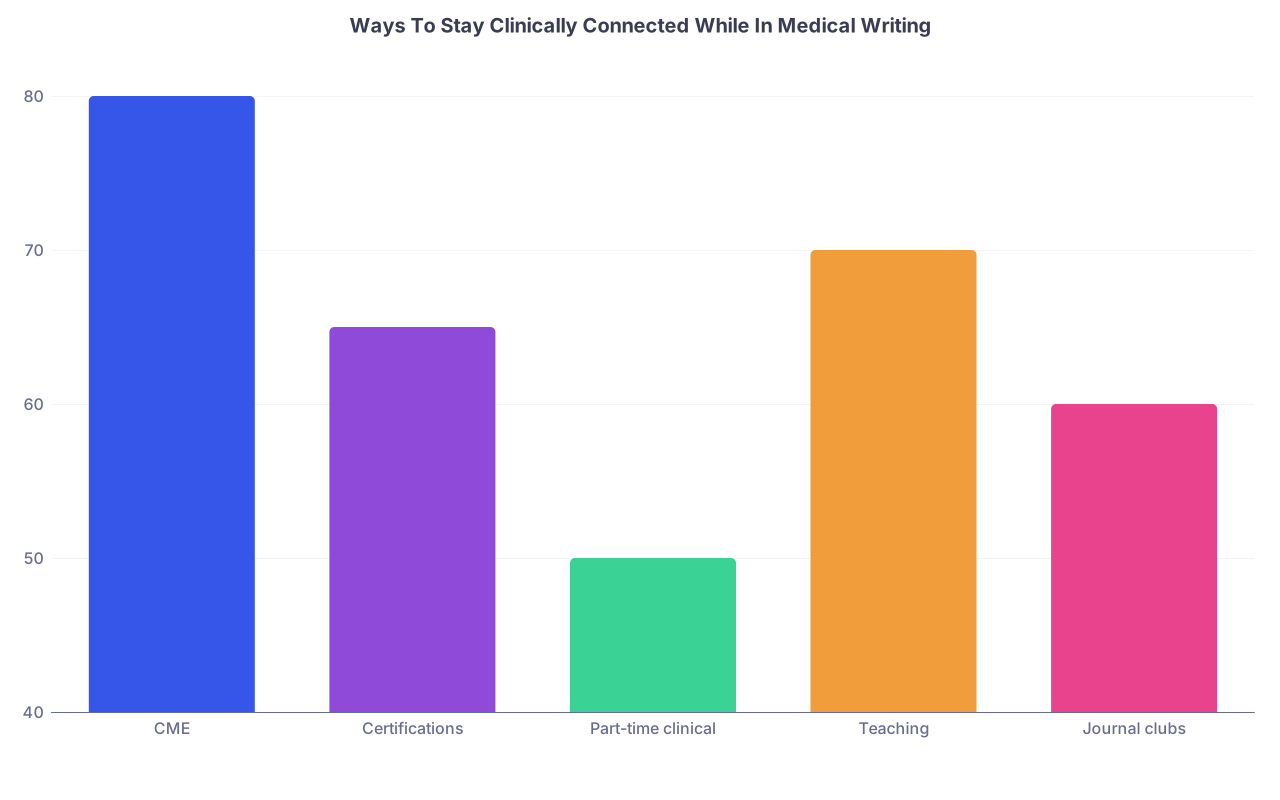
| Category | Value |
|---|---|
| CME | 80 |
| Certifications | 65 |
| Part-time clinical | 50 |
| Teaching | 70 |
| Journal clubs | 60 |
(Think of those numbers as “impact on future re-entry,” not exact percentages—but you get the idea: part-time clinical and teaching are heavy hitters.)
FAQ: Exactly 6 Questions
1. How long can I safely stay in medical writing before it really hurts my chances of returning clinically?
“Safely” is a loaded word, but under about 2–3 years, especially if you’re still doing CME and maybe a bit of teaching or clinical work, most places are pretty flexible. Beyond 3 years, people start scrutinizing more. Past 5, a lot of systems want structured re-entry or supervised refreshers. It’s a slope, not a cliff, but the longer you’re out, the more intentional you have to be.
2. If I never finished residency, is medical writing basically the end of my clinical career?
No, but it does narrow your options and makes the story more important. I’ve seen people leave after intern year, work in non-clinical roles, then match again—usually in less competitive specialties and often at community or mid-tier programs. You’ll need strong references, clear explanation of the gap, and evidence that you’ve stayed engaged with medicine (CME, teaching, related writing). It’s harder, not hopeless.
3. Will programs secretly think I “couldn’t hack it” if I go into medical writing?
Some will. Let’s not pretend everyone is enlightened. But framing matters. If you show: 1) intentional reasons for the switch (family, interest in evidence generation, burnout prevention), 2) consistent engagement with medicine, and 3) a serious, specific plan to return, plenty of people will respect that. Programs are full of jaded people… and also a few who understand that humans burn out.
4. Should I keep paying for my license and DEA if I’m not actively seeing patients?
If you have any realistic intention of going back, I’d lean hard toward yes, especially for your main state license. Losing and then re-obtaining licensure is a bigger pain and red flag than just having a gap in clinical work. The DEA is more flexible—if you’re doing no prescribing at all, you might let that lapse and re-apply later. But core licensure? I’d fight to keep it if you can afford it.
5. What if I’m already forgetting stuff—does that mean I’m done clinically?
Forgetting details is normal even in residency. The question is: can you relearn efficiently? Most people can. You’ll be rusty, and the first months back will feel awful, but rust is not the same as incompetence. If you’re serious about re-entry, plan for a ramp-up period—heavy CME, guidelines review, maybe supervised hours—before you’re fully back in unsupervised attending or busy resident roles.
6. Is it ever okay to just accept that I’m leaving clinical medicine for good?
Yes. You’re not morally obligated to cling to clinical work forever if it’s destroying you. There are people who move into medical writing, regulatory, pharma, or health tech and never look back—and they’re not “failed doctors.” If you reach a point where you know in your gut that you don’t want to go back, you can stop living like you’re in limbo. Just make that decision consciously, not out of fear or shame.
Open a blank note or document right now and write two things:
- “On a scale of 1–10, how likely am I to want clinical work again in the next 5–10 years?”
- “If that number is ≥4, what ONE concrete thing will I do this month to stay clinically connected—CME, cert renewal, shadowing, teaching, part-time work?”
Then actually schedule that one thing on your calendar. Not “someday.” This month.