
You’re not crazy for hating residency. You’re just in a system that pretends you’re disposable.
Let me say it bluntly: a lot more residents fantasize about leaving for industry than will ever admit it out loud. Pharma. Tech. Consulting. Insurance. Anything that doesn’t involve cross-covering 40 patients post-call while being told you “just need to be more efficient.”
You’re probably asking yourself the same loop of questions at 2 a.m. post-call:
- If I jump to industry now, am I throwing away my MD?
- Will I be seen as a failure or a quitter?
- What if I hate industry too and then I’m stuck?
- Do I have to finish residency to have a real career?
Let’s walk through this like we’re sitting in the call room at 3 a.m. You’re exhausted, scrolling job sites between pages, and trying not to cry in front of the night nurse.
You need honest, non-sugarcoated answers. So that’s what you’re getting.
The Harsh Truth: You Can Leave Residency… But There’s a Cost
You’re not locked in. You’re not legally chained to your program. People leave residency every single year. Quietly. Sometimes suddenly. Sometimes after months of planning.
But every exit has a price.
Here’s the uncomfortable part: the system is built on the assumption that you will suck it up and finish. So the moment you step off the treadmill, everything gets… more complicated.
There are three big axes you’re probably spinning in your head:
- Will I destroy my future clinical options?
- Will industry even want me without being board certified?
- What will people think? (Yes, this matters, even if everyone pretends it doesn’t.)
Let’s be clear where the actual risk lives:
- Clinically: leaving before finishing residency sharply limits your options to return as a traditional attending.
- Financially: industry can pay well, even at entry level, but you may be less competitive than board-certified physicians.
- Emotionally: identity crisis is real. Going from “future surgeon” to “medical science liaison” is a mental whiplash.
And yet—staying in a residency that is shredding your mental health also has a cost. Burnout. Depression. Suicide risk. That’s not “dramatic”; it’s literally in the literature.
You are not choosing between “stable traditional path” and “irresponsible chaos.” You’re choosing between two sets of imperfect risks.
Is Leaving Residency “Too Early”? The Timeline vs. Reality
You’re haunted by that word: too early. As if there’s some magic socially acceptable exit point.
Here’s what actually changes by stage:
| Stage | Clinical Future Impact | Industry Appeal | Emotional Difficulty |
|---|---|---|---|
| PGY1 early | Highest risk | Lowest | Very high |
| PGY2–3 mid | High | Moderate | High |
| Final year | Moderate | High | Extreme (so close) |
Is early PGY1 the riskiest time to leave?
Yeah. Pretty much.
Because:
- You haven’t proven long-term clinical competence.
- You don’t have board eligibility.
- Your CV looks like: MD → a few months → bounced.
But here’s the part people don’t say out loud: if a program is genuinely toxic or unsafe, or you are spiraling mentally, “too early” becomes a luxury concept. Survival comes first.
There is a reason many people try to at least finish one full year: some licensing boards and certain nontraditional roles consider completion of an intern year as “some training” that can be leveraged.
Is it ideal? No. But it’s better than disappearing in October of PGY1 without a plan.
What Does “Industry” Actually Mean for Someone Leaving Residency?
“Industry” sounds glamorous when you’re delirious on night float. But it’s vague.
Let’s strip the fantasy layer off and talk about actual buckets you’re probably thinking about:
- Pharma / biotech (medical affairs, MSL, safety, clinical development)
- Health tech / digital health startups (clinical strategy, product, medical director roles)
- Consulting (healthcare strategy, life sciences consulting)
- Payers / insurance / utilization management (medical director, chart review)
- Nonclinical but adjacent: medical education, writing, informatics, policy
Now the part you’re afraid of: is it too risky to jump into any of these without finishing residency?
Here’s the pattern I’ve seen:
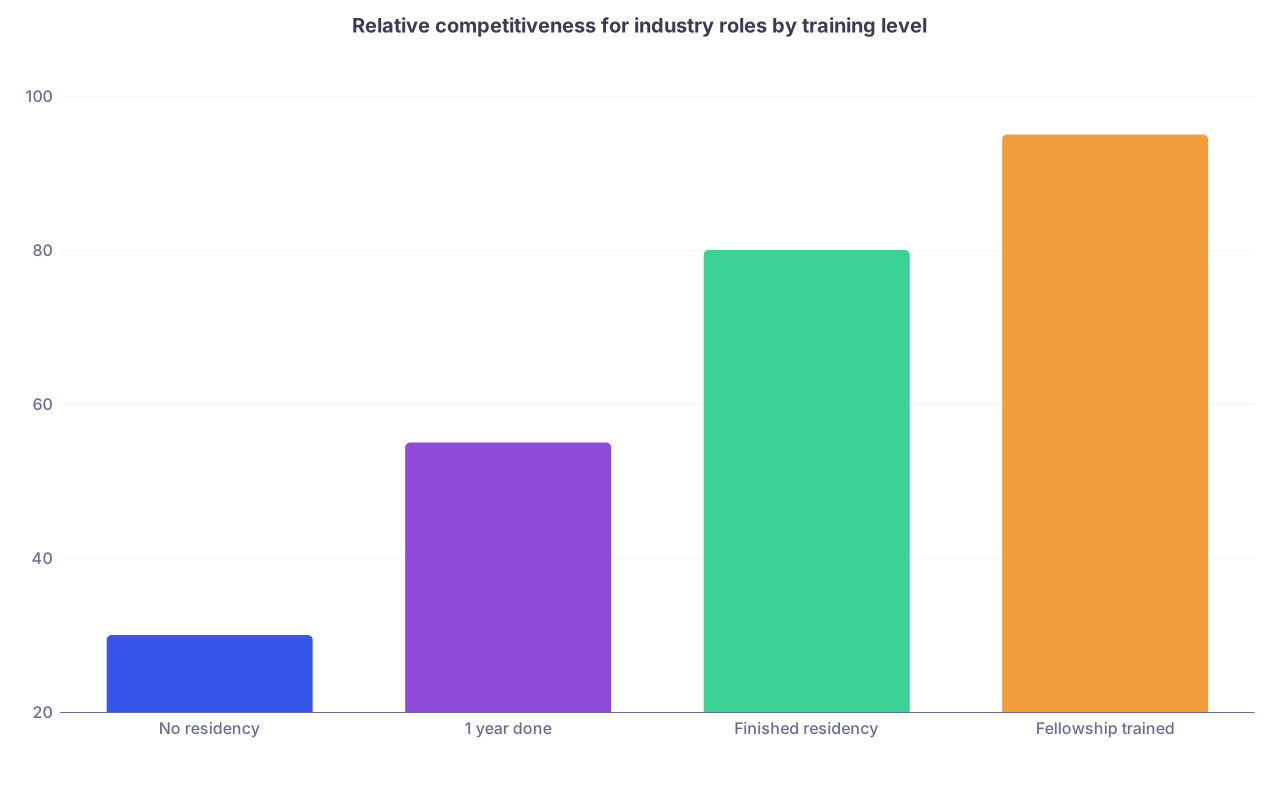
- Senior residents / fellows, board-eligible or board-certified → strong candidates for many industry roles, especially medical director, safety, clinical dev.
- People with a completed intern year but not full residency → more limited, but still viable for some MSL roles, some consulting, some startup roles.
- People who left during PGY1 very early and never went back → harder, but not impossible, especially if they have something else (research, prior career, MPH, coding, business) that makes them interesting.
So it’s not “industry hates unfinished residents.” It’s more: industry wants to minimize their risk. Just like you.
| Category | Value |
|---|---|
| No residency | 30 |
| 1 year done | 55 |
| Finished residency | 80 |
| Fellowship trained | 95 |
Those numbers aren’t real data; they’re reality-based vibes. But they track with who actually gets interviews and offers.
Worst-Case Scenarios (Because I Know That’s Where Your Brain Lives)
Let’s lean into the intrusive thoughts instead of pretending they’re not there.
Worst-case thought #1: “I leave residency, no one hires me, and I can never go back.”
Can that happen? Yes. Is it guaranteed? No.
Reality:
- Some people do leave residency and struggle for a long time to find a decent nonclinical role. They ping-pong between contract work, chart review, maybe some tutoring, some random startup gig.
- Some do re-enter residency later, but it’s harder the longer you’re out. Programs worry about skill decay, commitment, and whether you left in bad standing.
But the nuclear meltdown version—“I become unemployable with an MD”—is not how this usually plays out. You have a doctorate from a professional school in a field that touches every part of society. That’s not nothing.
The actual bigger risk is drifting. Leaving without clarity. One vague “I’ll figure it out” turning into two years of no structured narrative.
Worst-case thought #2: “Everyone will think I was too weak to handle residency.”
Some of them will. There are attendings who still brag about 120-hour weeks and sleeping under the desk, who think going to therapy is “for people who can’t cut it.”
They’re relics.
The people actually shaping future healthcare—physician leaders in tech, health systems innovation, and yes, industry—are a lot more open to nontraditional paths.
You’re not applying to impress your malignant PD. You’re trying to build a life that doesn’t crush you.
Worst-case thought #3: “If I stay, I’ll burn out so badly that I’ll never want anything to do with medicine again.”
Also not imaginary.
I’ve watched residents go from “mildly unhappy but functional” to “I hate patients, I hate the hospital, I hate myself” in under a year because they kept gritting their teeth instead of changing something.
Staying is not the neutral option. The cost of staying can be losing the part of you that actually wanted to help people.
Is It Smarter to Finish Residency First, Then Jump?
Yes. Purely from a strategic, risk-minimizing, doors-open standpoint? Yes.
Finishing residency gives you:
- Board eligibility/board certification → massive credibility
- The ability to moonlight or practice part-time if industry role disappears
- Way more leverage and pay in nonclinical roles
- A psychological sense of closure: “I completed the track”
The question is not “Is it better to finish?” The question is “Can you realistically safely finish?”
There’s a huge difference between:
- “I hate this, but it’s tolerable, and my mental health is bruised but not breaking.”
- “I’m dissociating on rounds, crying in the bathroom, having panic attacks during sign-out, and thinking about not waking up tomorrow.”
If you’re in that second bucket, the theoretical benefits of finishing may not matter as much as surviving this year intact.

| Step | Description |
|---|---|
| Step 1 | Hating Residency |
| Step 2 | Prioritize safety - consider leave or exit |
| Step 3 | Seek support, adjust, maybe finish |
| Step 4 | Plan structured transition to new path |
| Step 5 | Mental health stable enough to continue? |
| Step 6 | Program environment fixable? |
Things That Make Jumping Earlier Less Risky
If you’re leaning toward “I might actually leave,” you lower the risk by not doing it impulsively.
The people who land on their feet usually have at least some of this:
- A coherent story for why they left: not just “I hated it,” but “I recognized X wasn’t the right long-term fit, so I moved toward Y where my skills and interests better align.”
- One or two marketable extras: research background, informatics experience, an MPH/MBA, coding skills, strong communication/writing, startup work, quality improvement.
- Relationships: Attendings, mentors, or faculty who don’t think you’re a disaster and are willing to say you’re competent and thoughtful.
- Documentation: finishing the year if possible, evaluations that aren’t a trash fire, leaving in “good standing” rather than being pushed out.
If you’re truly on the edge, this is where concrete planning matters. Quietly update your CV. Start talking to people in roles you think you might want. Do informational interviews. Not a panicked “apply to 200 jobs on LinkedIn” spree the day after you resign.
Actual Roles Where Leaving Early Isn’t a Dealbreaker
Let’s be specific, because I know vagueness makes your brain spiral.
You might be able to get into, even with unfinished residency:
- MSL (Medical Science Liaison) roles at certain companies that accept MDs without residency, especially if you have research or publications.
- Medical writing / CME / education companies that value clinical training but don’t require board certification.
- Some health tech startups that just want a legit MD to help build clinical content, protocols, or product design.
- Clinical documentation improvement, utilization review roles with some payers (though they may prefer board-certified physicians, some take board-eligible or MD with partial training).
These are often not $400k glamorous “industry attending” jobs. But they’re stable-ish, daytime, and not emotionally annihilating.

The Identity Crisis No One Warns You About
Even if the logistics work out, this part can wreck you:
You went from “future cardiologist” to “what exactly am I now?”
Leaving residency feels to a lot of people like a breakup, a death, and a public failure all rolled into one. Even if your rational brain knows you’re making a healthier choice.
You might experience:
- Envy or shame watching your co-residents finish and post “Board Certified!” on Instagram.
- Awkwardness explaining your path to family who don’t get why you wouldn’t “just tough it out.”
- An empty feeling going from adrenaline-filled 28-hour calls to sitting at a desk in an office park.
That doesn’t mean you picked wrong. It means you’re adjusting to a different version of the life you thought you’d have.
And here’s the twist: a year or two out, a lot of people feel relief. You regain sleep. Basic joy. The ability to have dinner with someone without checking your pager. That counts for something.
How to Decide Without Letting Panic Drive the Bus
You’re scared of making an irreversible mistake. So you freeze. Or doomscroll. Or vent endlessly without moving.
Try this instead: a short, ruthless self-assessment.
Sit down on a non-call day and ask:
- On a scale of 1–10, how close am I to breaking? Not “dramatic,” but realistically.
- If someone offered me a safe pause—3–6 months off, no consequences—would I still want to fully leave medicine, or would I want a different version of it?
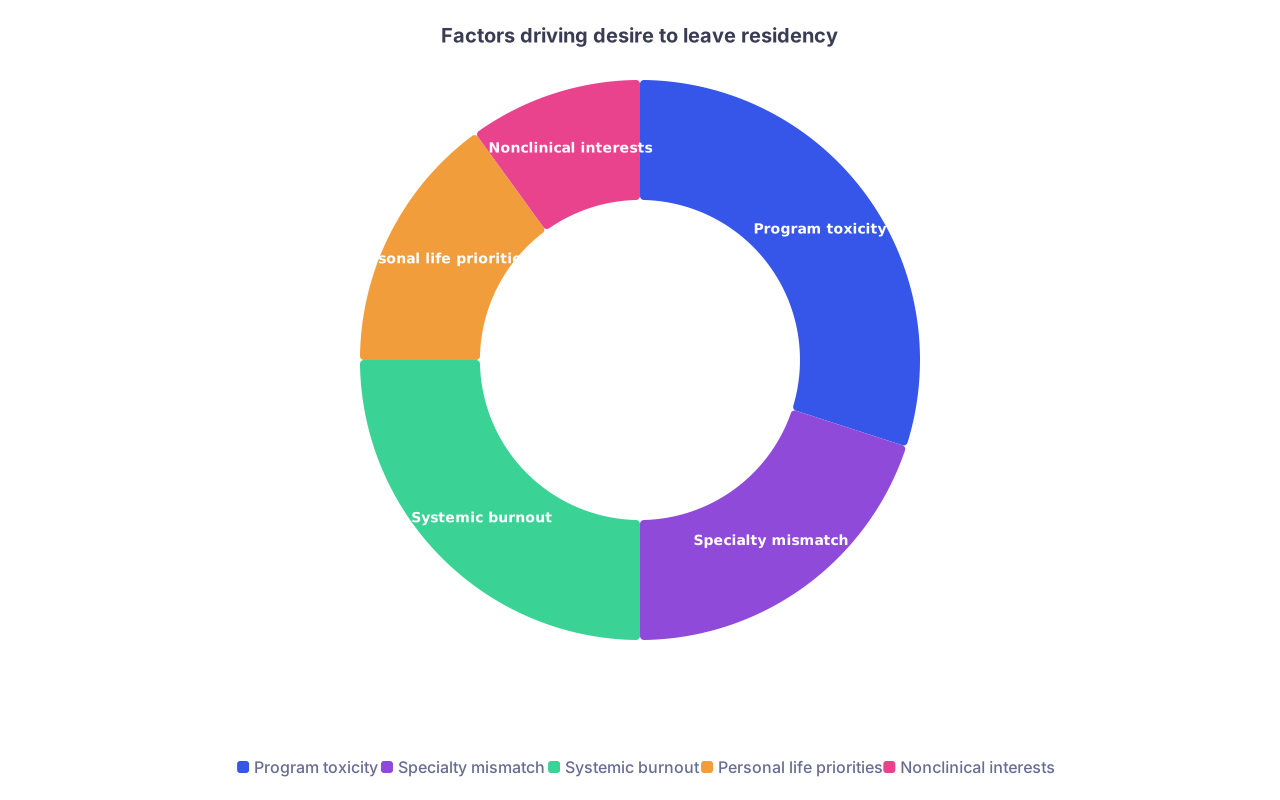
- What parts of residency do I hate: the specialty, the program culture, the hours, or medicine itself?
Those answers matter.
If you realize: “I actually still like medicine, I just hate this program,” then your best move might not be “industry now.” It might be: lateral transfer, LOA, different specialty, different hospital.
If your gut says: “I don’t ever want to be a traditional clinician,” that’s when serious exploration of alternative careers becomes less “escape” and more “realignment.”
| Category | Value |
|---|---|
| Program toxicity | 30 |
| Specialty mismatch | 20 |
| Systemic burnout | 25 |
| Personal life priorities | 15 |
| Nonclinical interests | 10 |
You’re Not a Failure for Even Asking This Question
The system wants you to believe that leaving residency = personal weakness.
That’s garbage.
You’re interrogating a path that demands your 20s, a chunk of your 30s, your mental health, your relationships, and your body. Of course you’re allowed to ask: “Is this worth it for me?”
Here’s the balanced, non-glossed-over answer:
- Yes, it is riskier to jump to industry early, before completing residency. Doors will close. Some people won’t understand. You may have to work harder to prove yourself.
- No, it is not automatically a disastrous, life-ruining move. Many people carve out good, meaningful, well-paying lives outside of residency and never look back.
- Staying also carries risk. The risk that you disappear inside a role that is grinding you down into someone you don’t recognize.
This is not about being brave or weak. It’s about being honest with yourself about what kind of life you can actually live.
Years from now, you won’t remember the exact wording of your resignation email or your first industry job description. You’ll remember whether you listened to yourself when it mattered.