
The fear of losing money is the main reason people stay stuck in careers that are slowly burning them out.
You’re not lazy. You’re not indecisive. You’re scared of blowing up your financial life. And honestly? You’re not wrong to be worried.
If you’re in medicine (or on the way there) and thinking about an alternative career—industry, consulting, tech, non-clinical, entrepreneurship—the pay cut question starts living rent‑free in your brain:
- “What if I leave and never make this kind of money again?”
- “What if I can’t support my family?”
- “What if I regret this and can’t get back?”
- “What if I’m 45 and broke and stuck?”
Let me say the uncomfortable thing out loud: yes, there are real financial risks to switching careers. But they’re not always the ones you’re obsessing over at 2 a.m.
Let’s drag all those worst‑case scenarios into the light and actually quantify them, because vague anxiety is always scarier than hard numbers.
The Biggest Lie: “You’ll Take a Huge Pay Cut Forever”
The classic narrative is simple and terrifying: stay in medicine and you’ll be rich; leave medicine and you’ll be poor.
That story is lazy.
Here’s what actually happens most of the time when clinicians switch into alternative careers:
- There’s usually a short‑term hit (or at least a stall).
- There’s often a medium‑term rebound.
- There can be long‑term upside—but only if you’re strategic, not romantic.
Let’s look at some rough, real‑worldish numbers. Say you’re an attending making $280k in a standard internal medicine job. You’re considering jumping to a non‑clinical role.
| Year in Role | Clinical Attending | Non-Clinical Career (Conservative) | Non-Clinical Career (Aggressive) |
|---|---|---|---|
| Year 1 | $280k | $180k | $200k |
| Year 3 | $300k | $210k | $250k |
| Year 5 | $320k | $230k | $300k |
| Year 10 | $360k | $260k | $380k |
Is this perfect data? No. But it’s close enough to what I’ve seen:
- Conservative track: medical affairs, safety, non‑leadership industry roles, some utilization review jobs.
- Aggressive track: leadership in pharma, health tech, consulting, entrepreneurship that actually survives.
So yes, you might go from $280k to $180–200k in year one. That’s a gut punch. But it’s not a guaranteed permanent downgrade. And that “forever pay cut” fear is often exaggerated in your head.
The real danger isn’t “I’ll never make money again.”
The real danger is: I don’t understand how my earning trajectory will actually change—and I’m too scared to look closely.
The Real Financial Risks You’re Probably Underestimating
The stuff that should worry you isn’t always the obvious “salary goes down” scenario.
Here’s what actually bites people.
1. The Transition Gap (a.k.a. The Oh-God-My-Paycheck-Stopped Phase)
This is the part everyone intellectually knows about but emotionally ignores.
You might:
- Take 3–12 months to find a new role.
- Need to do extra training/certification.
- Drop from full‑time to part‑time clinical during the switch.
- Pay for courses, coaching, conference travel, or networking.
So you don’t just lose some income; sometimes you lose all income for a bit.
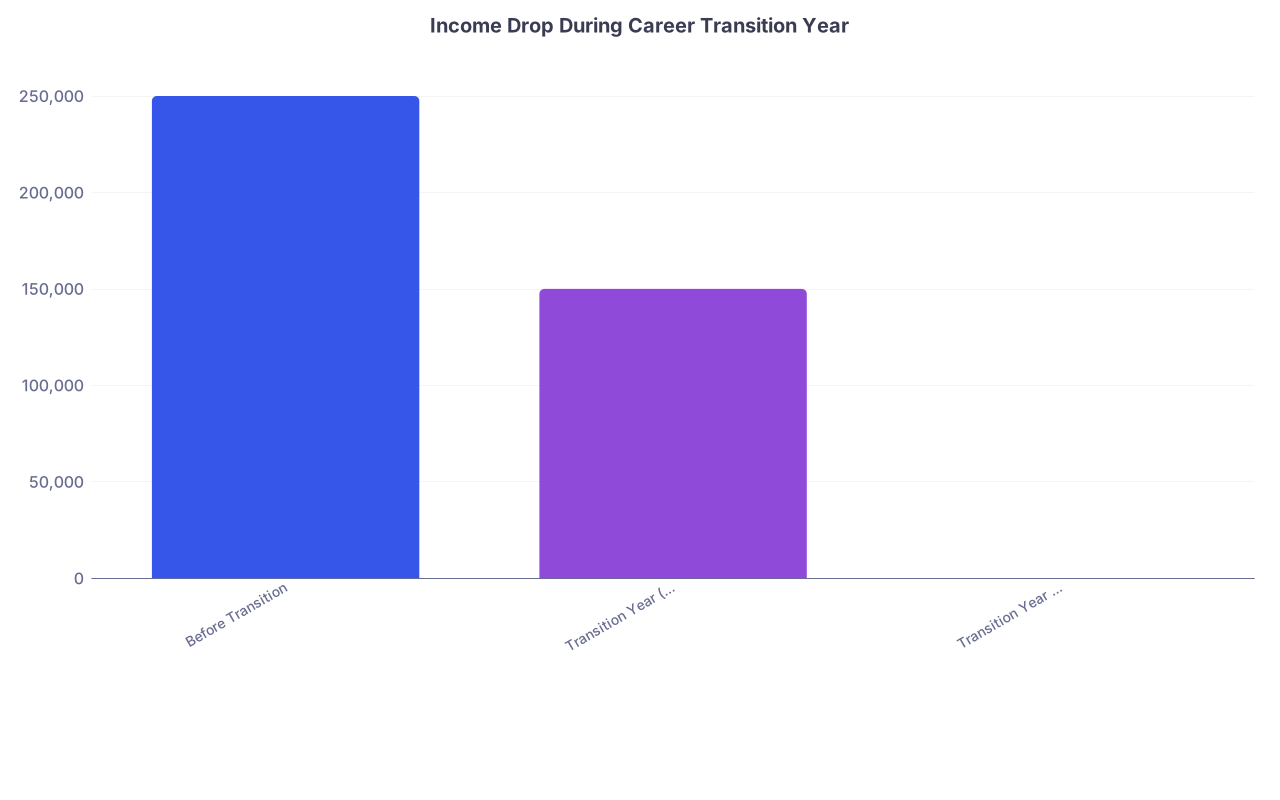
| Category | Value |
|---|---|
| Before Transition | 250000 |
| Transition Year (Typical) | 150000 |
| Transition Year (Worst Case) | 0 |
Worst‑case scenario that actually happens in real life:
- You hate your job.
- You impulsively quit (“I’ll figure it out, I just need out”).
- Your search for a non‑clinical role takes longer than expected.
- Suddenly you’re burning through savings and calling your student loan servicer to ask about forbearance.
If you want to be anxious about something, be anxious about that—then plan specifically so it doesn’t happen.
2. Student Loans + Lower Income = Silent Explosion
Medicine’s favorite combo: high debt, high income. When you drop one side of that equation, things get tense.
Risks:
- Losing eligibility for certain repayment plans if you switch employers.
- PSLF becoming a mess if you leave qualifying employment mid‑stream.
- Income‑driven repayment recalculating based on your old, higher income while your current income is lower.
- Running balances and interest ballooning if you go into forbearance during the transition.
I’ve seen people leave a $260k job for a $170k role and somehow feel more financially stressed, because their loans were structured for their old salary.
The pay cut isn’t always the problem. The mismatch between your new income and your old commitments is.
3. Benefits You Didn’t Realize Were Huge
A lot of clinicians underestimate how much their total compensation includes:
- Employer‑funded retirement contributions.
- Subsidized health insurance (especially for families).
- Disability insurance.
- Malpractice coverage (which you may need tail for).
- CME money and work‑related tax benefits.
You might technically go from $280k to $230k and feel like, “Not bad.” But if you gave up:
- $20k employer 401(k) contribution
- Solid health coverage
- Subsidized life and disability
…your true financial position may have dropped more than you think.
The Risks of Staying Put (That Your Brain Keeps Discounting)
Here’s the trap: your brain treats your current income as “safe” and anything else as “risky.”
But staying where you are isn’t risk‑free.
1. Burnout Has a Price Tag
This isn’t just “I’m tired.” Burnout messes with:
- Your likelihood of cutting back hours.
- Your risk of making mistakes (with real professional consequences).
- Your chance of quitting medicine later under worse conditions.
A burnt‑out attending cutting back from 1.0 FTE to 0.6 FTE over the next 3–5 years because they can’t handle the pace isn’t hypothetical. It’s everywhere.
If your current trajectory looks like:
- Year 1–3: $280k, full‑time.
- Year 4–7: $200k–220k, reduced hours.
- Year 8–10: contemplating early retirement with mediocre savings.
…then your “safe” path isn’t actually that safe.
2. Golden Handcuffs Tighten Over Time
The longer you stay purely clinical:
- The further you get from being “entry level” for alternative careers.
- The harder it is to accept a temporary step back.
- The more your fixed lifestyle expands to absorb your income.
Then what? You’re 45, trapped between “can’t afford to leave” and “can’t stand to stay.”
Financially, that’s risky as hell. Your greatest asset—your ability to pivot and grow new income streams—shrinks with time.
How to Actually Stress-Test a Career Switch (Instead of Just Spiraling)
Your anxiety wants fuzzy worst‑case images. You need specific numbers and specific plans.
Let’s break this down into something you can literally model on a piece of paper.
Step 1: Define the Worst Realistic 2-Year Scenario
Not asteroid‑hits‑the‑Earth bad. Realistic bad.
Example:
- Time to land first non‑clinical job: 9 months.
- Bridge income: part‑time shifts earning $4k/month.
- Living expenses: $6k/month.
- New job salary: $170k (vs current 260k).
- One‑time costs: $5k for courses/networking/travel.
Now actually run the math. How big a cash buffer would you need to survive that without panic?
| Item | Amount |
|---|---|
| 9 months income gap (net) | $18k |
| Reduced salary first year | $30k |
| Courses/networking/travel | $5k |
| Emergency buffer (extra) | $10k |
| Total Target Savings | $63k |
Is that number big? Probably. But now it’s concrete. You can aim at it. You can decide if it’s worth accelerating your exit, delaying it, or modifying it.
Step 2: Compare 10-Year Trajectories, Not Just Next Year’s Paycheck
Your brain amplifies the immediate loss (next year’s smaller paycheck) and completely ignores medium‑term gains (more sustainable career, potential promotions, second income streams).
Rough example:
- Stay clinical: linear raises, maybe small bonuses, but risk of cutting hours.
- Switch: step back 1–3 years, then ramp up as you gain leverage in a new field.
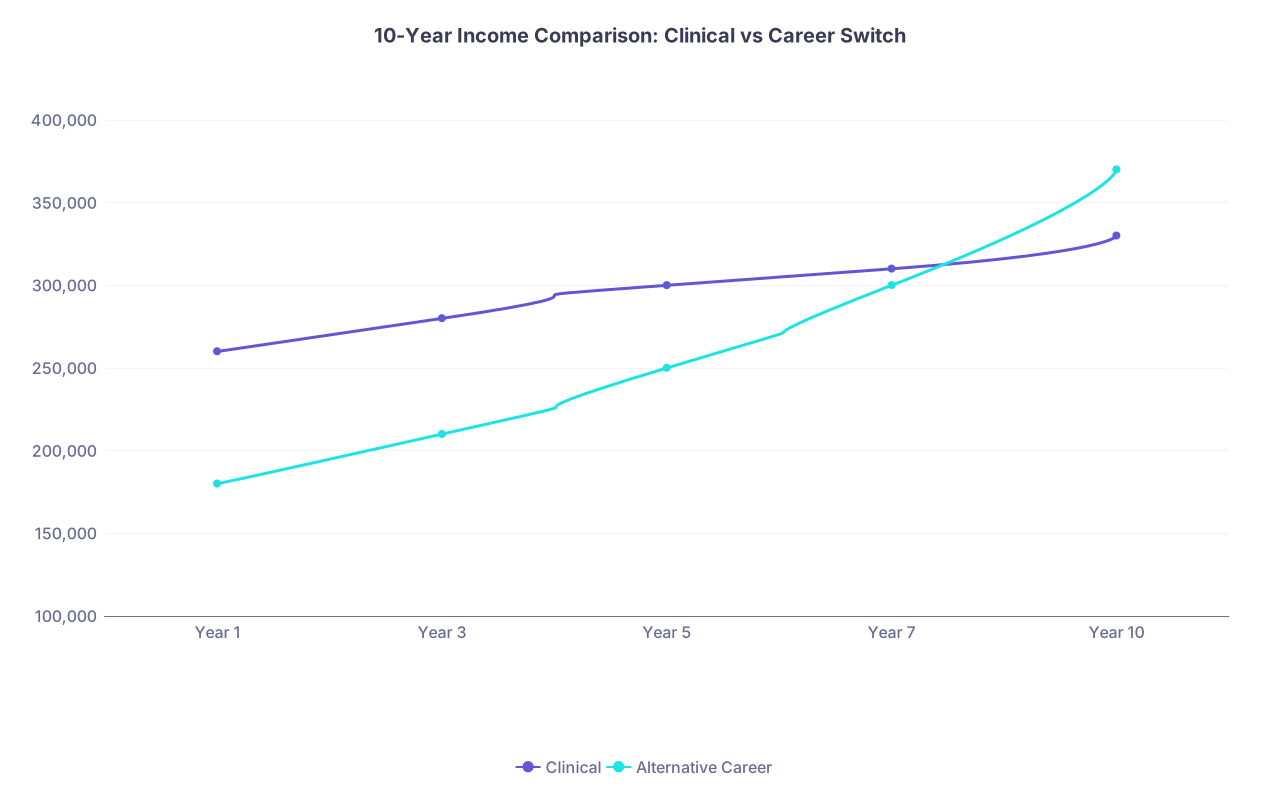
| Category | Clinical | Alternative Career |
|---|---|---|
| Year 1 | 260000 | 180000 |
| Year 3 | 280000 | 210000 |
| Year 5 | 300000 | 250000 |
| Year 7 | 310000 | 300000 |
| Year 10 | 330000 | 370000 |
Your actual future probably won’t match either line perfectly. That’s not the point. The point is: a smaller salary in Year 1 does not automatically mean lower lifetime earnings.
Step 3: Protect the Downsides You Can’t Afford
There are some fails you just can’t take on the chin:
- Losing health insurance for your family.
- Defaulting on loans or wrecking your credit.
- Running out of cash with no plan B.
- Burning bridges in your current field so you can’t go back.
So you build in guardrails:
- Don’t quit until you have 6–12 months of expenses in cash (or at least a brutally honest fallback plan).
- Keep your license and CME up‑to‑date for at least a few years post‑transition.
- Negotiate part‑time or per‑diem clinical work while you test a new field.
- Talk to a real financial planner who understands high‑debt, high‑income professions, not a generic advisor.
Specific Red Flags That Mean “Don’t Jump Yet”
If any of these are true, I’d be nervous about you making a big switch right now:
- You have less than 3 months of living expenses saved and no flexible support system.
- You have no idea what your minimum monthly number actually is (mortgage, loans, food, insurance, basics).
- Your entire plan is, “I’ll figure it out once I leave; I just can’t take this anymore.”
- You haven’t talked to a single person in the field you want to move into.
- You’re avoiding opening your loan portal because it makes you nauseous.
Career change from medicine isn’t a cute “follow your passion” Instagram move. It’s a calculated financial and professional shift. If you’re going to be scared (and you will be), at least be scared of the right things.
But What About Going Back If It Fails?
This is one of the most persistent, late‑night, anxiety‑loop questions: “What if I switch and then can’t get back into clinical work?”
Reality check:
- If you keep your license, CME, and some minimal clinical involvement (per‑diem, locums), your path back is much easier.
- The longer you’re totally out of clinical, the harder it is to return—and the more you’ll likely have to accept less‑ideal roles or retrain a bit.
- Hospital systems and groups are desperate for warm bodies in many specialties. A 2–3 year side quest into industry is not an automatic death sentence.
What does ruin your ability to go back?
- Leaving in a blaze of drama, burning every bridge.
- Letting your license and certifications lapse entirely with no plan.
- Being out for 5–10 years and having no recent experience, references, or CME.
If this is your worst fear, structure your transition so that “going back” is a realistic plan B, not just an emotional fantasy.
Quick Reality Check: What’s Actually Scarier?
Let me put two futures side by side. Both are a little scary.
Future A:
- You stay clinical.
- Your income is stable but you’re progressively more miserable.
- In 5–7 years, you cut to 0.6 FTE because you can’t handle full‑time.
- You wonder if you missed your window to pivot.
Future B:
- You plan for 12–18 months.
- You save aggressively, maybe pick up extra shifts short‑term.
- You make a controlled jump into a lower‑pay but scalable role.
- The first year stings. You feel exposed and insecure.
- In 3–5 years, your income is stable or higher, and you actually like your life.
Neither is guaranteed. But pretending A is “safe” and B is “insane” is just fear talking.
FAQ (Exactly the Stuff You’re Probably Still Worried About)
1. How much of a pay cut is “too much” to make a career switch worth it?
There isn’t a magic number, but I start getting very uneasy when:
- The new salary can’t cover your bare-bones required monthly expenses without dipping into savings, and
- You don’t have at least 6–12 months of cash buffer.
A 20–40% pay cut can be survivable and even smart if:
- You’ve cleaned up lifestyle creep,
- You have runway saved, and
- There’s real potential for growth in the new field.
A 60–70% cut with no savings and big fixed costs (mortgage, private school, loans) is usually a “not yet,” not a “never.”
2. Is it stupid to leave a high-paying clinical job before my loans are gone?
Not automatically. But you can’t wing it.
It’s risky if:
- Your repayment plan is built for a $300k income and you’re about to drop to $150–180k with no changes.
- You’re mid‑PSLF and leaving a qualifying employer without a strategy.
- You’re in denial about how much your payment will hurt at a lower income.
It’s manageable if:
- You re‑run the numbers on REPAYE/other IDR plans before you jump.
- You build your emergency fund specifically with your new payment in mind.
- You consider timing your move around key loan milestones (e.g., hitting 10 years of PSLF).
3. What if I switch and the new career doesn’t work out financially?
This is the nightmare scenario. So build structured exits:
- Keep some clinical involvement for the first few years.
- Don’t let your license or certifications lapse.
- Set a time horizon: “If by 24–36 months I’m not at $X or on track to get there, I reassess.”
- Keep good relationships with former colleagues and institutions—they’re your re‑entry doors.
The bigger risk isn’t “it doesn’t work and I’m permanently ruined.” It’s drifting for 5–7 years in a mediocre alternative path without ever running the numbers or making a deliberate call.
4. How do I know if I’m being financially cautious or just paralyzed by fear?
You’re cautious if:
- You’ve actually made a spreadsheet modeling your worst‑case transition.
- You’ve talked to people in the field and understand realistic salary ranges.
- You have a tangible savings target and a rough timeline.
You’re paralyzed if:
- You refuse to look at the numbers and just say “it’s impossible.”
- Every scenario you imagine is catastrophic and vague.
- You’ve been “thinking about leaving” for 3+ years with no concrete steps taken.
If your anxiety goes down when you look at real data, that’s caution. If it spikes and you slam the laptop shut, that’s fear running the show.
5. Is it ever financially smarter to stay miserable?
Yes. Sometimes.
If you’re:
- 1–3 years from a major financial milestone (PSLF, big equity vest, paying off huge high‑interest debt),
- Completely unprepared savings‑wise, with truly no safety net,
- Or supporting dependents with serious medical or educational needs…
…then gritting your teeth for a time‑limited, clearly defined period can be rational. But that’s different from “I’ll just suck it up forever.”
Smart misery has:
- An end date,
- A specific financial target,
- And a parallel plan for what comes after.
Endless misery “because money” is usually just fear dressed up as responsibility.
Key Takeaways:
- The scary part of switching careers isn’t just the initial pay cut—it’s the unplanned transition gap, loans, and benefits you didn’t account for.
- Staying in a high‑pay, high‑misery clinical job has its own massive financial risks: burnout, reduced hours, and missed chances to pivot.
- If you’re going to be afraid (and you will be), at least do it with real numbers, a concrete worst‑case plan, and a clear idea of what you’re trading for the chance at a more sustainable life.