
The most dangerous consulting contracts for physicians are not the blatantly bad ones—they’re the almost fine ones you sign too quickly.
If you plan to do consulting—industry, expert witness, telehealth advising, startups, pharma, device companies—you cannot treat contracts like just another consent form. That’s how smart physicians end up underpaid, overexposed, and legally trapped.
Let’s walk through the red flags physicians routinely miss and how to avoid getting burned.
1. “Quick Review” Trap: Rushing to Sign Without Real Protection
I’ve seen this over and over:
Company emails you a “standard consulting agreement.”
They say, “It’s boilerplate, all our consultants sign this.”
You glance at the rate, scan for obvious nonsense, and sign between patients.
That’s the first mistake.
Common rushed-sign red flags:
- No clear scope of work (SOW)
- Vague payment language
- No clear termination rights
- IP and non-compete clauses buried on page 7
- Arbitration in a state you’ve never lived in
If a company pressures you to “turn it around today” or “by COB,” assume there’s something they’d rather you not notice.
Here’s the rule: if they can wait months for regulatory approval, they can wait 48–72 hours for you to have a lawyer review the contract.
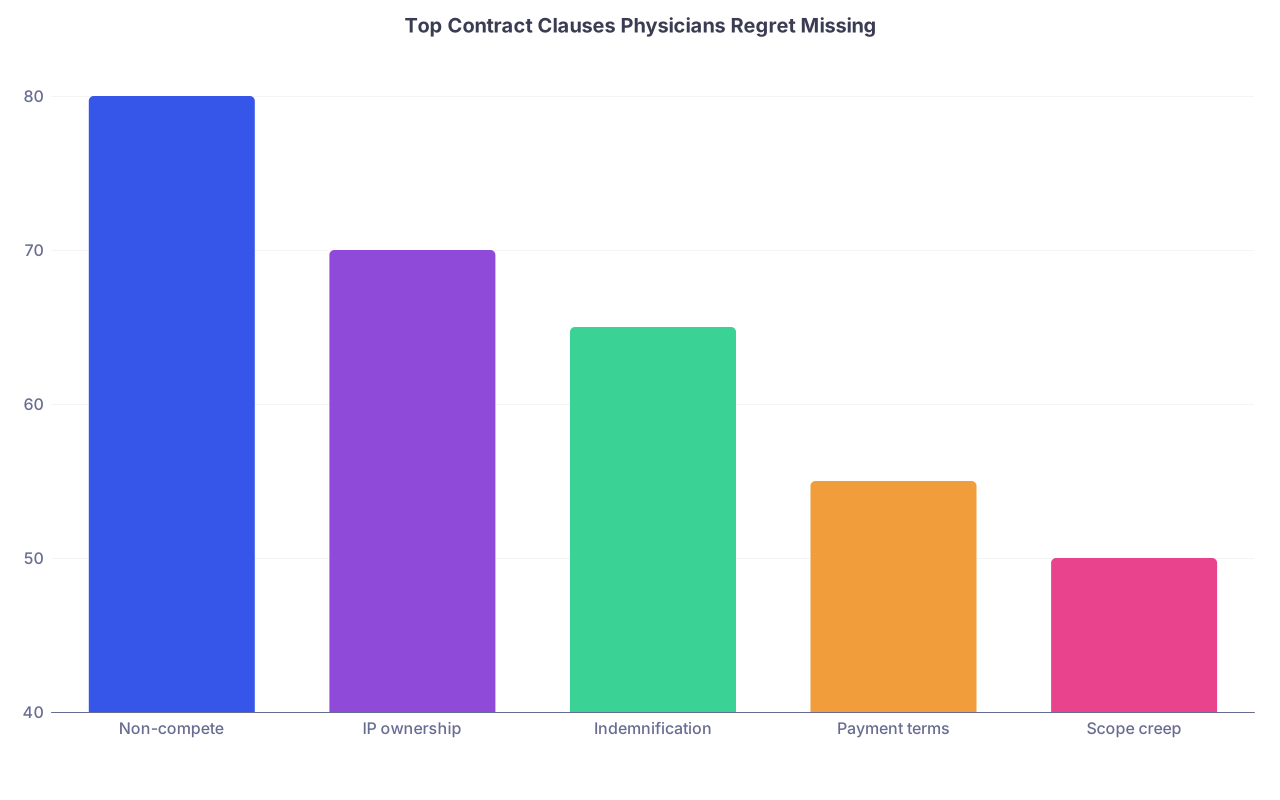
| Category | Value |
|---|---|
| Non-compete | 80 |
| IP ownership | 70 |
| Indemnification | 65 |
| Payment terms | 55 |
| Scope creep | 50 |
Those numbers are not theoretical. The majority of physician consultants I’ve talked to regret not pushing back on those exact items.
Don’t make this mistake:
If you’re doing more than a one-off 30-minute advisory call, treat the contract like a procedure consent: read every line, ask questions, and document clarifications in writing.
2. Compensation Clauses That Quietly Shortchange You
The number one thing physicians look at first? Hourly rate.
The number one way they get screwed? Everything around the hourly rate.
Vague or manipulable “hour” definitions
Watch for language like:
- “Billable hours shall be those pre-approved by Company.”
- “Time will be rounded to the nearest half-day.”
- “Consultant shall submit invoices after acceptance of work.”
Translation: they can decide after the fact what they’ll actually pay you for.
You want language that clearly states:
- How time is tracked (15-min increments, 30-min, etc.)
- That you bill for prep time, emails, and meetings (if that’s agreed)
- That your approval, not theirs, determines time worked—subject to a reasonable cap if needed
Hidden caps and “all-in” language
The trickier part is hidden limits like:
- “Compensation shall not exceed $X per calendar year.”
- “Consultant agrees that the Fee covers all services under this Agreement.”
- “No additional compensation will be due for ancillary services.”
You think you’re getting $400/hour.
They think they’re getting 40 hours and unlimited follow-up emails for a flat fee.
Net 60, net 90, or “pay when paid”
Another quiet insult: payment terms.
Watch for:
- “Net 60” or “Net 90” payment terms
- “Company shall remit payment after receipt of funds from its client” (pay-when-paid)
- Requirements for elaborate invoice formats with vague rejection rights
If you’re not a bank, don’t lend them money with your time.
Better structure:
- Net 15 or net 30, tops
- Explicit late payment interest (even if they never pay it, it signals you’re serious)
- Clear process: invoice monthly, paid by a stated method (ACH preferred)
3. The IP Landmine: Who Owns What You Create
Physicians massively underestimate this one.
You draft some slides. You refine a protocol. You help shape product features. In your mind, it’s “just consulting.” In their contract, it’s “work for hire”—they own it all.
Here’s the key problem:
Overreaching IP clauses can swallow your future opportunities.
Common red flags:
- “Consultant hereby assigns to Company all intellectual property of any kind conceived during the term of this Agreement.”
- “Including but not limited to any ideas, concepts, methods, processes whether or not reduced to writing.”
- “Consultant agrees that all Deliverables and any related know-how shall be the exclusive property of Company.”
That “any ideas, concepts, methods” language? That’s how you accidentally give away:
- A documentation framework you later want to use in a course
- A unique triage algorithm you’d like to implement in your own startup
- Educational materials you planned to reuse for other clients

What to push for:
- Limit IP assignment to specific deliverables: “slides created for X project,” “written reports,” etc.
- Carve out your pre-existing IP: anything you developed before the contract or outside of it
- Retain the right to use generalized knowledge and methods in the future
A reasonable clause acknowledges that you can use your clinical and consulting experience elsewhere. If it reads like they own your brain, it’s a red flag.
4. “You’re the Fall Guy”: Indemnification and Liability
Here’s where things go from annoying to career-threatening.
Many contracts try to flip liability onto you. Quietly. With language that looks harmless until there’s a lawsuit.
Watch for phrases like:
- “Consultant agrees to indemnify and hold harmless Company from any and all claims arising out of Consultant’s services.”
- “Consultant shall be solely responsible for any claims related to advice provided.”
- “Consultant shall maintain appropriate insurance and assume all risk related to the services.”
This sounds reasonable… until you realize:
- You’re not just responsible for malpractice-level clinical advice.
- You might be on the hook for product decisions you advised on, marketing claims that quoted you, or implementations you never even saw.
- Their lawyers wrote this to protect them, not you.
Compare two scenarios:
| Clause Type | Risk Level |
|---|---|
| Mutual, limited | Low |
| Consultant-only | High |
| Broad, undefined | Extreme |
| Tied to negligence | Moderate |
| No indemnification | Lowest |
Better structure:
- Mutual indemnification: each party is responsible for its own negligence or misconduct
- Your liability limited to:
- Gross negligence
- Intentional misconduct
- Breach of confidentiality
- Explicit statement that:
- You are not responsible for their use of your advice without your final review.
- You are not responsible for downstream business decisions.
Also: make sure the insurance required is realistic. If they demand coverage types you don’t carry (like specific tech E&O coverage) without discussing it, that’s a red flag they’re pushing risk downhill.
5. Non-Competes and Restrictive Covenants That Box You In
This is where physicians get trapped and angry.
You sign a “simple” consulting agreement. Six months later you want to consult for a similar startup or join a competitor’s advisory board. Suddenly you’re in violation.
The worst part? The non-compete didn’t even look that bad at first glance.
Common tricks:
- Overbroad scope: “any business that is competitive with Company’s current or future products or services”
- Huge geography: “anywhere in the United States” (or worldwide)
- Long duration: “for two years following termination”
- Vague roles: “in any capacity including advisor, consultant, officer, director, employee, or contractor”
For a physician consultant, that can mean:
- You can’t advise any telehealth platform if you consulted for one.
- You can’t work with any AI triage tool if you consulted for one.
- You can’t even do unpaid advisory work or sit on a board.
You are selling limited time and expertise. Not your entire future.
Reasonable restrictions:
- Narrow scope: specific product line or clearly defined market segment
- Reasonable duration: 6–12 months after the project ends
- Reasonable geography (or, better, no geography—just limited to named competitors)
If they refuse to narrow it, that tells you everything about how they see you: disposable labor, long-term control.
6. Sloppy or Predatory Confidentiality and Publication Clauses
You should expect to sign an NDA. That’s not the problem. It’s how they define confidentiality and what they do to your right to speak, publish, or teach.
Red flags in confidentiality clauses:
- No time limit on confidentiality. “In perpetuity” is excessive for most business info.
- Labeling everything as confidential, including things that are already public or clearly general knowledge.
- No carve-out for your own pre-existing knowledge or similar ideas developed independently.
Then there’s the gag order problem.
I’ve seen:
- “Consultant shall not publish, present, or otherwise disclose any information or learnings related to the services without Company’s prior written consent.”
- “Consultant shall not identify Company, the services, or any related subject matter in any teaching, courses, or presentations.”
That might be acceptable if you’re being very highly compensated and you want deep secrecy. For most physicians, it’s overreach.
Reasonable modifications:
- Confidentiality limited to truly proprietary information: trade secrets, non-public financials, unreleased products
- Time limit (e.g., 3–5 years after termination)
- Explicit carve-out that allows you to:
- Use de-identified, generalized learnings in teaching or writing
- Reference your role in your CV or bio
If you’re doing meaningful thought-leadership work, broad no-publication clauses can quietly erase a lot of long-term career benefit.
7. Termination Traps and “We Can Walk, You Can’t”
You need a clean exit path. Period.
Common one-sided clauses:
- Company can terminate “for any reason with or without cause” on short notice (10–30 days).
- Consultant can only terminate “for material breach” with cure periods.
- No payment guaranteed for work in progress if they terminate before formal acceptance.
This is how you end up:
- With blocked calendar time for a project that suddenly vanishes.
- Unpaid for partially completed work because it wasn’t “accepted.”
- Trapped in a toxic relationship because you technically have no right to exit.
Better structure:
- Mutual termination for convenience, with equal notice (e.g., 30 days)
- Clear payment obligations:
- All time worked up to termination
- Any non-cancellable commitments you made in reliance on the contract (within reason)
- No requirement that payment hinges solely on “acceptance” if you’ve delivered what was agreed
You should never be in a position where continuing feels unsafe or unethical but you’re contractually locked in. If the contract says otherwise, fix it or walk.
8. Jurisdiction, Dispute Resolution, and the “You’ll Never Sue Us” Problem
Physicians usually skim this section. Big mistake.
What matters:
- Governing law: which state’s laws apply
- Venue: where disputes must be litigated or arbitrated
- Arbitration vs litigation: how you’ll fight if things go bad
Red flags:
- Governing law and venue in a state with no connection to you, chosen solely for their convenience (or favorable laws).
- Mandatory arbitration in their home city with fees you’d never realistically pay to fight a $5,000 non-payment.
- Clauses forcing you to cover their attorney fees in most disputes.
Remember: these sections are often designed to make it too painful or expensive for you to contest anything.
More balanced approach:
- Governing law: your state, their state, or a neutral compromise—but something logical
- Venue: ideally your state or at least not exclusively theirs
- Arbitration: if used, with shared costs and reasonable location
The test is simple: if they breach the contract in a meaningful way, could you realistically pursue it? If not, you’re relying entirely on their goodwill.
9. Scope Creep Disguised as “Reasonable Requests”
Scope creep doesn’t always show up as a clear sentence. It sneaks in through vague language:
- “Consultant shall provide such additional services as reasonably requested by Company.”
- “Consultant will be available to respond to emails and ad hoc calls as needed.”
- “Consultant shall assist with marketing, sales, or business development activities when requested.”
That innocent “as needed” becomes:
- Night and weekend calls
- Unpaid prep for investor meetings
- Feedback on 15 product iterations when you thought you were doing 2

| Step | Description |
|---|---|
| Step 1 | Sign Contract |
| Step 2 | Initial Scope Clear |
| Step 3 | First Extra Request |
| Step 4 | Unpaid Calls and Emails |
| Step 5 | Expectation of Always On |
| Step 6 | Resentment and Burnout |
Prevent this by:
- Defining scope specifically: number of calls, estimated hours, type of work
- Stating what’s not included: e.g., no clinical care, no direct patient advice, no billing/reimbursement coding
- Requiring written agreement (including compensation) for additional services outside scope
If they push back with “we just need flexibility,” translate that as “we want free labor and blurred boundaries.”
10. Compliance, Stark/AKS, and Ethical Red Flags
Consulting doesn’t magically exempt you from healthcare law and ethics.
You should be wary when:
- Your compensation seems tied, even informally, to:
- Patient referrals
- Prescribing patterns
- Product usage metrics from your own practice
- They ask you to:
- Present their product as part of your usual patient education without clear disclosure
- Use your hospital/clinic platform to promote them
- Share de-identified patient data informally
Red flag phrases:
- “We’d love to see increased adoption in your practice.”
- “We expect our consultants to be champions of the product with their patients.”
- “It would be great if you could encourage colleagues to use it too.”
Legitimate consulting focuses on:
- Product design
- Clinical feedback
- Advisory input
- Formal speaking with clear disclosures
If it smells like a kickback or pay-to-prescribe scheme, walk away. No contract tweak is worth a license investigation.
11. How to Protect Yourself Without Torching the Relationship
You do not need to act like an adversary. But you do need to stop acting like a passive signee.
Core protections you should consider non-negotiable:
- Clear, written scope of work
- Transparent, enforceable payment terms
- Reasonable IP rights that don’t swallow your entire career
- Limited, mutual indemnification
- Narrow, time-limited non-competes (or none)
- Mutual termination rights
- Fair jurisdiction and dispute resolution
When you push back professionally, good companies respect it. The ones that don’t? Those are often the ones you would have had problems with later anyway.
FAQs
1. Do I really need a lawyer for every small consulting contract?
For a single one-hour panel at $500? Probably not. For anything ongoing, or anything involving IP, non-competes, or substantial money—yes, at least once. You can even have an attorney develop a standard “physician-favorable” addendum you reuse and adapt. The first time you avoid a bad deal, it will pay for itself.
2. Can I just sign their NDA first and worry about the rest later?
Be careful. Some NDAs are harmless; others already contain IP assignment or non-compete language masquerading as “confidentiality.” Read it in full. If it’s more than 2–3 pages or includes anything beyond confidentiality, slow down and review properly before signing.
3. What if they say, “We don’t change our standard contract”?
That’s a choice they’re making, and you can make yours. You can respond with, “I can’t accept these specific clauses as written, so I’ll need to pass this time.” Companies that truly value your expertise often “suddenly” discover they can modify boilerplate when a physician holds their ground.
4. Is it better to use my own consulting agreement instead of theirs?
Often yes. If you do enough consulting, have an attorney draft a physician-centric template and offer that as a starting point. Some companies will still insist on using theirs, but you’ll at least be negotiating from a much stronger base instead of from their wish list.
Remember:
Most consulting contract pain comes from what you didn’t read, didn’t question, or assumed was “standard.”
Do not trade your future flexibility, IP, and legal safety for the convenience of signing fast.
If a clause makes you pause, that’s your signal: slow down, ask, and protect yourself before you put your name on it.