
It’s 11:47 p.m. You’re post-call, half-braindead, staring at a half-written note in Epic and an open McKinsey recruiting page on your phone. Your co-resident just matched GI. Your attending is talking about you as “future cardiology material.” And you’re…looking at management consulting.
And the loop in your head is vicious and loud:
“If I talk to consultants now, am I basically telling the universe I’m not serious about fellowship?”
“If programs find out, will they blacklist me?”
“Can I even consider this without burning the bridge to subspecialty forever?”
Let me say it bluntly: you’re not the only one quietly stalking the consulting pages between admissions. I’ve seen residents do it in the workroom between pages, MS4s do it on sub-I’s, even fellows sneak peeks during slow call nights. You’re not weird. You’re just honest enough to admit you’re curious.
But the fear is real: can exploring consulting hurt your chances for fellowship later?
Let’s untangle this in a way that matches what actually happens, not the scare-stories you hear in the call room.
What Fellowship PDs Actually Care About (Versus What You’re Imagining)
You’re imagining a program director sitting there with a spreadsheet that says:
“Column J: Has this applicant ever looked at consulting?”
“If yes → reject immediately.”
That’s not reality.
Program directors care about a small set of things way more than anything else:
| Priority Area | Examples |
|---|---|
| Clinical strength | Rotations, letters, reputation |
| Career alignment | Personal statement, interviews |
| Academic output | Research, QI, presentations |
| Commitment signals | Electives, mentorship, projects |
| Professionalism | No red flags, solid reputation |
Where does “once considered consulting” fall on that list? Literally nowhere. Unless you shove it in their face in a way that makes them question your commitment.
Here’s the key distinction most people miss:
Exploring options privately ≠ branding yourself as non-clinical publicly.
Most PDs don’t care that you once thought about consulting. They care if you show up at interview saying things like, “I really like cardiology but I also might leave in two years to do pharma or consulting; not sure yet.” That’s the death sentence, not your secret case interview practice last year.
Ways Consulting Exploration Can Backfire (If You’re Not Careful)
Let me walk straight into the nightmare fuel first. Yes, there are ways this can actually hurt you. But they’re behavior choices, not the fact that you’re curious.
You risk problems if:
You start blowing off clinical work for consulting prep
You cancel shifts, show up disengaged, or are constantly “on a call” with recruiters. Attendings notice. Residents notice. “Brilliant but not really committed to medicine” is a kiss-of-death sentence in a letter.Your narrative becomes incoherent
On your ERAS or fellowship app you say you’ve “always been passionate” about academic GI and research… but there’s no research, no GI electives, no GI mentors, and instead you took a random 6-month leave to “explore business opportunities” that you can’t explain cleanly. That mismatch raises flags.You tell the wrong people the wrong way
Saying to a PD or big-name attending, “Honestly, I’m not sure I even want to practice clinical medicine long-term, I’m thinking maybe consulting,” during your key fellowship-mentorship phase? Yeah. That can absolutely change how invested they are in you.You put consulting front and center on your official story
You make your LinkedIn screaming “Future Strategy Consultant” while your ERAS screams “Future Academic Oncologist.” People Google you. They compare stories. Inconsistency = doubt.
The problem isn’t the curiosity. It’s broadcasting mixed signals in professional spaces that are built entirely on the assumption of commitment and continuity.

Quiet Exploration vs Public Pivot: Huge Difference
This is the line you really care about:
Can you quietly explore consulting now and still be a viable fellowship applicant later?
Yes. If you treat consulting exploration like you’d treat dating apps while in a vague situationship: discreet, not on the group chat, and not brought to dinner with your parents.
Here’s what “quiet exploration” looks like:
You talk to a couple of alums who went into consulting.
You go to a Zoom info session with BCG or LEK.
You dabble in case interviews on PrepLounge or with friends.
You maybe attend a weekend workshop on “physicians in non-clinical careers.”
You don’t blow up your attendance, documentation, or reputation to do it.
None of that shows up in your fellowship file unless you choose to make it show up.
Fellowship apps do not have a question that says: “Have you ever briefly panicked and considered non-clinical work at 2 a.m.?” If they did, every honest resident would check “yes.”
The Scenarios Everyone Freaks Out About
Scenario 1: You Actually Go to Consulting First, Then Want Fellowship
This is the big one people whisper about:
“What if I do 2–3 years at McKinsey/Bain/BCG, then decide I miss medicine and want heme/onc or GI? Am I dead?”
No. But it gets trickier, and it depends heavily on how you left and how you come back.
Here’s what programs will ask themselves:
- Did you complete residency and become board certified?
- Did you maintain some clinical connection or at least not let your skills rot?
- Can you clearly explain why you left and why you’re coming back now?
- Do your letters from residency still speak highly of you?
- Do you now have a compelling angle (healthcare operations, outcomes, value-based care, etc.) that adds to the specialty rather than looks flaky?
I’ve watched people do this successfully: IM → 2 years consulting → cardiology fellowship. Or surgery prelim → consulting → then later apply FM or IM. It’s not fantasy; it just requires a coherent story and some humility.
Where folks get burned is:
They left residency early in a messy way (“personality conflict,” borderline professionalism issues), disappeared for years, then showed up wanting competitive fellowship with no recent clinical activity. That’s rough.
If you complete your core training, leave on good terms, keep some clinical relevance (PRN work, occasional locums, CME, etc.), and re-enter with a strong narrative and support, it can absolutely work.
Scenario 2: You Don’t Go to Consulting, You Just Interview
“Will fellowship programs see that I applied to McKinsey?”
No. There’s no shared database where consulting firms report your name to ACGME like some career credit bureau. The only way a PD knows is if:
- You tell them
- Your mentor casually mentions “Yeah they were thinking about leaving for consulting last year” in a letter or in person
- You publicly plaster it on LinkedIn or Twitter
Interviewing with consulting firms doesn’t magically tag your ERAS file. It’s like flirting with another job in any field: only risky if your current boss hears about it in the wrong way, at the wrong time, and framed the wrong way.
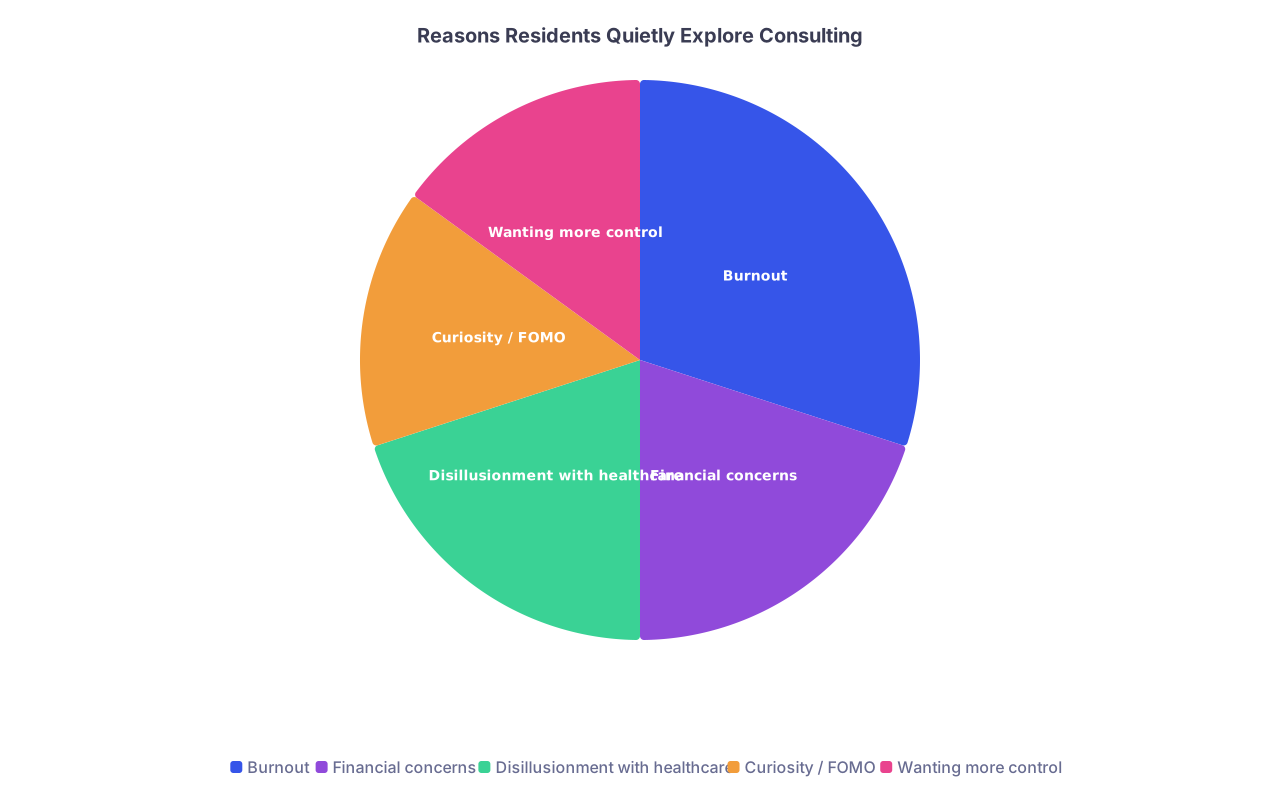
| Category | Value |
|---|---|
| Burnout | 30 |
| Financial concerns | 20 |
| Disillusionment with healthcare | 20 |
| Curiosity / FOMO | 15 |
| Wanting more control | 15 |
How To Explore Consulting Without Sabotaging Fellowship
You can absolutely do both: keep the fellowship door open while you investigate whether you even want to walk through it.
Think of it like parallel tracks:
Track A: Build a credible fellowship profile
Track B: Quietly gather data about consulting
Track A means you still:
- Show up clinically. Your reputation on the wards is your currency.
- Get at least one strong subspecialty mentor.
- Do some scholarly thing in the field (even a small QI project or single abstract).
- Choose electives that vaguely align with your potential fellowship interests, not ones that scream “I checked out of medicine.”
Track B means you:
- Talk to alumni and colleagues who actually did consulting, not just people on Reddit.
- Attend a couple of recruiting events or webinars.
- Maybe try a case prep group if you’re serious.
- Keep this off your residency group text and away from the loudest, gossipy attending.
If someone you trust asks, “Are you thinking about leaving medicine?” you can be honest without tanking yourself. Something like:
“I’m committed to finishing my training and I still like [specialty]. But I’m also curious about how physicians work on the systems side, so I’ve been talking to a few people in consulting to understand what’s out there. I want to make an informed decision instead of reacting out of burnout.”
That frames you as thoughtful, not flaky.

The Part No One Says Out Loud: People at the Top Explore Too
Here’s what you don’t see when all you look at are Instagram “Matched to Cardiology!” posts:
The resident with the insane research CV and perfect letters? Half of them took a McKinsey PST practice exam “just to see.”
The PGY-3 chief track person? They had a 30-minute call with a friend in pharma last month.
That star fellow who’s clearly on track for faculty? They went to a “physicians in industry” dinner during their second year.
Exploration does not equal disloyalty. It equals being awake to the reality that medicine is not the monolithic, safe, noble path we were sold when we were 21.
Fellowship PDs know this. A lot of them sit on hospital committees with consultants. Some of them have kids or partners in consulting. Some are quietly planning their own exit into industry.
They might not love hearing, “I’m applying here as a backup while I’m really trying for Bain,” but they’re not shocked that you know Bain exists.
Red Flags You Should Worry About (Because PDs Do)
Instead of obsessing about whether “considering consulting” itself is bad, focus on the things that actually tank people:
- Chronic unreliability: late notes, missed pages, frequent sick calls that magically line up with your case interview schedule
- Mixed messaging: telling one mentor you’re 100% dedicated to transplant hepatology while your personal statement appears generic IM with zero hepatology anything
- Awkward explanations: “I took 9 months off to figure my life out,” with no coherent narrative, no references, and no productivity
- Bad-mouthing medicine: sounding bitter and contemptuous of clinical work in letters, interviews, or casual conversations that get back to leadership
Those are the things that make PDs think, “This person is going to leave halfway” or “This person is toxic,” which is way more concerning than “they once flirted with non-clinical careers.”

| Step | Description |
|---|---|
| Step 1 | Curious about consulting |
| Step 2 | Maintain strong clinical performance |
| Step 3 | Build subspecialty profile |
| Step 4 | Quietly explore consulting |
| Step 5 | Consider full pivot to consulting |
| Step 6 | Apply with clear narrative |
| Step 7 | Apply and leave on good terms |
| Step 8 | Want fellowship option open? |
| Step 9 | Choose later |
The Honest Risk Assessment
Let me be unemotional for a second and answer the core question:
Can exploring consulting hurt your chances for fellowship later?
- Exploring privately, while maintaining strong performance and a coherent clinical story → basically no, not in any meaningful way.
- Publicly pivoting hard, trashing medicine, then later trying to walk it back → yes, that can absolutely hurt you.
- Leaving residency half-finished in a messy way, disappearing into consulting, then expecting to walk into a hyper-competitive fellowship → that’s an uphill battle and you’ll need a very careful strategy.
The real “danger” isn’t curiosity. It’s visible ambivalence at the exact moment people are deciding whether to invest limited fellowship slots in you.
So if you want fellowship later, then while you’re still in the pipeline, keep your public identity: “Dedicated clinician who might someday work on systems-level improvements.” You can still, in your private brain and browser history, be: “Also googling ‘consulting case examples’ at 1 a.m.”

FAQs
1. If I put an MBA or business coursework on my CV, will fellowship PDs assume I’m headed to consulting?
Not automatically. I’ve seen plenty of people get into GI, cards, heme/onc, anesthesiology with MBAs or health policy degrees. The key is how you frame it. If your personal statement and interviews make it clear you want to be the person improving care delivery, running value-based programs, or leading quality for your subspecialty, PDs often see that as a plus. If instead you sound like you’re using fellowship as a stepping stone to leave clinical work ASAP, that’s where they start to worry.
2. Should I hide all non-clinical interests when I talk to mentors?
No, but you need filters. There are mentors who are rigidly “clinical or bust” and will see anything else as betrayal. There are others who are surprisingly pragmatic and will help you think through options. Start with people who’ve shown some openness to systems work, research, admin, or industry collaborations. Frame it as wanting to understand all the ways physicians can impact healthcare, not “I’m over medicine and want out.”
3. What if a consulting interview conflicts with a clinical shift or conference?
This is where people quietly blow up their reputation. Don’t lie, don’t fake being sick, don’t leave your co-residents scrambling so you can impress a firm that might ghost you anyway. If you truly must miss something, handle it professionally: schedule PTO if possible, swap shifts well in advance, and don’t be vague in a way that makes people suspicious. A single awkward day off won’t ruin you. A pattern of sketchy behavior will.
4. Can I talk about my consulting interest in a fellowship interview if they ask about long-term goals?
Carefully. If you’re applying to fellowship, your primary identity in that room should be someone who actually wants to practice that specialty. You can mention wanting to combine clinical work with “systems-level improvement, possibly including partnerships with industry or advisory roles in the future.” That sounds normal. Saying, “I might just do this for a few years and then go full-time consulting” tells them they’re a temporary stepping stone. Programs don’t like being stepping stones.
5. I already told an attending I was thinking about leaving for consulting. Am I screwed?
Not automatically. What matters most now is how you follow up. If you’ve stabilized, are performing well, and later say, “I was really burned out then; I took time to think, and right now I’m committed to finishing training and pursuing [X fellowship] while keeping an open mind to future ways to contribute,” most reasonable people will accept that. If that attending is writing you a letter, you might want to explicitly clarify your current plans so they’re not guessing and hinting at ambivalence.
6. Is it safer to just ignore consulting completely until after fellowship?
“Safer” in the sense of avoiding any possible perception issue? Maybe. But it’s also how you end up in PGY-6, deep in debt and deeply unhappy, realizing you never seriously examined other paths because you were too scared to look. Quiet, thoughtful exploration now can actually prevent impulsive, desperate exits later. As long as you don’t let exploration undermine your day-to-day performance or turn your story into a confused mess, you don’t have to live in career denial to stay fellowship-viable.
Bottom line:
Your curiosity about consulting doesn’t disqualify you from fellowship.
What matters is how you act while you’re curious, how you perform clinically, and how coherent your story is when you eventually apply.
Protect your reputation. Keep your options. And stop assuming that one late-night click on a McKinsey page just destroyed your future in cardiology. It didn’t.