
What happens if your PD finds out you’ve been looking at non-clinical jobs on LinkedIn instead of UpToDate?
Because that’s the fear, right? Not the generic “I’m curious about options,” but the very specific nightmare: someone screenshots your profile, sends it to your PD, and suddenly you’re labeled “not committed,” “red flag,” “flight risk.”
Let me say this bluntly: you are not the first person in medicine to type “medical affairs jobs,” “consulting with an MD,” or “how to leave clinical practice” into Google at 2 a.m. after a brutal call. You’re just the one worrying you’ll get punished for it.
Let’s unpack how this actually plays out.
What Program Directors Really Care About (And Where You Fit In)
Most program directors are not sitting around stalking your LinkedIn and thinking, “How DARE they explore other careers.” They’re thinking about three things:
- Will you finish the program without melting down or quitting?
- Will you represent the program well (boards, fellowships, jobs, reputation)?
- Are you going to create problems for them—complaints, conflicts, professionalism issues?
Everything else is secondary.
So when you’re asking, “Will PDs judge me for exploring non-clinical careers?” what you’re really asking is:
“Will they see me as:
- not committed,
- likely to leave,
- or a liability?”
The answer depends on three things:
- How you act in the program day-to-day
- How open or cryptic you’re being
- How threatened or enlightened your leadership is
There are absolutely PDs who still believe, “If you’re not 110% committed to traditional clinical medicine, you don’t belong here.” They exist. They’re not a myth.
But there are also PDs who quietly say things like:
- “Look, not everyone is going to be a 30-year clinician, and that’s okay.”
- “If you want to go into industry or consulting, I just want to make sure you’re still doing right by your patients while you’re here.”
I’ve heard both.
Where the Line Actually Is: Private Curiosity vs Program Problem
Exploring options privately? Normal.
Letting non-clinical side hustles tank your performance? Problem.
This is the real dividing line.
If your situation looks like this:
- You show up on time
- Your notes get done
- You’re at least baseline prepared
- You’re not openly miserable, hostile, or disengaged
…then most PDs will not care if you’re quietly exploring non-clinical paths, building a LinkedIn, or talking to people in industry. Even if they suspect it.
What does make them nervous:
- You keep talking about how you “hate clinical medicine” in front of staff, students, or co-residents
- You say things like, “Honestly, I’m probably not going to finish residency”
- You’re distracted enough that your work quality, exams, or patient care are slipping
- Nurses, attendings, or co-residents start saying, “They’re really checked out lately”
That’s when “exploring alternatives” becomes “red flag” in their head.
How Risky Are Different Non-Clinical “Signals”?
Let’s be very literal about this, because anxiety loves vagueness.
| Activity / Signal | Likely PD Reaction |
|---|---|
| Private job searching, no impact on work | Mostly neutral / unaware |
| LinkedIn updated with vague “open to work” | Mild curiosity, rarely action |
| Side project clearly non-medical but small | Mild interest, often positive |
| Constantly talking about quitting | Major concern |
| Moonlighting non-clinical, work slipping | Big professionalism red flag |
Do some PDs dig into your online presence? Yes, especially at the hiring stage.
Do most actively surveil your mid-residency LinkedIn? No, they’re too busy trying to fix the schedule and deal with accreditation.
The scarier (and more realistic) route things get to your PD is not the internet. It’s people:
- A co-resident tells the chief: “They keep saying they want to leave medicine.”
- A nurse complains: “They said they don’t care, they’re leaving for pharma anyway.”
- An attending writes: “Seems disengaged, openly talking about leaving mid-year.”
That’s how reputation really spreads. Not because you clicked “follow” on some healthcare consulting firm.
Should You Tell Your PD You’re Interested in Non-Clinical Careers?
This is the terrifying question.
Because there are situations where being honest is useful. But there are also situations where it’s like handing them a loaded weapon and hoping for the best.
I’d break it down like this:
Safer to Share If:
- You’re still planning to finish the program
- You are performing well clinically
- Your PD has shown they’re reasonable, not punitive
- You frame it as: “I want to be a strong clinician first, but I’m also curious about policy/industry/tech/education.”
Something like:
“I really value what I’m learning here and I’m committed to finishing. Long-term, I’m also interested in maybe blending clinical work with something in industry or health tech. If there are electives, projects, or alumni I could talk to who’ve done that, I’d really appreciate your guidance.”
You’re signaling:
- I’m not bailing on you now.
- I respect the training.
- I’m thinking long-term, not impulsively.
Most reasonable PDs will not punish that. Some will actually help.
Much Riskier to Share If:
- You are already struggling academically or clinically
- You’re hinting at leaving early
- You sound like you fundamentally hate medicine and everything about it
- Your PD has a known “all-in or you’re out” mindset
If what you really want to say is, “I don’t know if I even want to be here in 6 months,” saying that to your PD is not a career chat. That’s a “they might start documenting you as ‘at risk’” situation.
In that scenario, talk to:
- A trusted senior resident
- A faculty member known to be supportive
- A therapist
- A mentor outside your direct chain of command
First. Not your PD.
LinkedIn, Side Projects, and the Fear of Being “Found Out”
Let’s go through the specific panic thoughts.
“If I Optimize My LinkedIn, Will They Think I’m Leaving?”
Probably not. Most professionals on earth have a LinkedIn. Many clinicians do too.
Red flags are more like:
- Your headline is “Aspiring ex-physician looking for anything non-clinical”
- You publicly post rants about hating medicine
- You connect with half the leadership of Big Pharma and put “Seeking industry roles ASAP”
A more neutral/safer profile:
- Headline: “Internal Medicine Resident | Interested in clinical care, health policy, and industry innovation”
- Experience: Standard training roles + maybe “Consultant – healthcare data project” or “Founder – small health education initiative”
Reasonable PDs see that and think, “Ambitious, maybe doing something entrepreneurial.” Not, “Time bomb.”
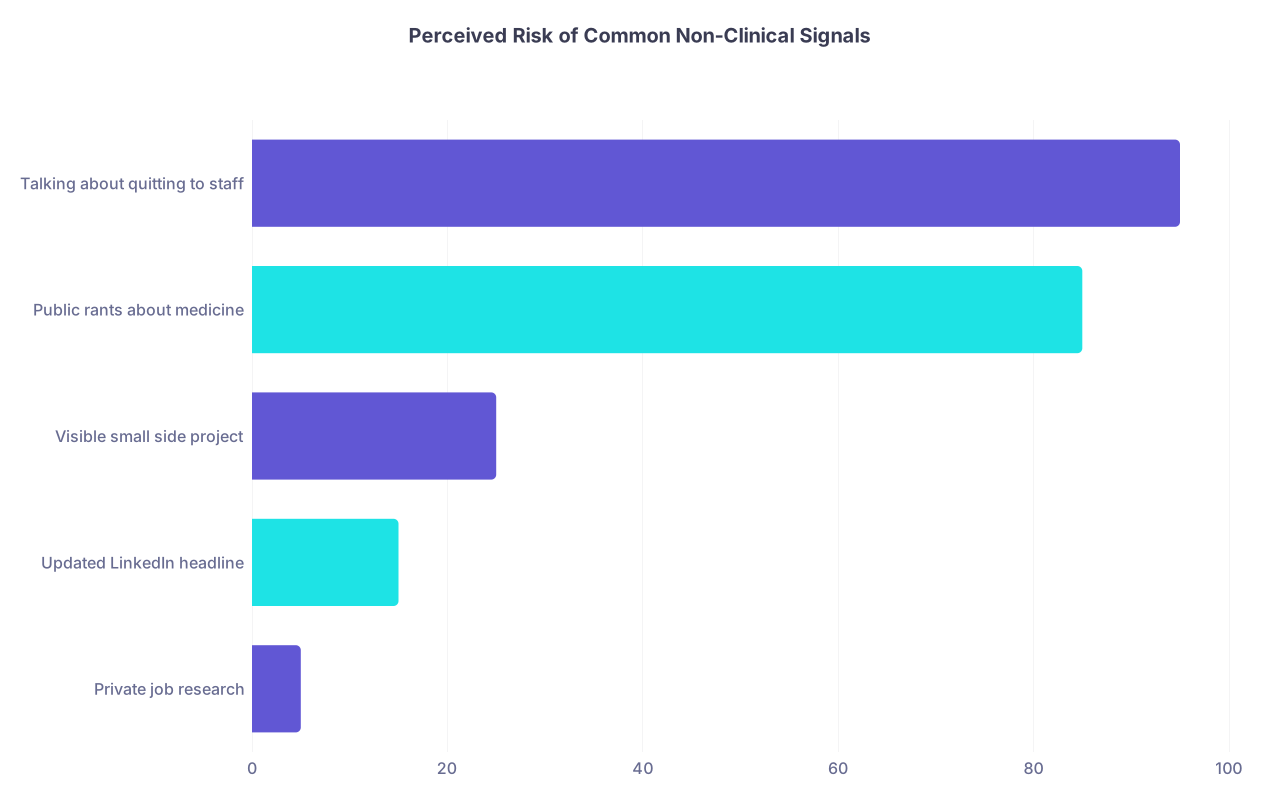
| Category | Value |
|---|---|
| Private job research | 5 |
| Updated LinkedIn headline | 15 |
| Visible small side project | 25 |
| Public rants about medicine | 85 |
| Talking about quitting to staff | 95 |
(100 = almost guaranteed problem, 0 = none. You get the idea.)
“What About Side Gigs?”
PDs care about:
- Duty hour violations
- Moonlighting against policy
- Patient care impact
- Anything that smells like burnout + distraction
So if your side gig:
- Fits into your off hours
- Is allowed by your contract
- Doesn’t show up in your clinical performance
…it’s usually a non-issue. Some PDs will like it if it’s related to health, education, or research. It makes the program look interesting.
The nightmare scenario is:
- You’re chronically late
- Your notes are always unfinished
- Then they find out you’re spending 20 hours a week doing a non-medical remote job
Now your non-clinical interest becomes “unprofessional behavior” in their mind.
Can Non-Clinical Interests Actually Help You?
Yes. If you handle them correctly and don’t torch your clinical performance.
Plenty of PDs secretly like having residents who:
- Understand policy or health systems
- Can build a database or app
- Write well or communicate with the public
- Have business or leadership skills
These things help with QI projects, research, accreditation, community outreach, and grant proposals.
Where trainees get in trouble is when they:
- Talk like they’re “above” clinical work
- Constantly dismiss bedside medicine as meaningless
- Treat their current role as just an annoying stepping stone
If you position your non-clinical interest like:
“I want to be excellent clinically, and I’m also interested in applying that experience to X later on,”
that reads very differently than:
“I’m just trying to survive this until I escape into something ‘real.’”
One builds trust. The other destroys it.
Worst-Case Scenarios You’re Probably Playing Out (And How Likely They Really Are)
Let’s walk through the catastrophic thoughts:
1. “They’ll see my LinkedIn and fire me.”
Firing a resident is a huge deal involving documentation, committees, sometimes lawyers. Nobody is firing someone for having a normal LinkedIn and curiosity about other careers. They fire people for:
- Serious professionalism issues
- Repeated poor performance
- Safety concerns
LinkedIn is not that.
2. “They’ll blacklist me if they know I might leave clinical medicine later.”
Some old-school PDs absolutely have a bias toward the “lifer clinician.” But most are practical. Once you finish and are board-eligible/board-certified, what you do with your career is largely your business.
What they might care about:
- If you start telling junior residents or med students: “Clinical medicine is a scam, don’t do it.”
- If you hurt the program’s reputation after you leave by publicly trashing it.
But quietly transitioning into pharma, consulting, tech, or policy? That’s happening everywhere. They’ve seen it.
3. “If I admit I’m struggling with wanting to quit, they’ll destroy my career.”
This one is more complicated.
If you openly say, “I’m thinking of quitting this year,” yes—that activates a whole different process: remediation, documentation, sometimes fitness-for-duty evaluations. From the program’s standpoint, they have to take that seriously.
But if what you really need is:
- Burnout help
- Therapy
- Time to explore long-term options
You don’t have to phrase it as “I want to quit.” You can say:
“I’m struggling with burnout and trying to figure out my long-term path. I’m committed to finishing the year, and I want to keep doing a good job, but I need support.”
Very different message. Much less likely to trigger the nuclear options.
A Simple Strategy That Lets You Explore Without Self-Destructing
You want room to explore non-clinical careers without getting labeled as “checked out.” So here’s a balanced approach:
Anchor your identity (for now) in being a competent trainee.
Not a superstar. Just solid. Show up. Do the work. Get your charts done. Make it boring for anyone to criticize you.Explore non-clinical paths off the radar but not in a shady way.
Informational interviews. Reading. Online courses. Very low-visibility projects. This is not the time to launch a huge “I’m leaving medicine” brand.Be very careful who you vent to.
Some co-residents are safe. Some will repeat whatever you say to chiefs and attendings by the end of the day. Learn the difference.If you share your interests with leadership, frame it as “both/and,” not “instead of.”
“I want strong clinical training and I’m curious about X for the future.”If your performance slips, fix that before you scale up non-clinical stuff.
Whether fair or not, once you’re “on their radar,” everything else you do gets interpreted through that lens.

| Step | Description |
|---|---|
| Step 1 | Current Trainee |
| Step 2 | Quietly explore options |
| Step 3 | Stabilize performance first |
| Step 4 | Frame as both clinical and non clinical interest |
| Step 5 | Use external mentors |
| Step 6 | Reduce side projects |
| Step 7 | Clinical performance solid? |
| Step 8 | Safe to tell PD? |
Examples of How to Talk About It (Without Freaking Them Out)
If you do talk to your PD or faculty, language matters.
Bad version:
“I just don’t see myself doing clinical work long-term. I’m trying to get into pharma as soon as possible, honestly.”
What they hear: Flight risk. Already halfway out the door.
Better version:
“I really want to come out of this as a competent clinician, but I also think long-term I might want to combine that with work in industry or health tech. If there are electives, projects, or contacts that could help me understand those options while still being present in my training, I’d be grateful.”
Bad version:
“I hate medicine. I’m only doing this because I’m trapped.”
Better version:
“I’m struggling with burnout and trying to figure out what kind of career would be sustainable for me long-term. I’m committed to doing right by patients while I’m here and finishing strong, but I also need to think carefully about my future.”
Quick Reality Check: You’re Not Broken for Wanting Options
This needs to be said clearly:
Wanting a non-clinical or mixed career does not mean:
- You’re weak
- You’re failing your patients
- You’ve wasted your training
Medicine is changing. The idea that the only “valid” path is 40 years of 1.0 FTE clinical work in a traditional role is outdated and frankly unrealistic for a lot of people.
You’re allowed to look around. You’re allowed to want a life that doesn’t end with you burned out and resentful in your 40s.
Your job—for now—is to:
- Keep yourself safe
- Keep your patients safe
- Keep your options open
That includes protecting how you’re perceived by people who have power over your immediate future.

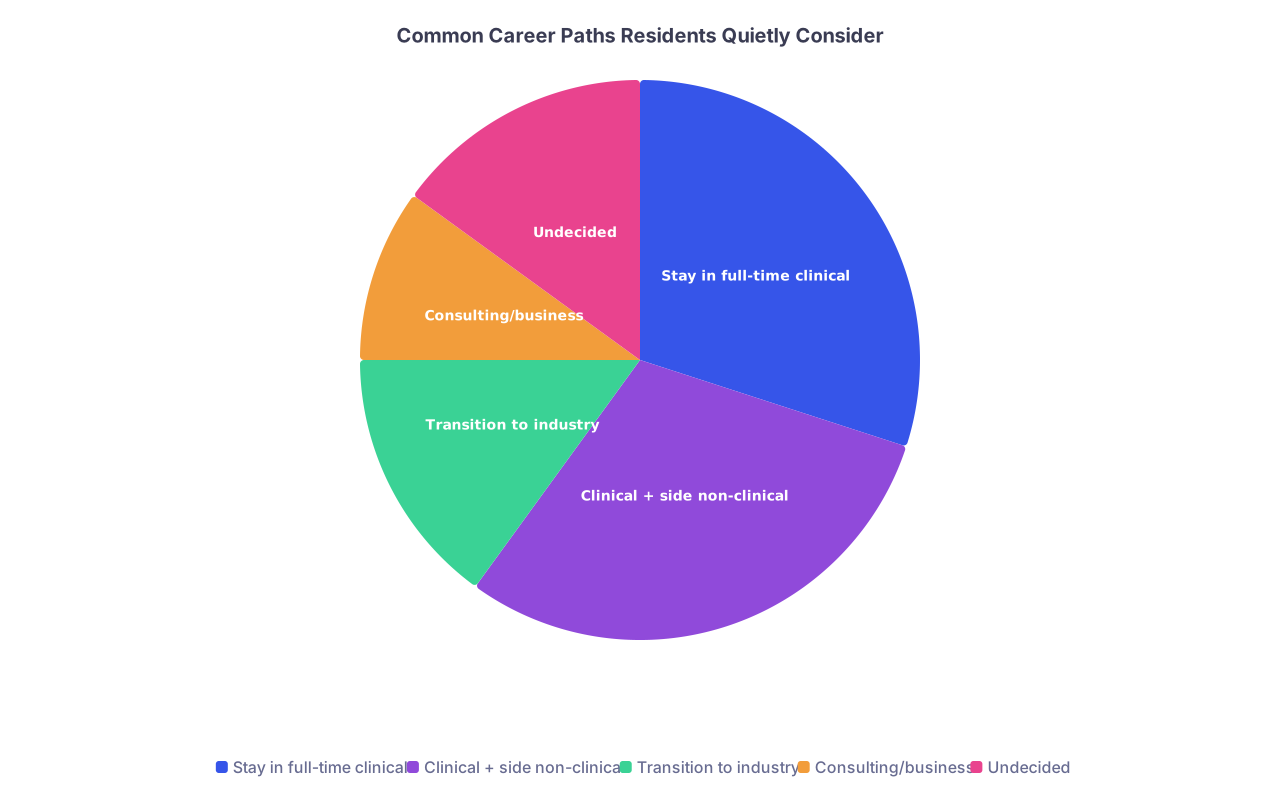
| Category | Value |
|---|---|
| Stay in full-time clinical | 30 |
| Clinical + side non-clinical | 30 |
| Transition to industry | 15 |
| Consulting/business | 10 |
| Undecided | 15 |



FAQ (Exactly 4 Questions)
1. Will program directors see me as “less committed” if I mention non-clinical interests?
Some might raise an eyebrow if you sound like you’re trying to escape medicine entirely. But if you frame it as wanting to be a solid clinician and exploring future options like policy, industry, or tech, many PDs accept that as normal. The bigger factor is your actual performance: if you’re reliable and competent, non-clinical curiosity by itself is rarely a deal-breaker.
2. Can my program fire me for exploring non-clinical jobs or having a LinkedIn?
Not realistically, no. Terminating a resident requires serious documented issues—poor performance, professionalism problems, safety concerns. Having a professional LinkedIn profile or quietly talking to people in industry doesn’t qualify. What can get weaponized against you is if your work clearly slips and leadership can tie that to you being “checked out” because of external commitments.
3. Should I hide all non-clinical activities from my program?
You don’t need to broadcast them, but you don’t have to live in paranoia either. If your side projects are small, legal under your contract, and not affecting your work, they’re usually non-issues. If you’re unsure about your program’s culture, start by talking to a trusted senior resident or faculty member who isn’t your PD, and get a read on what flies and what doesn’t.
4. What if I’m seriously thinking about leaving clinical medicine altogether?
Then you need two parallel tracks: protect your immediate situation and plan your exit thoughtfully. Don’t impulsively tell your PD, “I’m done, I’m out.” Instead, shore up your performance, get mental health support if you’re burned out, and start gathering information about alternatives through mentors and networking. If and when you decide to leave, you’ll be in a much stronger position—both professionally and psychologically—than if you blow things up in a moment of despair.
Key points:
- Most PDs care far more about your clinical performance and reliability than your long-term career flavor, as long as you’re not openly checked out.
- You can explore non-clinical paths quietly and professionally without sabotaging how your program sees you—frame it as “both/and,” not “instead of.”
- Protect your current position first, build options second, and don’t hand people ammunition by venting to the wrong person or letting your work slide.