
The biggest lie physicians tell each other is, “If you leave practice, you’ll be unemployable.”
The Fear You Don’t Say Out Loud
You know exactly how the script goes in your head:
“If I step away now—clinical gap, no recent experience, no one will hire me. I’ll be radioactive. I’ll have wasted my degree, my residency, my board scores. I’ll never match this salary again. I’ll end up doing something random, embarrassed to tell people I used to be a doctor.”
And the worst one: “I’ll never get back in if I change my mind.”
I’m not going to sugarcoat this: some doors do get harder to reopen once you step away from clinical work. Academic tracks. Very procedural specialties. Hyper-competitive hospital systems that worship ‘continuous full-time experience.’
But the blanket statement “you’ll be unemployable” is just wrong. Factually wrong. And very convenient for systems that benefit from you being too scared to leave.
Let’s separate three different fears that keep getting mashed into one huge, paralyzing monster:
- “No one will hire me for anything if I leave practice.”
- “No one will hire me for a good job if I leave practice.”
- “No one will hire me for clinical work again if I leave practice.”
Those are three different problems with three different answers. Lumping them together is how you end up stuck, burnt out, doom-scrolling job boards at 2 a.m.
What Leaving Practice Actually Does To Your Marketability
Here’s the blunt version: leaving practice changes which doors are easiest to open, not whether any doors exist.
Most physicians wildly underestimate how weird their work is from a non-clinical lens. You make life-or-death decisions with incomplete data. You document in a hostile EMR while managing an angry family. You’re project-managing an entire care team on the fly. And somehow that all gets mentally filed under “just being a doctor.”
Non-clinical employers don’t see it that way. They see:
- You can handle complexity and ambiguity.
- You can talk to humans who are anxious, angry, confused, or non-compliant.
- You can learn massive bodies of information under time pressure.
- You can make decisions, document them, and be accountable.
Let me put some numbers to this, because anxiety loves specifics.
, Telehealth Leadership, Health Tech, Public Health/Policy](https://cdn.residencyadvisor.com/images/articles_svg/chart-example-job-categories-that-commonly-hire-physicia-2291.svg "Example Job Categories That Commonly Hire Physicians")
| Category | Value |
|---|---|
| Utilization Management | 70 |
| [Pharma/Med Affairs](https://residencyadvisor.com/resources/alternative-medical-careers/the-unspoken-hierarchy-inside-medical-affairs-departments) | 55 |
| Telehealth Leadership | 40 |
| Health Tech | 35 |
| Public Health/Policy | 30 |
That chart isn’t “official statistics.” It’s a rough snapshot of how often I see former clinicians land in these spaces. Point is: there are patterns of real, recurring roles where ex-clinicians show up. You are not inventing some insane new path out of thin air.
What does change when you leave:
- Recruiters stop knowing what to do with you if your resume is just “Clinical, clinical, clinical…” and nothing else.
- The default conveyor belt (med school → residency → practice → maybe leadership) no longer pulls you forward. You have to steer.
- You lose the easy shorthand of “I’m a full-time practicing [specialty] at [hospital]” that impresses people and opens doors by itself.
That’s scary. It feels like moving from being “obviously valuable” to “having to prove yourself again.” But that is not the same as being unemployable.
The “Gap” Panic: How Bad Is A Resume Break, Really?
Let’s attack the piece that usually sends people into a tailspin: the gap.
You’re thinking something like: “If I stop practicing for 6–12 months to figure things out, every future interviewer will see a red flag the size of a billboard.”
Not necessarily. Employers care far less about a gap than about a black box.
A 10-month gap that you can clearly explain as:
“I was burning out clinically, so I stepped back and spent a year taking structured coursework in clinical informatics, did a part-time telehealth role, and completed a certificate in data analytics to pivot toward health tech implementation.”
…is far more hireable than:
“I kept practicing but I’m clearly resentful, cynical, and don’t know what I want.”
The worst-case scenario is not “I left clinical for a bit.” The worst-case scenario is “I can’t tell a coherent story about what I did or what I want.”
Let me break down a few common timelines I’ve seen work in real life.
| Pattern | Timeline (Approx.) | Outcome Type |
|---|---|---|
| Immediate pivot | 0–3 months | Lateral clinical-adjacent role |
| Exploration year | 6–12 months | New non-clinical career track |
| Gradual wind-down | 12–24 months | Portfolio of part-time roles |
| Full stop then reentry | 12–36 months | Return to modified clinical or academic |
None of those are magical. They all share one thing: the person didn’t just vanish. They used the time to build a story that makes sense to an employer.
A gap full of intentional choices is not a red flag. It’s a pivot.
A gap full of “I did nothing because I was frozen in fear” is a problem. Mostly for you, not for them.
“But I’ll Be Overqualified And Underqualified At The Same Time”
This is the cruel brain trap: you imagine yourself too clinical for business roles, too non-business for business roles, too rusty for clinical roles, and too old for “entry-level anything.”
You feel like you fit nowhere.
I’m going to be rude for a second: this is largely a framing issue, not a reality issue.
Most physicians present themselves to the outside world in one of two awful ways:
- CV copy-paste. Ten pages of every rotation, every publication, every poster, no translation into skills anyone outside medicine understands.
- Total personality erase. “Hard-working team player passionate about healthcare” with no specifics.
So of course you look “unemployable.” No one can tell what you’re actually good at.
Your real advantage is that you sit at the intersection of clinical, operational, and human complexity. But you actually have to say that in a language outsiders get:
Instead of: “In my role as a hospitalist, I managed inpatient care for high-acuity patients.”
Try: “I coordinated multidisciplinary teams (nursing, pharmacy, consultants) to deliver time-sensitive care for 15–18 high-acuity patients per shift, prioritizing competing demands and making risk-balanced decisions with incomplete data.”
One sounds like a job description. The other sounds like someone who knows how to manage chaos and lead humans. That’s employable.

The Clinical Return Myth: If You Leave, Are You Locked Out Forever?
This is the nightmare scenario: you try something non-clinical, it’s not what you hoped, and then… no one will take you back.
Can that happen? Yes. Are there specialties and systems that are harsher about it? Also yes.
Reality check:
- Many community hospitals are much more flexible than big-name academic centers about hiring people back after a gap.
- Telemedicine, urgent care, and locums often care more about license, board certification, and basic recency of practice than a perfect, uninterrupted CV.
- You may not waltz back into the exact same department, schedule, or prestige hospital. But that’s different from “no options.”
What actually threatens your re-entry chances is not “I left” but:
- You let your license lapse and didn’t plan for reactivation.
- You let board certification go and now need remediation/retesting.
- You stepped away for 5–7 years and did absolutely nothing clinical-adjacent or CME-related.
Those are fixable, but they’re heavier lifts.
Here’s what lowers your risk if you think you might want the option to go back:
- Keep at least one license active if humanly possible.
- Maintain CME and some kind of clinical-adjacent thread: per-diem telemedicine, PRN urgent care, or even structured volunteering in a clinical environment if it’s allowed and legit.
- Document that you’ve stayed current: courses, conferences, updated certifications.
You’re not trapped in an “all or nothing, forever” decision. You are making your future work logistically easier or harder, though. That part’s real.
The Money Spiral: “What If I Can’t Replace My Income?”
Here’s the part no one is honest about: you probably won’t, at least not right away. Or not in the same way.
If you’re making $280–400k+ clinically, you are not going to casually stroll into a first non-clinical role at the exact same compensation with the exact same benefits and zero loss anywhere.
Non-clinical paths often look like this at first:
- Base comp lower than your attending salary.
- Upside in lifestyle, predictability, fewer nights/weekends, less emotional exhaustion.
- Longer-term salary growth through leadership, bonuses, equity, or switching companies.
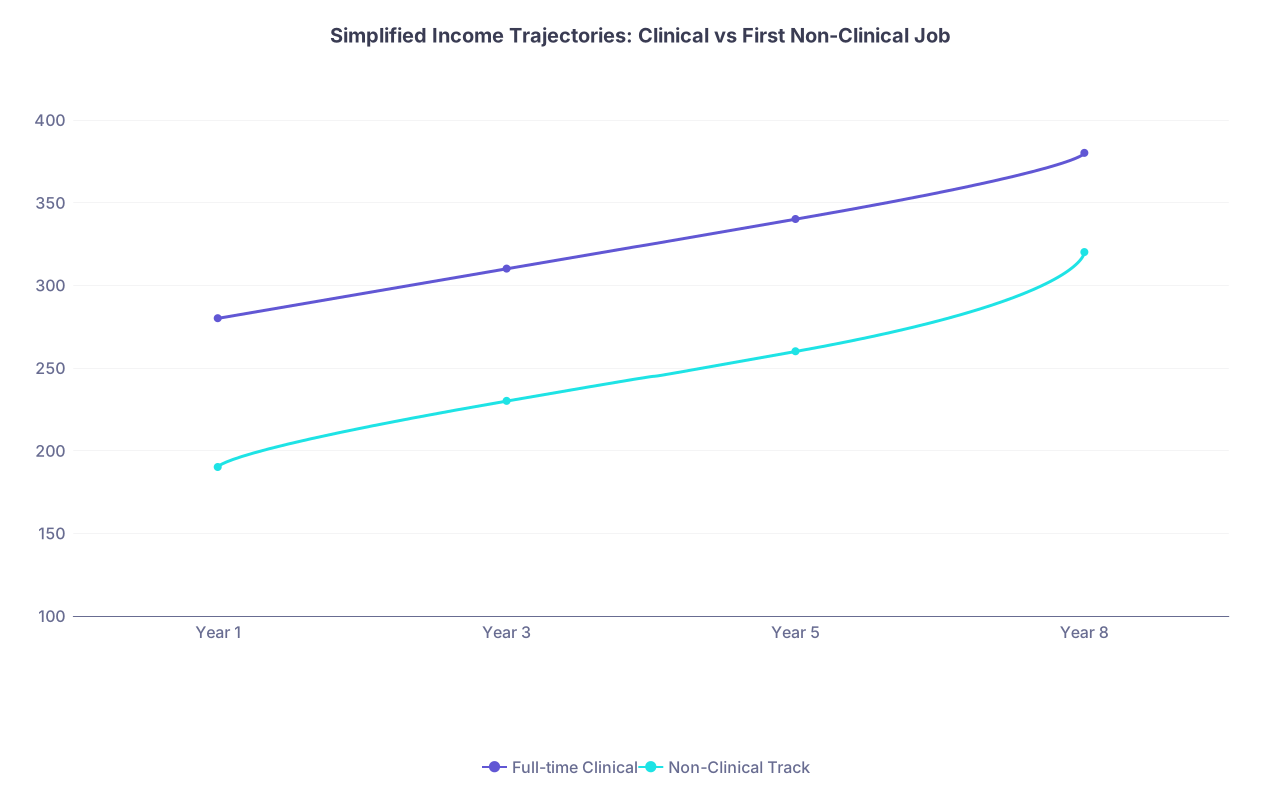
| Category | Full-time Clinical | Non-Clinical Track |
|---|---|---|
| Year 1 | 280 | 190 |
| Year 3 | 310 | 230 |
| Year 5 | 340 | 260 |
| Year 8 | 380 | 320 |
Again, rough illustrative numbers, not gospel. But they show the tradeoff:
- Short-term: you probably take a hit.
- Medium-term: depends on the path; some stagnate, some catch up, some surpass.
- Long-term: the more you’re willing to lean into leadership, tech, strategy, or entrepreneurship, the less “unemployable” and more valuable you become.
The real danger isn’t that you’ll never make money again. It’s that you’ll cling to a high but unsustainable income while your mental and physical health quietly erodes.
I’ve seen too many attendings stay three, five, ten years longer than they should because of the phrase “golden handcuffs,” then try to leap when they’re so burnt out they can barely function. That’s when transitions get ugly, because you’re too exhausted to build any kind of bridge.
What Actually Makes You Look “Unemployable”
Let me be brutally specific, because your anxiety is probably painting vague horror images.
The things that actually make employers nervous aren’t “left practice” or “took time off.” It’s stuff like:
- You can’t explain why you left without sounding bitter, hostile, or evasive.
- You have no idea what the job you’re applying for actually does day to day.
- You talk only about how miserable you were and not about what you can bring to the new role.
- Your resume is 12 pages of clinical detail and not a single bullet speaks the language of the new field.
- You clearly haven’t done even basic homework (talked to someone in the field, looked up common responsibilities, learned the jargon).
That’s fixable. All of it.
What reassures employers:
- A clear narrative: “I loved X parts of patient care, struggled with Y, and now I’m seeking roles that focus on Z skill set.”
- Evidence of commitment: relevant courses, small projects, consulting, volunteer work, shadowing, even structured informational interviews.
- Humility: you’re not trying to waltz into a VP role on day one just because you were an attending.
- Transfer language: you can connect what you’ve done to what they need without making them work to decode it.

| Step | Description |
|---|---|
| Step 1 | Clinical Burnout |
| Step 2 | Decide to Explore Options |
| Step 3 | Self Assessment |
| Step 4 | Talk to People in Target Fields |
| Step 5 | Build Skills or Certificates |
| Step 6 | Update Resume and LinkedIn |
| Step 7 | Apply to Focused Roles |
| Step 8 | Land First Non Clinical Job |
Notice that “be magically employable” isn’t a step. It’s a process, and yes, it’s work. But it’s not impossible work.
You’re Not Imagining It: Loss Of Identity Hurts More Than Loss Of Job
Here’s the part that never gets discussed in all the “alternative career” content: the psychological crash.
You’re not just afraid of being unemployed. You’re afraid of being no one.
You’ve had a short introduction that does everything for you: “I’m a cardiologist.” “I’m an EM doc.” People know where to put you in their mental map. You know where to put yourself.
When you say, “I’m… figuring things out,” it feels like stepping off solid ground into fog.
That identity free fall is exactly when the “unemployable” stories in your head get the loudest. Because if you’re not a Doctor with a capital D, who are you? And will anyone want you?
This is where people make desperate, panicked choices:
- Staying in toxic roles because “at least I still count as a real doctor.”
- Jumping into the first non-clinical offer that shows up, even if it’s a horrible fit, because “I can’t risk having no title.”
- Refusing to take a few months for deliberate exploration because “gaps are deadly.”
I’m telling you: the identity work is not optional. You either do it intentionally now, or you do it painfully and chaotically later.
You don’t become unemployable when you leave practice. You become temporarily unmoored. And that’s uncomfortable enough that people will say almost anything to avoid it.
So… Is The Fear Total Nonsense?
No. It’s not total nonsense. Parts of it are grounded in real risks:
- Some specialties and institutions will penalize you for leaving.
- Some recruiters are unimaginative and will skip you if they don’t see a perfect, straight-line CV.
- Some non-clinical hiring managers won’t understand how to value your background unless you do the translation work for them.
But the absolute statement—“You’ll be unemployable”—isn’t a prediction. It’s a scare tactic.
You’re not deciding between “employable” and “unemployable.”
You’re deciding:
- Whether you’re willing to trade a known, status-heavy path for a messier, more self-directed one.
- Whether you’re open to taking a temporary income/ego hit to build a more sustainable career.
- Whether you’re ready to talk about yourself as more than your specialty and your RVUs.
You will be employable if you’re willing to:
- Tell a coherent story about what you’re doing and why.
- Translate your skills into the language of the roles you’re targeting.
- Tolerate that first phase where you don’t yet have the title, salary, or identity you’re aiming for.
If you’re looking for a guarantee that you can walk away, do nothing, never adapt, and still be showered with offers… no, that doesn’t exist. Not in medicine, not outside it.
But you’re not powerless. You’re just scared. And honestly? Given what the system has drilled into you, that’s a completely rational response.
FAQ (Exactly 6 Questions)
1. How long can I safely be out of clinical practice before it really hurts my chances of returning?
There’s no magic cutoff, but 1–2 years with active licensure, CME, and some clinically-adjacent activity is usually very recoverable, especially in community settings, telehealth, or urgent care. Once you cross 3–5 years with no real engagement, you’re looking at more scrutiny and sometimes formal re-entry programs. It’s not impossible, but it’s more work and often more limited options. The key is staying connected to the clinical world in some tangible way if you think there’s any chance you’ll want to go back.
2. Will employers outside medicine judge me for leaving clinical practice?
Some will. Many won’t. What they will judge you on is how you talk about it. If your story is, “I burned out, everything was terrible, I just had to get out,” they’ll worry you’re running away, not running toward something. If your story is, “I learned X about myself in practice, I’m now looking for roles where I can use Y skills without Z constraints,” it signals maturity and self-awareness. They don’t need you to love medicine. They need you to know what you’re doing next and why.
3. Do I need another degree (MBA, MPH, etc.) to be employable outside clinical work?
No. Extra degrees can help, especially for certain paths (health policy, admin-heavy leadership, formal public health work), but plenty of ex-clinicians break into utilization management, pharma MSL roles, digital health, medical affairs, and consulting without a new alphabet soup. What you do need is some way to show you can do the job: targeted coursework, certificates, small projects, or part-time roles. Another degree is a tool, not a magic key. Don’t hide from the job market in school out of fear.
4. What if I leave clinical, try a non-clinical job, and hate it? Am I stuck?
You’re not stuck, but you will have to eat some humility and maybe take a step sideways (or slightly backward) to reset. I’ve seen people go from hospitalist → UM reviewer → realize they miss patients → return to part-time outpatient or urgent care. Or EM → health-tech product role → hate the corporate vibe → end up in a portfolio mix: part-time clinical, part-time consulting. The real trap is thinking any single move has to be perfect and permanent. It doesn’t. Don’t burn bridges, keep licenses active if you can, and accept that you might need a few iterations.
5. How do I explain a “gap year” on my resume without sounding flaky?
You tell the truth—but edited for clarity and direction. For example: “Took a structured 12-month career transition period: completed X certificate, did Y part-time role, and Z volunteer/consulting project to pivot toward [target field].” The more concrete and intentional it sounds, the less anyone cares that you weren’t in a formal job. Flaky is “I was just kind of resting and didn’t really do much.” Deliberate is “I built skills and experimented while I figured out my next step.” Aim for deliberate.
6. What’s one thing I can do this week to make myself more employable if I’m thinking of leaving practice?
Pick one non-clinical area you’re even mildly curious about—UM, informatics, pharma, digital health, public health, medical writing—and schedule two informational conversations with people actually working in those roles. Not podcasts. Not blog posts. Real humans. Ask what they do all day, what skills matter, what they wish they’d done earlier. Then update one section of your resume to highlight a skill they mentioned (project management, communication, data comfort, whatever) using a concrete example from your clinical work. That’s how you start shifting from scared theory to actionable reality.
Open your CV or resume right now and read the first third of the first page. If a non-physician couldn’t tell, within 20 seconds, what you actually do well beyond “see patients,” start rewriting those bullets. That’s the first crack in the “unemployable” myth.