
The worst way to explore non-clinical careers is to act like a teenager sneaking out of the house. The best way is to run a disciplined experiment while protecting your reputation, your license, and your current income.
That is what this article is about.
You are not “betraying medicine” by looking around. You are managing risk. The goal is simple: test-drive alternative paths without trashing relationships, violating contracts, or triggering panic in your current leadership.
Let me walk you through exactly how to do that.
Step 1: Get Clear On What You Are Actually Testing
“Non-clinical” is not a career. It is a giant bucket. If you try to “explore non-clinical” in general, you will spin your wheels, talk to random people, and learn almost nothing specific.
You need hypotheses.
Think like this:
- “I think I might like: medical communications / pharma MSL / informatics / utilization management / health tech product.”
- “I need: remote or hybrid work, less call, income ≥ X, moderate travel at most.”
- “Deal breakers: heavy sales quotas, constant travel, night/weekend pager, relocation in the next 12 months.”
Write that down in a one-page “career hypothesis” document. Seriously. On paper.
Include:
3–5 specific roles you want to test
Examples:- Medical Director, Utilization Management (payer)
- Medical Science Liaison (pharma)
- Medical Advisor or Safety Physician (pharma/biotech)
- Clinical Informatics / CMIO track
- Medical Writer / Medical Communications
- Telehealth leadership / Virtual Care Ops
- Public Health / Government roles (CDC, local health departments)
- Health tech Product / Clinical Strategy
Your test objectives
For each role, define:- What does a typical week look like?
- What are the key pressures (metrics, deadlines, politics)?
- What skills and credentials are truly required vs “nice to have”?
- Compensation band for someone with your background.
Your constraints
- Time you can realistically devote weekly (e.g., 2 evenings + 1 weekend block)
- Contractual obligations (non-compete, moonlighting clauses, FTE requirements)
- Financial runway (how long you can tolerate reduced income if needed)
Without this, everything you do next will feel random. With it, you have a clear filter: “Does this conversation or side project help me test one of these hypotheses?”
Step 2: Lock Down the Legal and Political Landmines First
Before you touch LinkedIn. Before you take a “quick side gig.” You need to know what can get you fired or sued.
A. Read your contract like a lawyer who got burned once
Look specifically for:
Outside employment / moonlighting clauses
- Some contracts require written permission from your employer for any compensated work.
- Sometimes they are vague: “No outside work that conflicts with your duties.” That can still bite you.
Non-compete and non-solicitation language
- Does it restrict clinical practice only or any healthcare-related work?
- Geographic and temporal scope: 10 miles for 1 year is very different from “any competitor nationwide for 2 years.”
Intellectual property and “work for hire”
- If you build something (content, software, process), does your current employer own it by default?
Confidentiality
- Obvious, but crucial: you cannot use internal data, patient info, or proprietary processes in any side project or interview.
If anything is unclear or broad, do not guess. Spend the money on a brief consult with a physician-contract attorney. I have seen careers derailed by a sloppy assumption that “this does not really apply to me.”
B. Decide how “visible” you can safely be
You have a spectrum:
Low visibility
- Anonymous medical writing
- Consulting for companies geographically and strategically far from your employer
- Remote chart review / utilization management with different payor regions
- Courses and certifications (no public profile change)
Medium visibility
- Speaking at conferences on non-clinical topics
- Being listed as an advisor on a startup website
- LinkedIn profile showing interest in “health tech” but still clearly practicing
High visibility
- Publicly announcing a non-clinical job search
- Being featured in articles about “physicians leaving medicine”
- Taking board seats or leadership titles at competing organizations
Early testing stays in the low-to-medium category until you understand your environment. In some academic centers, you can be quite public. In some private groups, even a whiff of “looking elsewhere” triggers defensive behavior.
Step 3: Quietly Reset Your Professional Brand
You can signal interest in non-clinical paths without posting “I am done with clinical medicine” on social media.
A. Fix your LinkedIn (properly)
Do not start with “Open to Work” banners. Start with alignment.
Headline
Move from:- “Internal Medicine Physician at XYZ Health System”
To: - “Internal Medicine Physician | Healthcare Quality and Utilization Management”
- “Emergency Physician | Digital Health and Clinical Informatics”
- “OB/GYN | Medical Communications and Patient Education”
The second part is your “test space.”
- “Internal Medicine Physician at XYZ Health System”
About section
Translate your clinical skills into business language:- “Led multidisciplinary team implementing new sepsis protocol, resulting in 15% reduction in mortality and decreased length of stay.”
- “Reviewed complex prior-authorization cases and collaborated with payers on evidence-based coverage decisions.”
- “Developed patient-facing educational materials adopted system-wide.”
That is what non-clinical hiring managers understand.
Skills and endorsements
Add skills like:- Medical Affairs
- Clinical Research
- Health Policy
- Medical Writing
- Clinical Informatics
- Quality Improvement
- Utilization Management
- Population Health
You are quietly repositioning, not resigning.
Activity
Start engaging (likes, comments, occasional shares) with content in your target area.- Follow pharma, health tech, payers, consulting firms, medical communication agencies.
- Comment intelligently on posts about value-based care, AI in health, drug launches, etc.
No bridge burned. But if a recruiter or contact looks you up, you do not look like “just a clinician who is bored.” You look like someone already straddling the clinical–business line.
Step 4: Run Structured “Career Experiments” in 90-Day Sprints
You are not “deciding your future for the rest of your life.” You are running small, reversible experiments.
Think in 90-day sprints:
- 1–2 target roles
- Clear goals
- Pre-defined time budget
| Week Range | Focus Area |
|---|---|
| 1–2 | Research roles + basic reading |
| 3–6 | Informational interviews |
| 7–10 | Small paid or volunteer project |
| 11–12 | Reflection + next-step decision |
A. Start with deep-dive research (but time-box it)
For each role:
- Read 10–15 real job descriptions
- Look at requirements, responsibilities, recurring keywords.
- Find 2–3 people on LinkedIn with your background who made that move.
- Read 1–2 books or short courses relevant to the area
- MSL: materials on pharma field roles
- MedComms: resources on medical writing and agency work
- Informatics: AMIA resources, intro texts
Cap this research to 5–7 hours. You are not getting a PhD in “jobs on the internet.” You are targeting enough knowledge to have intelligent conversations.
B. Conduct real informational interviews (not “pick your brain” disasters)
Target:
- 8–12 conversations in 90 days
- 20–30 minutes each
- Focused, prepared
Who to talk to:
- Physicians who recently transitioned (0–5 years out)
- Non-physician leaders who hire physicians in those roles
- Recruiters who specialize in your target area
How to reach out (short, specific, and honest enough):
“Hi Dr. Smith,
I am a hospitalist in [city] with 7 years of experience and growing interest in utilization management and payer roles. I am not actively job hunting yet, but I am trying to understand what the work is actually like day to day.
Would you be open to a 20-minute call in the next few weeks to share a bit about your path and how you would advise someone like me to test whether this is a good fit?”
Notice:
- You are not lying.
- You are not signaling immediate departure.
- You are framing yourself as thoughtful and intentional.
During the call, ask:
- “What surprised you most after moving into this role?”
- “What does a bad day look like? A good one?”
- “What do you wish you had done 6–12 months before you made the leap?”
- “If you had 5 hours a week to test this career, how would you use them?”
- “What are the mistakes you see physicians make when they try this path?”
And at the end:
- “Given what you know now, does my background sound like a plausible fit if I gain XYZ exposure?”
- “Is there a small way I could get experience in this space while still practicing—shadowing, contract work, a project?”
This is how you get invitations to small, low-risk experiments.
Step 5: Use Low-Risk Side Gigs as Your Test Drive
Now we get to the part most people skip: actually doing some of the work before you blow up your clinical career.
You want:
- Short-term
- Clearly scoped
- Low visibility (at least initially)
- Compatible with your contract
Here are specific options by domain.
A. Medical writing / MedComms
Low-bridge-burn potential. High signal.
Ways to test:
- Freelance platforms with healthcare focus (agencies, specialized firms)
- Medical education companies that need CME content
- Patient education content for reputable health sites
- Ghostwriting for physician blogs, newsletters, or health tech companies
What you learn:
- Can you write clearly on deadline?
- Do you actually enjoy the process?
- How long does a 1,000-word piece really take you?
- Do revisions and client feedback drain you or energize you?
Protect yourself:
- Use a pen name if needed (some do this early on).
- Confirm no conflict with your employer (most are fine if there is no competing brand and no time conflict).
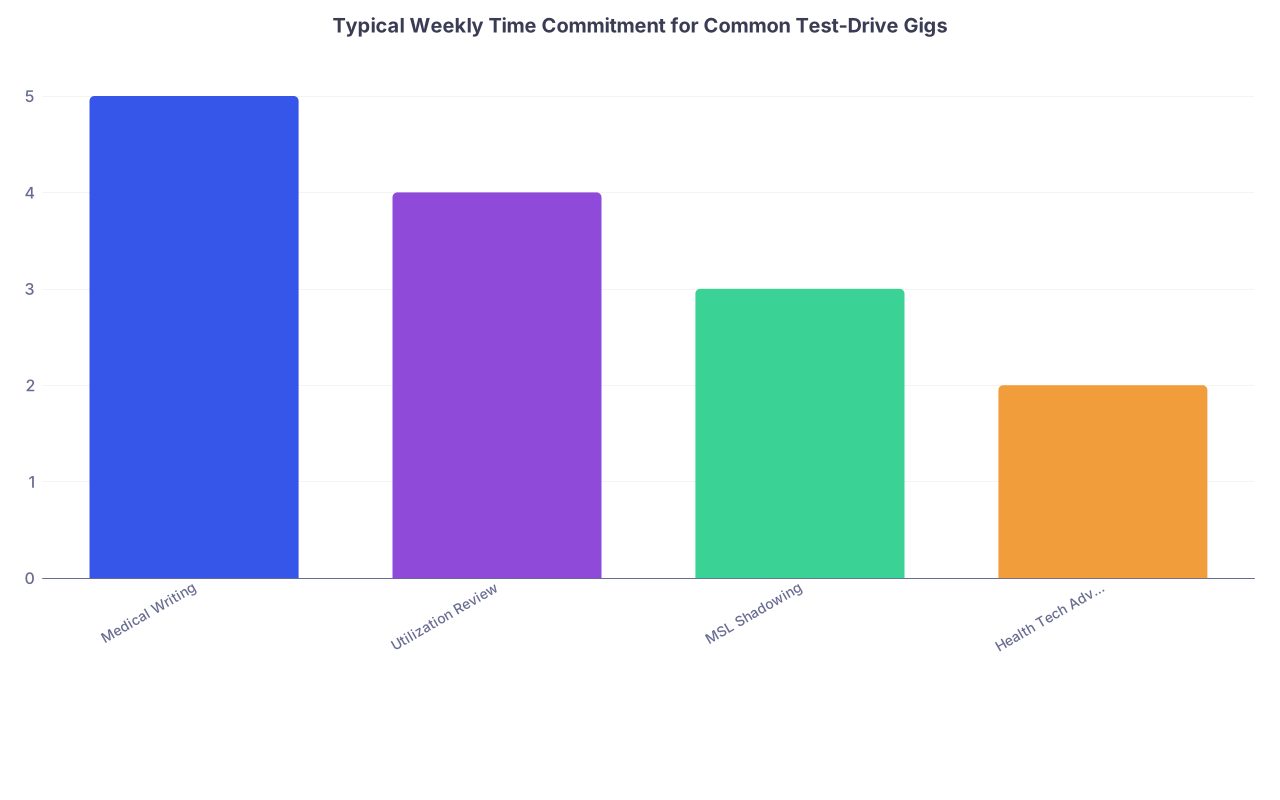
| Category | Value |
|---|---|
| Medical Writing | 5 |
| Utilization Review | 4 |
| MSL Shadowing | 3 |
| Health Tech Advisory | 2 |
B. Utilization management / Chart review
This looks very “adjacent” to clinical, so it usually raises fewer eyebrows.
Options:
- Remote chart review for smaller UM firms
- Peer-to-peer review with payers on a part-time contract
- Advisor roles on appropriateness criteria (via professional societies)
What you learn:
- Can you tolerate heavy protocol and guideline work?
- How does it feel to say “no” to fellow clinicians?
- Do you like the pattern-recognition and systems side?
Watch for:
- Your contract: some employers already contract with payers; you must avoid direct competition.
- Mental load: a few hours per week may feel fine, but full-time UM is different. Notice your own reaction.
C. Medical Science Liaison / Medical Affairs
Harder to “side-gig,” but you can still test the waters.
Tactics:
- Volunteer to help with investigator meetings, local CME, or speaker programs (if you already do research).
- Present at disease-area symposia where pharma/biotech staff attend.
- Take on roles in clinical trials that include liaison with sponsors.
You will learn quickly if you enjoy:
- Explaining data in high-detail conversations
- Handling pushback from skeptical clinicians
- The travel and relationship-building aspect (even sampled locally)
D. Health tech / Product / Informatics
You do not need to code. You do need to translate clinical reality into product decisions.
Test-drive moves:
- Join a local or online health tech startup as a small paid advisor (2–4 hours/month).
- Participate in user testing or advisory boards for EMR vendors or digital health tools.
- Partner with your hospital’s IT/informatics group on a discrete project (order sets, decision support, workflow redesign).
What you observe:
- Do you like messy, ambiguous problems?
- Can you handle engineers telling you your idea is not feasible in the current sprint?
- Does talking “product roadmap” and “user adoption” interest you or bore you?

| Step | Description |
|---|---|
| Step 1 | Define Career Hypotheses |
| Step 2 | Review Contract and Constraints |
| Step 3 | Quiet LinkedIn Rebrand |
| Step 4 | 90 Day Research and Networking |
| Step 5 | Low Risk Side Gig or Project |
| Step 6 | Assess Fit and Energy |
| Step 7 | Expand Scope or Apply |
| Step 8 | Return to New Hypothesis |
Step 6: Manage Optics at Your Current Job Like an Adult
This is where people blow things up unnecessarily. They get excited about a new path and start acting checked out. Colleagues notice. Rumors start. Bridges start to smolder.
You must treat your current role as your primary investor in your transition. You protect that relationship.
A. Performance first, exploration second
Non-negotiable:
- Do not let clinical performance slip.
- Do not start declining committee work only to say yes to external projects.
- Do not talk constantly about “leaving medicine” at work.
If your metrics tank or you develop a reputation for being disengaged, those same attendings and chiefs will not write strong recommendations when you need them. And you will need them.
B. Be deliberate about what you share and with whom
You need 2–3 trusted people in your current environment. Not 20.
Choose:
- The mentor who has already hinted at non-traditional paths.
- The colleague who has done industry work and came back.
- The chair who actually understands burnout and career evolution.
With them, you can be more transparent:
“I am exploring where I can have the most impact over the next 10–15 years. I am not quitting next month, but I am doing some structured exploration of non-clinical roles. I want to do it in a way that does not compromise my work here or surprise leadership. Any advice on how to balance that well?”
Most reasonable leaders respect that. Some might even help by pointing you toward health system roles (quality, informatics, management) that give you experience and help them.
C. Decide your story in advance
Imagine your department chair asks, “I heard you are interested in non-clinical work. What is going on?”
Your answer must be:
- True
- Calming
- Future-oriented
For example:
“I am exploring how to use my clinical background in broader ways. Right now, that mainly means learning and doing a few small side projects. I am still committed to my role here and I will give plenty of notice if I ever decide to change my primary work. In the meantime, some of what I learn might actually benefit our department, particularly around [quality/telehealth/education].”
You have just:
- Reduced perceived threat.
- Positioned your exploration as potentially beneficial to them.
- Kept the door open.
Step 7: Learn How to Talk to Non-Clinical Employers Without Burning Bridges
There is a right way and many wrong ways to talk in early-stage conversations with companies.
A. Avoid “I hate medicine” as your main story
Hiring managers hear this:
- “I am burned out and running away.”
- “I will get bored and leave again when this is hard.”
- “I may be a negative presence on the team.”
Instead, frame:
- What you are running toward: systems impact, population-level change, data-driven decisions.
- Specific skills: leading teams, navigating complex stakeholders, communicating with clinicians.
Bad version:
“I am just tired of call and documentation. I want to get out of clinical ASAP.”
Better:
“I have realized my favorite part of clinical work has always been improving systems—new protocols, EMR workflows, reducing unnecessary care. I am looking for roles where that is the core of the job, not just something I do off the side of my desk.”
B. Do not over-commit or under-commit
When asked about your timeline:
- Do not say: “I could quit clinical next month if you have something.”
- Do not say: “I am just browsing; maybe in 5 years.”
Try:
“I am actively exploring options for the next 6–18 months. I want to ensure any move I make is a good long-term fit for both sides, so I am doing some part-time work and learning first.”
This signals seriousness without desperation.
C. Be clear on what you will and will not tell your current employer
Many companies will ask: “Are you comfortable informing your current employer if we move forward with an offer?”
Your options:
- For side gigs and advisory work:
- You can often say: “My contract permits this work without disclosure as long as there is no direct competition. I have confirmed that.”
- For major career moves:
- “Once we are at the point of a formal offer, I would absolutely inform my employer and arrange an orderly transition. I take that responsibility seriously.”
Companies respect professionalism. They do not respect scrambling, last-minute resignations, or secrecy that smells like a lawsuit.
Step 8: Decide When to Scale Up and When to Walk Away
At some point in each 90-day sprint, you must stop “exploring” and make a call:
- Double down
- Maintain as a side stream
- Drop it and test a different path
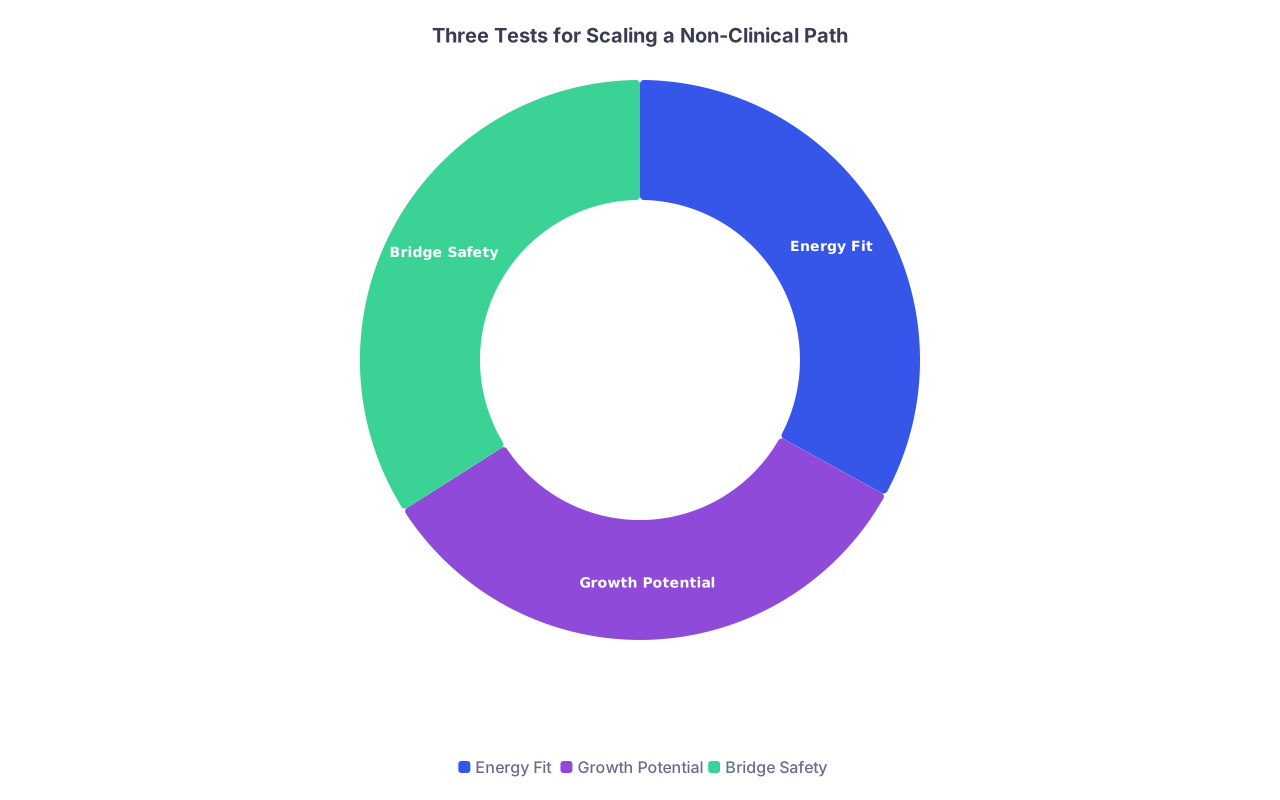
Use three questions:
Energy test
After doing this work for 2–3 hours, how do you feel?- More energized and curious → good sign.
- Drained, resentful, or numb → pay attention.
Growth test
Do you see a credible path to:- Income that meets your needs within 2–3 years?
- Increasing responsibility and impact?
- Some form of mastery that interests you?
Bridge test
Can you pursue this path without:- Violating your contract?
- Torching relationships you may need later?
- Destroying your financial backup plan?
If two of three are “no,” that path is a hobby, not a career. Move on without drama.
If the answers are “yes,” then you are ready to:
- Increase hours in that non-clinical lane
- Apply to formal roles
- Negotiate a shift in your current clinical commitments (reduced FTE, different schedule)
| Category | Value |
|---|---|
| Energy Fit | 33 |
| Growth Potential | 33 |
| Bridge Safety | 34 |
Step 9: Keep Your Clinical Backstop Intact (At Least Initially)
One of the worst mistakes I see: physicians cut their clinical ties completely, then discover the new role is a bad fit or unstable.
You want optionality for at least 12–24 months, ideally more.
Concrete safeguards:
- Maintain your license and board certification. Pay the fees. Keep CME up.
- If you reduce FTE, push to keep at least a small clinical footprint (e.g., 0.1–0.2 FTE urgent care, telemedicine, weekend shifts).
- Leave in good standing: full notice, written gratitude, offers to help transition patients or projects.
This is not about “planning to fail.” It is about acknowledging that industries change, layoffs happen, and sometimes the dream job is not what you imagined.
A future hiring manager will ask your former chair, “Would you rehire them?”
You want the answer to be “Absolutely.”
Step 10: A Concrete 6-Month Playbook You Can Start Today
Let me put this all together into something you can literally follow.

| Period | Event |
|---|---|
| Month 6 - Decide | scale, maintain, or stop |
If you execute that timeline with discipline:
- You will know far more about 1–2 realistic non-clinical options.
- You will have done real work, not just reading blogs.
- You will still have your job, your reputation, and your license intact.
That is how grownups change careers.
Here is your next step:
Block 60 minutes this week, sit down with your employment contract and a blank page, and write out your top three non-clinical hypotheses plus your constraints. Until you see those in front of you, you are just daydreaming.