
You are here
You are on call, scrolling PubMed on your phone between pages, staring at a wall of abstracts you barely have time to read. Your co-resident just matched into cardiology after publishing in Circulation. Another colleague left for pharma, now remote two days a week, making more than your attending, with “Medical Director” in their email signature.
You are stuck in between:
- You do not want another fellowship treadmill.
- You do not hate clinical work, but you want options.
- You have no R01, no NEJM, no massive lab network.
- You do have: some clinical exposure, maybe a case report, maybe nothing.
And you keep hearing: “Pharma likes people with publications and posters.” But nobody tells you how to use PubMed and posters in a targeted way to actually get into industry.
So let us fix that.
This is a practical, step-by-step playbook to use:
- PubMed strategically (as a tool, not a rabbit hole).
- Posters and small projects as “career launch vehicles” into pharma, med affairs, clinical development, HEOR, and beyond.
You do not need a PhD, a famous PI, or a bench lab. You do need intentional, visible outputs.
Step 1: Get clear on which pharma roles your PubMed work should point toward
Before you grind on abstracts and posters, you need to know what you are aiming at. Random publications are nice. Targeted ones are leverage.
Here are the main early- and mid-career pharma roles that your PubMed/poster work can feed into:
| Role | Core Focus | Best Matched Outputs |
|---|---|---|
| Medical Science Liaison | Education, KOL liaison | Clinical posters, reviews |
| Medical Affairs Manager | Data communication | Disease area reviews |
| Clinical Research/Dev | Trials & protocols | Clinical trial analyses |
| HEOR/Real-World Evidence | Cost, outcomes, data | Database/claims studies |
| Safety/Pharmacovigilance | Safety signals | ADR/case series, safety |
You do not need to pick your forever niche today, but you must pick a direction. Because that direction should decide:
- Which disease area you will become “the person who keeps publishing” in.
- Which data sources you chase (case reports vs retrospective vs registry vs database).
- Which conferences you target for posters (ASCO vs ACC vs ISPOR vs small regional).
Quick decision tool: which lane matches you?
Pick the one that sounds closest to you right now:
- You like talking to people, explaining data, presenting → aim toward MSL / Medical Affairs.
- You like protocols, endpoints, methods, and stats → Clinical Development / Clinical Research.
- You like cost-effectiveness, “does this drug make sense at a health system level?” → HEOR/RWE.
- You obsess over side effects and weird safety signals → Pharmacovigilance / Safety.
Now we will align your PubMed and poster work with that lane.
Step 2: Turn PubMed into a prospecting and idea-generation engine
Most trainees use PubMed like Google: search, click, skim, close. That is fine for a quick question. Useless for building a career asset base.
You need a system.
2.1 Build a tightly focused search strategy
You want to sit at the intersection of:
- One or two disease areas or therapeutic areas (e.g., heart failure, IBD, melanoma).
- 1–3 study types aligned with pharma-relevant work (e.g., retrospective cohort, RWE, meta-analysis, safety case series).
Example: You lean toward cardiology + industry.
- Define: “Heart failure + SGLT2 inhibitors” as your start.
- PubMed search:
("Heart Failure"[Mesh] OR "heart failure") AND (SGLT2 OR sodium-glucose cotransporter) AND (outcomes OR mortality OR hospitalization) - Set filters:
- Last 5–7 years.
- Humans.
- English.
- Save the search and set alerts (using a personal NCBI account).
Now PubMed feeds you the field, instead of you wandering into it.
2.2 Build a “gap list” from the literature
Your posters and papers should answer: “What is missing or underpowered here?”
Concrete process:
Skim 30–50 abstracts in your area. Just abstracts.
For each, jot down in a simple spreadsheet:
- Topic
- Population
- Study design
- Outcome
- What they did not do (single center, short follow-up, no subgroup X, poor real-world data, did not look at cost).
Then create a “gap list” tab:
- “No real-world adherence data in older adults with SGLT2 and CKD.”
- “No cost-effectiveness in community hospitals vs academic centers.”
- “No safety series on rare adverse event X in pregnant patients.”
That gap list is pure gold. Every item is a potential poster or small paper with pharma relevance.
Step 3: Choose project types that convert to pharma value
Not all publications are equal for pharma. Case reports are fine. Systematic reviews are fine. But some formats align much more cleanly with industry work.
Here is the short list you should target:
- Retrospective clinical audits or cohorts (EMR-based).
- Real-world evidence projects (registries, claims data, hospital databases).
- Clinical trial secondary analyses (if you have access).
- Meta-analyses / systematic reviews in a defined niche.
- Safety series and pharmacovigilance-relevant case clusters.
Yes, case reports still count as a start if you have no infrastructure. But do not stop there.
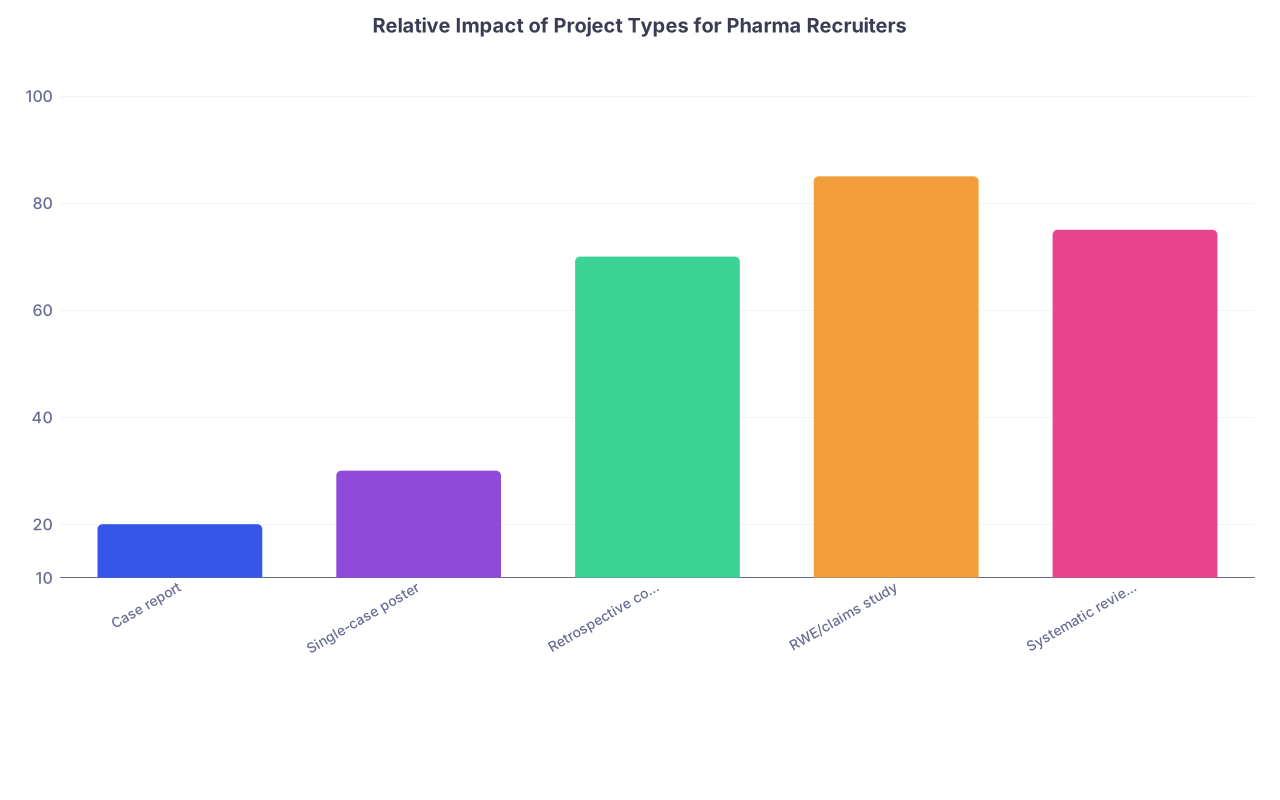
| Category | Value |
|---|---|
| Case report | 20 |
| Single-case poster | 30 |
| Retrospective cohort | 70 |
| RWE/claims study | 85 |
| Systematic review/meta-analysis | 75 |
How to pick your first 2–3 projects
You want fast wins, not a 2-year RCT you will never finish. Use this filter:
- Can be designed in 1 week.
- Data accessible within your current setting.
- Analysis done in 4–8 weeks.
- Abstract submitted to a realistic conference within 3–6 months.
Example 1 – Medical Affairs / MSL path
- Topic: Real-world persistence with biologic X in moderate–severe psoriasis.
- Design: Retrospective chart review of patients started on biologic X in your clinic over 3 years.
- Output: Poster at dermatology or immunology conference + short paper.
Example 2 – HEOR path
- Topic: 30-day readmission rates and cost for COPD patients on triple therapy vs dual.
- Design: EMR + billing data; compare subgroups.
- Output: Poster at ISPOR or ATS.
You are not trying to change global practice. You are building visible, industry-relevant patterns.
Step 4: Get from idea to PubMed and poster without a research empire
Here is the usual block: “I do not have a research mentor or infrastructure.” Fine. Then you build a small, scrappy pipeline.
4.1 Find a practical mentor, not a superstar
You are not looking for the Nobel laureate. You are looking for:
- Someone with 3–20 PubMed-indexed papers in your interest area.
- Actively involved in a few small projects.
- Open to: “I will do the work if I can be first author / co-author and present.”
How to find them:
- PubMed search in your institution name + topic.
- Sort by most recent.
- Identify 3–5 mid-career names (associate/assistant professors, staff physicians).
Send a short email:
Subject: Small retrospective project in [X] – I will do the legwork
Dr [Name],
I am a [MS4/PGY2/fellow] interested in [therapeutic area] and exploring a future in industry (medical affairs / clinical research). I reviewed your recent work on [topic] and had an idea for a small retrospective study in [one-line description].I am happy to do the heavy lifting (chart review, data extraction, first draft of abstract/manuscript) and would appreciate your guidance and mentorship.
Would you have 15 minutes for a quick discussion to see if this could be feasible in your group?
Best,
[You]
You will get ignored by some. That is fine. You only need one yes.
4.2 Use minimal viable tools and workflows
Do not overcomplicate this.
- Data extraction: RedCap if available; otherwise Excel with clear de-identification.
- Stats:
- Simple comparisons: SPSS, R, or even JAMOVI.
- If you are not comfortable, partner with a biostat student or MPH who wants a co-authorship.
- Writing: Start in a simple Word/Google Doc with a skeleton:
- Background – 1 paragraph
- Methods – 1–2 paragraphs
- Results – bullet key numbers
- Conclusion – 3–4 sentences tied to clinical impact
Remember: posters are often simpler than manuscripts. Design for poster first, paper later.
Step 5: Poster strategy – not just “submit anywhere”
Random posters are weak. Smartly chosen posters are an industry calling card.
You want to optimize:
- Conference choice
- Poster content structure
- Networking around the poster
5.1 Choose conferences like a pharma recruiter would
Prioritize conferences where pharma actually sends people:
- Major specialty societies (ASCO, ESMO, ACC, AHA, ATS, EASL, ADA, etc.).
- Disease-area specific events (e.g., MS-focused, IBD-focused).
- Methodologic/professional societies for HEOR and RWE (ISPOR, ISPE, DIA).
If you are early and funds are limited, a regional or national sub-specialty meeting is perfectly fine as a first step. But for industry exposure, aim to get at least one poster to a higher-profile meeting over 1–2 years.
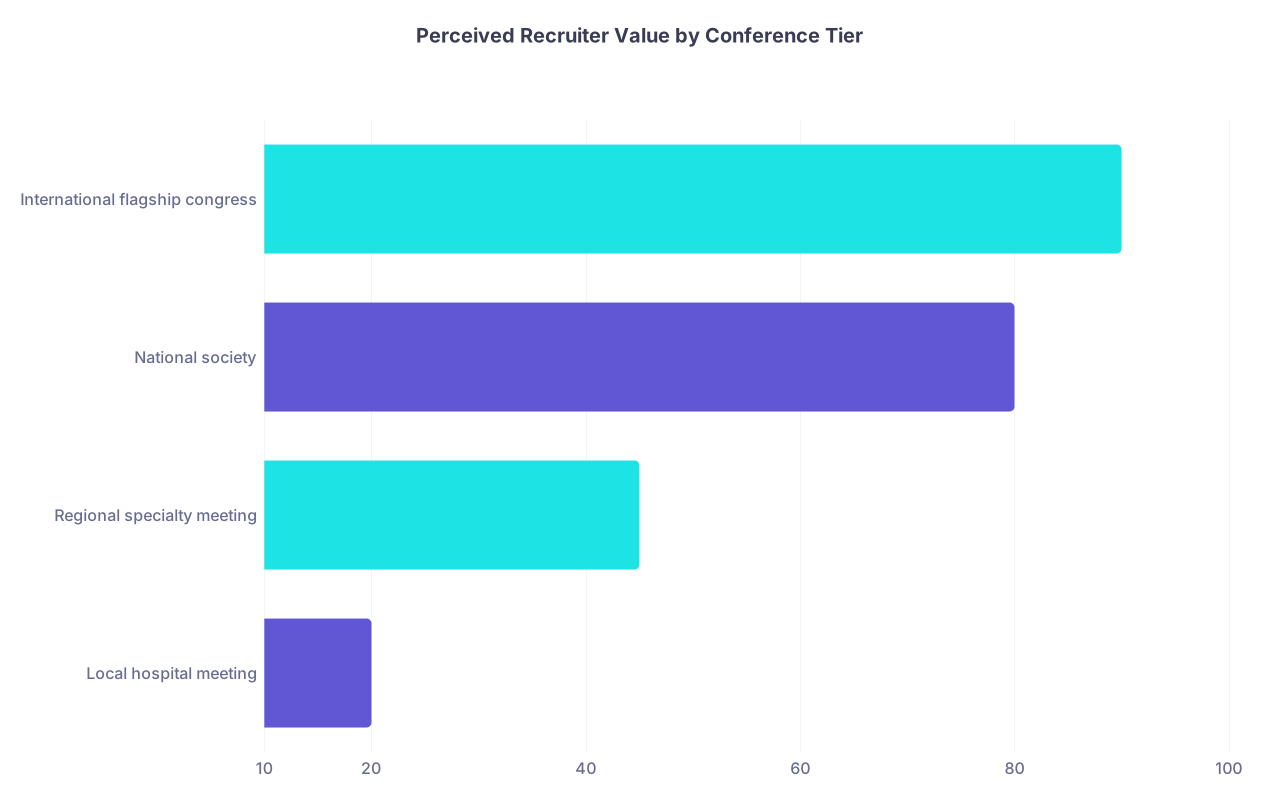
| Category | Value |
|---|---|
| Local hospital meeting | 20 |
| Regional specialty meeting | 45 |
| National society | 80 |
| International flagship congress | 90 |
5.2 Structure your poster like a pharma data story
Most academic posters are walls of text. Pharma lives and dies on clarity and messaging.
Your poster should answer, at a glance:
- Who did you study?
- What did you measure?
- What changed / what is different?
- Why should anyone in industry care?
Practical layout tips:
- Title: Include both disease and outcome (“Real-world hospitalization rates in…”)
- Top left: Concise background with 1–2 key references only.
- Methods: Clear diagram or flowchart if possible; list inclusion/exclusion.
- Results:
- 2–3 key tables or graphs, nothing gratuitous.
- Highlight N, key endpoints, effect sizes, and confidence intervals if appropriate.
- Conclusion: 3 bullets:
- One clinical takeaway.
- One relevance-to-practice or policy.
- One hint at next step (which often sounds like something industry would sponsor).
Example conclusion bullets for an HEOR-style poster:
- Patients on triple therapy had significantly lower 30-day readmissions compared with dual therapy.
- However, mean cost per patient was 28% higher, largely driven by drug spend.
- Further work should evaluate cost per readmission avoided across different health system types.
That last line is basically you signaling: “I think like HEOR/market access.”
Step 6: Weaponize your PubMed and posters on your CV and LinkedIn
You are not doing this work for a framed certificate. You are doing it to be found and taken seriously by pharma hiring teams.
6.1 Fix your CV to speak industry language
Industry CVs are not the same as fellowship CVs. For your PubMed and poster work:
- Group output by therapeutic area where possible.
- Bold or underline items that are clearly industry-relevant.
Example section:
Publications and Presentations – Immunology / Dermatology
- Doe J, Smith A. Real-world persistence with biologic X in moderate to severe psoriasis in a community dermatology clinic. Poster presented at American Academy of Dermatology (AAD) Annual Meeting, 2025.
- Doe J, et al. Safety profile of biologic X in patients with prior malignancy: A retrospective cohort from a regional network. Manuscript under review, Journal of Dermatologic Treatment.
- Doe J, et al. Treatment patterns and cost drivers in biologic-treated psoriasis patients in a large community practice. Submitted to ISPOR 2026.
This is what a pharma recruiter skimming your CV wants: a coherent narrative in a disease area.
6.2 Translate your work into bullet points for applications
For each major poster or publication, write 1–2 application bullets that reflect skills and outcomes, not just titles.
Bad:
- “First author on poster about SGLT2 inhibitors.”
Better:
- “Designed and executed a retrospective cohort analysis of 230 heart failure patients on SGLT2 inhibitors, including protocol development, data extraction, and basic statistical analysis.”
- “Presented real-world clinical outcomes data at [Conference], discussing study limitations and potential implications for treatment guidelines with academic and industry attendees.”
This is the language of Medical Affairs / Clinical Development.
Step 7: Connect the dots at conferences – where posters become job leads
Presenting the poster is half of it. The other half is who you talk to before and after.
7.1 Before the conference: prepare a hit list
Do not “just go and see what happens.” That is how you come home tired with nothing.
Identify companies with products or pipelines matching your disease area:
- Use conference exhibitor lists.
- Check company websites for their portfolio in your niche.
On LinkedIn, look for:
- Medical Science Liaisons in that therapeutic area.
- Medical Affairs Directors.
- Clinical Research Physicians.
- HEOR scientists related to your disease.
Send short pre-conference messages:
Hi [Name],
I am a [resident/fellow] at [Institution] with a strong interest in [disease area] and industry roles in [Medical Affairs/Clinical Development]. I will be presenting a poster on [very short description] at [conference].If you are attending, I would value 10 minutes to hear your perspective on how clinicians with my background can best prepare for future pharma roles.
Best,
[You]
You are not asking for a job. You are asking for advice. People say yes to that.
7.2 At the conference: use your poster as your excuse to talk
When people stop by your poster:
- Give a 30-second version of your study, not a 10-minute monologue.
- Then ask them about their angle:
- “How does this compare to what you see in your practice / in your company’s data?”
- “In Medical Affairs, what types of real-world data do you actually use day-to-day?”
If they are industry:
- After a good chat:
- “Would you mind if I connect on LinkedIn and reach out later with a couple of questions about industry roles?”
Then actually follow up.

| Step | Description |
|---|---|
| Step 1 | Present Poster |
| Step 2 | Short conversation |
| Step 3 | Thank and move on |
| Step 4 | Ask about their work |
| Step 5 | Ask to connect on LinkedIn |
| Step 6 | Post-conference follow up |
| Step 7 | Informational call |
| Step 8 | Referral or guidance |
| Step 9 | Is attendee industry? |
Step 8: Build a 12–18 month “industry-facing” publication plan
This is where most people fail. They do one poster, then disappear for two years. That does not build a recognizable profile.
You need a simple, realistic timeline.
| Quarter | Goal | Example Output |
|---|---|---|
| Q1 | 1 small retrospective project | Abstract drafted, IRB submitted |
| Q2 | Submit abstract + start review | Poster accepted, manuscript start |
| Q3 | Present + start second project | Second abstract submitted |
| Q4 | 1 paper submitted, 2nd poster | At least 2 visible outputs |
If you are more ambitious and have some infrastructure, stretch to:
- 2 posters + 1 paper per year in the same therapeutic area.
By the end of 18–24 months, your CV should read like:
- Multiple outputs in one or two clear disease areas.
- Mix of retrospective / RWE / safety / HEOR-flavored projects.
- At least one major or mid-tier conference appearance.
That is enough for many entry-level Medical Affairs or Clinical Development roles when combined with clinical training.
Step 9: Avoid common mistakes that waste your time
Let me be blunt about what does not impress pharma much, especially if it is your only output.
9.1 Scattered, unrelated one-offs
- A case report in orthopedics.
- A letter about COVID.
- A bench-lab summer project in oncology.
- No coherent theme.
This looks like “I did whatever was around me,” not “I am becoming an expert in [X].”
Fix: focus your next 2–3 projects in a single therapeutic area that Pharma actually spends money on: oncology, cardiometabolic, immunology, neurology, rare disease, etc.
9.2 Over-investing in ultra-basic case reports
Case reports are fine as starter projects if you have nothing. But they are weak long-term currency. One or two? Fine. Ten? That looks like you are stuck.
Upgrade quickly to:
- Small cohort.
- Chart reviews.
- Safety clusters.
- Any project with N > 20 and some statistics.
9.3 Ignoring authorship order and contributions
Pharma people do not care about H-index that much at junior levels. But they do care if:
- You ever led a project (first author).
- You did more than “collected 10 charts” for a giant consortium as author 27.
Try hard to get:
- At least 1–2 first-author posters or papers in your target area.
- Some obvious sign that you can drive a project.
Step 10: Translate your academic work into the language of pharma interviews
When you finally get the interview, your posters and PubMed entries become behavioral stories.
Prepare 3–5 specific stories using your projects:
- A time you led a project from idea to output.
- A time data did not show what you expected and how you handled it.
- A time you collaborated across disciplines (clinicians, statisticians, pharmacists).
- A time you had to present complex data to a non-technical audience.
- A time you handled disagreement on interpretation of results.
Example answer skeleton using a retrospective HEOR-type project:
- Situation: “We noticed high readmission rates in our COPD population despite guideline-based therapy.”
- Task: “I proposed and led a retrospective review to compare outcomes between dual and triple therapy in our system.”
- Action: “I designed the protocol, coordinated with IT to pull EMR and billing data, and worked with a biostatistician to structure the analysis.”
- Result: “We found a 15% reduction in readmission with triple therapy but with significantly higher per-patient costs. I presented the data at [conference] and later joined discussions with our pharmacy committee on formulary decisions.”
That is exactly how Clinical Development and Medical Affairs think: data → insight → impact.
Pulling it together
If you strip away all the noise, launching a pharma career with PubMed and posters boils down to three things:
Pick a lane and double down.
One or two therapeutic areas. Project types that map to Medical Affairs, Clinical Development, HEOR, or Safety. No more random scatter.Build small, fast, industry-relevant projects.
Retrospective cohorts, RWE, safety series, clear posters. Push out 2–3 visible pieces over 12–18 months that tell a consistent story.Use your outputs as networking and branding tools.
Optimize your CV and LinkedIn. Target the right conferences. Use your posters as excuses to meet industry people, ask smart questions, and line up informational calls.
Do this consistently and you stop being “just another resident who likes pharma” and start looking like what companies actually hire: a clinician who already thinks, writes, and presents like someone on their Medical or Clinical team.