
The hardest decision most burned-out clinicians face isn’t “what else could I do?” It’s this: “Do I leave clinical medicine completely, or try a non-clinical side gig first?” And most people are thinking about it the wrong way.
You’re not choosing a job. You’re choosing a life configuration.
Let’s sort it out.
The Core Question: Escape vs Redesign
Let me be blunt: if you’re asking this, you’re likely in one of three situations:
- You’re crispy-burned and fantasizing about quitting.
- You’re bored and under-challenged, but not miserable.
- You’re genuinely curious about non-clinical work and don’t want to destroy your career to try it.
Each group needs a different answer.
Here’s the simple rule I use with physicians I’ve advised:
- If your primary goal is relief from pain right now → seriously consider stepping way back or leaving, at least temporarily.
- If your primary goal is growth, challenge, or diversification → start with a non-clinical side gig.
- If your primary feeling is confusion and fatigue → don’t make an irreversible decision yet. You test, you don’t torch.
Let’s walk through a framework that actually works in real life, not on motivational posters.
Step 1: Diagnose the Real Problem (Before You Torch Your License)
Most doctors blame “medicine” when what’s actually killing them is a narrower set of problems.
Ask yourself, directly and on paper, these five questions:
If I had:
- 30% fewer patients
- 50% less pointless admin
- a predictable schedule
…would I still want to leave all clinical work?
When I’m actually with a patient, in the room, doing the thing I trained for — do I feel:
- Alive or drained?
- Neutral?
- Numb?
What’s the top thing making my life miserable right now?
- Call?
- RVU pressure?
- Toxic leadership?
- Documentation?
- Commute?
- Lack of autonomy?
If I could practice 1 day a week with great support and zero admin outside the visit, would I want to keep any patient care?
Am I running from something, or toward something specific?
If you’re honest, you’ll land in one of three buckets:
| Bucket | Your Internal Experience | Likely Best Initial Move |
|---|---|---|
| Burned & Trapped | Dread, Sunday-night anxiety, exhaustion | Major reduction or temporary exit |
| Bored & Curious | Not hating work, but restless | Non-clinical side gig |
| Confused & Tired | Blurry mix of both | Small, low-risk experiments |
If the thought of never seeing another patient again feels like relief, not grief, that’s data.
If the thought makes you oddly sad, even while hating your current job – that’s different data.
Step 2: Understand What You Actually Risk by Leaving Completely
Leaving clinical practice entirely is not a “see how it goes” decision. It’s a one-way door for a lot of specialties after a few years.
Risks no one sugarcoats when I talk to them privately:
- Skills atrophy fast. After 2–3 years out, most hospitals will treat you like a high-risk re-entry project.
- Credentialing gets harder. Recent clinical hours and procedure logs matter.
- You lose leverage. Walking away makes you a beginner again in a new field, often with a pay cut.
- Identity whiplash is real. You go from “Dr. So-and-so” to “new project manager on the health IT team.”
That doesn’t mean you shouldn’t leave. It means you don’t do it on a whim at 2 a.m. post-call after a disastrous shift.
When leaving clinical entirely makes sense
I’ve seen it be the right move when:
- You’re experiencing major mental health issues triggered or worsened by clinical work.
- You’ve switched jobs/schedules/organizations and it still feels like slow death.
- You feel nothing in patient care anymore — no meaning, no engagement, just obligation.
- You have a clear, realistic non-clinical path that can support you financially (or a genuine runway to find one).
If you tick three or more of those, it’s not cowardly to leave. It’s self-preservation.
But if you’re not sure, a clean break is a high-stakes experiment with bad reversibility.
Step 3: What a Non-Clinical Side Gig Actually Buys You
This is the part most people underestimate. A non-clinical side gig isn’t just “extra money” or “something interesting.” It buys you:
- Optionality: proof that you can earn outside the exam room.
- Identity diversification: you stop being only a clinician.
- Data: you find out what you like, not what LinkedIn thinks you should like.
- Psychological safety: you’re less trapped, which paradoxically can make your clinical job more tolerable.
Common categories of non-clinical side gigs for clinicians:
- Medical writing / content: CME materials, patient education, blogs, industry content.
- Consulting / advising: digital health startups, medtech, pharma MSL-type roles.
- Education: online courses, coaching other clinicians or students, test prep.
- Entrepreneurship: niche telehealth service, small product, membership communities.
- Utilization management / chart review: part-time remote work (sometimes evenings).
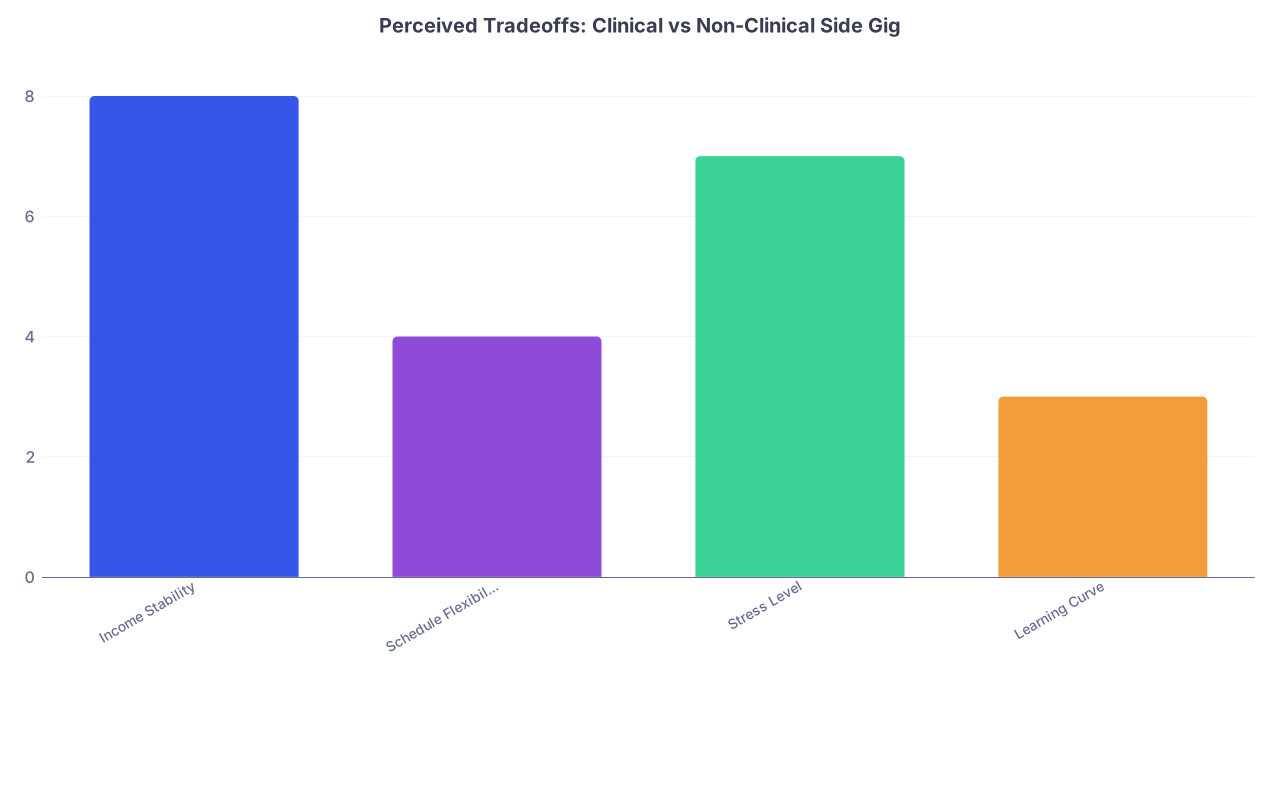
Here’s the tradeoff picture:
| Category | Value |
|---|---|
| Income Stability | 8 |
| Schedule Flexibility | 4 |
| Stress Level | 7 |
| Learning Curve | 3 |
(Scale 1–10 where higher is “more” – clinical tends to give more stability and stress, less flexibility and learning curve. Side gigs flip that.)
When a side gig is the smarter first move
Start non-clinical part-time if:
- You still feel something meaningful in patient care.
- You’re not sure what you’d do full-time outside of medicine.
- Financially, you can’t tank your income for 6–18 months.
- You want leverage — to negotiate down your clinical FTE later.
For most physicians, this is the rational first step: treat non-clinical as a lab, not a lifeboat.
Step 4: A Simple Decision Framework (That Doesn’t Require a Sabbatical Fantasy)
Use this 2×2 in your head:
- Axis 1: How much do I still value patient care? (High vs Low)
- Axis 2: How clear is my non-clinical path? (Clear vs Unclear)
Now place yourself:
High value on patient care + unclear non-clinical path →
Best move: stay clinical, start a small side gig to explore.High value on patient care + clear non-clinical path →
Best move: design a hybrid. Gradually reduce clinical to 0.4–0.6 FTE and build the other side.Low value on patient care + unclear non-clinical path →
Best move: don’t leap yet. Dramatically change how you practice (different job, less FTE, locums) while testing side gigs.Low value on patient care + clear non-clinical path →
Best move: plan an exit with a defined timeline and a specific on-ramp into the new work.
To make that clearer:

| Step | Description |
|---|---|
| Step 1 | Ask - Do I still value patient care? |
| Step 2 | Plan hybrid career |
| Step 3 | Keep clinical, start side gig |
| Step 4 | Plan full exit over 6 to 18 months |
| Step 5 | Change clinical job, run small experiments |
| Step 6 | Yes |
| Step 7 | No |
| Step 8 | Clear non clinical path? |
| Step 9 | Clear non clinical path? |
You don’t need a coach or a retreat to use this. You need an honest hour with yourself and maybe one trusted person.
Step 5: Money, Time, and Sanity – Be Brutally Practical
I’ve seen too many doctors blow this part. They chase a “passion” and forget rent exists.
Run these three numbers before you decide anything dramatic:
Your bare-minimum life number
Not your current lifestyle. Your survival baseline for 12–18 months. Mortgage/rent, loans, insurance, food, childcare, basic transportation.Your real work capacity
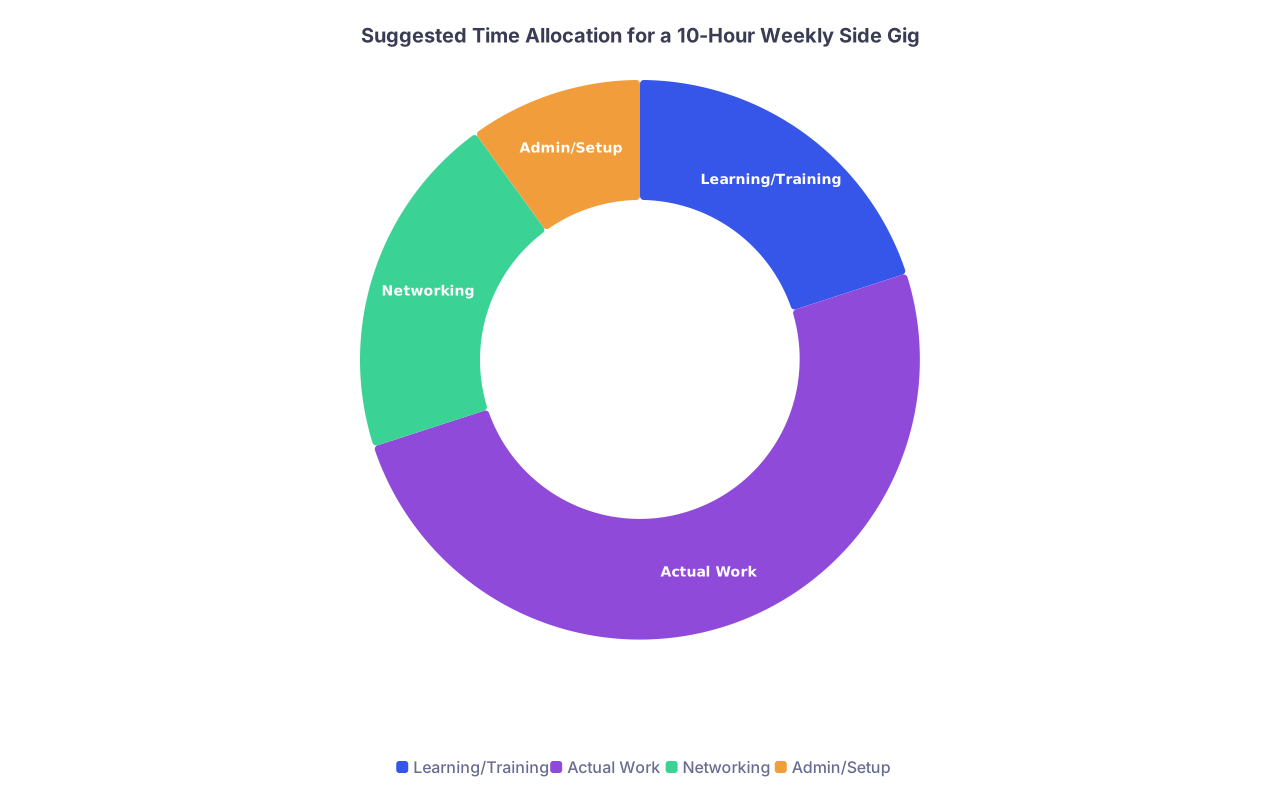
Given your current exhaustion, how many actual weekly hours can you redirect to a side gig without implosion? For most burned-out docs, it’s 5–10 hours, not 25.Your realistic side-gig earning timeline
Most decent-paying non-clinical side paths take:- 3–6 months to gain traction
- 6–18 months to become meaningfully lucrative
Anyone promising you “replace your attending income in 3 months” is selling fantasy.
Use those numbers to decide:
- If you must keep your current FTE for now.
- If you can drop to 0.8 or 0.6 FTE to buy time.
- If you have enough runway (savings / partner income) to step out fully.
Step 6: Concrete Options – What “Leaving” and “Side Gig” Actually Look Like
Here’s a side-by-side reality check:
| Path | Pros | Cons |
|---|---|---|
| Full Exit | Immediate relief, full focus on new path, no more call | High risk, income drop, hard to return, identity loss |
| Keep FTE + Side Gig | Stable income, low risk, exploratory | Time squeeze, slower progress, can worsen burnout if poorly managed |
| Reduce FTE + Side Gig | Balance of security and space, faster side growth | Requires negotiation, temporary income drop |
| Temporary Clinical Break | Mental reset, test life without clinic | Re-entry hurdle, looks odd on CV if not explained well |
If you want examples that actually exist:
- Hospitalist goes to 0.7 FTE + medical legal chart review 10 hrs/week → later moves to 0.3 FTE + full-time UM.
- Outpatient psychiatrist launches a small niche telehealth cash practice 1 day/week before leaving large system.
- Pediatrician burns out, takes 6 months off with savings, re-emerges in pharma safety role full-time, no clinical.
Notice a pattern? The ones who transition well don’t go from 1.0 FTE clinic to zero with nothing else lined up.
Step 7: Identity and Meaning – The Part Everyone Pretends They’re Above
You might tell yourself, “I don’t care about the ‘doctor’ identity.” Fine. Then why does it feel weird to imagine not using your MD/DO at all?
Here’s what I see often:
- First 3–6 months out: relief, spaciousness, sleeping like a human.
- 6–12 months: mild identity ache — “What do I actually do?” at parties, with family, with yourself.
- Beyond that: either you integrate a new identity successfully, or you spiral into second-guessing.
This is easier if:
- You keep even a small clinical footprint (telemedicine, 0.1–0.2 FTE).
- Your new work is clearly meaningful to you (not just “pays the bills”).
- You’re honest that you’re grieving a version of yourself — and that’s normal.
A Simple 90-Day Plan if You’re Unsure
If you’re on the fence, here’s what I’d tell you to do over the next 90 days instead of endlessly ruminating:
Month 1: Clarity and Constraints
- Write down your top 3 reasons for wanting to leave clinical work.
- Write down 3 parts of clinical work you’d actually miss.
- Calculate your 12–18 month bare-minimum number.
- Decide a max weekly time budget for non-clinical exploration (5–10 hours, not more).
Month 2: Micro-Experiments
Pick one of these to test:
- Do 2 small paid or volunteer projects (e.g., write an article, help a startup with clinical input, review CME).
- Shadow or talk in-depth with 3 people in non-clinical physician roles (UM, pharma, tech, education).
- Start a tiny, well-defined experiment: a paid webinar, a small course, a consulting pilot, etc.
| Category | Value |
|---|---|
| Learning/Training | 2 |
| Actual Work | 5 |
| Networking | 2 |
| Admin/Setup | 1 |
Month 3: Recalibrate and Decide Next Step
After 60 days of real data, ask:
- Do I feel more alive doing this non-clinical work than 90% of my clinic time?
- Is there a clear path to more of it?
- Could I see myself at 0.6 clinical + 0.4 this in 12 months?
Then choose one of three moves:
- Double down on side gig and plan to reduce clinical FTE within 6–12 months.
- Keep side gig small but continue as a diversification hobby, no big changes yet.
- Decide to fully plan an exit — with a specific field, timeline, and financial plan.
The Bottom Line: So, Should You Leave or Start a Side Gig?
Here’s my honest answer:
If you are severely burned out, dreading every shift, and nothing has improved after actively trying to change your clinical setup →
Start planning a partial or full exit. Protect your health first. Use side gigs tactically to build the bridge.If you are tired but not dead inside, still find some meaning with patients, and don’t have a clear next path →
Stay put for now, but start a non-clinical side gig. Treat it like R&D for your future.If you are excited by non-clinical roles but afraid of losing your doctor identity →
Build a hybrid career for at least 1–3 years. 0.5–0.8 FTE clinical + structured side work. Then reevaluate with real experience, not fantasy.
You don’t have to decide “forever.” You have to decide your next 12–18 months.
Today, not someday, do this:
Sit down with a blank page and write two headings — “Leave Completely” and “Start Side Gig.” Under each, list 5 specific consequences (money, time, identity, health). When you see it in black and white, your next move usually stops being vague and starts being obvious.
FAQ (Exactly 5 Questions)
1. If I leave clinical practice, how long can I be out before it’s basically impossible to go back?
There’s no universal number, but 2–3 years is where it starts getting ugly for many specialties. After that, you’re often looking at re-entry plans, supervised practice, extra CME, or being viewed as higher risk by credentialing committees. Surgical fields are less forgiving than outpatient specialties. If you think there’s any real chance you’ll want to return, consider keeping a minimal clinical footprint (locums a few weeks a year, telemedicine, or 0.1–0.2 FTE).
2. Can a non-clinical side gig actually replace my full attending income?
Yes, but not quickly and not always. People who get there usually do it in one of three ways: move into high-paying industry roles (pharma, medtech, health tech), build a serious consulting/education business, or land senior leadership roles over time. Most need 1–3 years to ramp, and many take a temporary pay cut. The fantasy is “replace my income in 3 months” — the reality is “build a new career over a couple of years.”
3. What are the safest non-clinical side gigs to start with while still working full-time?
“Safe” meaning low risk, flexible, and doable in 5–10 hours/week: medical writing, small consulting/advising projects, test prep teaching, utilization review, and telehealth in a different structure than your main job. They won’t all pay huge at first, but they teach you skills, give you portfolio pieces, and get you used to working outside the EMR grind.
4. Won’t a side gig just make my burnout worse by adding more work?
It can, if you treat it like another job instead of a strategic experiment. The key is boundaries: cap your weekly side-gig hours, pick something you’re actually curious about, and be willing to drop it if it drains you. For many clinicians, a good side gig reduces burnout because it restores a sense of control, creativity, and future options. If you’re so exhausted you can’t imagine doing anything after work, your first step might be reducing clinical demands, not adding a gig.
5. How do I talk to my employer about reducing FTE without tanking my career?
You don’t go in with “I’m burned out and want to start a side hustle.” You go in with: “I want to be here long-term, and I’ve realized I do my best work at X FTE. Here’s how I think we can structure this so the clinic still gets what it needs.” Offer solutions: different schedule, focused patient panels, call adjustments. Keep the non-clinical work vague or completely separate. Many groups would rather keep you at 0.6–0.8 FTE than lose you entirely — but they won’t offer unless you ask.