
The hard truth: most physicians wildly underestimate how complicated “I’ll just keep a small clinic on the side” becomes once they move into pharma.
You can often keep a part-time clinical practice while working in a pharma role—but only if you’re brutally realistic about four things: your contract, conflict of interest rules, your schedule, and your long‑term career story. Miss any one of those and you can tank your job, your license, or both.
Let’s walk through what actually works, what doesn’t, and how to structure this so it’s sustainable and defensible.
The Core Answer: Yes, But Only If These Boxes Are Checked
Here’s the blunt version:
You can usually maintain some level of clinical practice alongside a pharmaceutical industry role if:
- Your employment contract explicitly allows outside clinical work (or you’ve got written approval).
- Your clinical work doesn’t overlap with your company’s therapeutic area in a way that creates conflicts of interest.
- You’re not using company time, resources, data, or patients in ways that blur the line between your employer and your side practice.
- You maintain full compliance with licensure, malpractice, documentation, and regulatory expectations.
If those are all “yes,” then the real conversation shifts to practical questions:
- How many hours can you handle before you burn out?
- Does your clinic make sense for your future career direction?
- What happens if you get promoted or your role changes?
Most people ask, “Is this allowed?” You should really be asking, “Is this smart, sustainable, and aligned with where I’m going?”
How Pharma Employers Actually View Side Clinics
Let me be clear: pharma companies are not scared of you doing clinical work. They’re scared of risk and distraction.
Here’s how they tend to think:
- They like that you’re clinically current. It boosts your credibility in medical affairs, clinical development, safety, HEOR, etc.
- They don’t like:
- Anything that looks like double dipping (e.g., seeing patients related to studies your company runs).
- Potential off-label promotion risk if you’re known locally as “the doc who works for X company.”
- Time conflicts—clinic bleeding into meetings, travel, deadlines.
- Reputational issues if something goes wrong in your private practice and the news headline says “Company Y physician…”
So they design policies to keep these problems away from them. Your job is to understand those policies cold.
| Role Type | Clinic Compatibility | Typical Flexibility |
|---|---|---|
| Medical Affairs (field) | Often compatible | Moderate |
| Medical Affairs (office) | Sometimes compatible | Moderate–High |
| Clinical Development | Less compatible | Low–Moderate |
| Drug Safety / PV | Usually compatible | High |
| Regulatory Affairs | Sometimes compatible | Moderate |
| Commercial-facing roles | Risky | Low |
If you’re in early discovery research with a 9–5 lab structure, you’ll have a clearer boundary. If you’re a global medical director on launches across time zones, it’s… not going to be simple.
The Contract: The First Thing You Read (Not the Last)
Most physicians skip right past this and then get burned.
Your contract and company policies typically address:
Outside employment / “moonlighting” clauses
Many say something like: “No outside work without prior written approval.” That includes clinic. Verbal “it’s probably fine” from your manager is worthless. You want documented approval.Non-compete / conflict of interest
- If you’re working in oncology at Company A, and you run an independent oncology clinic where you’re prescribing competitor drugs and documenting outcomes—that’s a conflict magnet.
- Some companies will limit you to non-competing areas (e.g., you work in cardiology at Company X; your clinic is general internal medicine or urgent care).
Use of company name / affiliation
- You usually can’t market your clinic using the pharma company’s name.
- Be careful about your bios, websites, LinkedIn: separate your identities cleanly.
Action step: Before you sign an offer, ask HR or legal (via your hiring manager) directly:
- “Does the company allow part-time clinical practice?”
- “What’s the process to get side practice approved?”
- “Are there any limits on therapeutic area, hours, or setting?”
If you’re already employed, pull up your employee handbook and conflict of interest policy today. Don’t guess.
Clinical Practice Options That Actually Work With Pharma
Let’s be honest: a full half-day clinic in a busy subspecialty practice every week is often a fantasy once you’re in a global pharma role. But lots of people successfully keep slimmer, targeted clinical setups that work.
Here are the most realistic options:
Hospitalist / inpatient shifts (occasional)
- A few weekend shifts per month.
- Clean scheduling boundaries.
- Often in a more generalist role (less likely to conflict with your exact therapeutic area).
Urgent care / walk‑in clinics
- Less longitudinal responsibility.
- Predictable, discrete shifts.
- Good for keeping basic skills and patient interaction.
-
- Highly flexible, can be strictly outside business hours.
- Easy to scale up or down as your pharma workload changes.
- But watch for documentation and privacy compliance; you still need proper malpractice.
One half‑day per week in a clinic
- This is what many people think they want.
- Usually only works if:
- Your pharma job is relatively stable and non‑insane.
- Your clinic is well-supported (staff, EMR, scheduling).
- You treat it as a fixed, protected block, not something you constantly cancel.
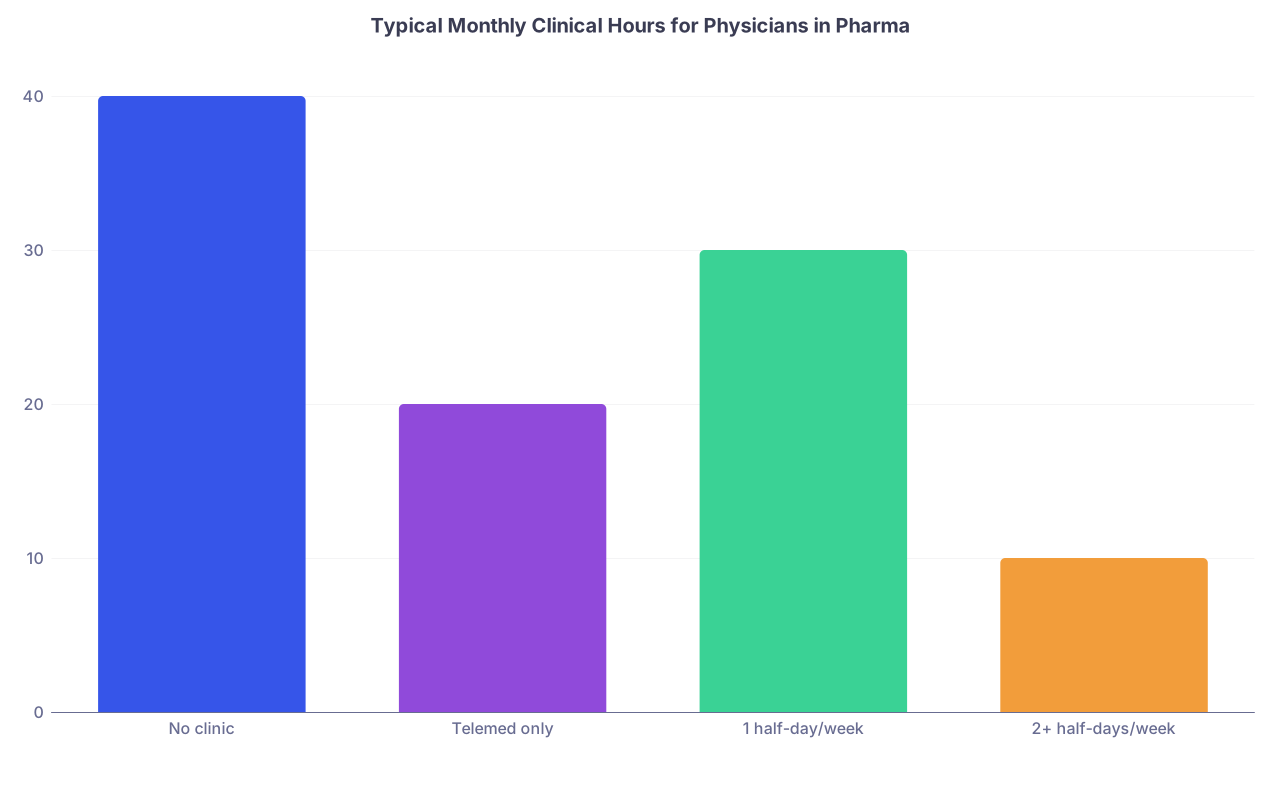
| Category | Value |
|---|---|
| No clinic | 40 |
| Telemed only | 20 |
| 1 half-day/week | 30 |
| 2+ half-days/week | 10 |
The pattern I see:
Most people who sustain dual roles long-term land in the telemed / occasional inpatient bucket. The “two half‑days of subspecialty clinic every week” crowd often tap out within 1–2 years.
Licensure, Insurance, and Compliance: Non-Negotiables
Staying part-time doesn’t mean your obligations are part-time.
You still need:
- Active license in the state(s) where you see patients.
- DEA registration if you’re prescribing controlled substances.
- Malpractice coverage that explicitly covers your setting and activities.
- Proper documentation even if you’re seeing 3 patients a week.
Common mistakes I’ve seen:
- Letting board certification lapse because “my main job is pharma now” and then realizing a hospital credentialing office cares.
- Assuming your old clinic’s malpractice covers your new occasional moonlighting work. It often doesn’t.
- Using personal devices for PHI in telemedicine without proper security.
If you want future optionality—going back to full-time clinical, academic roles, or hybrid jobs—don’t let your professional “paperwork life” decay.
Conflict of Interest and Ethics: Where People Get in Trouble
This is the area you absolutely can’t be sloppy.
You must avoid:
- Recruiting your clinic patients into your company’s trials without going through proper, formal channels.
- Letting your pharma job influence your prescribing in ways that look like promotion.
- Using internal, non‑public company data to guide your clinical practice in ways competitors could point to as unfair or unsafe.
Absolute rules I’d live by:
- Don’t run investigator-initiated trials through your own clinic on drugs from your employer without very explicit legal and compliance oversight.
- Don’t be the key prescriber in your geographic region for the exact drug you help oversee at work. That’s how headlines happen.
- Disclose your pharma affiliation to your clinic or hospital, and follow their COI policies too.
You’re juggling two heavily regulated worlds. If there’s even a hint of “is this a gray zone?”—assume it’s not allowed until compliance gives you a written okay.
Time and Energy: The Burnout Math
Let’s do the math you’re probably not doing.
Your pharma role might be nominally 40 hours/week. In reality:
- Global meetings at 7am or 8pm.
- Travel for conferences, investigator meetings, or field visits.
- Slide decks, reviews, and deadlines that don’t care about your Friday afternoon clinic.
Add even:
- 4–6 hours of clinic/week
and you’ve now:- Extended your workweek to 50+ hours.
- Added EMR inbox, lab follow‑ups, refills.
- Taken on emotional and cognitive load that doesn’t turn off.
If you have family obligations, research projects, or leadership ambitions on top—something will give. It’s usually your sleep or your sanity.
Be strategic:
- Start small. 1–2 telemed sessions/week. One weekend shift a month. See how it feels in six months.
- Give yourself an exit option. Write into your agreement with your clinic that you can scale back if your pharma role changes.
- Re‑evaluate yearly. What made sense in year 1 may crush you in year 3 when you’re a director managing a global team.
Should You Keep a Clinic At All? The Strategic Question
Forget logistics for a second. Ask why you want to keep clinical work:
Common good reasons:
- You genuinely love patient care and would feel hollow without it.
- You want to stay clinically credible in a therapeutic area for long‑term career flexibility.
- You’re early in your pharma career and not 100% sure you’ll never go back.
Common bad reasons:
- You can’t emotionally detach from your old identity, so you cling to clinic even if it makes your life miserable.
- You’re scared of what colleagues or family will think if you “stop being a real doctor.”
- You assume you “need” clinic for credibility in industry—often overstated, especially as you move up.
Here’s my rule of thumb:
If clinical work energizes you more than it drains you, and you can make it work logistically and ethically—do it.
If clinical work is now something you’re doing mainly to appease guilt or external expectations, it will eventually corrode both careers. In that case, consider structured ways to stay close to medicine (teaching, advisory boards, pro bono clinics a few times a year) without weekly clinic.
How to Set This Up Without Shooting Yourself in the Foot
Quick framework if you’re serious about doing both:
Get written approval from your pharma employer.
Don’t move forward without this. No “we talked about it once in the hallway.”Choose the least-conflicted clinical setting.
- Ideally, not in the exact niche of your company’s flagship product.
- Prefer clear, shift-based work (hospitalist, urgent care, telemed).
Lock down compliance and insurance.
- Separate malpractice for your clinic role.
- Confirm license, DEA, hospital privileges, and clinic contracts are all up to date.
Create hard boundaries in your calendar.
- Clinic only outside core pharma hours.
- Block time for documentation so it doesn’t spill into company time.
Revisit annually.
- Is your role different now?
- Has your company’s pipeline shifted into your clinical area?
- Are you more tired, less present, or slipping in either job?

| Step | Description |
|---|---|
| Step 1 | Pharma Offer or Job |
| Step 2 | Do not do clinic |
| Step 3 | Choose low conflict setting |
| Step 4 | Get written approval |
| Step 5 | Secure malpractice and licenses |
| Step 6 | Start small and reassess yearly |
| Step 7 | Company allows outside clinic? |
| Step 8 | Conflict with company area? |
| Step 9 | Can you handle extra hours? |
FAQ: Part-Time Clinic While Working in Pharma (7 Questions)
1. Can I legally work clinic and pharma at the same time?
Yes, as long as you’re properly licensed, insured, and your employer allows outside work. There’s nothing inherently illegal about doing both. The risk comes from conflicts of interest, improper use of company resources, or violating contract terms—not from the mere fact of holding two roles.
2. Will pharma companies see my clinic as a positive or negative?
Both. Positive: you stay clinically sharp and understand real-world practice, which is gold in medical affairs and development. Negative: they worry about divided focus, scheduling conflicts, and regulatory risks if your clinical work overlaps with their products. Present it as a small, well-contained commitment, and be ready to show you’ve thought through compliance.
3. How many hours of clinic per week is realistic with a full-time pharma job?
For most people, 0–4 hours/week is sustainable. A half‑day clinic or a few telemed sessions is about the limit before performance, family life, or health start suffering. Once you hit 2 half‑days/week, you’re functionally doing two jobs. That’s rarely stable long-term unless one of them is extremely light.
4. Do I need to tell my clinic employer that I work in pharma?
Yes. Your hospital or clinic will have its own conflict of interest policies. If you’re known to work for a specific company, they may restrict which drug samples you handle, talks you give, or studies you run. Failing to disclose can backfire badly if there’s ever a COI investigation or media attention.
5. Will I lose my clinical skills if I only work a few hours a week?
Some skills, yes. You won’t stay at peak procedural proficiency doing one clinic half‑day every other week. But you can maintain enough clinical familiarity to:
- Understand practice patterns
- Communicate credibly with clinicians
- Re-enter more clinical work later with a ramp-up period
If you want to maintain procedural depth (e.g., interventional, surgery, complex ICU), ultra‑part‑time practice is usually not enough.
6. Is telemedicine safer from a conflict-of-interest standpoint?
Safer sometimes, not automatically. It’s convenient and easier to schedule around pharma work, but you still have to:
- Keep therapeutic areas non-overlapping where possible
- Avoid pushing your company’s products
- Maintain proper malpractice and privacy protections
Treat telemed as “real clinic with a webcam,” not as a lightweight exception.
7. How do I know when it’s time to drop clinic entirely?
Red flags: you’re constantly rescheduling patients due to pharma travel; you dread clinic days; documentation lags; your pharma performance reviews mention responsiveness or availability; or you feel like you’re failing both worlds. At that point, have an honest conversation with yourself: is keeping clinic serving you now, or is it just serving an old version of your identity?
Open your calendar for the next three months right now. Block out a realistic clinic schedule you think you could maintain on top of your pharma role—and then ask yourself honestly: would I still want this life if my job got 30% busier? If the answer is no, scale the clinic plan back before you ever sign up.