
The titles lie more than the people do.
“Director” and “VP” sound like a clean hierarchy. In industry, especially for physicians, it’s nowhere near that simple. I’ve sat in rooms where an MD “Director” had more real power than a non‑clinical VP, and I’ve watched physicians chase VP titles that came with zero actual influence and a lot of political exposure.
You’re about to see how it really works behind the HR job descriptions.
The Dirty Secret: Titles Are Currency, Not Truth
Here’s the first thing nobody tells residents and attendings jumping to industry: titles are bargaining chips, not standardized ranks. Especially for physicians.
Most companies will quietly admit this if you get them off the record:
- They use physician titles to manage egos.
- They use them to fit you into existing HR bands that were never designed for MDs.
- They use them to control cost while still making you feel “important.”
So a “Medical Director” at one company might be the equivalent of a Senior Manager at another. A “VP, Medical Affairs” at a small startup might have less budget, headcount, and influence than a Senior Director at Pfizer.
Inside leadership meetings, this is understood. Outside, physicians make career decisions based on the label on LinkedIn. That’s how people get burned.
Let’s put some structure on the chaos.
What “Director” Usually Means for Physicians
Ignore the title for a second and look at the reality: in most large pharma, medtech, or payer organizations, Director is the default landing zone for physicians coming out of clinical practice or fellowship.
The honest version:
- You’re a senior individual contributor or small-team lead.
- You’re close to the actual work: protocols, studies, strategy decks, field questions.
- You’re expected to execute and advise, not to own entire business lines.
At a global pharma, a “Medical Director” in Clinical Development might:
- Own a few studies in a specific indication.
- Sit on a cross‑functional team with regulatory, biostats, operations.
- Present to a governance committee but not chair it.
- Have maybe 1–3 direct reports. Or none.
At a large payer: a Medical Director might review appeals, help design utilization policies, and sit on a committee or two. You’re important, but you’re not setting the company’s agenda.
Where you land within “Director” actually matters more than you think, but nobody explains it:
| Company Type | Common Physician Titles | Rough Internal Level |
|---|---|---|
| Big Pharma | Associate Director, Director, Senior Director | Manager → Sr Manager → Director+ |
| Mid-size Biotech | Director, Senior Director | Director band |
| Small Biotech/Startup | Director, VP | Same band, different labels |
| Large Payer / Health Plan | Medical Director, Senior Medical Director | Manager/Director mix |
A few “inside baseball” points on Director roles that you will not see on job postings:
1. Director is the “safe” physician bucket.
HR can justify your salary, you sound senior enough for your MD ego, but you’re still replaceable. Brutal, but true. If they need to cut, Medical Directors are the first layer scrutinized.
2. A Director’s power comes from proximity, not the title itself.
If you’re the Director sitting on the key asset team for a billion‑dollar drug, you’ll have more real influence than a Director in some sleepy legacy portfolio. I’ve watched “lowly” Directors completely shape label strategy because they were in the room when it mattered.
3. Most Directors are still judged as doers.
Your promotion cases, your bonuses, your reputation – they’re all tied to: Did you run the trial? Did you answer the health authority? Did you deliver the slide deck the SVP used with the board? You may “lead” things, but the company still expects hands-on.
4. Internal politics: you’re staff, not royalty.
People will listen because you’re the doctor. Then they will ignore you if you cannot translate that into business language. As a Director, you’re high enough to be a nuisance, not high enough to be feared.
What “VP” Actually Buys You (And What It Costs)
Let me be blunt: most physicians fantasizing about “VP” roles have no idea what they’re asking for.
VP for an MD in industry typically means:
- You’re responsible for a function, a franchise, or a geography.
- You own headcount, budget, and performance metrics that roll up into C‑suite goals.
- You live and die by non‑clinical metrics: revenue, timelines, launches, payer adoption, field engagement.
A VP, Medical Affairs for Oncology at a large pharma, for example:
- Directs multiple Directors and Senior Directors.
- Sits on a governance board that signs off on launch strategy and evidence generation.
- Gets called when the FDA, EMA, or a big payer is furious.
- Is expected to have a view on everything: medical strategy, KOL dynamics, congress presence, health economics, field force messaging.
Here’s the part physicians don’t anticipate:
As a VP, your day is mostly meetings and politics. You’re not the one reading every paper. You’re the one deciding which paper gets turned into a strategy. You’re calibrating egos between commercial, regulatory, legal, and your own medical team.
On paper, it’s a massive upgrade. In reality, there are trade‑offs:
- Less time thinking deeply about science, more time negotiating timelines and resources.
- Less control over minute details, more accountability for high‑level failure.
- More comp and stock, yes, but also more visibility when things go sideways.
In many orgs, VP is the first level where you’re expected to have a recognizable P&L impact, even if you don’t literally own a P&L. C‑suite will ask: “What did your function do to move revenue, reduce risk, or protect the brand this quarter?” Not “Did you practice good evidence-based medicine?”
And here’s a little secret from promotion committees: people watch how you behave at Director and Senior Director levels to decide if you’re “safe” for VP. Loud, purely clinical purists rarely make it. The ones who translate clinical judgment into business trade‑offs do.
The Director vs VP Reality: Scope, Pay, Power
You’re not choosing between titles. You’re choosing between jobs and identities.
Let me lay out the differences the way insiders think about them:
| Dimension | Director (Physician) | VP (Physician) |
|---|---|---|
| Scope | Program / indication / function slice | Franchise / region / entire function |
| Focus | Execution + tactical strategy | Vision, trade-offs, political alignment |
| Time Use | Content, documents, study details | Meetings, decisions, crisis management |
| People | 0–5 direct reports | Multi-layer teams + other leaders |
| Accountability | Study milestones, functional deliverables | Revenue, launches, reputational risk |
| Visibility | Functional leadership | C-suite and sometimes board |
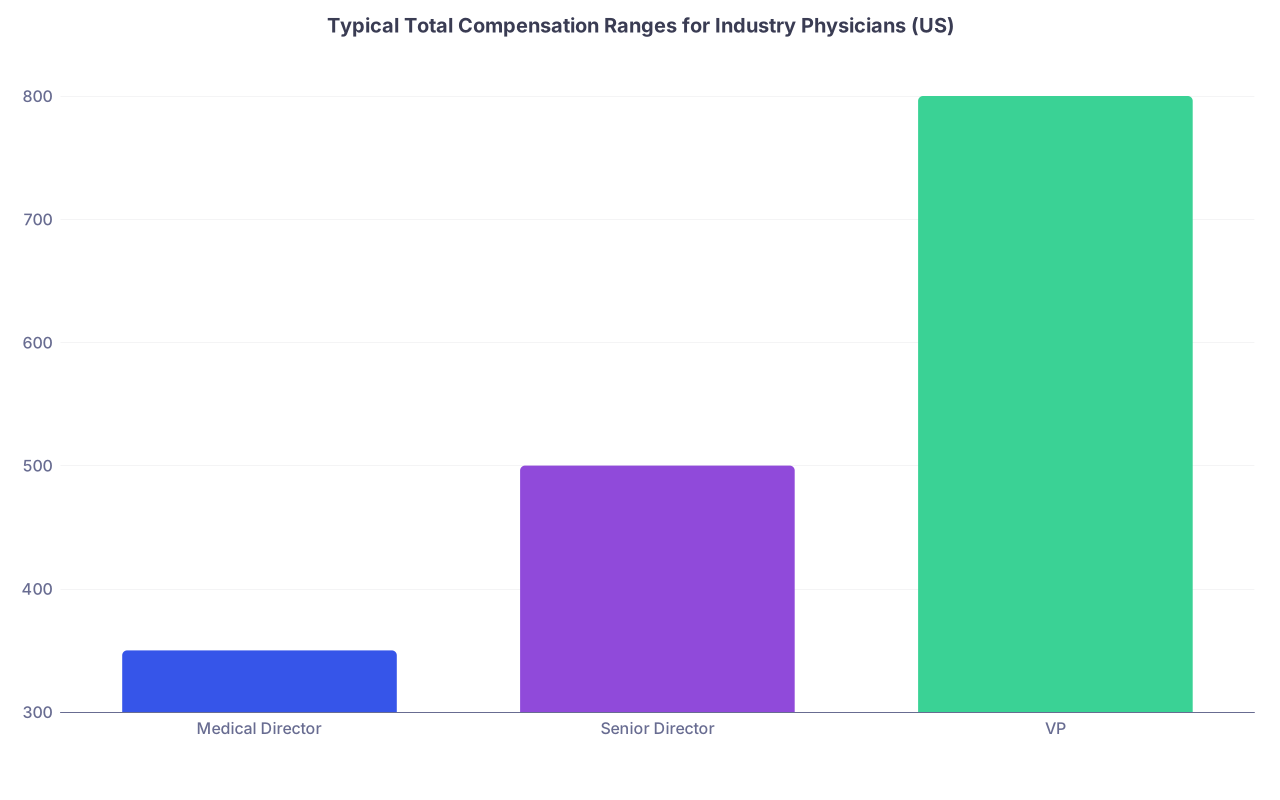
Now: pay. Everyone wonders but few get honest numbers. They vary wildly by company, geography, and bonus structure, but I can give you realistic ballparks from what I’ve seen in US‑based roles:
| Category | Value |
|---|---|
| Medical Director | 350 |
| Senior Director | 500 |
| VP | 800 |
Those numbers are approximate total comp in thousands (base + target bonus + typical equity). At very large pharma, top VPs blow past that. At payers or smaller companies, Director and VP numbers can be 30–40% lower.
The real gotcha: risk and volatility scale faster than comp.
As a Director, you can have a bad year, even a failed study, and recover. Someone above you will absorb the strategic embarrassment.
As a VP, if your launch flops, your region misses numbers, or your team burns out and quits? You’re the story. I’ve watched VPs vanish after one high-profile failure that wasn’t entirely their fault. They still carried the badge.
Why Title Means Something Different at Startups vs Big Pharma
Here’s where people get especially confused: a “VP, Medical” at a 30‑person Series A biotech is not the same creature as a VP at Novartis.
At a startup:
- “VP” is often bait to get you to accept lower salary + higher theoretical equity.
- You do everything: protocol review, vendor calls, medical monitoring, KOL outreach, slides for investors.
- You might manage exactly zero people for the first 12–24 months.
At large pharma:
- “VP” has been comp committee‑approved. HR knows exactly which bands, what bonus targets, what LTI grants.
- You inherit an existing machine with layers under you.
- You spend more time on alignment than creation.
This is why you’ll see some very senior pharma people “step down” to VP or even CMO at a tiny biotech. On LinkedIn, it looks like a promotion. In reality, sometimes it’s a risky bet with a chance at real upside and more control.
For physicians leaving clinical practice, this is where most miscalculations happen. They see:
“Director, Clinical Development” at BigPharma vs “VP, Clinical Development” at TinyBio.
And they assume VP = more senior. You must judge by:
- Headcount: how many direct and indirect reports?
- Budget: what’s the spend you actually control or influence?
- Decision rights: what can you sign off on without extra approvals?
- Exposure: who do you present to regularly? CEO? Board? Or middle management?
I’ve seen a “Director” at a large pharma quietly influencing a $2B portfolio while a “VP” at a startup was fighting to get basic vendor invoices approved.
HR Levels vs Business Cards: The Hidden Layer
Here’s the hidden architecture: HR job levels.
Companies usually have internal bands: L8, L9, M3, M4, Grade 13, Grade 14, etc. Titles like Director, Senior Director, VP are mapped to these bands, but not always one‑to‑one.
For physicians, this creates a mess:
- You might be called a “Medical Director” but slotted into the same band as non‑MD Senior Managers.
- At another company, that same “Medical Director” title might sit in a higher band equivalent to Directors.
The only way to know is to ask the right questions when you’re interviewing:
- Where does this role sit in the HR level structure?
- What titles are at the levels above and below this role?
- What’s the typical next step from this title for high performers?
- How many layers are between this role and the C‑suite?
Candidates rarely ask. Insiders always do. Because you can’t compare “Director vs VP” without knowing whether you’re being leveled correctly in the underlying system.
Here’s a visual that matches how career progression usually looks for physicians in big organizations:

| Step | Description |
|---|---|
| Step 1 | Associate Medical Director |
| Step 2 | Medical Director |
| Step 3 | Senior Medical Director |
| Step 4 | Executive Director |
| Step 5 | VP Medical |
| Step 6 | SVP / CMO |
Notice something? There are more levels than just “Director” and “VP”. Companies often wedge in “Senior Director” or “Executive Director” as buffers – partly to slow promotions, partly to keep you motivated without paying VP money yet.
How Program Directors and Execs Actually Think About You
You want the unvarnished truth about how leadership looks at MD Directors vs MD VPs?
Here it is.
Directors (MDs):
These are the “smart doers.” The expectation is: you know the medicine cold, you can grind through complex documents, and you’ll hold the scientific line when commercial gets overeager. You’re allowed to be a bit academic, even prickly, as long as you deliver.
You’ll hear comments behind closed doors like:
- “She’s great in the details but not ready to run a franchise.”
- “Brilliant clinician, but still thinks like a fellow.”
- “We need him in the weeds on this filing; keep him at Director for now.”
VPs (MDs):
These are judged on a different axis: Can you be trusted in front of the CEO and the board? Can you take a nasty safety signal or a payer backlash and help navigate the company through it without panicking or going full ivory‑tower?
The off‑record comments change tone:
- “He’s great externally but weak internally; his team is flailing.”
- “She gets the business; we can put her in front of the Street.”
- “He still wants to rewrite every slide; that’s a Director mindset, not VP.”
See the pattern? By the time you’re at VP, nobody cares if you personally wrote the best protocol of your career last year. They care whether you’re building and steering a system that creates value and avoids disaster.
If that sounds unappealing, good. Better to realize it before you chase a VP title you won’t enjoy.
Which Should You Aim For?
Now we get to the part candidates never answer honestly with themselves.
Director and VP in industry aren’t just rungs on a ladder. They’re different lifestyles.
If you love:
- Deep dives into data.
- Arguing over endpoints and inclusion criteria.
- Crafting detailed clinical narratives.
- Teaching and mentoring without political theater.
You’re probably going to be happier and more effective in Director / Senior Director roles. You can still make high six figures, have impact on patients at scale, and keep a decent amount of cognitive autonomy.
If you’re drawn to:
- Big strategic calls.
- Balancing risk vs reward under pressure.
- Managing complex teams and egos.
- Being “the face” of medical externally and internally.
Then VP might make sense—but you should go into it with your eyes open. It’s not a pure promotion. It’s a transformation into a different type of job.
One more uncomfortable truth: not everyone is seen as VP material, regardless of how smart they are.
Many physicians plateau at Senior Director / Executive Director because:
- They can’t stop diving into details.
- They’re visibly contemptuous of commercial realities.
- They’re politically tone‑deaf in cross‑functional settings.
- Or they simply do not want to sacrifice life further for the job.
I’ve seen some of the best clinical minds I know choose to stay as Directors because they care more about the integrity of the science than about leading town halls and negotiating headcount.
That’s not failure. That’s alignment.
How to Read Job Descriptions Without Being Fooled
Last piece of real talk: job descriptions are marketing documents. Titles are branding. If you want to make smart choices, you have to decode what’s underneath.
When you see “Director” or “VP” in an alternative medical career posting, ignore the label for a minute and ask yourself:
- What exactly am I accountable for? Studies? A product? A region? A whole function?
- How many people and which functions report to me? None? Cross‑functional dotted lines? A full hierarchy?
- Who do I present to when things go wrong? My boss? The C‑suite? The board?
- What part of my time is doing vs deciding? If 80% is meetings and 20% content, that’s VP‑ish regardless of title.
You can also look at who previously held the role. LinkedIn cyber‑stalking is fair game here. If your “Director” predecessor is now a VP at a competitor, you know the role has real heft. If your “VP” predecessor is now a “Director” elsewhere, that tells you something too.
Do not get hypnotized by the allure of a VP title if the job is essentially Senior Medical Director work with a little extra pressure and not much extra scope. Companies do that. A lot. They know doctors love status symbols.
The Bottom Line
Three things to keep straight about physician titles in industry:
Director vs VP is about scope, risk, and identity—not just prestige. You’re choosing how much of your life you want to spend in the weeds versus in boardrooms, and how much political exposure you’re willing to sign up for.
Titles lie; levels, scope, and decision rights tell the truth. Ignore the business card until you understand where the role sits in the org chart, what budget and headcount it owns, and who you’re accountable to when things explode.
Your best career move might be not chasing VP. A well‑positioned Director or Senior Director role with real influence over key assets can be more satisfying, more stable, and nearly as lucrative as a VP job that turns you into a full‑time firefighter and politician.
If you remember nothing else: in industry, “Director” and “VP” are costumes. Look underneath at what the job actually demands—and costs—before you decide which one you really want to wear.