
The riskiest digital health products are built without a physician who actually understands UX, safety, and clinical guardrails.
If you are a clinician looking for an alternative career that is real, impactful, and not just “medical advisor theater,” this role is it. Done well, a Digital Health Product Physician is the difference between a safe, clinically coherent product and a shiny but dangerous app that quietly harms patients.
Let me break this down specifically.
What a Digital Health Product Physician Actually Does
Most job descriptions for “Clinical Product Lead,” “Physician Product Manager,” or “Medical Director – Digital Health” are vague by design. They list a grab bag of responsibilities and hope someone will self-select.
In practice, the role sits at the intersection of three hard things:
- Clinical reasoning
- Product thinking
- UX and safety engineering
If you strip away the fluff, your core responsibilities look like this:
- Define what “clinically correct” means in the product, in precise, testable detail
- Translate that into workflows, decision logic, copy, and guardrails the dev and design teams can actually implement
- Anticipate where patients and clinicians will misunderstand, misclick, or misuse the product
- Own the clinical risk surface: what can go wrong, and how the product prevents or mitigates it
Let’s make that less abstract.
Concrete day-to-day work
A typical week in this role could look like:
- Reviewing Figma prototypes and spotting that the “Skip” button on a chest pain triage flow is functionally an easy path to missing red flags.
- Writing “clinical acceptance criteria” for a blood pressure monitoring feature:
- When SBP ≥ 180 or DBP ≥ 110 on two readings within 15 minutes, trigger urgent safety messaging, suppress “congratulations” banners, and provide clear instructions for in-person care.
- Working with data science to define which variables must be in a risk model (e.g., excluding age from a pregnancy hypertension model is not acceptable).
- Building escalation logic:
- Which symptom combinations generate an in-app alert only
- Which trigger clinician review
- Which must instruct immediate emergency care
- Sitting in a design review and saying, “No, we are not labeling this as ‘diagnosis’ in the consumer app; we will call it ‘risk assessment’ and we will clarify limitations in-line.”
This is not academic guideline discussion. It is operationalizing medicine in hostile environments: tiny screens, distracted users, partial data, and regulators looking over your shoulder.
UX: Where Most Clinicians Underestimate the Job
Too many physicians think UX is “making the screens pretty.” That is how you end up with beautifully designed harm.
User experience for digital health is closer to applied human factors engineering. The big questions:
- What will a tired, anxious user actually tap?
- What will a busy PCP assume when they see a dashboard at 5:30 pm?
- Which labels will non-native English speakers misunderstand?
- What happens when the user doesn’t read your carefully crafted disclaimer?
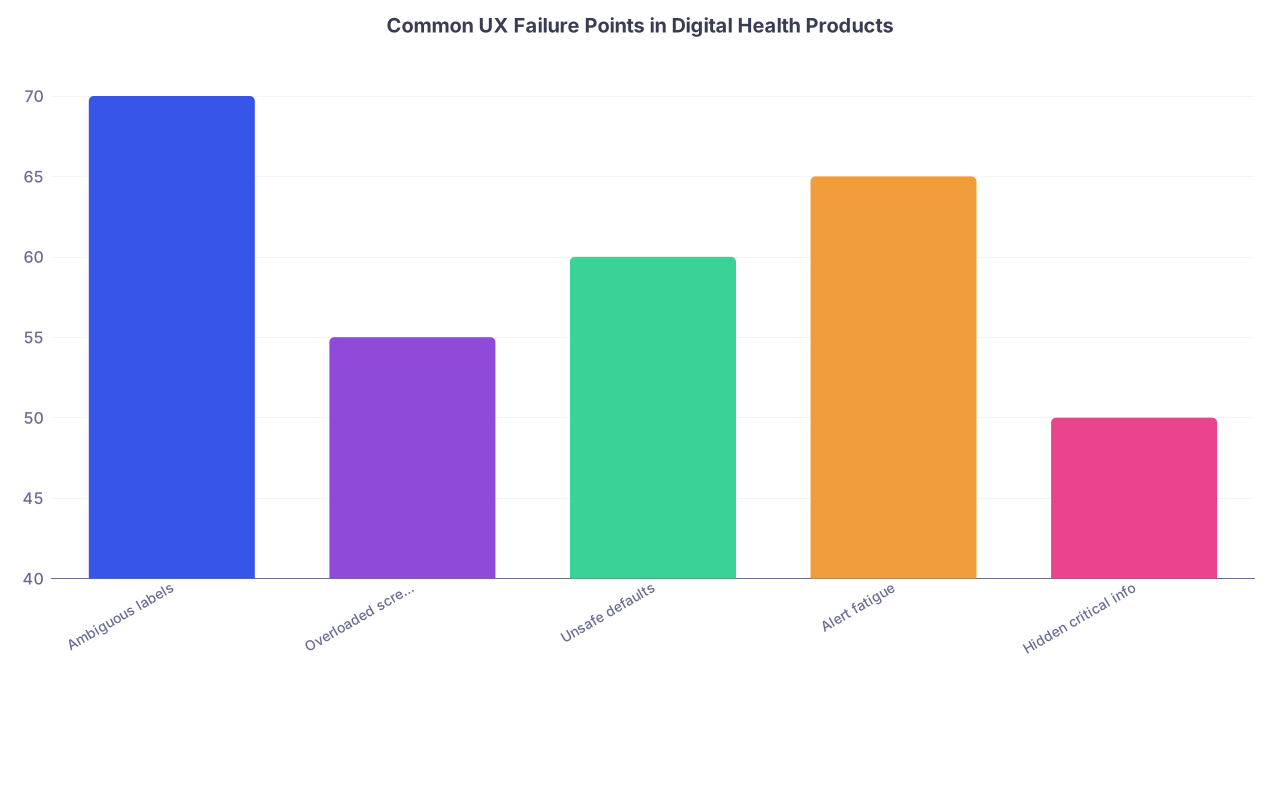
| Category | Value |
|---|---|
| Ambiguous labels | 70 |
| Overloaded screens | 55 |
| Unsafe defaults | 60 |
| Alert fatigue | 65 |
| Hidden critical info | 50 |
Core UX responsibilities for a physician in product
You are not the designer. But you must be the person who says, “This interaction is clinically dangerous.” The key areas:
Information hierarchy
Critical data must be:- Visually dominant
- Accessible in one or two taps
- Interpretable without reading a paragraph
Example: A remote monitoring dashboard that shows “adherence streak” in bright green at the top, and a small red SBP 190 in the bottom-left. That is inverted risk hierarchy. Your job is to call that out.
Copy and microcopy
Many clinical errors in digital products are language errors, not algorithm errors.- “Normal” vs “Reassuring” vs “Stable for now” carry very different implications.
- “You may continue to monitor at home” vs “You can safely ignore this” – those are not equivalent.
- “Contact your doctor” is useless at 11pm on a Sunday in a rural area. What actually happens?
I have seen a hypertension app with the line “Everything looks good” on a page that also showed multiple stage 2 readings. The algorithm was checking trends, not absolutes. A physician with UX awareness would never allow that sentence without context.
Flows, not screens
Clinicians think in encounters. Product physicians must think in flows.How does a user go from symptom → input → advice → action → follow-up?
You must walk that path repeatedly and ask at each step:
- What if they lie (intentionally or not)?
- What if they abandon the flow halfway through?
- What if they come back 3 days later with new symptoms?
Edge-case empathy
There will always be a subset of users who:- Screen-read instead of reading
- Tap the largest button
- Mis-interpret color (colorblindness, cultural associations)
- Have limited health literacy
Your role is to defend the edge cases that matter clinically. Not every edge case. The ones where harm is credible.
Clinical Safety and Guardrails: The Part That Actually Keeps People Alive
Here is where the role becomes non-negotiable. If you do not take ownership of clinical safety, no one else will. The lawyers will try, but they work backward from risk, not forward from clinical sense.
Safety in digital health is not just “follow the guidelines.” It is designing an entire system so that the safest behavior is also the easiest behavior.
Categories of clinical guardrails
Think of guardrails at several layers:
- Input guardrails – What data you allow and how you collect it
- Processing guardrails – How the system interprets and combines that data
- Output guardrails – How decisions, advice, or insights are presented
- Operational guardrails – Human workflows, escalation paths, and audits around the product
| Layer | Example Guardrail |
|---|---|
| Input | Hard stop if chest pain + shortness of breath + syncope reported |
| Processing | Ceiling on “reassuring” score if any red flag present |
| Output | Force display of emergency message before any self-care advice |
| Operational | All red-flag triage cases reviewed within 1 hour by RN/MD |
Input guardrails
You decide:
- Which symptoms are mandatory in a triage flow
- Which combinations cannot bypass certain questions
- What defaults are acceptable (never default to “No” for red-flag symptoms)
- What ranges are allowed for vitals and lab values
A classic failure: allowing users to enter impossible values (like HR 10) and then letting the system treat them as real. You want:
- Range checking
- Confirmation prompts for extreme values
- Clear explanation of measurement instructions to reduce garbage inputs
Processing guardrails
This is where people get hurt in algorithmic products.
You must define:
- The minimum data needed to generate any recommendation
- The conditions under which the algorithm must refuse to give advice
- The “override” conditions that trump statistical risk scores
For instance:
- Any chest pain in a >40-year-old with diabetes and diaphoresis triggers a “seek urgent care” pathway, even if some ML model thinks the probability of ACS is 0.4%.
- No symptom triage conclusion is generated if less than 60% of critical questions were answered; instead, the product explains uncertainty.
You also specify how clinical guidelines are encoded:
- Do you allow off-guideline behavior for usability?
- If yes, what extra warnings appear?
- How frequently do guidelines get re-reviewed, and by whom?
Output guardrails
This is what users see and act on. Three big levers:
Language strength
- “You should go to the emergency department immediately.”
- “Consider going to urgent care within 24 hours.”
- “You can monitor at home.”
The verbs matter. “Should,” “must,” “consider,” “can.”
Channel escalation
- In-app message only
- Push notification
- SMS
- Phone call
- Integration with clinician inbox or EHR
You decide which clinical events justify which escalation level. A “possible arrhythmia detected” alert that quietly lands in an in-app inbox is malpractice design.
Blocking vs non-blocking UX
Sometimes you must block normal flows until the user acknowledges a serious risk.Example: Before allowing a user to complete a refill request after reporting suicidal ideation, you show a blocking screen with crisis resources and clear instructions. The user has to dismiss that before proceeding.
How This Role Fits Inside a Digital Health Company
If you take this job, you will not sit in a nice neat “Clinical” silo writing guidelines no one reads. You will be in the mess.
Typical org positioning
Titles vary:
- Digital Health Product Physician
- Clinical Product Lead / Director
- Physician Product Manager
- Medical Director, Product Safety
- Clinical UX Lead (less common, but a good role)
Where you actually sit matters more than your title.
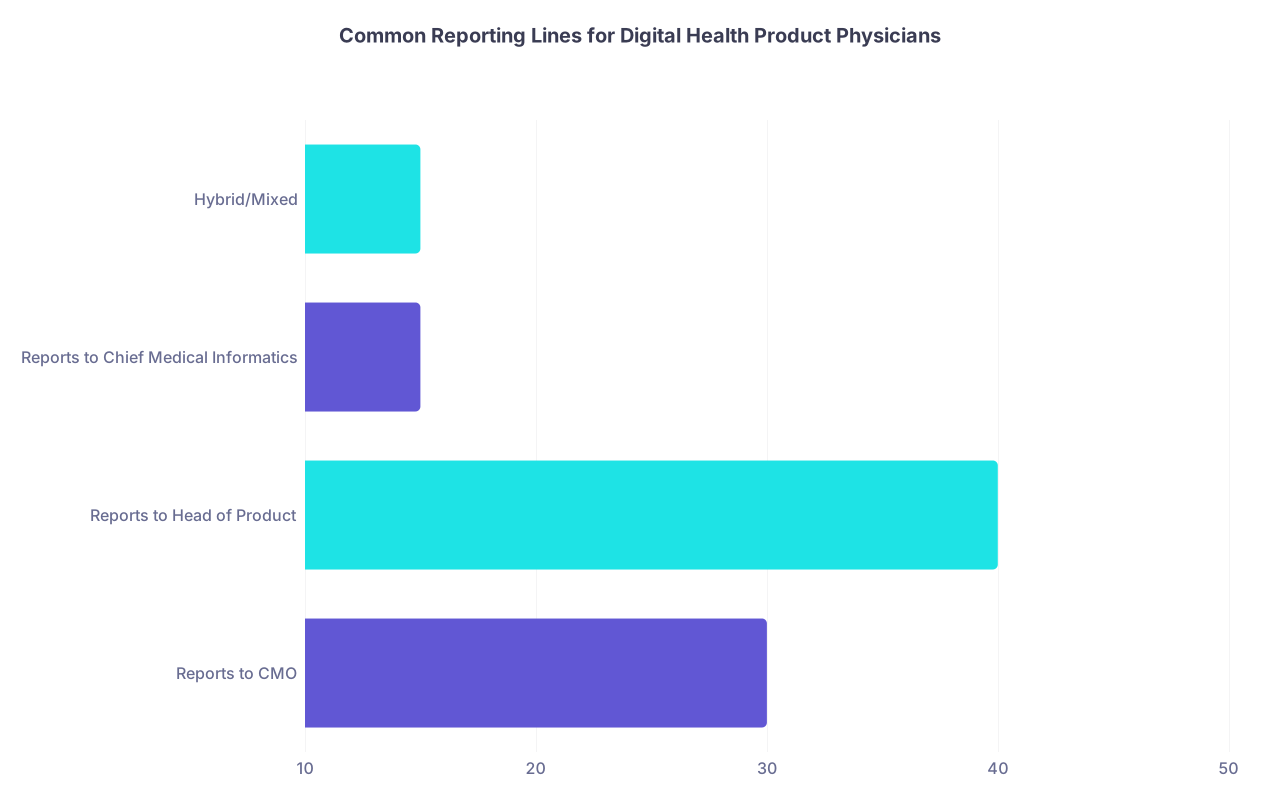
| Category | Value |
|---|---|
| Reports to CMO | 30 |
| Reports to Head of Product | 40 |
| Reports to Chief Medical Informatics | 15 |
| Hybrid/Mixed | 15 |
If you report to:
- Head of Product – You get closer to roadmap and UX decisions, but you must actively protect clinical standards. Good if you have strong product instincts.
- CMO or Chief Clinical Officer – You will be “consulted” a lot and ignored more than you like unless the CMO is powerful internally.
- Dual/Matrix (Product + Clinical) – Best case when functional; worst case you get pulled in opposite directions.
Teams you must deeply partner with
Product managers
Your closest partner. You co-own:- Feature definitions
- Success metrics that are not just engagement (e.g., reduced unsafe triage outcomes, fewer missed escalations)
- Prioritization of safety debt vs shiny new features
Design / UX
You should be in:- Early discovery interviews (listening, not dominating)
- UX flow reviews for anything with clinical consequences
- Copy review for high-risk parts of the product
Engineering
Less about telling them “how” and more about:- Defining clinical logic as clear rules, states, and exceptions
- Answering edge-case questions quickly
- Signing off on test cases for safety-critical features
Data science / ML
Particularly with AI products:- You define what “safe to deploy” means
- You review model outputs on real cases, not just AUC curves
- You insist on biased or dangerous outputs being blocked or flagged
Regulatory / Legal / Quality
You speak both languages: clinical and product. Here you play interpreter.- Align what the product does with how it is labeled (class II vs “wellness tool” nonsense)
- Define post-market surveillance for clinical outcomes
- Participate in safety incident investigation and corrective actions
Concrete Examples: What Good vs Bad Looks Like
Let’s walk through two scenarios you are likely to face.
Scenario 1: Symptom checker for chest pain
Bad version (I have seen variants of this in the wild):
- User selects “Chest pain”
- Asked a few generic questions about duration and severity
- Reports “mild, intermittent pain for 2 days, worse with deep breath”
- No questions about risk factors, dyspnea, diaphoresis, exertional nature, or radiation
- End result: “Low risk. You can continue monitoring symptoms at home.”
Problems you as product physician should catch:
- No branching for age or comorbidities
- No attempt to distinguish pleuritic vs exertional vs reproducible musculoskeletal pain
- No explanation of uncertainty or limitations
- “Low risk” language with a false sense of security
A safer, properly designed flow under your guidance:
- Mandatory early branching questions:
- Age
- Sudden onset vs gradual
- Associated symptoms (SOB, diaphoresis, syncope, nausea)
- Known CAD risk factors
- Hard safety stops:
- Any combination of chest pain + SOB + syncope or near-syncope triggers a blocking “seek emergency care now” message with clear instructions. No home monitoring recommendation allowed.
- Output language:
- For non-red-flag patterns: “Based on what you told us, this pattern is less likely to be a medical emergency. However, this tool cannot diagnose heart problems. If your symptoms worsen or new symptoms appear, seek urgent care.”
- Operational guardrail:
- For high-risk responses, the system logs the episode and triggers a safety audit to confirm logic performed as expected.
Scenario 2: AI model predicting risk of hospital readmission
Company wants a “smart” model to predict 30-day readmission post-discharge for heart failure.
Dangerous pattern:
- Data scientists build a model with dozens of features, including race, zip code, income proxies
- Model performs well on traditional metrics
- Product wants to show “Your patient has a 70% chance of readmission” in the clinician dashboard and auto-enroll high-risk patients into low-touch remote monitoring only
Your role:
- Feature sanity: push back on using sensitive demographic proxies that entrench inequity without clear justification
- Use constraints: for high-risk predictions, you advocate for:
- More clinician attention, not less
- Clear display of key drivers (why the model thinks risk is high)
- Guardrails that prevent under-treatment of low-risk patients who still meet guideline-based follow-up criteria
- UX decision:
- Change “70% chance of readmission” to “High risk of readmission compared with similar patients” with a short list of drivers (e.g., “multiple recent admissions,” “low sodium,” “reduced mobility”).
- Safety follow-up:
- Require post-deployment monitoring of outcomes: are certain groups systematically under-served by the model? Are clinicians over-trusting it and skipping their own assessment?
Skills You Actually Need (And How to Get Them)
Being a good clinician is necessary but not remotely sufficient. I have seen excellent internal medicine attendings fail in this role because they never adapted their thinking to product reality.
Here is the practical skill set.
1. Product thinking
You must understand:
- How roadmaps are built and traded off
- How user research is run
- How metrics are defined (and gamed)
If you cannot talk in terms of “user problem,” “hypothesis,” and “MVP,” you get ignored.
How to build this:
- Read real product resources:
- “Inspired” by Marty Cagan (filter out the non-health fluff, focus on team and discovery)
- “Continuous Discovery Habits” by Teresa Torres
- Shadow product managers, sit in backlog grooming and sprint planning, observe how decisions actually get made
2. UX literacy
You do not need to design Figma screens. You do need to:
- Read flow diagrams
- Understand affordances, hierarchy, and usability testing
- Give actionable feedback to designers
How to build this:
- Ask to sit in 5–10 usability test sessions and take notes specifically on where clinical meaning is lost
- Learn basic UX terms: information architecture, wizard flow, modal vs inline, progressive disclosure
3. Safety and risk management mindset
This is closer to quality improvement and patient safety than to traditional clinical practice.
You need:
- Familiarity with incident investigation (RCA-style)
- Comfort with writing and enforcing policies
- Understanding of regulatory frameworks:
- FDA SaMD guidance
- IEC 62304 (software life cycle) and ISO 14971 (risk management) if your company touches regulated space
- HIPAA / GDPR basics if you work with PHI

| Step | Description |
|---|---|
| Step 1 | Identify Clinical Use Case |
| Step 2 | Hazard Analysis |
| Step 3 | Define Guardrails |
| Step 4 | Implement in Product |
| Step 5 | Pre-release Testing |
| Step 6 | Launch |
| Step 7 | Monitor Incidents |
| Step 8 | Root Cause Analysis |
| Step 9 | Iterate Guardrails |
4. Communication in two directions
- Upwards: explaining risk and trade-offs to executives in business terms
- Sideways: working with designers and engineers without condescension
- Downwards (if you lead teams): enforcing clinical standards without creating bureaucratic drag
The best digital health product physicians can say, in one slide: “If we ship X without Y guardrails, our plausible worst-case scenario is Z, which looks like [real patient harm story]. My recommendation: do A instead; impact on roadmap is B weeks, impact on risk is C.”
Career Path, Compensation, and Reality Check
You are probably wondering: is this better than staying in clinical practice or going full pharma/consulting?
Where this role sits on the “alternative career” map
Think of it this way:
- Pure clinical – Max direct patient impact, variable autonomy, increasingly bad system constraints
- Pharma MSL / medical affairs – High comp, structured, less creative, more distance from product decisions
- Consulting – Broad exposure, abstract, often slideware more than implementation
- Digital health product physician – Medium to high comp (varies by company stage), direct influence over real products, fast feedback loops, genuinely transferable skills
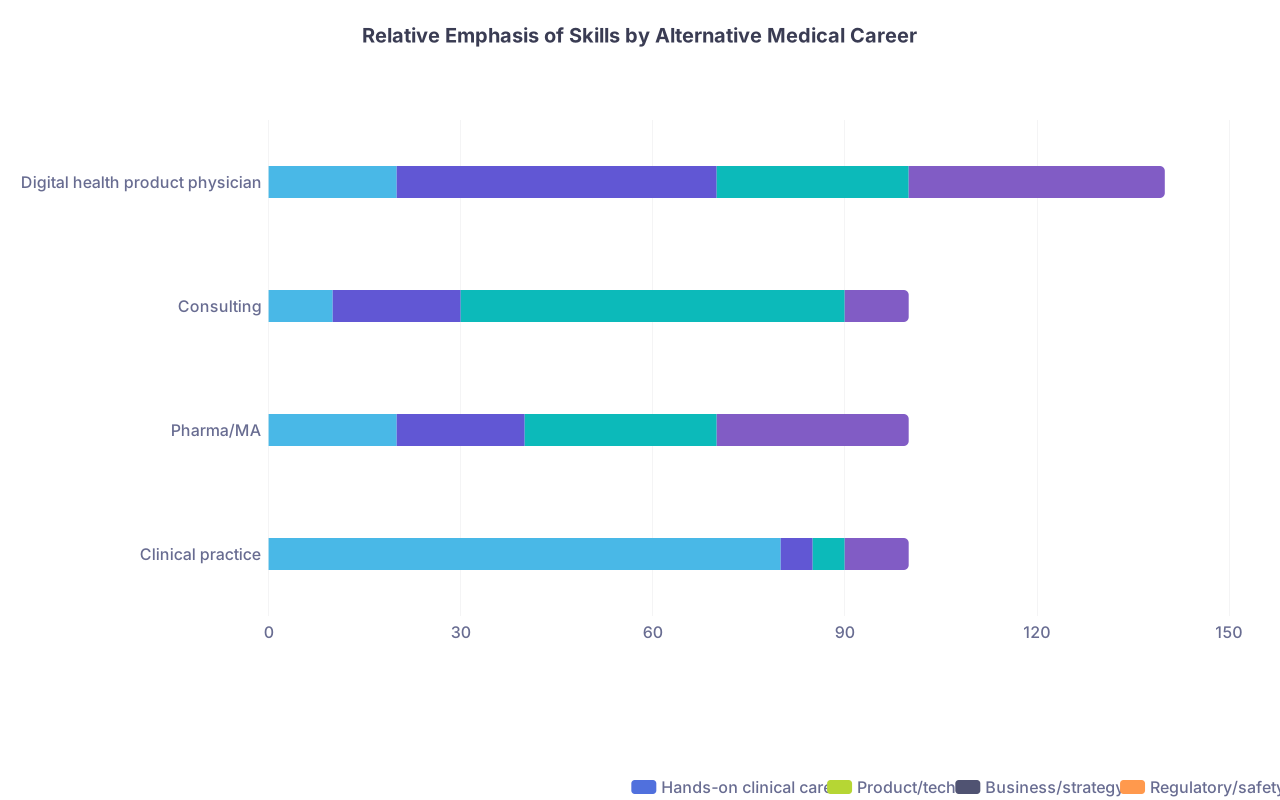
| Category | Hands-on clinical care | Product/tech | Business/strategy | Regulatory/safety |
|---|---|---|---|---|
| Clinical practice | 80 | 5 | 5 | 10 |
| Pharma/MA | 20 | 20 | 30 | 30 |
| Consulting | 10 | 20 | 60 | 10 |
| Digital health product physician | 20 | 50 | 30 | 40 |
Compensation bands (very approximate, US, as of recent years)
Early-stage startup (Series A/B):
- Base: $170k–$230k
- Equity: meaningful but high risk
- Often hybrid clinical/product role at first
Growth-stage / later (Series C+ or public):
- Base: $220k–$320k+
- Bonus: 10–25%
- Equity: options/RSUs, more predictable but diluted
Big tech health arms (Google Health-type setups, Apple Health, etc.):
- Base: $250k–$350k+
- Total comp with stock/bonus can be significantly higher if senior
You will rarely match the top cardiologist private practice income, but you will beat most academic salaries with saner hours and less burnout, if you land at the right company and level.
The non-glamorous truth
A few realities you should not ignore:
- You will argue with people who do not understand why a single word in button text matters. A lot.
- You will lose some battles. The point is to win the ones that matter for safety.
- You will spend a non-trivial amount of time in Jira and Confluence, documenting logic that feels obvious to you.
- If you lack patience for iteration and negotiation, you will burn out.
That said, when the system works, you will see thousands or millions of users benefiting from decisions you made. That is a different kind of satisfaction than a single great save in the ED.
How to Move Into This Role (Without Faking It)
If you are serious, do not just slap “digital health” on your LinkedIn and hope.
Get proximate to product where you are now
- Join or start a clinical informatics or IT working group in your hospital
- Volunteer to help review or redesign order sets, patient portals, or EMR workflows
- Document what you actually did: “Redesigned anticoagulation order sets reducing prescribing errors by X%,” not “interested in health tech”
Ship something, however small
- Co-create a simple internal tool (e.g., Excel-based calculator, basic web form) with IT and own the clinical logic
- Participate with a startup as a real advisor where you push through at least one feature from idea to release, not just attend “advisory board” dinners
Learn the language
- Take one short course in product management or UX. Not to become a PM, but to stop sounding like an outsider.
- Read and reverse-engineer 3–5 digital health apps: what is their triage flow, what guardrails do they use, what looks unsafe?
Target your applications
- Look for roles with explicit phrases like “own clinical logic,” “define safety guardrails,” or “work closely with design and engineering.”
- Avoid roles that are clearly dummy “medical face” positions: heavy emphasis on “speaking at conferences” and light on “working with UX / PM / engineering.”
Key Takeaways
- A Digital Health Product Physician is not a glorified advisor; it is the person who embeds real clinical judgment into UX, algorithms, and workflows – and owns the safety surface.
- The job lives at the intersection of product, UX, and clinical risk management. If you cannot think in flows, guardrails, and trade-offs, you will not be effective.
- This is one of the few alternative medical careers where your clinical brain remains central, but you get to scale your impact through software rather than RVUs.