
The biggest myth about pharma is that clinical development physicians “just review safety data.” That is wrong. The real leverage point is protocol design—and if you are the MD in that seat, you are effectively shaping the science, the label, and the fate of a multi‑million (sometimes billion) dollar asset.
Let me break that down specifically.
What a Clinical Development Physician Actually Does
, Regulatory & Health Authority, Cross-functional Meetings, Publications & Medical Support](https://cdn.residencyadvisor.com/images/articles_svg/chart-typical-time-allocation-of-a-clinical-development--6316.svg "Typical Time Allocation of a Clinical Development Physician")
| Category | Value |
|---|---|
| Protocol & Strategy | 30 |
| [Data Review & Safety](https://residencyadvisor.com/resources/alternative-medical-careers/inside-the-role-of-a-pharmacovigilance-physician-skills-and-workflow) | 25 |
| Regulatory & Health Authority | 20 |
| Cross-functional Meetings | 15 |
| Publications & Medical Support | 10 |
The job title varies—Clinical Scientist, Clinical Development Physician, Global Clinical Lead, Medical Director—but the core function is the same: you are the medical owner of the clinical program.
Day to day, that means:
- Translating biology and preclinical data into testable clinical hypotheses
- Designing protocols that can survive regulators, investigators, and real patients
- Arguing over endpoints, inclusion criteria, and sample size with statisticians and operations
- Defending your study to regulators, KOLs, and internal governance committees
You are not “doing patient care,” but your decisions absolutely affect patient care downstream: which patients ever see the drug, at what dose, under what conditions, with what evidence behind it.
The protocol is your scalpel.
From Target to Trial: How Protocol Design Really Starts
Big misconception: protocol writing starts when someone opens a Word template. By then, most of the damage is already done.
A serious clinical development physician starts much earlier.
Step 1: Understand the asset and the biological story
You need to know the molecule or intervention cold. Mechanism of action, PK/PD, preclinical signals, off‑target liabilities. You should be able to explain:
- Why this target?
- Why this modality (small molecule, mAb, gene therapy, cell therapy)?
- What failure modes have similar assets had?
This is where your clinical brain is an asset. The PhDs know the receptor binding; you know that the hypotension they are brushing off will crash your elderly heart failure patients in a phase 2 dose‑finding study.
Step 2: Define the clinical problem and population
You are not just “testing a drug.” You are testing a drug in someone with something, under specific conditions.
You must answer:
- What is the exact disease segment?
- Example: not “heart failure,” but “HFrEF, NYHA II‑III, post‑recent hospitalization, on optimized GDMT”
- Where is the unmet need within that segment?
- Who are we excluding and why? (And will regulators buy that?)
If you have ever rolled your eyes at a trial whose patients look nothing like those in your clinic, this is where that goes wrong.
Step 3: Align with the future label and commercial reality
Here is the part academic clinicians underestimate. Your protocol is not just a science experiment. It is a label‑building machine.
You should be asking:
- If this study is positive, what could the label say?
- Does this population align with real‑world prescribing?
- Will payers reimburse this use case, in this line of therapy, with these endpoints?
You do not need to be a salesperson. But you do need to understand that a gorgeous protocol that cannot support a viable label is functionally useless.
Core Components of a Protocol: What the MD Really Owns

Let us dissect the parts of a clinical trial protocol that actually live or die by your medical judgment.
1. Study objectives and endpoints
If your objectives are fuzzy, everything downstream becomes a mess.
You own:
- Primary objective: the single most important clinical question
- Primary endpoint: the measurable outcome that answers that question
- Key secondary endpoints: the “supporting cast” that will appear in the label, payer dossiers, and manuscripts
Typical traps I see:
- Overloading the study with too many primary endpoints (regulators hate this, statisticians hate this, everyone hates this)
- Choosing surrogate endpoints that no one outside the building respects
- Underpowering clinically critical secondaries that will be key in payer negotiations
You need to fight for endpoints that are:
- Clinically meaningful
- Measurable and robust
- Regulatory‑acceptable
- Operationally feasible at scale
If those do not all coexist, the trial will hurt.
2. Inclusion / exclusion criteria
This is where MDs coming from pure academia sometimes stumble. They chase the “perfect” population instead of the useful one.
You must constantly ask:
- Is this criterion medically justified or just defensive?
- How many patients will this knock out in real screening?
- Are we accidentally building a study that no site can enroll?
Example I have seen too often: adding absurdly tight lab cut‑offs “for safety,” then discovering in feasibility that 70 percent of the target population fails screen because of mild CKD or LFT wiggles that do not matter clinically.
You are the one who should say: “We can accept AST/ALT up to 3x ULN for this population, given the risk‑benefit and the mechanism. Here is the literature to support that.”
3. Dosing, schedule, and control
Here, your clinical pharmacology colleagues will have strong opinions. So should you.
Key questions:
- Is the proposed dose and regimen realistically tolerable for the population?
- For oncology: are you just running at MTD because that is tradition, or do you have a rational, exposure‑response based choice?
- Is your control appropriate: placebo, active comparator, or standard of care add‑on?
Regulators will hammer you on: “Is this a fair comparison?” If your control arm is structurally weaker than what top centers would actually use, you will pay for it later.
4. Assessments and visit schedule
Operations teams often generate enormous tables of assessments because everyone wants “just one more biomarker.”
You need to be the one asking:
- Does each assessment change safety management, efficacy interpretation, or mechanistic understanding?
- What is the patient burden—a 12‑hour PK day for frail oncology patients might look great on paper and be a disaster in reality
- Are we over‑monitoring and creating a “study patient” who is nothing like real‑world patients?
Lean protocols enroll faster, retain better, and generalize more convincingly. That is your responsibility as much as operations’.
The Real Tradeoffs: Science, Feasibility, Regulatory, and Commercial
Protocol design is not “pick the best science and write it down.” It is a four‑way negotiation:
- Scientific validity
- Operational feasibility
- Regulatory acceptability
- Commercial viability
| Dimension | You Push For | You Push Against |
|---|---|---|
| Scientific | Clinically meaningful endpoints | Weak surrogates for speed |
| Operational | Feasible visit schedules | Overly complex assessments |
| Regulatory | Clear, defensible choices | Novel but unjustified designs |
| Commercial | Label-aligned populations | Unrealistic, hyper-selected cohorts |
When you sit in a protocol review meeting, you will hear:
- Operations: “Sites will never do this many biopsies.”
- Biostats: “We are underpowered; we need more events or a longer follow‑up.”
- Regulatory: “The agency will ask why you excluded these patients.”
- Commercial: “This population is not where prescribers feel the pain.”
Your job is to arbitrate. With data. And with a clear sense of where you are willing to bend.
If you say yes to everyone, you get a 60‑page monster protocol that nobody can enroll and from which nobody can draw a clean regulatory conclusion. I have watched programs die exactly that way.
Protocol Design Across Phases: How Your Role Shifts
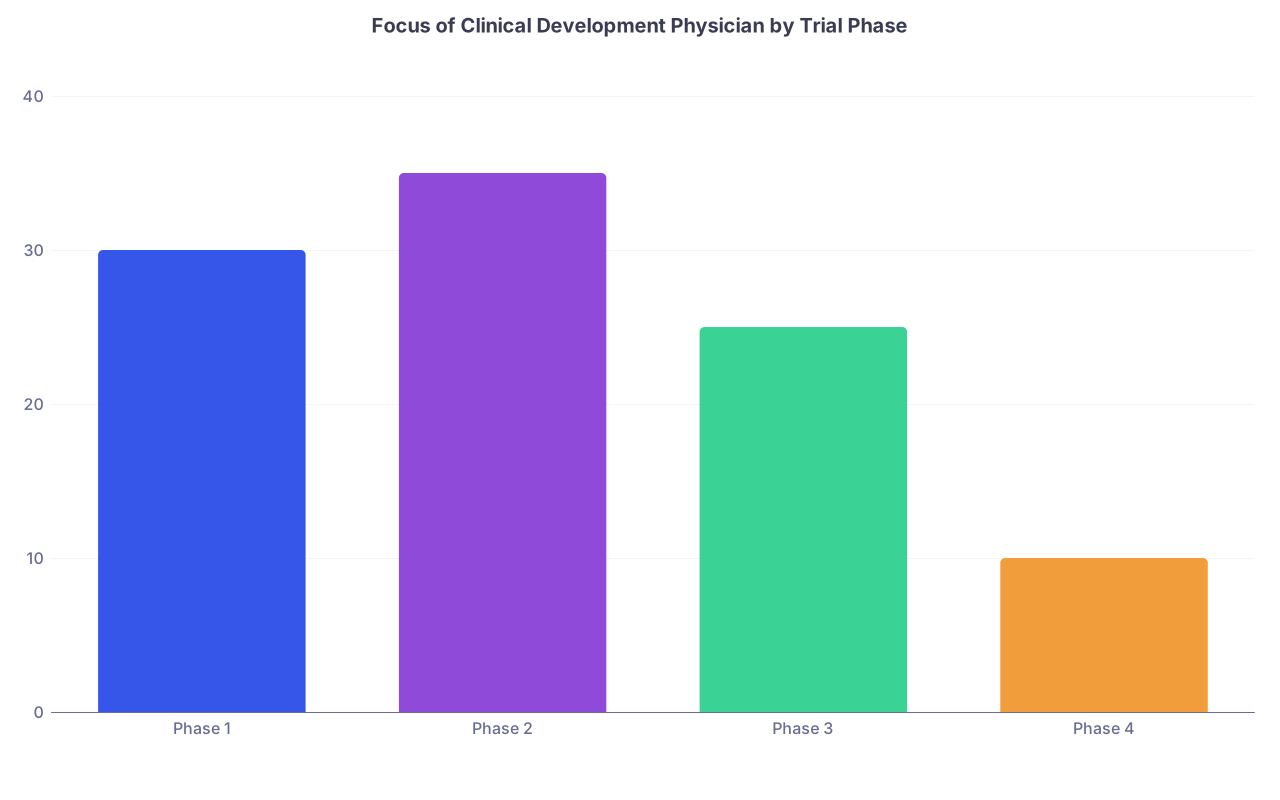
| Category | Value |
|---|---|
| Phase 1 | 30 |
| Phase 2 | 35 |
| Phase 3 | 25 |
| Phase 4 | 10 |
That bar chart is a simplification, obviously, but it makes the point: protocol design intensity is brutal in early and mid‑development.
Phase 1: Safety, PK, and proof of biology
This is where:
- First‑in‑human (FIH) protocols live or die by your judgment of risk
- You define starting dose, escalation rules, stopping criteria
- You decide how aggressive you want to be in oncology or rare diseases versus more conservative in primary prevention settings
Concrete issues you wrestle with:
- How much human PK/PD data do we need before combining with standard of care?
- Can we justify skipping healthy volunteers and going straight into patients? (Common in oncology, less so elsewhere.)
- How do we monitor for unexpected class effects (e.g., QT prolongation, immune‑mediated toxicities)?
The MD in the room is responsible for signing off that this is ethically and medically defensible. That is a serious responsibility, not a rubber stamp.
Phase 2: Signal‑finding and dose‑finding
This is where protocol design missteps tend to haunt companies.
Choices you make:
- Single dose vs multiple dose arms
- Adaptive vs fixed design
- Narrow, “perfect” populations vs slightly broader but more generalizable cohorts
You must balance:
- Wanting a clean biological signal
- Needing enough real‑world complexity to inform phase 3
- Avoiding a maze of subgroups with no clear path forward
I have seen 4‑arm phase 2 studies with 200 patients total trying to answer six different questions at once. Statistically fragile, operationally painful, and strategically useless.
Your mandate: simplify without dumbing down.
Phase 3: Label‑building and confirmatory
By phase 3, you are no longer “experimenting.” You are building the evidence package you will live with for the life of the drug.
Protocol design questions become:
- How global do you go—US/EU only, or also Asia, Latin America, etc.?
- Are your endpoints harmonized with competitors or intentionally different?
- How strict are your inclusion criteria relative to guidelines?
You also begin thinking very specifically about:
- Subgroup definitions that will appear in the label
- Secondary endpoints that will drive market access (QoL, resource use, PROs)
- Long‑term safety and extension protocols
Any sloppiness in phase 3 protocol design will be weaponized by payers, competitors, and occasionally regulators.
Phase 4: Pragmatic real‑world validation
Less glamorous, but medically important.
Here you think about:
- More inclusive criteria—elderly, comorbidities, real‑world practice patterns
- Pragmatic endpoints—hospitalizations, treatment persistence, resource utilization
- Embedding studies in registries or EHR‑based systems
Different kind of protocol. Same core skills.
Inside the Room: How Protocols Are Actually Built

| Step | Description |
|---|---|
| Step 1 | Target and Asset Review |
| Step 2 | Concept Sheet Draft |
| Step 3 | Cross Functional Input |
| Step 4 | Draft Protocol v1 |
| Step 5 | Feasibility and KOL Review |
| Step 6 | Protocol Revision v2 |
| Step 7 | Governance Committee Review |
| Step 8 | Final Protocol Approval |
The process is not linear, despite tidy diagrams.
Realistically, you will:
- Start with a short concept sheet: objectives, design, key criteria, population, endpoints
- Present it to internal stakeholders (biostats, operations, regulatory, commercial, safety)
- Get shredded
- Revise
- Send to a handful of external KOLs for sanity checks
- Revise again
- Take it to internal governance (with senior leadership) for an approval or more homework
Your job in this chaos:
- Keep the medical and scientific spine intact
- Learn which fights are worth picking
- Anticipate regulatory objections before they hit
You should be able to say, in a governance meeting: “If we relax this exclusion criterion as requested, we increase event rates by X, but we also increase noise and risk diluting the treatment effect. Here are three scenarios with projected impacts on sample size and timeline.”
That is how you get taken seriously.
Skills You Actually Need (Beyond “Being a Doctor”)

Being clinically sharp is necessary. It is not sufficient.
You need to build:
1. Statistical literacy (not PhD level, but real)
You should comfortably:
- Discuss power, alpha, multiplicity, and type I/II errors
- Understand event‑driven designs and interim analyses
- Challenge design choices: “Why are we powering on this endpoint and not that one?”
If you tune out when biostats starts talking, you will be sidelined in protocol discussions.
2. Regulatory pattern recognition
You gain this by:
- Reading actual FDA/EMA guidance documents for your area
- Studying recent approval packages and complete response letters
- Sitting in on health authority meetings whenever possible
Over time, you develop a sense of what each regulator will “buy.” That heavily shapes protocol design.
3. Operational empathy
If you design a study that no site can execute, you have failed.
Spend time with:
- Clinical operations leads
- Site feasibility feedback
- Real site staff if you can—CRCs, research nurses, investigators
Ask them what is a headache, what slows enrollment, what makes patients drop. Then change your protocol.
4. Communication and argumentation
You are constantly:
- Explaining complex tradeoffs to non‑physicians
- Defending your design to critical KOLs
- Negotiating compromises internally
If you cannot clearly and concisely explain why your proposed inclusion criteria, endpoints, and design are right, someone else will override you.
Getting Into This Role (And What To Expect)
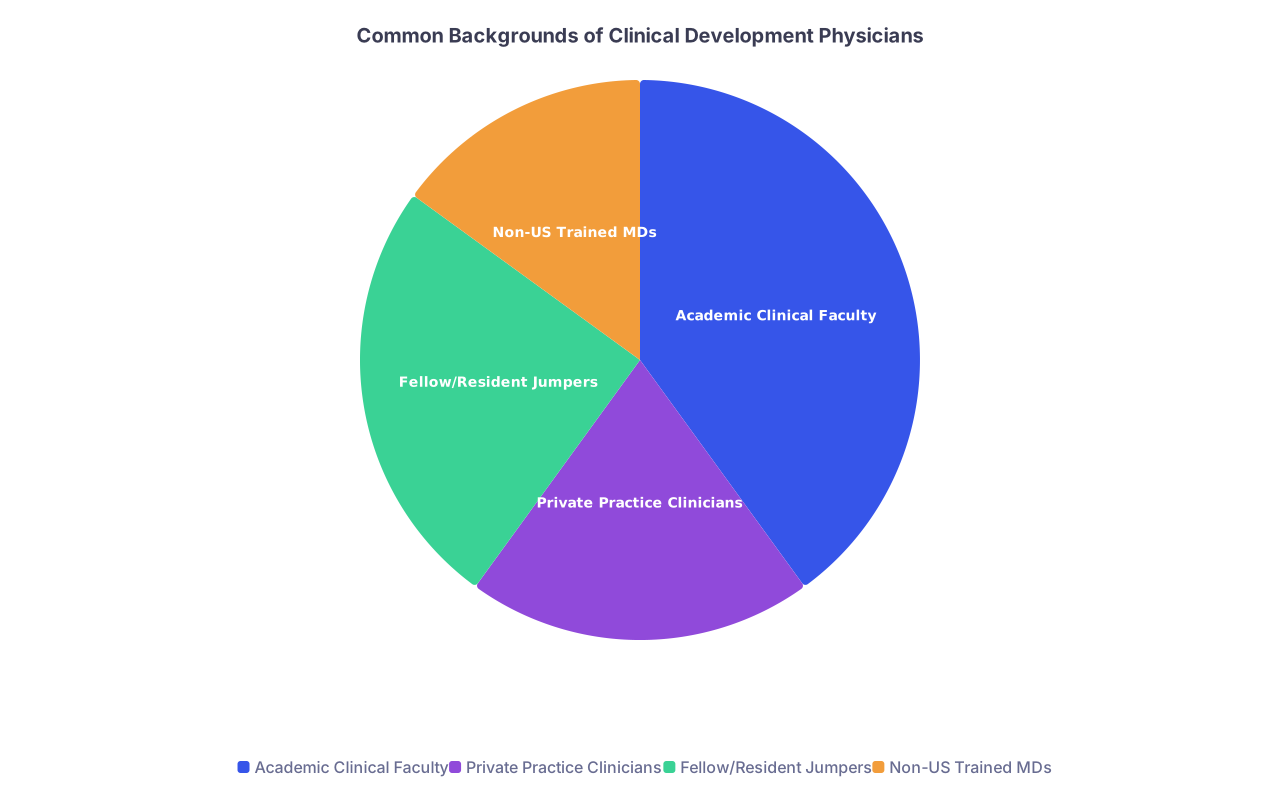
| Category | Value |
|---|---|
| Academic Clinical Faculty | 40 |
| Private Practice Clinicians | 20 |
| Fellow/Resident Jumpers | 25 |
| Non-US Trained MDs | 15 |
Rough patterns I have seen:
- Academic subspecialists with clinical trial experience slide in relatively smoothly
- Private practice physicians can succeed but must ramp up on research methods fast
- Fellows and residents who jump early bring energy but lack clinical seasoning—compensate with heavy reading and mentorship
- International MDs bring diverse clinical experience and often strong work ethics, but must learn Western regulatory / payer landscapes
Realities to expect:
- You will not “own” the patient bedside decisions anymore
- You will own design decisions that shape care for thousands (or millions) of patients later
- Your days are meeting‑heavy, document‑heavy, email‑heavy
- You get exposure to business strategy, portfolios, and global health systems you never saw in residency
If you are the kind of physician who obsessed over trial methodology more than writing notes, you will probably like it.
Where This Is Headed: Future of Protocol Design

Protocol design is not going to stay frozen.
Three trends already reshaping it:
Real‑world data (RWD) and synthetic controls
- Using EHR datasets and registries to refine inclusion criteria and event rates
- Reducing or even replacing control arms in specific settings
- Designing external comparator cohorts regulators will accept
Adaptive and platform trials
- More seamless phase 2/3 designs
- Dropping or adding arms based on interim data
- Platform trials in oncology and infectious disease where multiple assets share a backbone protocol
Digital endpoints and remote assessments
- Wearable‑based activity metrics, home spirometry, ePRO apps
- Decentralized or hybrid trials with fewer in‑person visits
- Continuous monitoring creating richer but more complex datasets
For the clinical development physician, this means:
- Learning to interrogate RWD quality and bias, not just RCTs
- Getting comfortable with more complex statistical and operational structures
- Rethinking patient burden and feasibility with technology in mind
But one thing does not change: someone still needs to decide who is in the trial, what matters clinically, and what risk is acceptable. That is still your job.
FAQs
1. Do I need prior clinical research experience to become a clinical development physician?
No, but it helps a lot. If you have never touched a protocol, case report form, or IRB submission, you will have a steeper ramp. You can compensate by: taking on research projects now, doing a clinical research fellowship, or at least getting involved in observational or registry studies. Hiring managers like to see some evidence you understand how trials work in practice, not just from reading NEJM.
2. How much of my time will actually be spent on protocol design vs “everything else”?
The answer depends on phase and company size. In early development or smaller biotechs, you might spend 40–50 percent of your time deep in protocol and program design, especially during key windows. In late‑stage or big pharma, that may drop to 20–30 percent, with the rest on data review, regulatory interactions, safety, and medical support. But when a big study is in design, it will dominate your calendar.
3. Can I still see patients while working as a clinical development physician?
Sometimes, but do not count on a full clinic. Some physicians maintain a half‑day or day per week in an academic setting, especially in Europe. In the US, it is more common to see people do occasional locums, volunteer clinics, or teaching rounds instead of a regular full panel. Your primary job is corporate, with corporate timelines and meetings. If you want 50/50 clinical and industry, that is difficult to sustain long term.
4. What is the most common mistake new clinical development physicians make in protocol design?
They try to please everyone. They add every “nice to have” endpoint, every cautious exclusion criterion, every exploratory analysis. The result is a bloated, slow, fragile study. The better approach: start with a brutally clear primary objective and end‑to‑end story, then defend it. Say no to extras unless they have a concrete impact on safety, regulatory success, or future decision‑making.
Key takeaways: Protocol design is the central craft of the clinical development physician; it is where your medical judgment actually changes the trajectory of a drug. You are constantly trading off science, feasibility, regulatory, and commercial realities—and if you do not own those tradeoffs, somebody else will. If you are a clinician who cares about methodology, population definitions, and endpoints more than relative value unit counts, this is one of the few non‑clinical roles where your MD still truly sits in the driver’s seat.