
The myth that “real-world evidence is for data scientists, not clinicians” is flat-out wrong.
If anything, the best real-world evidence (RWE) work is suffocating without strong clinical brains in the room. I have watched brilliant PhDs design spotless causal inference frameworks…that answer clinically useless questions. And I have seen average statisticians do great work simply because a sharp clinician framed the right question, defined the right endpoints, and killed dumb analyses early.
Let me break this down specifically: where you, as a clinician, actually fit in data-heavy RWE roles, what these teams look like in the real world, and how to pivot into this space without pretending to be something you are not (a full-stack data engineer).
What Real-World Evidence Teams Actually Do
RWE is not mysterious. It is just systematic use of data generated in routine care to answer questions that trials either cannot or will not answer.
Think:
- Electronic health records (EHRs)
- Claims and billing data
- Registries and disease cohorts
- Patient-reported outcomes, devices, wearables
- Pharmacy dispensing data, lab systems, imaging systems
The work typically clusters into a few buckets:
Regulatory-facing RWE
Used to support label expansions, post-marketing commitments, safety surveillance. This is what FDA, EMA, MHRA care about. It is rigid, heavily documented, and methodologically conservative.Medical affairs and HEOR
Real-world effectiveness, burden of disease, adherence patterns, treatment sequences, comparative effectiveness to support field medical, payer discussions, guidelines.Market access and value demonstration
Cost, resource use, time-to-next-treatment, hospitalizations, quality of life, budget impact models.Safety and pharmacovigilance
Signal detection, disproportionality analysis, risk characterization, long-term outcome tracking.
Underneath all of that, RWE teams are doing three main things:
- Formulating clinically and commercially relevant questions
- Turning messy real-world data into analyzable, interpretable constructs
- Packaging results into something regulators, KOLs, payers, and internal leaders will actually use
Clinicians are useless for the second step without some upskilling. But they are absolutely central to the first and third. And quite valuable in the data-design middle if they learn the language.
Anatomy of a Real-World Evidence Team
Forget the org chart fiction. This is what a functional RWE group usually includes.
| Role Type | Core Focus |
|---|---|
| RWE Physician / Clinician | Clinical questions, endpoints, interpretation |
| RWE Scientist (PhD) | Study design, advanced methods |
| Data Scientist / Analyst | Coding, modeling, analytics |
| Data Engineer | Pipelines, ETL, database structure |
| Epidemiologist / HEOR | Observational methods, health economics |
You might see titles like:
- Director, Real-World Evidence – Medical
- Medical Director, RWE
- Clinical Lead, RWE
- RWE Scientist (MD/PharmD/PhD)
- HEOR & RWE Medical Advisor
- Observational Research Physician
Then on the “quant” side:
- Senior RWE Scientist (usually PhD epi/biostats)
- Data Scientist – RWE / Observational Research
- Real-World Data Engineer
And cross-functional partners:
- Safety / Pharmacovigilance
- Market Access
- Medical Affairs
- Biostatistics (often still living in the clinical development world)
The key point: RWE is not “a data science job”. It is a composite. If you walk in as a clinician hoping to “learn Python on the job”, you will fail. But if you walk in as the person who keeps the work clinically sane, you can have a long, serious career without writing production-grade code.
Where Clinicians Actually Add Unique Value
Here is where I have seen clinicians make or break RWE projects.
1. Framing Questions That Matter Clinically
Most RWE projects start with something like:
“Characterize treatment patterns and outcomes in condition X with therapy Y vs standard of care.”
That is uselessly vague.
A good clinician breaks it down:
- Which line of therapy? First-line vs post-biologic is a different population and different question.
- What is “standard of care” exactly in 2024? Not the textbook version, the real-world mess: step edits, regional formularies, off-label use.
- What outcomes actually matter to a specialist? Time to next biologic? Steroid-free remission? Hospital-free survival? Avoiding colectomy?
- What is a clinically credible follow-up time? Three months “real-world effectiveness” in heart failure is a joke. Two years in multiple myeloma may be reasonable, in melanoma it might not be.
I have seen studies killed at publication stage because reviewers simply asked “why this time window?” and no one had a coherent clinical answer.
You, as the clinician on the team, are the one who says:
“No oncologist cares about this endpoint. Here is what they care about, and here is how the disease actually behaves.”
2. Translating Guidelines and Practice Into Data Logic
RWE lives and dies on operational definitions.
Example: “Second-line therapy in metastatic colorectal cancer”.
Sounds simple until you look at the data. Claims data will show:
- Chemo regimens starting and stopping
- Gaps that may be toxicity, travel, or death
- Biologic add-ons or switches
- Local practice that does not follow NCCN neatly
A non-clinician may define “line of therapy” by clean algorithm alone: X days with no claim equals treatment discontinuation, next regimen equals new line.
A clinician knows:
- Some regimens are maintenance, not new lines.
- Some regimens are escalations, not switches.
- A 45-day gap in chemo through the holidays might not be “progression”.
Translating this into logic is where you sit with the data scientist and say:
- These regimen codes should be grouped as one line.
- These intervals are clinically plausible for a hold; beyond that, treat as discontinuation.
- These add-on drugs mark escalation, not a fresh line.
You do not write the SQL. But you absolutely own what the algorithm is trying to represent clinically.
3. Choosing and Critiquing Endpoints
RWE ends up with a lot of surrogate proxies:
- Adherence → medication possession ratio (MPR) or proportion of days covered (PDC)
- Exacerbations → steroid bursts + ER visits + hospitalization codes
- Progression → time to treatment switch or death
- Severity → baseline steroid use, number of hospitalizations, oxygen claims, lab levels (if EHR-based)
Your job is to say:
- “This MPR threshold is arbitrary; in this disease, adherence needs to be closer to 90%, not 80%.”
- “That exacerbation definition is missing outpatient scenarios where I would clearly escalate therapy.”
- “You are misclassifying flares and treatment intensifications as toxicity-driven switches.”
Again, this is where RWE papers live or die during peer review. Statisticians can argue propensity score methods all day; if the endpoint definition is clinically ridiculous, reviewers will tear it apart in two paragraphs.
4. Identifying and Handling Confounding that Actually Matters
Everyone can list “confounding by indication”. Few can articulate what it really looks like in a specific therapeutic area.
You can.
Think of:
- Sicker patients preferentially receiving newer or more aggressive therapies
- Frail or co-morbid patients being steered away from certain treatments
- Regional differences in diagnostic intensity or referral patterns
You are the one who says:
- “Patients who get drug A have failed at least two other lines and often have poor performance status. If you compare them head-to-head with drug B without anchoring to line of therapy and performance proxies, you are dead on arrival.”
- “In community practice, we under-code mild flares; your model underestimates exacerbations in milder disease because they are invisible in claims.”
Then you work with the epi/biostats lead to choose:
- Propensity score matching vs weighting
- Instrumental variable approaches (if anything credible exists)
- Subgroup definitions that actually correspond to clinical strata
- Sensitivity analyses that reassure a skeptical clinician (“we re-ran restricting to patients who had at least one EUA code and a steroid burst…”)
5. Communicating Results to People Who Do Not Speak Regression
This is where clinicians in RWE become invaluable.
You can stand in front of:
- A room of KOLs at an advisory board
- Internal MSL teams
- Regulatory reviewers (in some settings)
- Payer medical directors
…and translate:
- “Patients starting on therapy X had about a 30% lower risk of hospitalization over a year compared with what we typically see in patients on Y, after adjusting for baseline risk.”
Not:
- “Hazard ratio 0.7, 95% CI 0.6–0.8, weighted Cox proportional hazards model with robust sandwich variance…”
You know which caveats matter:
- “We cannot prove causation like a randomized trial, but we did three different sensitivity analyses that all pointed in the same direction.”
- “The signal is strongest in the subgroup we would expect physiologically: younger, less comorbid patients treated earlier in disease.”
This communication layer is where clinicians are non-negotiable. Data scientists and statisticians can learn to speak clinically, but it is slow and often awkward. A decent clinician can learn enough RWE language in a year to be dangerous—in a good way.
Concrete Roles Clinicians Can Hold in RWE
Let’s get specific. Here are the real roles I see clinicians in, and what their days actually look like.
1. Medical Director, RWE (Pharma / Biotech)
You usually sit in Medical Affairs, sometimes in a central RWE/HEOR group.
Your responsibilities:
- Define RWE strategy for one or more products or indications
- Prioritize study questions: what do we need to show for regulators, guideline committees, payers, and prescribers
- Co-lead study design with an RWE/epi counterpart
- Champion data partnerships (e.g., Flatiron, Cegedim, Optum, IQVIA, TriNetX)
- Present results at advisory boards, medical congresses, internal strategy meetings
- Co-author or senior author on RWE publications and congress abstracts
You will spend more time in meetings than you think. Program reviews, vendor calls, cross-functional alignment sessions. The work is intellectual and political.
2. Clinical RWE Scientist / Physician Epidemiologist
This tends to be closer to the data, in pharma, CROs, or large health systems.
Your work:
- Draft and refine study protocols and SAPs with biostats / epi
- Work directly with data analysts on cohort definitions, variable lists, and code logic
- Review interim outputs: baseline tables, missingness, model diagnostics, outliers
- Interpret results: does this treatment effect size make any sense given what you see at the bedside?
- Lead manuscript drafting, especially intro, methods justification (from clinical angle), and discussion
This role is a good fit for someone who likes methods but does not want to be coding full-time. You might pick up some R or SQL for sanity checks or exploratory work, but you are not the primary coder.
3. RWE Lead in a Health System / Integrated Delivery Network
Large systems (Kaiser, Geisinger, NHS Trusts, VA, some academic centers) run internal RWE units.
Clinicians here:
- Drive learning health system initiatives
- Design and review “real-world QI turning into publishable RWE” projects
- Interface between clinicians, IT, data warehouse teams
- Help select or design local registries, phenotyping algorithms, dashboards
- Often keep some clinical practice, which keeps their credibility high
This is where you see roles like “Medical Director, Clinical Analytics” or “Director, Outcomes Research”. It is RWE under a slightly different brand.
4. Payer / PBM / HTA RWE Medical Roles
Payers and HTA bodies are heavy RWE consumers and sometimes producers.
Your work:
- Interpret external RWE for coverage and formulary decisions
- Co-develop internal RWE analyses on utilization, outcomes, and cost of therapies
- Contribute to risk-sharing agreement design (e.g., outcomes-based contracts) using RWE
- Communicate with pharma counterparts (yes, you will sit opposite your own former role in pharma sometimes)
Less glamorous academically, but surprisingly influential.
What Skills Clinicians Need to Be Credible in RWE
You do not need to become a biostatistician. You do need to stop sounding naïve.
Here is the minimum viable skill set.
1. Observational Methods Literacy
You should be very comfortable with:
- Cohort vs case-control vs nested case-control designs
- New-user vs prevalent-user designs (and why new-user is preferred)
- Time-at-risk definitions, immortal time bias
- Confounding, selection bias, information bias
- Propensity scores (matching, weighting, stratification) at a conceptual level
- Competing risks, censoring, and what “informative censoring” means
You do not need to derive formulas. But if someone proposes an “ever vs never” exposure definition in a chronic condition, you should hear alarm bells.
2. Data Source Strengths and Weaknesses
You should be able to say, without blinking:
- Claims data: strong for utilization, costs, longitudinal follow-up; weak for labs, disease severity, clinical nuance.
- EHR-derived data: rich clinical detail, labs, BMI, smoking status; messy, variable completeness, harder to standardize across sites.
- Registries: deep phenotyping, curated outcomes; limited generalizability, sometimes biased to academic centers.
- Patient-reported data: good for symptoms and QoL; recall bias, missingness, selection bias.
You also need to know which data vendors exist in your therapy area. Oncologists should know Flatiron, COTA. Rheumatologists should know CorEvitas, for example. Cardiologists should know big claims/EHR data sets widely used in CV outcomes work.
3. Enough Programming Awareness to Ask Good Questions
I am not saying you must code. I am saying you cannot be frightened of code.
You should:
- Understand that phenotyping algorithms are implemented as code + value sets, not magic.
- Grasp that small tweaks in inclusion/exclusion logic can massively alter the cohort.
- Be able to read a pseudo-code or logic diagram and say, “This will misclassify patients X, Y, Z.”
If you can run basic R or Python to pull a few tables, even better. But do not try to sell yourself as a data scientist unless you are one. That backfires fast.
4. Communication and Political Navigation
RWE sits at the intersection of:
- Medical
- Regulatory
- Commercial
- Payers
- Health systems
You will routinely be the person saying “no” to powerful people who want the data to say something it does not.
You need:
- A spine: “We cannot claim reduced mortality here. The study was not powered and mortality code capture is unreliable in this data source.”
- Diplomacy: framing caveats without making people feel you are killing the product.
- Clarity: explaining methodology to clinicians and execs without losing rigor.
This is learned mostly by doing, but if you are conflict-averse, RWE leadership will be painful.
Common Misconceptions Clinicians Have About RWE Roles
Let me kill a few illusions I see constantly.
Misconception 1: “I need a full MPH or PhD to be taken seriously.”
Helpful? Yes. Mandatory? No.
I have seen MDs with:
- A strong methods-focused master’s (MPH in epi/biostats)
- Several first-author observational papers
- Good mentoring by a senior RWE lead
…get director-level RWE roles without a PhD.
What you must show is:
- You understand bias and confounding in real-world data
- You have actually participated in real RWE studies (not just chart reviews)
- You respect methodologists and know where your expertise stops
A “decorative” MPH with no real methods work behind it will not move the needle.
Misconception 2: “RWE is easier than clinical research.”
No. It is messier and more politicized.
In trials, you control:
- Inclusion/exclusion
- Data collection
- Visit schedule
- Endpoint adjudication
In RWE, you are reverse-engineering reality from broken, inconsistent data. And every stakeholder has strong opinions. It is intellectually harder in many ways, especially for those who like clean answers.
Misconception 3: “I will be stuck behind a computer, not using my clinical skills.”
You will use your clinical thinking constantly.
Typical week for a medical RWE director:
- Two hours on a study design call arguing about how to define severe disease.
- One hour reviewing draft phenotyping algorithms with a data scientist.
- One or two hours prepping for an advisory board to test proposed RWE questions with KOLs.
- One hour in a cross-functional medical/market access meeting explaining why a certain RWE analysis will help a payer negotiation.
- Some time reviewing abstract or manuscript drafts.
You will spend more time in meetings than in code. But those meetings absolutely require deep clinical judgment.
Career Paths and Progression for Clinicians in RWE
Let’s talk trajectory.
Early-Career / Entry Points
Typical on-ramps:
- Clinician in academic outcomes research group → industry RWE scientist / medical director
- Med affairs / MSL with strong interest in data → internal transfer to RWE-focused role
- Clinical epi postdoc → pharma observational research physician role
- Health system QI / analytics clinician leader → payer or pharma RWE role
At this stage, you are usually:
- Study-level responsible: define and shepherd individual studies.
- Building your methods literacy.
- Learning internal processes (compliance, regulatory, safety, publications).
Mid-Career
Next step up:
- RWE Franchise Lead (for a therapeutic area)
- Director / Senior Director, RWE – Medical
- Outcomes Research Lead Physician
Now you are:
- Portfolio-level responsible: deciding which 5–10 RWE projects matter, not just how to run them.
- Negotiating budgets, external data partnerships.
- Setting methodological “guardrails” for your therapeutic area.
You are also the person field teams call when a skeptical KOL trashes an RWE paper at a meeting.
Senior Leadership
Top end:
- Head of RWE – Medical (across TA)
- VP, RWE and HEOR (MD/PhD mix)
- Chief Outcomes Officer / Chief Analytics Officer in health systems
Now you are:
- Shaping global RWE strategy: what data assets to invest in, which external collaborations to build, what your company becomes known for.
- Representing the organization externally at major conferences, regulatory workshops.
- Allocating headcount budget between clinicians, epi, data science.
You are far from the code. But if you lost your RWE method radar, you will be dangerous and easily manipulated by vendors and internal “experts” with conflicting incentives.
How to Prepare Yourself Pragmatically
If you are serious about this path, do three things in parallel.
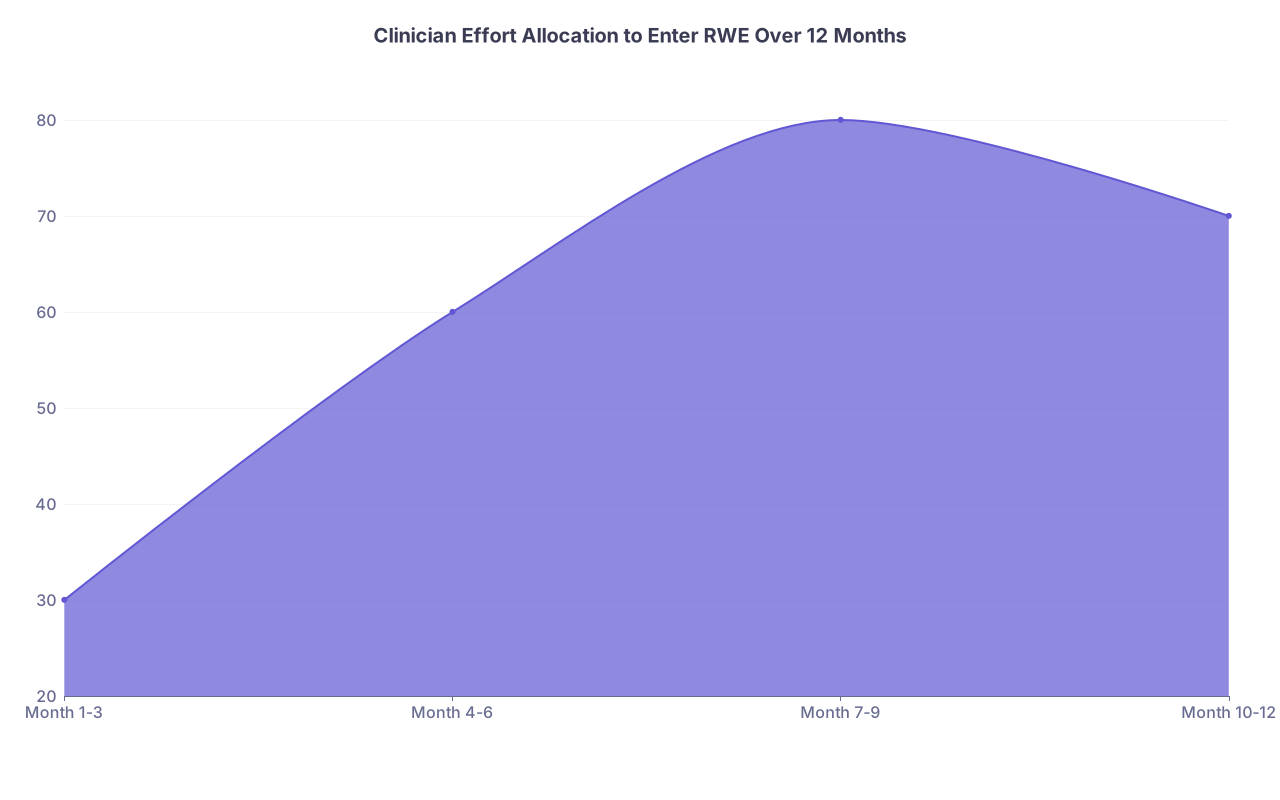
| Category | Value |
|---|---|
| Month 1-3 | 30 |
| Month 4-6 | 60 |
| Month 7-9 | 80 |
| Month 10-12 | 70 |
Interpret that as: ramp your effort, but do not imagine this is a weekend project.
1. Build a Real Methods Foundation
Not Coursera tourism. Targeted depth.
Good starting points:
- Read a serious observational methods textbook (e.g., Hernán & Robins “Causal Inference: What If” – even if you do not follow every equation, the bias thinking is gold).
- Take one proper graduate course in epidemiology or advanced statistics if you can.
- Read RWE papers in your specialty from high-quality groups and force yourself to critique methods, not just clinical narrative.
If you cannot explain immortal time bias with a simple example, you are not ready for a serious RWE role.
2. Do or Join One Real RWE Project
You need at least one actual project where:
- Data are not collected “for the study” but are pulled from an existing system (EHR, claims, registry).
- You participate in defining inclusion criteria, endpoints, and analysis plan.
- You go through the pain of cleaning, revising, re-running analyses based on weird findings.
Even if the paper is small and local, this experience changes how you talk in interviews. You stop being theoretical.
3. Network with the Right People, Not Just Anyone in “Data”
Focus on:
- RWE leads in pharma / biotech in your therapy area
- Academic clinicians who publish serious observational work (not just tiny retrospective series)
- Outcomes research units in major health systems
Ask them:
- How they structure clinician vs methodologist roles.
- Which skills they look for in clinician hires.
- How they themselves made the transition.
This is also where you learn which companies actually respect methods and which just want “pretty graphs for slide decks.” You want the former, unless you enjoy being a decoration.
A Very Simple Mental Model for Your Role
Here is how I explain the clinician RWE role to people internally.

| Step | Description |
|---|---|
| Step 1 | Clinical Question |
| Step 2 | Study Design |
| Step 3 | Cohort and Endpoint Logic |
| Step 4 | Analysis by Data Team |
| Step 5 | Clinical Interpretation |
| Step 6 | Output to Stakeholders |
You partially touch study design, you partner on logic, and you own the question and interpretation. You respect but do not replace the data team.
Where Clinicians Fit in a Data-Heavy Future
RWE is not going away. If anything, it is eating more of the evidence ecosystem every year.
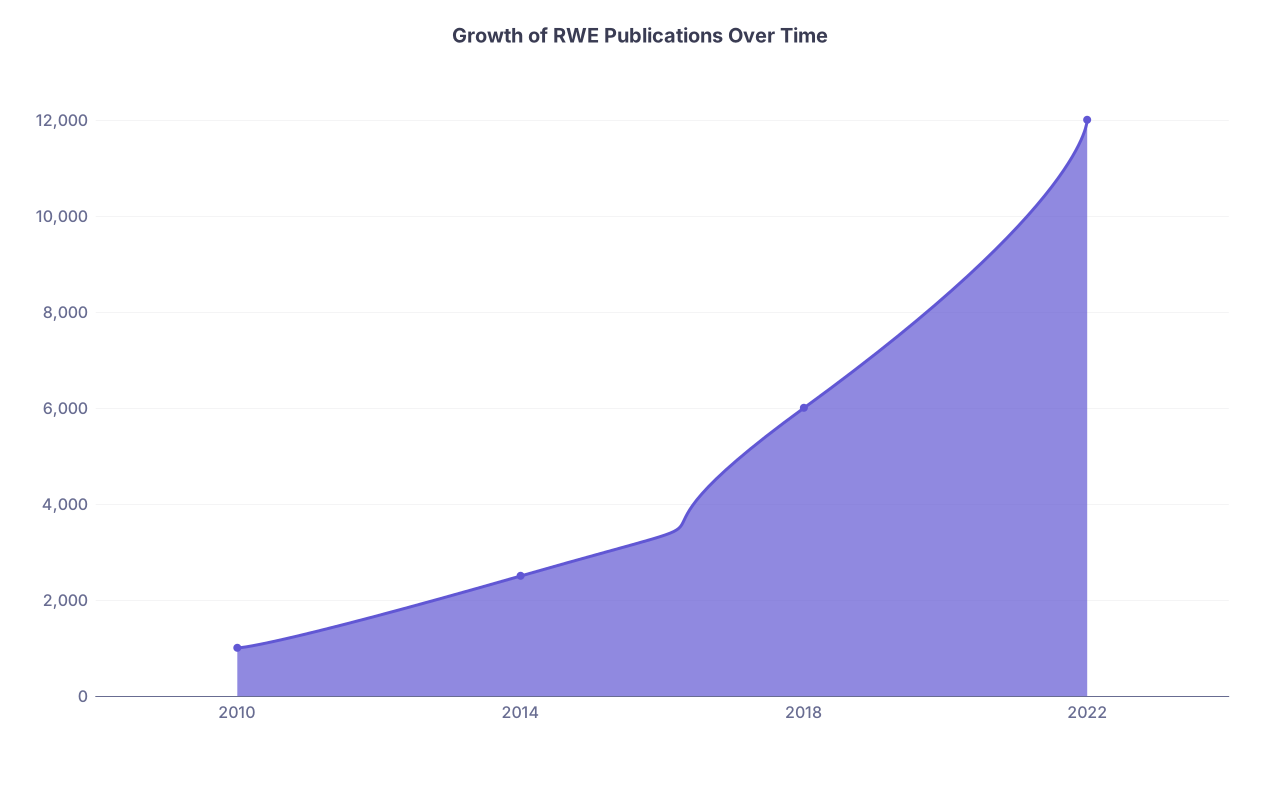
| Category | Value |
|---|---|
| 2010 | 1000 |
| 2014 | 2500 |
| 2018 | 6000 |
| 2022 | 12000 |
Rough trend only, but you get the point: regulators, payers, clinical societies are increasingly comfortable referencing RWE. That means:
- More RWE-specific guidance from FDA, EMA, etc.
- More cross-talk between trialists and RWE folks (hybrid designs, external control arms).
- More demand for clinicians who can sit in that intersection.
If you like thinking at population scale, if you are comfortable with ambiguity, and if you can handle telling uncomfortable truths about what the data actually show, then you fit here.
The clinicians who thrive in RWE share three traits:
- They are clinically grounded but not nostalgic; they accept that “what I see in clinic” is a tiny, biased slice, not the whole story.
- They are method-curious; they respect statisticians and data scientists, but do not outsource thinking to them.
- They are honest communicators; they will not let a product team spin a weak, biased finding into a miracle story.
If that sounds like you, real-world evidence is not just an “alternative” career. It is a front-row seat to how medicine, regulation, and economics will actually work in the next 20 years.
Remember these three points:
- RWE teams are not data-science-only clubs; clinicians are essential for defining questions, endpoints, and credible interpretation.
- You do not need to be a programmer or a PhD statistician, but you must have solid observational methods literacy and at least one real project behind you.
- The best clinician roles in RWE sit at the intersection of medical judgment, data-savvy skepticism, and clear communication to regulators, payers, and peers.