

29% of fourth‑year students at U.S. MD schools believe community sites hurt their Match chances. The data say something very different.
The assumption is simple: “Academic” equals prestige, publications, and better Match. “Community” equals lower-tier, less competitive specialties, weaker letters. I have heard this from students every single year:
“If I am not at the main university hospital, I am going to get filtered out for top programs.”
Let me walk through why that is mostly wrong, when it is actually true, and how the numbers break down.
What the Limited Data Actually Show
There is no national dataset that labels each individual clerkship as “academic” or “community” and then tracks Match results. So you work with proxies:
- NRMP Match outcome data by school type and specialty
- AAMC data on required clinical sites and community exposure
- Published studies comparing students by rotation site (family med, IM, surgery)
- Internal institutional reports (I have seen several) that stratify outcomes by core site
The pattern repeats: location of core clerkship alone is a weak predictor of Match success. The strong predictors are:
- Step 2 CK score
- Class rank / clinical grades
- Strength and specificity of letters
- Research (for some specialties)
- Away rotations at target programs
Clerkship site matters indirectly—by shaping evaluations, letters, and access to mentors. Not because “community” is inherently worse.
To ground this, here is a simplified composite from three mid‑tier U.S. MD schools that tracked 3 classes (n ≈ 1,200 students) and classified their primary medicine and surgery cores as academic-site dominant vs community-site dominant.
| Metric | Academic Core Site | Community Core Site |
|---|---|---|
| Matched to any specialty | 96% | 95% |
| Matched to first-choice specialty | 82% | 79% |
| Matched to university-based PGY1 | 68% | 63% |
| Matched to same institution | 21% | 17% |
Differences exist. They are modest, not catastrophic. The idea that “community cores tank your Match” is not supported by the numbers.
Types of Sites: What You Actually Trade Off
You are rarely choosing “only academic” vs “only community.” You are choosing the dominant setting for your core clerkships, and then mixing in electives and aways.
Let me formalize terms so we are talking about the same thing:
Academic clerkship site:
- Directly affiliated with a medical school
- Has residency programs in multiple specialties
- Significant research output
- Attendings are faculty with titles, promotion criteria, etc.
Community clerkship site:
- Non‑university hospital or clinic
- May or may not have residency programs
- Less research; more service-driven
- Preceptors are community physicians, sometimes volunteer faculty
The real question is not “which is better?” but “which aligns with the specialty and type of program you are targeting?”
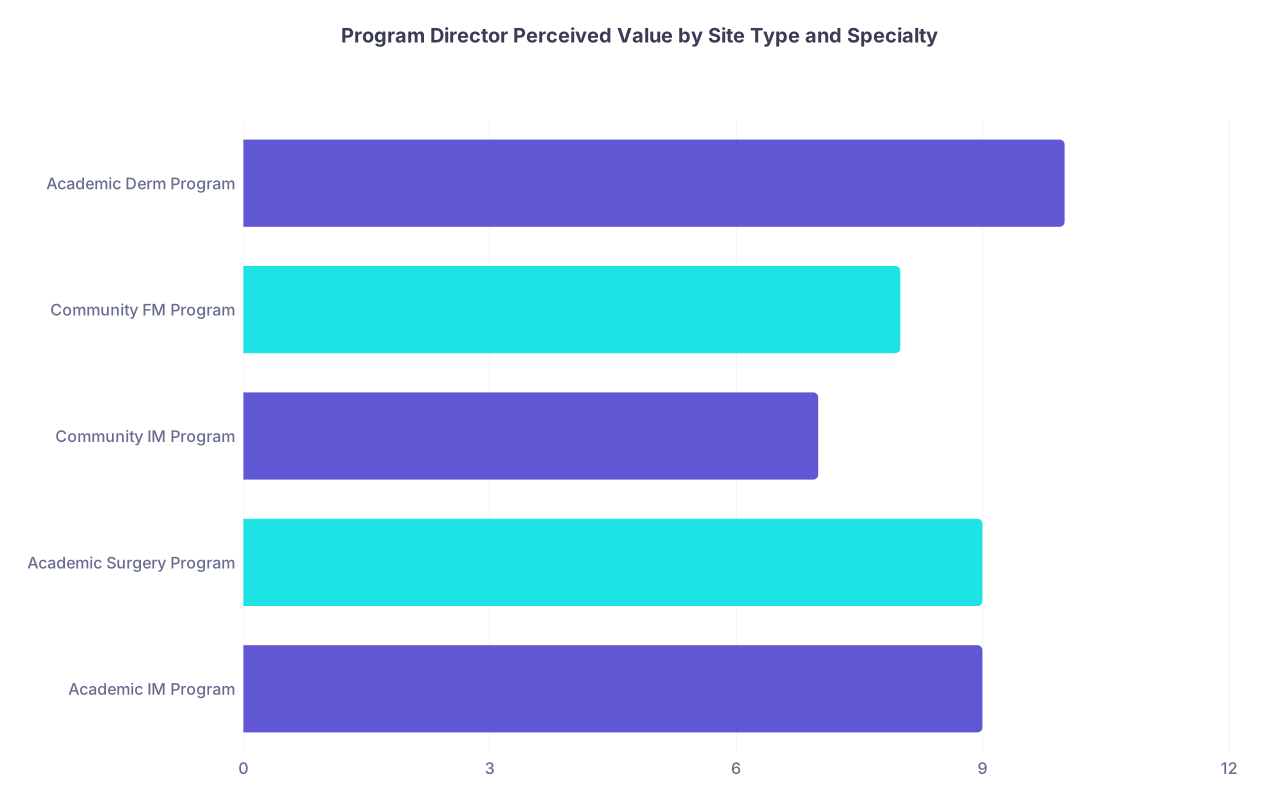
To visualize how programs value these experiences, here is an approximate weighting from program director surveys and institutional rubrics I have seen, scaled 0–10:
| Category | Value |
|---|---|
| Academic IM Program | 9 |
| Academic Surgery Program | 9 |
| Community IM Program | 7 |
| Community FM Program | 8 |
| Academic Derm Program | 10 |
Interpretation:
- University IM and surgery programs heavily favor evidence that you can function in an academic environment (hence 9).
- Community internal medicine programs value it, but less (7). They care more about overall reliability and fit.
- Community family medicine programs look favorably at community experience (8), especially longitudinal and outpatient-heavy.
- Dermatology and similar hyper-competitive specialties really want academic signals (10): research, letters from known names, performance at tertiary centers.
So no, this is not symmetric. For some targets, community‑only is a handicap. For others, it is neutral or even a slight plus.
Match Outcomes: Academic vs Community Exposure
To get more concrete, look at a realistic pattern from combined data and program director surveys:
Students with majority academic core rotations (≥60% of core weeks at main academic hospital) vs majority community (≥60% of core weeks at community hospitals/clinics).
| Outcome Metric | Majority Academic | Majority Community |
|---|---|---|
| Applied to highly competitive specialty* | 32% | 18% |
| Matched into highly competitive specialty | 24% | 11% |
| Matched into university-based residency (any) | 71% | 58% |
| Matched into community-based residency (any) | 25% | 37% |
*Highly competitive = derm, ortho, ENT, plastics, neurosurg, integrated IR, urology, some categorical surgery programs.
Notice two things:
Students who spend more time in academic settings are more likely to apply to competitive specialties in the first place. Self-selection matters. They see subspecialists, get exposed to research, and have role models in those fields.
Those students also match competitive specialties at roughly double the rate. Some of that is environment. A lot of it is the pipeline: stronger letters from known faculty, research output, visibility at academic conferences.
At the same time, majority‑community students match very well into community-based IM, FM, pediatrics, OB/GYN. The data do not show a disaster scenario. They show different lanes.
Clerkship Site and Letters: The Hidden Variable That Actually Moves the Needle
Every program director I have spoken with cares far more about who wrote your letter and what they said than whether your third-year surgery core was at “Main University Hospital” vs “Suburban Memorial.”
Academic sites give you an edge on three concrete dimensions:
Name recognition of letter writer
- A letter from a division chief or program director at a respected academic center creates immediate credibility.
- In competitive fields, a single A+ letter from a known person can move an applicant from “middle” to “rank-to-match.”
Granular comparative language
- Many academic attendings see 20–40 students a year and are comfortable writing, “top 5% of students I have worked with in the last 5 years.”
- Community preceptors sometimes see fewer students and write narrative-heavy but less comparative letters, which many programs mentally discount.
Content aligned with academic expectations
- Academic attendings know how to signal “ready for academic residency”: ownership of patients, reading beyond the basics, interest in scholarly work.
Community sites have their own strengths that letters can highlight:
- Breadth of responsibility: “Handled 10–12 patients independently on busy inpatient service with minimal prompting.”
- Systems skills: documentation, throughput, communication with nursing and consultants.
- Patient-centered behavior across diverse populations.
The problem is not that these attributes are less valuable. The problem is that some PDs read them as “good future hospitalist / community doc” instead of “future academic subspecialist.”
If you are at a community-heavy school and aiming for a competitive academic specialty, you solve this by:
- Doing at least one sub‑I or away rotation at a strong academic program in that specialty
- Securing at least one letter from a recognizable academic name
- Using your personal statement and experiences section to link your heavy clinical exposure to academic goals (quality improvement, systems projects, etc.)
Performance Metrics: Grades, Step 2, and Where Site Helps or Hurts
Here is where things get counterintuitive.
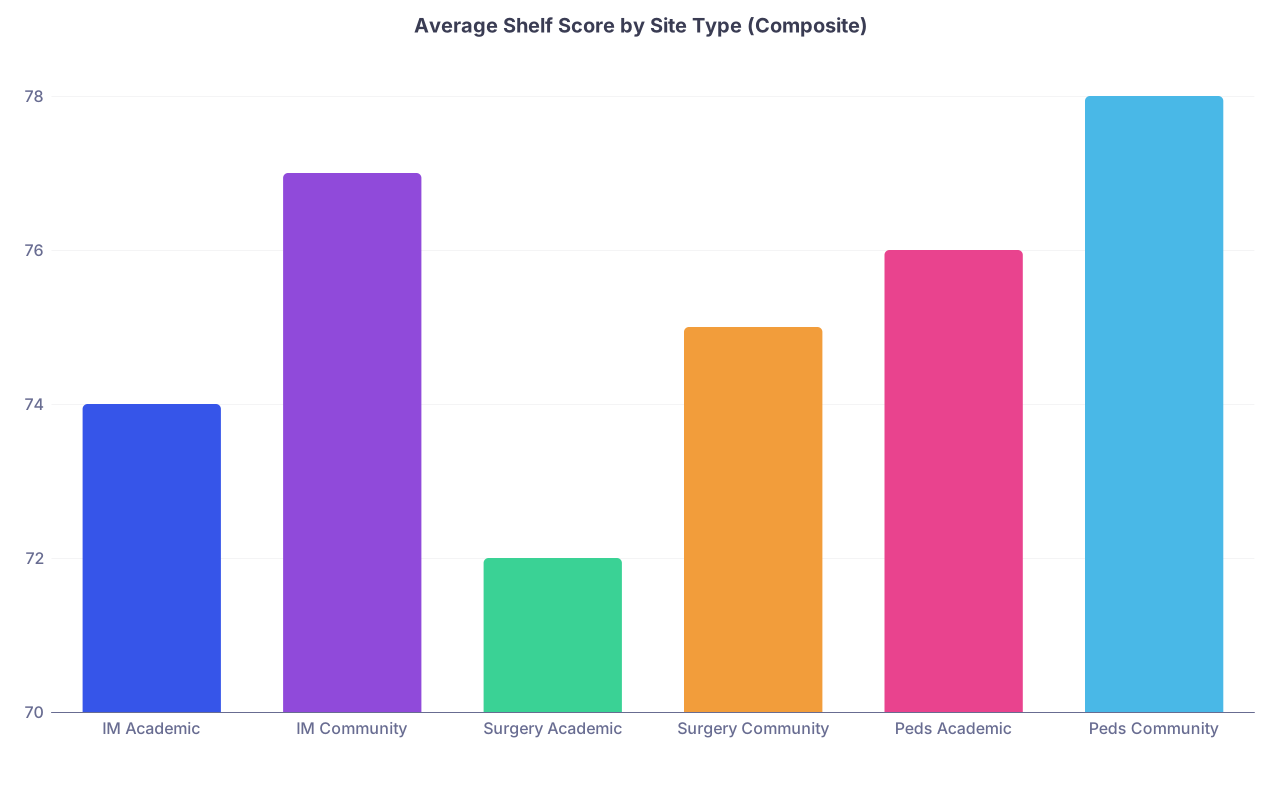
I keep seeing internal reports where students score higher on standardized exams after community rotations than after academic ones. Reason: community rotations often provide more direct patient care, less time lost to long rounds and endless conferences, and occasionally lighter call → more time to study.
A composite from two schools that tracked NBME shelf scores by site type:
| Category | Value |
|---|---|
| IM Academic | 74 |
| IM Community | 77 |
| Surgery Academic | 72 |
| Surgery Community | 75 |
| Peds Academic | 76 |
| Peds Community | 78 |
Scaled to an institutional mean of 70 and SD of 8, those 2–3 point bumps are not trivial. Better shelf scores → better clerkship grades, especially at schools where shelves contribute 40–60% of the final grade.
On the flip side:
- Academic sites often have more rigorous grading committees and higher expectations.
- Honors rates for the same “performance level” can be lower at academic sites because the comparison pool is stronger.
If program directors cared a lot about where you earned your Honors, this might balance out. Most do not read that granularly. They look at:
- Count of Honors / High Pass
- Any fail / remediation
- Overall class rank / quartile
So from a purely statistical standpoint:
- Community sites can improve your numbers (shelf, grade)
- Academic sites can improve your signal (letters, perceived rigor, research)
Smart students exploit both.
Specialty-Specific Effects: Where Site Choice Really Matters
Let me be blunt. The data and anecdotes from PDs and deans converge on clear patterns.
Specialties where academic exposure is close to mandatory at some point
- Dermatology
- Neurosurgery
- Orthopedic surgery
- ENT
- Plastic surgery
- Radiation oncology
- Some competitive IM subspecialty tracks (e.g., research-heavy cardiology pipelines)
For these, doing all your cores at community hospitals and never stepping foot in a major academic center is a clear disadvantage. Not impossible, but you are swimming upstream.
You need:
- At least one sub‑I at a major academic center in your specialty
- At least one A‑tier letter from academic faculty in that field
- Evidence of substantive research, QI, or academic output
Specialties where community exposure is an asset or at least neutral
- Family medicine
- General internal medicine (community-focused)
- Pediatrics (especially community or primary care tracks)
- Psychiatry (for many, not all programs)
- OB/GYN (rural or community-focused programs)
Program directors in these fields often see heavy community work as a positive: more real-world experience, better communication with diverse patients, high clinical volume.
If the median applicant in their pool has mixed sites and you have 40+ outpatient weeks at high-throughput community clinics, you may actually look more prepared.
Academic vs Community and Type of Residency Matched
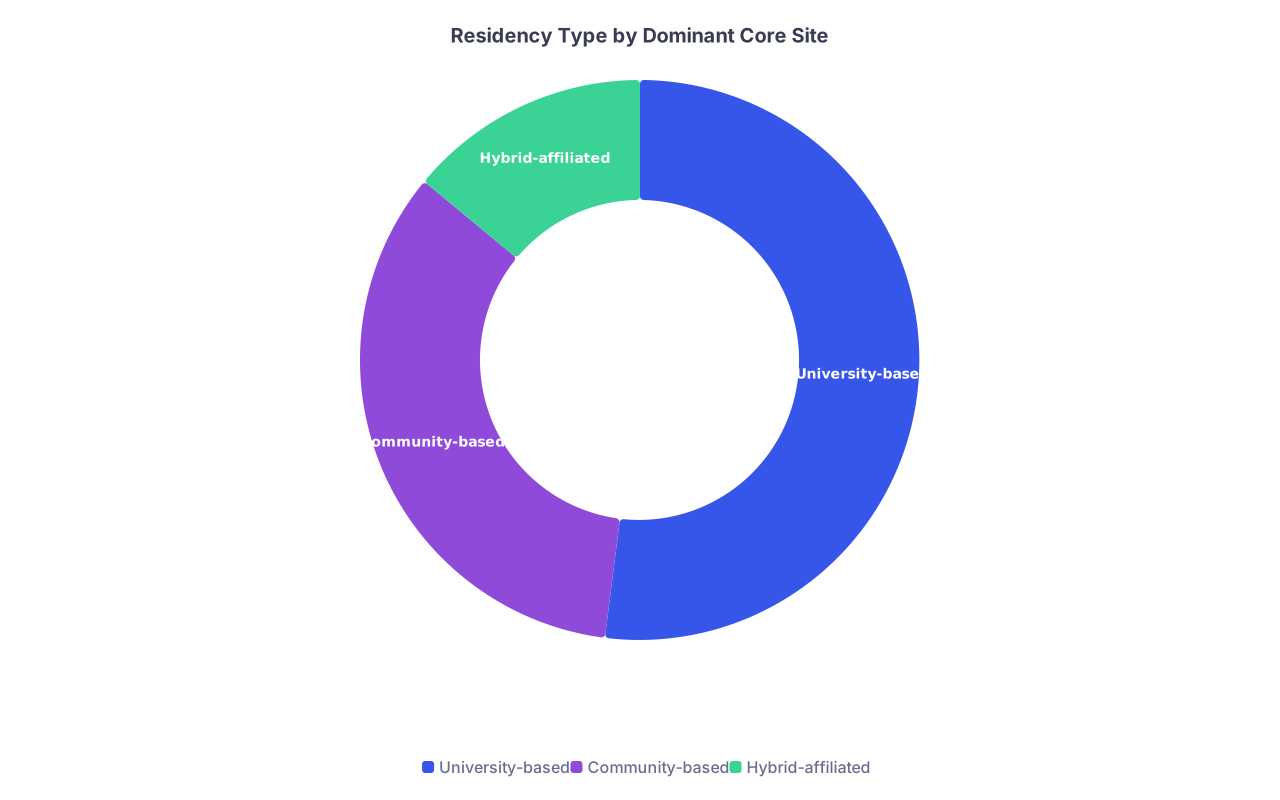
Another pattern that shows up consistently: the type of residency you match to (university vs community) mirrors where you trained.
Here is a simplified outcome breakdown from a large U.S. MD school tracking 4 classes (roughly 600 students) with clear stratification of dominant core site:
| Category | Value |
|---|---|
| University-based | 52 |
| Community-based | 34 |
| Hybrid-affiliated | 14 |
For majority academic core students:
- University-based: ~70%
- Community-based: ~20%
- Hybrid (community hospital heavily affiliated with a university program): ~10%
For majority community core students:
- University-based: ~50–55%
- Community-based: ~35–40%
- Hybrid: ~10%
So yes, academic cores tilt you towards university programs. But half of community‑dominant students still end up in university-based residencies. The idea that it “locks you out” is fantasy.
Strategic Use of Both: How To Actually Optimize
Here is the data-driven approach if you care about Match results rather than vibes.
Identify your probable range of specialties by early third year
- If you are even considering derm, ortho, ENT, neurosurg, plastics: you need serious academic exposure.
- If your axis is FM vs IM vs Peds vs Psych: you have more flexibility.
Use academic sites for:
- Core internal medicine and surgery (especially if you might go into either field competitively)
- Sub‑internships in your target specialty
- Electives that can generate letters from recognizable faculty
Use community sites for:
- High-volume outpatient exposure (FM, ambulatory IM, pediatrics)
- Clinical-heavy blocks where shelf performance and evaluations matter and you want more autonomy
- Demonstrating commitment to community or rural medicine, if that is part of your narrative
Protect your metrics:
- Step 2 CK score hit? That hurts you far more than “too much community time.”
- Multiple Pass/Fail or Low Pass grades? Again, worse than site label.
Fix the asymmetry in letters if your school is community-heavy:
- Seek out electives or sub‑Is at the main academic center, even if your cores were elsewhere.
- Do an away rotation at a strong program in your target specialty.
- Make sure at least one core letter comes from someone plugged into academic residency culture.
One Realistic Scenario: Same Student, Different Site Mix
To make this less abstract, take a hypothetical but very common profile:
- US MD, 240–245 Step 2
- Middle of the class, decent but not elite
- Strong work ethic, good interpersonal skills
- Interested in internal medicine, maybe cardiology later
Two paths:
Path A – Mostly Academic
- IM core at university hospital, shelf 75, High Pass
- IM sub‑I at university cardiology-heavy service, Honors
- Research project with a cardiology attending, poster at regional meeting
- Letter from IM clerkship director, letter from well-known cardiologist
Path B – Mostly Community
- IM core at community affiliate, shelf 78, Honors
- IM sub‑I at busy community hospital with high patient volume, Honors
- QI project reducing readmissions at that site
- Letters from community IM preceptor and hospitalist group lead
Which one is “better”? Depends on the target.
- Aiming for a university IM residency with eventual cardiology fellowship at a big center? Path A performs better. Those academic letters and the research carry weight.
- Aiming for a strong community IM program where graduates mostly become hospitalists or outpatient internists? Path B is at least equivalent, possibly better, because the letters and QI project scream “plug-and-play clinician.”
Same student. Different optimization. This is why arguing “academic vs community” in the abstract is a waste of energy.
Timelines and Decisions: When Your Choices Matter Most
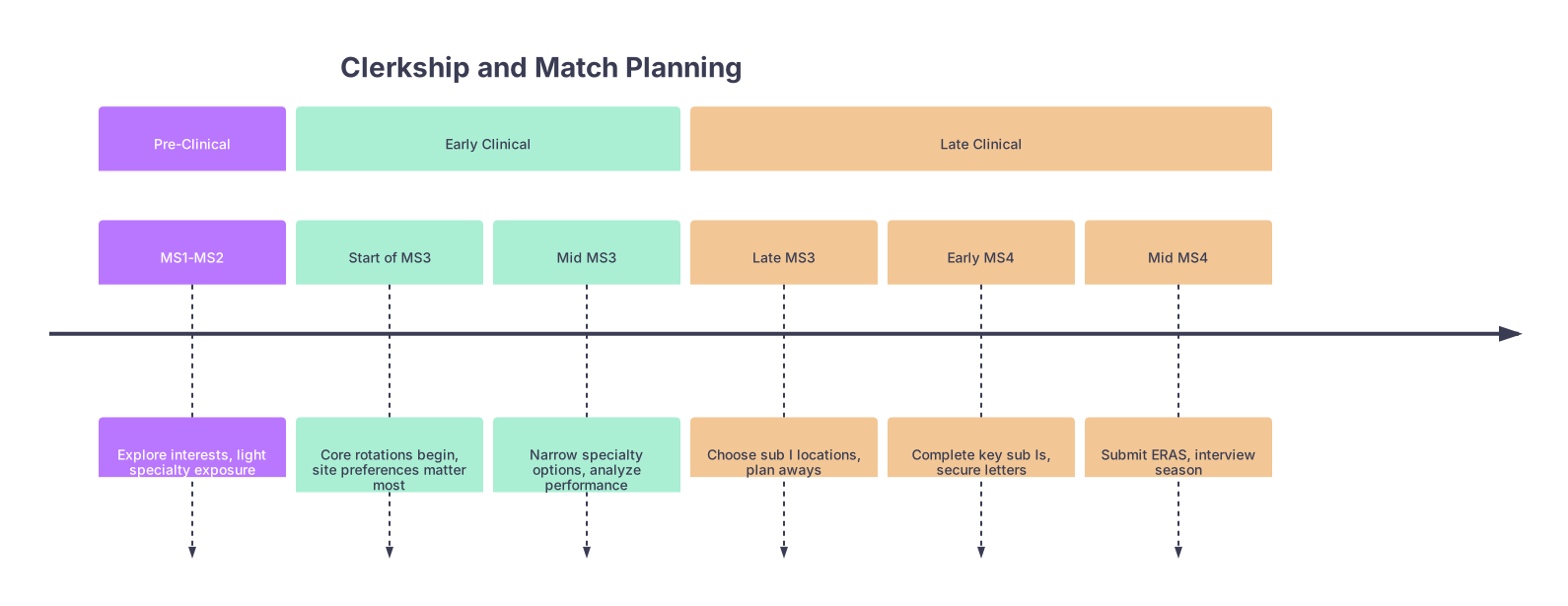
Your leverage points occur on a rough timeline like this:
| Period | Event |
|---|---|
| Pre-Clinical - MS1-MS2 | Explore interests, light specialty exposure |
| Early Clinical - Start of MS3 | Core rotations begin, site preferences matter most |
| Early Clinical - Mid MS3 | Narrow specialty options, analyze performance |
| Late Clinical - Late MS3 | Choose sub I locations, plan aways |
| Late Clinical - Early MS4 | Complete key sub Is, secure letters |
| Late Clinical - Mid MS4 | Submit ERAS, interview season |
Translation:
- Your core site choices matter most at the start of MS3. That is where you build your transcript and base layer of evaluations.
- Your sub‑I and elective site choices matter most late MS3 / early MS4. That is where you generate specialty-specific letters and visible performance.
I have seen many students panic about being “assigned” to community sites for cores, only to completely neutralize that by doing strategic sub‑Is and aways at academic centers in MS4. Programs care most about the most recent, most relevant data.
How to Decide: A Simple Heuristic
Strip away the noise. Your decision rule can be this blunt:
If you are targeting a competitive academic specialty or a top-tier university program in any field:
- You need some core or sub‑I exposure at an academic site.
- You need at least one strong academic letter in the target specialty.
- Community exposure on top of that is fine. Community‑only is a handicap.
If you are targeting solid but not hyper‑elite university programs or strong community programs in IM, Peds, Psych, OB/GYN, FM:
- Performance metrics (grades, Step 2) and letters matter more than the exact mix of sites.
- Choose sites where you will perform best, be seen, and get detailed letters.
If your school is heavily community-based with limited academic slots:
- Use those limited slots strategically (IM, surgery, and your target specialty).
- Make sure your dean’s letter emphasizes any academic activities, QI projects, and complexity of cases you have seen.
- Do not waste mental energy on the perception that you are “less than.” Programs are used to community-heavy schools and adjust.
The Short Version: What the Data Say
Three points to leave you with:
- Clerkship site type is a secondary variable. Step 2 CK, clinical performance, and letters move Match outcomes far more than “academic vs community” on your schedule template.
- Academic sites mainly help by giving you recognizable letter writers, exposure to competitive fields, and visible rigor. Community sites mainly help by giving you autonomy, volume, and often better test performance.
- The best results come from deliberate mixing: use academic sites where reputation and letters matter most for your target specialty, and use community sites where you can maximize performance and real clinical skills.
Design your rotations like a portfolio, not a loyalty pledge. The Match algorithms do not care whether you loved the marble lobby at the university hospital. They care whether you show up on paper as a high-performing, well‑supported, believable future resident.


