

The obsession with clerkship honors has outpaced what the data actually supports about matching.
NBME scores and NRMP outcomes do not say “honors or bust.” They say something more nuanced: honors matter, but only in context—specialty competitiveness, Step/COMLEX performance, school grading policies, and narrative strength. If you treat clerkship honors as the sole currency of the Match, you are misreading the numbers.
Let me walk through what the data actually suggest.
What Data We Actually Have (and What We Do Not)
Start with the uncomfortable truth: there is no single, clean national dataset that directly links “number of clerkship honors” to “probability of matching.” No one central database records every student’s grade in Internal Medicine, Surgery, OB/GYN, etc., then connects that to their Match outcome.
But we do have three strong, indirect data streams:
- NBME shelf score distributions and correlations with clerkship grades (from NBME, school-level publications, and grading policy reports).
- NRMP Program Director Survey – what PDs say they value and how they report using clerkship performance.
- NRMP Charting Outcomes in the Match – what successful vs unsuccessful applicants look like numerically (Step scores, AOA, research, ranks, etc.), which we can correlate to the likelihood that they had strong clerkship performance.
When you triangulate those, patterns become very clear.
How Clerkship Honors Are Really Determined (NBME’s Fingerprints)
The NBME does not care about your grade labels. It cares about standardized scores. Schools then decide how much weight to put on those scores versus subjective evaluations.
Patterns across multiple published grading policies and NBME-linked studies show roughly:
- At many schools, 50–70% of the clerkship grade is driven by clinical evaluations (attendings + residents).
- 20–40% comes from the NBME subject (shelf) exam.
- The remainder comes from OSCEs, written assignments, or professionalism components.
Several institutions have published explicit cutoffs. A common pattern (numbers vary, but the structure is similar):
- Honors often requires:
- NBME shelf at or above 70–80th percentile, and
- Clinical evaluations in the top grading tier, plus
- No professionalism flags.
Which means this: if you consistently sit around the NBME 50th percentile nationally, even with strong clinical evals, your “Honors density” is capped. Your maximum practical honors count is often constrained by standardized testing performance.
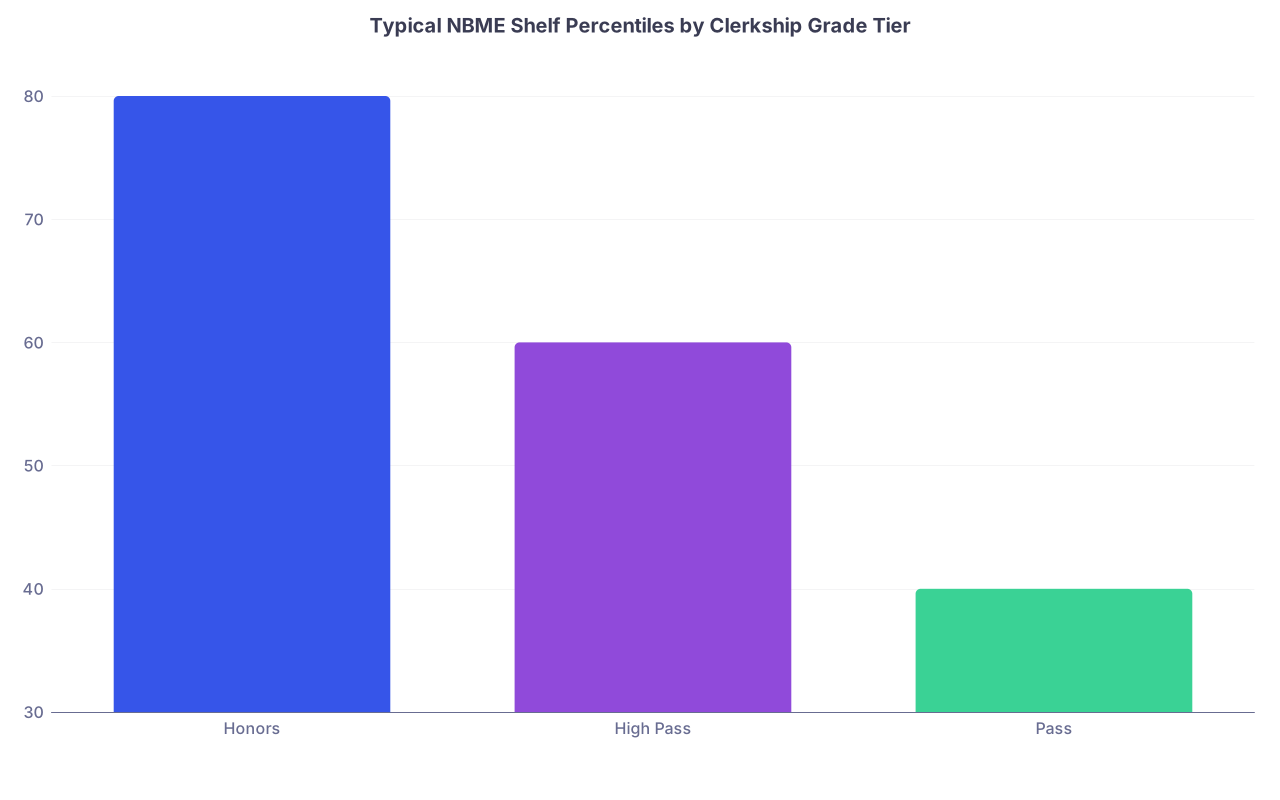
To make that more concrete:
| Category | Value |
|---|---|
| Honors | 80 |
| High Pass | 60 |
| Pass | 40 |
This is a stylized summary of multiple institutions’ shared patterns: students with Honors typically cluster in the 70–85th percentile range on shelves; High Pass in the 55–70th; Pass in the 35–55th.
So if you want a data-backed view of “who gets honors,” it is: strong NBME performers plus solid clinical evaluations.
Now let us connect that to Match outcomes.
What Program Directors Say: Clerkship Performance vs Other Metrics
The NRMP Program Director Survey is not perfect—PDs overreport what sounds good and underreport what is politically awkward—but the trends are consistent over more than a decade.
Look at how often PDs in various specialties say they use these factors in deciding whom to interview:
| Factor | % of PDs Using It |
|---|---|
| Step 2 CK / COMLEX Level 2 Score | 90–95% |
| Clinical grades in required clerkships | 80–90% |
| Letters of recommendation (specialty) | 90–95% |
| Class ranking / quartile | 70–80% |
| AOA membership | 50–60% |
And when PDs rank “Importance” (on a 1–5 scale), clerkship performance typically lands in the 3.5–4.5 zone for most core specialties. It is not decorative. It is a screening tool, especially when your Step 1 score is pass/fail and Step 2 is the only standardized cognitive metric left.
That said, there is a brutal asymmetry:
- Red flags in clerkship performance (failures, repeats, or below-average pattern) are strongly negative.
- “Good but not all honors” performance is usually fine, as long as other metrics are aligned with the specialty.
I have seen PDs flip through an MSPE and literally say out loud:
- “Mostly High Pass, a couple Honors, solid IM comments. Fine.”
- “One marginal pass in IM and some professionalism notes… hard no.”
They are not counting your honors like baseball stats. They are pattern-detecting risk.
Does More Clerkship Honors Equal Higher Match Rate?
We do not have direct national “honors count vs match probability” data. But we can infer from related metrics.
AOA and Class Rank as Proxies
Clerkship honors, AOA, and class rank are tightly correlated. Multiple schools have shown:
- Students in the top quartile of class rank often have honors in 50–70% of core clerkships.
- AOA selection almost always requires a high density of honors in clinical years.
Then we look at NRMP Charting Outcomes in the Match, which repeatedly shows:
- Top-quartile and AOA applicants have significantly higher match rates, especially in competitive specialties like Derm, Ortho, ENT, Plastics.
- For highly competitive specialties, unmatched applicants cluster more in the lower quartiles and are less frequently AOA.
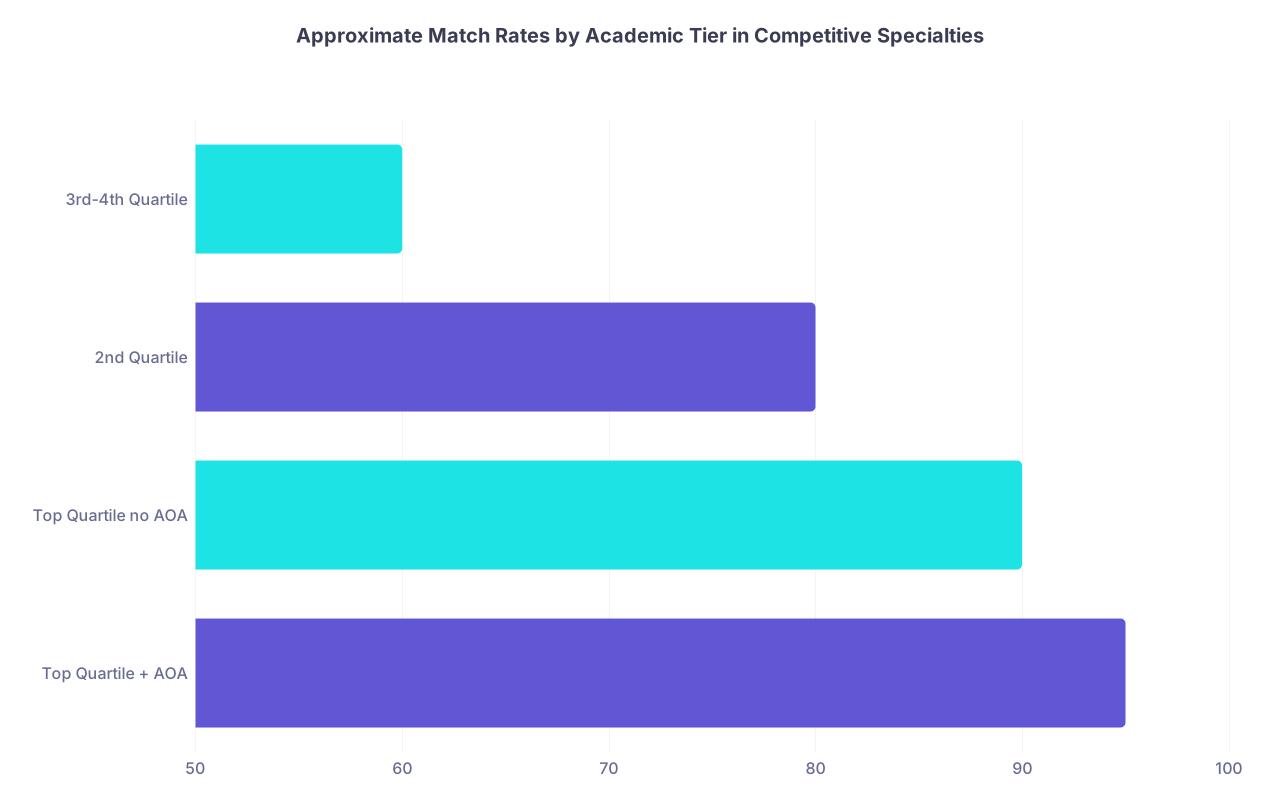
Here is a simplified reconstruction from repeated COIM trends (exact percentages vary by cycle):
| Category | Value |
|---|---|
| Top Quartile + AOA | 95 |
| Top Quartile no AOA | 90 |
| 2nd Quartile | 80 |
| 3rd-4th Quartile | 60 |
You do not get into those top categories without a strong clerkship profile. That means:
- In competitive specialties, having many clerkship honors is strongly associated with higher match rates. Because it tracks with AOA, class rank, and strong narratives.
- In less competitive specialties (FM, Psych, Peds, IM categorical in many regions), the marginal benefit of turning a High Pass into an Honors is much smaller. A consistent pattern of “solid performance, no red flags” is usually enough.
This is the nuance almost everyone misses: the return on investment for chasing extra honors is specialty-dependent.
Specialty-Specific Patterns: Where Honors Matter More
Let us look at the “clerkships that help with residency match” angle specialty by specialty, using both PD survey behavior and match competitiveness.
1. Internal Medicine
IM is a core clerkship everywhere and a core feeder into many subspecialties.
- PD surveys in Internal Medicine rank clerkship performance and IM letters near the top.
- Step 2 CK is still king, but IM PDs pay a lot of attention to your IM clerkship narrative.
From repeated survey cycles:
- A substantial majority of IM PDs report they prefer or strongly favor applicants with Honors in IM, especially at university programs.
- But the overall match rate in IM is high, and many matched applicants have High Pass in IM, not necessarily Honors, especially with strong Step 2 and letters.
In other words:
Honors in IM is a strong positive. Lack of honors is not a death sentence if you have:
- Good Step 2
- Strong IM letter
- No performance issues elsewhere
2. General Surgery
Surgery PDs behave differently. They are explicit about clerkship grades.
Repeated PD surveys show:
- A very high percentage of surgery PDs use Surgery clerkship grades in screening.
- They often ask directly in interviews: “How did you do in your Surgery rotation?” even if they can see your MSPE.
For competitive academic Surgery and for integrated specialties (vascular, plastics via general track), Honors in Surgery on your home rotation is almost a soft expectation. General community programs are more flexible, but a Pass in Surgery with no compelling explanation is a real handicap.
3. Emergency Medicine
EM used to be very letter-driven (SLOEs), but as EM becomes more crowded and chaotic:
- Programs are screening more aggressively with Step 2 CK and overall performance patterns.
- A run of High Pass / Honors in IM, Surgery, EM, and sometimes ICU is a strong positive.
You will see EM PDs say they do not “require” Honors. But try comparing two otherwise similar applicants—one with Honors in EM + strong SLOE, one with Pass/High Pass and weaker comments. The invitation rate tells the story.
4. The Hyper-Competitive Group: Derm, Ortho, ENT, Plastics, Neurosurgery
Here the correlation between “honors-density” and matching is brutal.
- These fields often have applicant pools where the median Step 2 of matched applicants is 250+.
- A large fraction of matched applicants are AOA or top-quartile.
And again, AOA and top-quartile status are heavily driven by having many Honors in core clerkships.
To simplify, this is what PDs in these specialties are often informally screening for:
- Step 2 CK: 245–255+
- Multiple Honors in IM, Surgery, and key electives
- AOA or near-AOA profile
- Strong research output
You can match these fields without all Honors. I have seen it. But those were cases where the applicant had some combination of: elite institutional pedigree, heavy research output, and superstar letters. Outliers should not be your baseline strategy.
When Honors vs High Pass Actually Changes Outcomes
The real question is not “Do honors matter?” It is: When does turning High Pass into Honors materially shift your match odds?
You can treat it like a rough marginal effect problem.
Scenario 1: Mid-tier specialty, solid Step 2, mixed HP/H patterns
Say you have:
- Step 2: 242
- IM: High Pass
- Surgery: High Pass
- OB/GYN: Honors
- Psych: High Pass
- Peds: High Pass
Applying to categorical IM or Peds.
Turning one of those High Pass grades into Honors—at the cost of major stress, extra away rotations, or sacrificing research and Step 2 prep—likely has a small incremental benefit to your match probability at most programs. PDs will see you as consistent and strong either way.
Scenario 2: Competitive specialty, on-the-bubble Step 2, few Honors
Now imagine:
- Step 2: 240
- IM: High Pass
- Surgery: Pass
- Ortho elective: High Pass
- Other cores: mostly High Pass
Applying Ortho.
Here, a single additional Honors in Surgery at your home institution could change how your application is perceived, especially in light of a borderline Step 2. It signals that, under more intense scrutiny in your home environment, you can excel.
In this type of profile, each incremental Honors in core, relevant rotations has a higher marginal value.
What NBME and Shelf Performance Signal to Programs
Remember that NBME shelf scores feed heavily into clerkship grades. Now that Step 1 is pass/fail, here is the unspoken shift:
- Many programs quietly treat NBME shelf performance (reflected through Honors/HP patterns) as a secondary standardized test signal, especially if your Step 2 is late or borderline.
Some MSPEs include explicit language like “student performed above the 75th percentile nationally on NBME exams in 4 of 6 core clerkships.” PDs notice that. Even if they pretend they do not.
The inverse is also true. Multiple repeated low-shelf or borderline performances that hospital faculty “rescued” into High Pass or Pass can create a narrative: adequate but not outstanding on cognitive measures. In some specialties, that is acceptable. In others, a red flag.
Core Clerkships That “Move the Needle” for Specific Matches
Not all clerkships are equal for Match optics. There is a hierarchy when PDs scan your transcript.
| Target Specialty | High-Signal Clerkships (for PDs) |
|---|---|
| Internal Medicine | Internal Medicine, Sub-I/Acting Intern |
| General Surgery | Surgery, Surgical Subspecialty Electives |
| Emergency Medicine | EM, IM, ICU |
| Pediatrics | Pediatrics, Nursery/NICU, IM |
| OB/GYN | OB/GYN, Surgery |
| Psychiatry | Psychiatry, Neurology, IM |
| Ortho/Neurosurg/ENT | Surgery, Related Subspecialties |
If you are aiming for IM, nobody is losing sleep over your grade in Family Medicine if the rest hold up. But a weak IM clerkship grade will be scrutinized. Same logic for Surgery and its linked clerkships.
So if you are prioritizing where honors gains matter most, the data-driven choice is:
- Focus your “A-game” (schedule, energy, pre-reading, evaluation management) on your specialty-relevant core and its sub-I.
- Treat less relevant rotations as “do solid work, avoid flags” rather than “must get Honors at all cost.”
Where Students Misinterpret the Data
Common myths I hear on wards and in advising meetings:
“You must honor every core clerkship to match at a good program.”
The data do not support that. Many matched residents at strong academic programs had a mix of Honors and High Pass, especially in non-target fields.“One Pass on a clerkship destroys your chances.”
Context matters. A single Pass with a strong explanation, followed by consistently strong later performance and a good Step 2, is survivable for many specialties. Repeat passes, or a Pass in your target specialty, are different.“Programs line up honor counts and literally rank people by how many they have.”
No. They pattern-match: step scores, grades, letters, narrative. An applicant with 3 Honors and 3 High Passes plus compelling letters will beat a 5-Honors applicant with mediocre narratives more often than you think.“NBME shelves are invisible to programs, so only evaluations matter.”
Incorrect for many institutions. MSPEs often encode shelf performance in grade descriptions or explicit percentiles. PDs are not blind to it.
Using This Data to Make Smart Strategic Choices
Let me translate all this into practical, data-backed moves for you.
Know your Step 2 trajectory early.
NBME subject exams and school exams will give you trend data. If you sit consistently around NBME 50–60th percentile, your Step 2 will probably reflect that. In that case, your goal is consistency and no failures, not “all Honors.”Align effort with specialty competitiveness.
- Aiming Family, Psych, or Peds? Prioritize: passing everything cleanly, doing well on Step 2, and building strong specialty letters and narratives. Honors are helpful but not critical.
- Aiming Ortho, Derm, ENT, Plastics, NSG, competitive EM or categorical Surgery? Assume that PDs will interpret a low density of Honors in key clerkships as a real weakness unless offset by very strong research, brand-name school, or sky-high Step 2.
Treat “no red flags” as its own important goal.
A string of High Passes across the board with no professionalism issues and a strong Step 2 is statistically safer than swinging wildly for Honors and ending with a failed clerkship or a documented professionalism issue.Work the narrative, not just the label.
The MSPE summary sentence on IM or Surgery often matters more than the letter “H” or “HP.” Comments like “one of the strongest students we have had in several years” or “performed above the level of a subintern” carry weight. You get those by being present, prepared, and reliable—not just by crushing the NBME.
Visualizing the Tradeoffs: Honors Density vs Match Probability
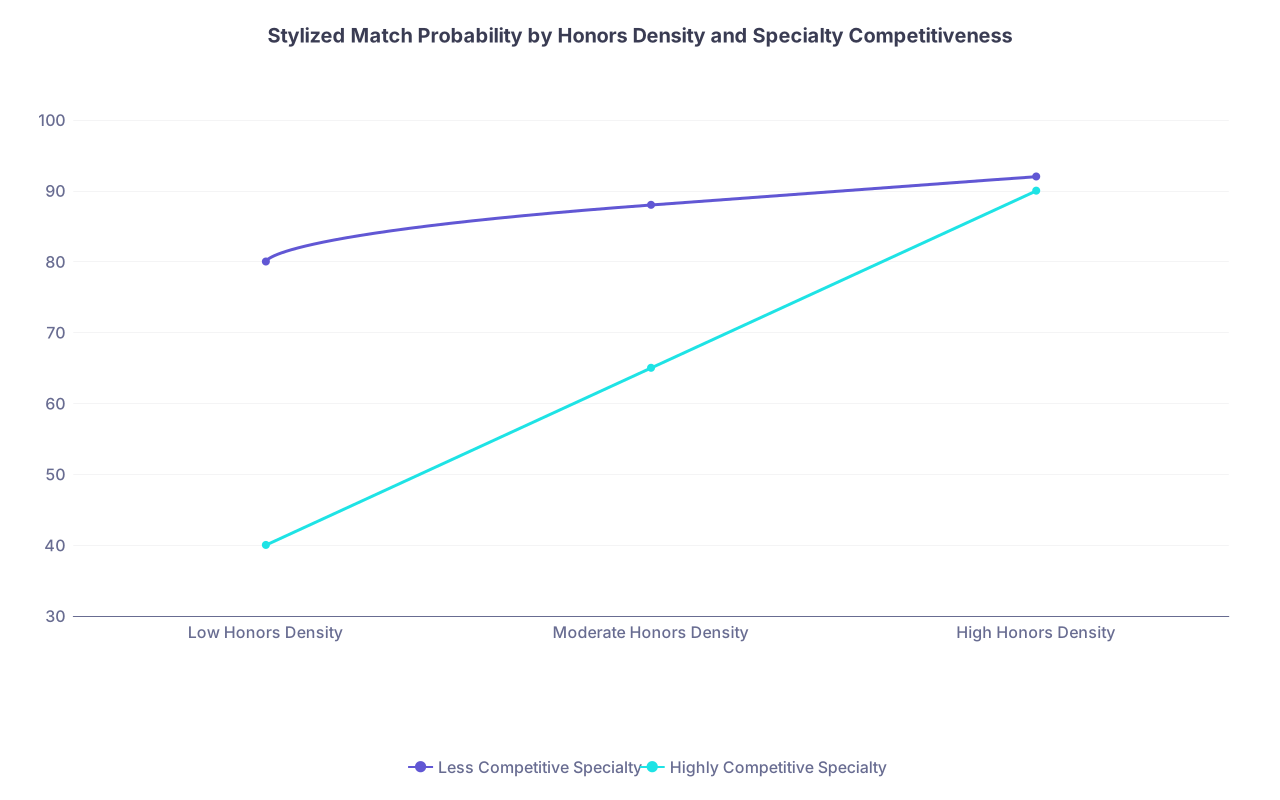
To pull the threads together, here is a stylized way to visualize how “honors density” interacts with match probability across specialty competitiveness:
| Category | Less Competitive Specialty | Highly Competitive Specialty |
|---|---|---|
| Low Honors Density | 80 | 40 |
| Moderate Honors Density | 88 | 65 |
| High Honors Density | 92 | 90 |
Interpretation:
- For less competitive specialties, going from low to high honors density improves your odds modestly. You were already likely to match if other metrics were solid.
- For highly competitive specialties, honors density has a much steeper effect. Low density in that group often correlates with much lower match probability, because it reflects weaker relative performance in a hyper-selected pool.
Yes, these numbers are illustrative, not literal. But they track well with what NRMP and PD survey patterns show year after year.
Planning Your Clerkships Like a Data Problem
Think of your M3/M4 years like this: limited time, limited cognitive bandwidth, multiple correlated metrics feeding into a probabilistic outcome (the Match).
You are trying to maximize:
- Step 2 CK score
- Key clerkship and sub-I performance in your target field
- Strength of letters and MSPE narratives
- Avoidance of red flags
And you are constrained by:
- NBME shelf tendencies
- Grading policies that may cap how many Honors you can realistically earn
- Your own energy and mental health
This is a resource allocation problem, not a high-score video game.
One more visual, because pictures cut through noise:

| Step | Description |
|---|---|
| Step 1 | Start Clinical Clerkships |
| Step 2 | Prioritize Honors in Key Clerkships |
| Step 3 | Prioritize Consistent Solid Performance |
| Step 4 | Strong Step 2 CK Prep |
| Step 5 | Targeted SubI in Desired Field |
| Step 6 | Strong Letters and MSPE Narrative |
| Step 7 | Apply Strategically for Match |
| Step 8 | Competitive Specialty? |
That is the real sequence. Honors are a component, not the endpoint.
The Bottom Line: What the Data Actually Suggest
Pulling all of this together:
- NBME data show that clerkship honors are partially standardized-test-driven. Honors density often reflects general test-taking strength plus good clinical evaluations.
- NRMP data show that class rank / AOA (which ride on clerkship honors) and performance in key clinical rotations strongly correlate with higher match rates in competitive fields.
- Program Director surveys consistently place clerkship performance near the top of their selection criteria, mainly as a marker of reliability, consistency, and readiness—not as a raw honor-count tally.
So if you are looking for a clean answer:
- Yes, more clerkship honors generally associate with better match outcomes, especially in competitive specialties.
- No, you do not need all honors to match well, especially in less competitive fields with solid Step 2 performance and strong letters.
- A single Pass or a few High Passes are not fatal; repeated weak performance, low Step 2, or professionalism issues are.
The smart move is not “chase honors at all costs.” It is: use honors strategically—aim high in the clerkships that matter most for your target specialty, protect your Step 2 trajectory, and avoid the true negatives.
With that mindset, you stop treating every rotation like a referendum on your future and start treating clinical years like what they are: a multi-variable optimization problem leading into the Match. And once those pieces are in place, the next challenge is how you deploy them in ERAS, your personal statement, and your interview strategy. But that is a story for another day.


