

Honors in Ob/Gyn and Surgery are massively overrated as “must-haves” for competitive specialties. They are helpful signals. They are not golden tickets. And they are absolutely not strict requirements.
If you hang around anxious third-years long enough, you’ll hear the same script:
“If I don’t get honors in Surgery and Ob, Derm is done for me.”
“I got high pass in Surgery – there goes Ortho.”
“Everyone going into competitive stuff at my school honored both.”
That narrative is emotionally satisfying. Simple rule: Honor the hard rotations or you are dead. Problem: the actual data and how programs read applications do not support that black‑and‑white thinking.
Let’s break the myth.
The Myth: Honors in Ob/Gyn and Surgery = Requirement for Competitive Fields
The belief goes like this: for anything “competitive” — dermatology, orthopedics, ENT, plastic surgery, neurosurgery, urology, sometimes even EM — you must:
- Honor Surgery
- Often honor Ob/Gyn as proof you can survive the OR
- Ideally honor Medicine too “to be safe”
Miss one? Your chances supposedly fall off a cliff.
Where does this come from?
- Gunners bragging: The loudest people matched into competitive spots and had multiple honors, so everyone assumes causation.
- Lazy shorthand from advisors: “Aim for honors in Surgery and Ob,” which quietly mutates into “You must get honors...”
- Selection bias: People who match at top programs often have strong transcript patterns. You don’t see all the people with similar clerkship grades who did not match, or the ones with weaker grades who did.
Now what do competitive programs actually care about, relative to clerkship honors?
Let me be blunt: for most competitive fields, Surgery and Ob/Gyn honors are:
- Nice-to-have differentiators, especially at the very top tier
- Moderately weighted signals that you can function on high-intensity services
- Far less determinative than Step 2, specialty letters, away rotation performance, research, and your home department’s support
Programs do not have an internal rule that says “No honors in Ob = auto-reject.”
What the Data and Programs Actually Prioritize
Look at NRMP’s “Charting Outcomes in the Match” and Program Director Surveys over the years. They’re not perfect — but they consistently show where the real weight is.
For competitive specialties (Derm, Ortho, ENT, Plastics, Neurosurgery, Urology), the highest‑impact factors usually cluster around:
- USMLE Step 2 CK score
- Letters of recommendation in that specialty
- Grades in core clerkships (weighted, but as part of a pattern)
- Class rank / AOA / school reputation
- Research productivity in that specialty
- Performance on away/audition rotations
- Interview performance and perceived “fit”
Notice the nuance: “Grades in required clerkships” as a set, not “Surgery and Ob/Gyn must be honors.”
Programs care about how you did relative to your environment and in context:
- Is your transcript mostly High Pass with a couple Honors, or mostly Pass with random spikes?
- Did your performance improve over the year?
- Do the narrative comments match the grade, or are there red flags (professionalism, work ethic, team issues)?
To make this concrete:
| Component | Typical Impact Tier* |
|---|---|
| Step 2 CK score | Very High |
| Specialty letters | Very High |
| Away rotation performance | Very High |
| Research in specialty | High |
| Class rank / AOA | High |
| Core clerkship grades overall | Moderate–High |
| Honors in Ob/Gyn specifically | Low–Moderate |
| Honors in Surgery specifically | Moderate |
*Across Derm/Ortho/ENT/Plastics/Neurosurg/Urology; individual programs vary, but this ranking is consistent with PD surveys.
Notice the bottom two. Are they meaningless? No. Are they required? Also no.
How Different Specialties Really View Ob/Gyn & Surgery Honors
Here’s where the myth really falls apart. Competitive fields are not a monolith. They care about different signals.
1. Surgical Subspecialties (Ortho, ENT, Plastics, Neurosurgery, Urology)
These are the ones students most often panic about if they “only” get High Pass in Surgery.
Reality:
- Surgery clerkship performance is examined.
- But your sub-internships / audition rotations and letters from surgeons in your specialty carry far more weight.
I’ve watched this play out every year:
- Student A: High Pass in Surgery, Honors in Medicine, High Pass in Ob. Excellent ortho away rotation, glowing letter (“top 5% of students I’ve worked with in 10 years”), 255+ Step 2, solid ortho research. Matched ortho at a very strong academic program.
- Student B: Honors in Surgery and Ob, but only decent away rotation feedback and generic letters. Similar board scores. Matched ortho, but mostly mid-tier community-heavy programs.
Who would programs prefer? The one whose actual specialty attendings went to bat for them, not the one who nailed an 8-week general surgery block as an MS3.
Programs know clerkship grading is messy:
- Some schools cap honors at 10-15% of students.
- Others give 50-60% of students honors in certain rotations.
- Some weight NBME exams heavily, others barely at all.
- Narrative comments might be outstanding but the grade is held down by a test score.
They read your transcript with that noise in mind.
For many surgical subspecialties:
- Surgery honor is a mild to moderate plus. It reassures them you can handle being in the OR and a surgical team environment.
- No surgery honor is not a categorical problem if your sub-I and specialty rotations show you crush it in the OR for their field.
Ob/Gyn? For these fields, often barely moves the needle unless they are just scanning for global excellence.
2. Ob/Gyn Residency
Different story.
If you’re going into Ob/Gyn, then yes, Ob/Gyn clerkship performance matters a lot. Programs look carefully at:
- Your Ob/Gyn grade
- Narrative comments describing teamwork, OR behavior, and triage
- Any Ob/Gyn sub-I performance and letters
Do you need honors in Ob to match Ob? No.
I’ve personally seen:
- HP in Ob, H in Surgery, strong letter from Ob faculty, 240s Step 2, good but not crazy research → matched academic Ob at a state flagship and had multiple interviews.
- P in Ob due to a rough first few weeks and a mediocre NBME, then strong Ob sub-I with clear upward trend and advocacy from the department → matched community Ob and is now a thriving attending.
Programs want convincing evidence that your initial Ob performance does not define you and that attendings who currently know you like working with you.
3. Nonsurgical Competitive Specialties (Derm, Rad Onc, maybe GI cards down the line via IM)
For Derm especially, the transcript is just one part of a much deeper package:
- They care far more about: research, letters from dermatologists, and Step 2 CK.
- Ob/Gyn and Surgery honors are generic “this person is smart and functional” signals. Nice to see, not mandatory.
I’ve seen Derm matches with:
- Honors in Medicine, HP in Surgery, HP in Ob/Gyn, 260+ Step 2, 10+ derm pubs/abstracts, killer derm letters.
No one on that committee rejected them because “they forgot to honor Ob/Gyn.”
The Noisy Reality of Clerkship Honors
Here’s the part students don’t like to admit: honors in Surgery and Ob/Gyn are often a reflection of factors that have nothing to do with your “competitiveness.”
I’ve sat in clerkship grading meetings. I’ve heard the talk.
- “We already have too many honors this block, someone on team 3 is getting bumped.”
- “Their evals are great but the NBME was 1 point below the cutoff.”
- “This attending is a hard grader, this one gives everyone ‘outstanding.’”
- “The student was on a malignant team and barely got any face time with attendings.”
Clerkship grading is a mix of:
- Objective-ish exam performance
- Subjective evaluations (with huge inter-attending variability)
- Institutional policy (honors caps, curve structures)
- Luck of the draw (which team, which residents, which patients)
Programs know all this. They read the pattern more than the individual data point.
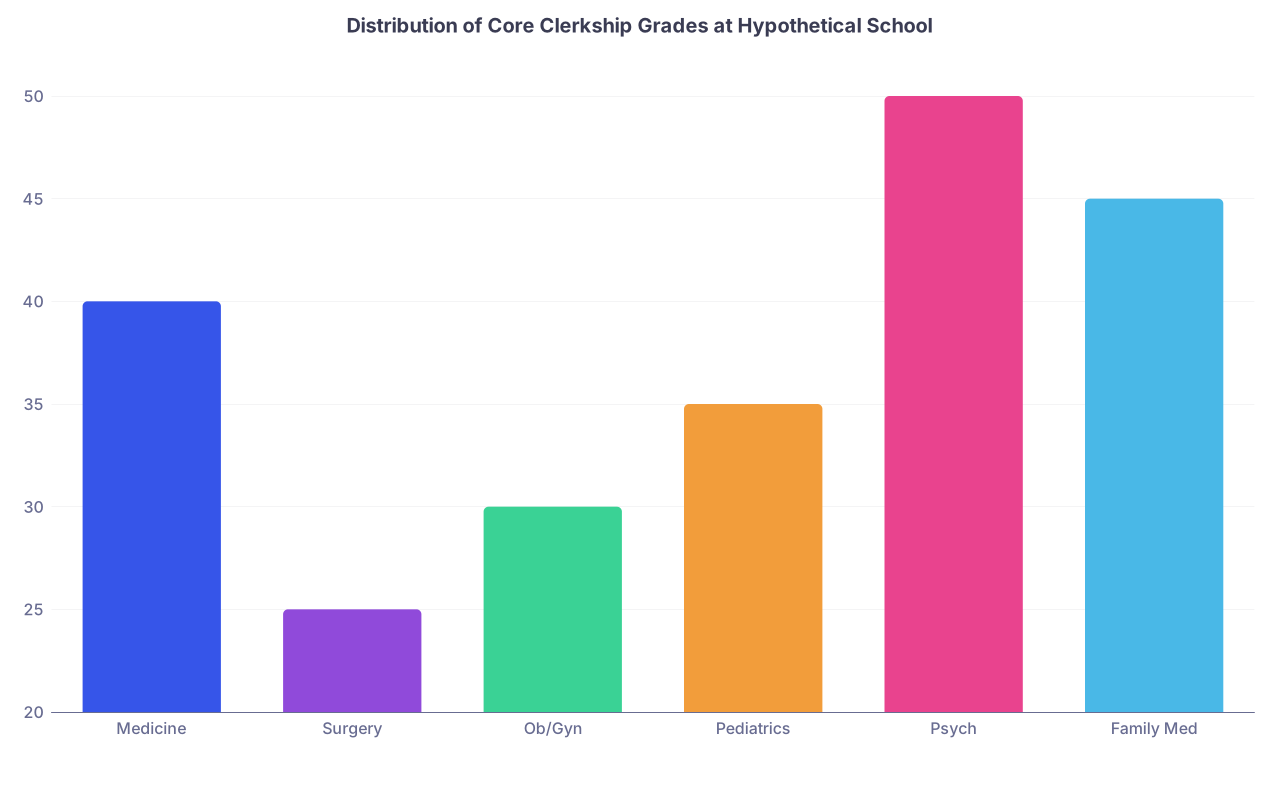
| Category | Value |
|---|---|
| Medicine | 40 |
| Surgery | 25 |
| Ob/Gyn | 30 |
| Pediatrics | 35 |
| Psych | 50 |
| Family Med | 45 |
If your school gives 25% of students honors in Surgery, but 40-50% in Medicine or Psych, missing honors in a “tight” rotation says a lot less about you than you think.
Where Honors Do Really Help
Let’s not swing too far in the other direction. Honors aren’t meaningless.
They help most in three situations:
You’re borderline on another important metric
- Example: Your Step 2 CK is fine but not stellar for your field. Strong clerkship performance (including Surgery/Ob) can rebut any doubt about work ethic or clinical ability.
You’re from a lesser-known or lower-ranked school
- For applicants from schools without a national name, a clear pattern of strong performance (multiple honors in core rotations) helps reassure programs you’re at the top of your local cohort.
You’re aiming at the absolute top-tier programs
- Super-competitive academic programs sometimes have a pile of great applications and use “mostly honors in cores” as one of their filters. But even here, they don’t make it “Ob and Surgery or bust.”
The key point: honors add weight in context. They do not function as pass/fail gates.
What If You Did NOT Honor Ob/Gyn or Surgery?
This is the part you actually care about.
You got High Pass or even Pass in one (or both). Does that kill your chances at competitive fields?
No. It just means you have to be smart and intentional about everything else.
Step 1: Look at the Pattern, Not the Single Grade
Programs do what you should do: zoom out.
Ask yourself:
- Are my other core rotations mostly HP/H with good comments?
- Was there a clear reason that block was weaker (first clerkship, illness, terrible team, exam day disaster)?
- Do my narrative comments still describe me as hard-working, reliable, and teachable?
If the overall pattern is “strong student, one or two rotations less than perfect,” committees will interpret that as… being human.
Step 2: Overcorrect Where It Counts
If you’re going into a competitive surgical subspecialty and didn’t honor Surgery:
- You must absolutely crush your sub-I in that specialty and any aways.
- You need letters that explicitly say: “They functioned at the level of an intern” or “One of the best students I’ve worked with recently.”
If you’re going into Ob/Gyn and only got HP or P in Ob:
- Target a strong Ob sub-I and ask for a letter that comments on your growth since the clerkship.
- Make sure the letter writer knows and can contextualize your initial grade.
If you’re going into Derm, Rad Onc, etc. without Ob/Surg honors:
- Double down on research output and specialty connections.
- Make sure your Medicine and IM subspecialty rotations are excellent; those often weigh more for cognitive-demand specialties.
Step 3: Use Your Dean’s Letter and Advisors Strategically
The MSPE (Dean’s Letter) will often have:
- Comparative performance language (“Above expectations,” “One of the strongest students on the team”)
- Sometimes explicit explanation if there were anomalies.
If your Ob or Surgery grade doesn’t match the narrative (“Outstanding student, stellar team player”) that discrepancy usually helps you, not hurts you. It signals that the grade might have been constrained by institutional factors.
Your home specialty advisor can also silently “translate” your transcript to PDs during calls and emails:
“Yes, she got HP in Surgery, but that was an early rotation and our honors cutoff that block was brutal. She has since done a superb sub-I in our service and is absolutely ready.”
And PDs believe those translations more than your internal monologue of doom.
What You Should Actually Optimize During Clerkships
If you want to match a competitive specialty, your strategy shouldn’t be “must honor Ob and Surgery or perish.” That’s too narrow and ignores what PDs actually read.
Focus on:
- Consistency: Mostly strong grades across core clerkships, with upward trajectory if you started slow.
- Narrative comments: Aim for phrases like “self-directed,” “works at intern level,” “independent,” “excellent with patients,” “team asset.” These matter more than you think.
- Relationships: Faculty and residents who actually know you and will write specific, detailed letters.
- Step 2 CK: Like it or not, this is still a primary screening tool.
- Specialty engagement: Research, shadowing, conferences, projects with attendings in your field.
Put differently: honor the right things. Not just the grade label for an 8-week block that half depends on who staffed the service that month.
A Quick Reality Check: How PDs Read You
Picture a program director sorting applications:

| Step | Description |
|---|---|
| Step 1 | Application Received |
| Step 2 | Screen out or low priority |
| Step 3 | Unlikely to interview |
| Step 4 | Context matters, maybe borderline |
| Step 5 | Likely interview |
| Step 6 | Step 2 CK strong for our field |
| Step 7 | Strong specialty letters |
| Step 8 | Core clerkships mostly strong |
See what’s missing? “Did they honor Ob and Surgery specifically?”
At most programs, that question doesn’t show up as an explicit decision node. It’s baked into the third box as part of the general impression of your clinical performance.
So, Are Honors in Ob/Gyn and Surgery Required?
No. They are signals, not requirements.
- You can match Ortho with HP in Surgery if your specialty letters, sub-I, and Step 2 are strong.
- You can match Derm without a transcript full of honors in every rotation, if your research and derm support are excellent.
- You can match Ob/Gyn with a less-than-perfect Ob clerkship grade, if you show growth and get your department behind you.
What hurts you is not a single non-honors grade. It’s a pattern of mediocrity, vague or lukewarm comments, and lack of specialty-specific strength.
So by all means, aim high. Work hard on Surgery and Ob/Gyn. But stop acting like a High Pass on one of those blocks is some kind of professional death sentence.
Years from now, nobody will care what your third-year grade in Ob/Gyn was; they’ll care how you show up as a resident. Build the application — and the habits — that make that part undeniable.


