

27% of graduating U.S. MD seniors say their most impressive letters of recommendation came from non-teaching / private services—but program directors consistently rank core clinical teaching services as far more reliable for judging applicants.
So the usual student assumption—“Private service = more autonomy = better for my application”—is often wrong, or at least incomplete.
Let me break this down specifically.
You are trying to game out a very practical question:
- Should you chase private/attending-only services to stand out?
- Do residency programs value “clinical teaching services” rotations more?
- Does it vary by specialty?
- Does it change how your letters, evaluations, and experiences read on your application?
This is exactly the kind of nuance that makes or breaks marginal candidates. And even strong ones. I have watched 250+ students quietly sabotage their match strategy by choosing the wrong service at the wrong time, then wondering why their “strong” letter from a private doc carried less weight than they expected.
We are going to compare clinical teaching services vs private/non-teaching services with one target in mind: residency match outcomes.
1. Definitions: What actually counts as “teaching service” vs “private”?
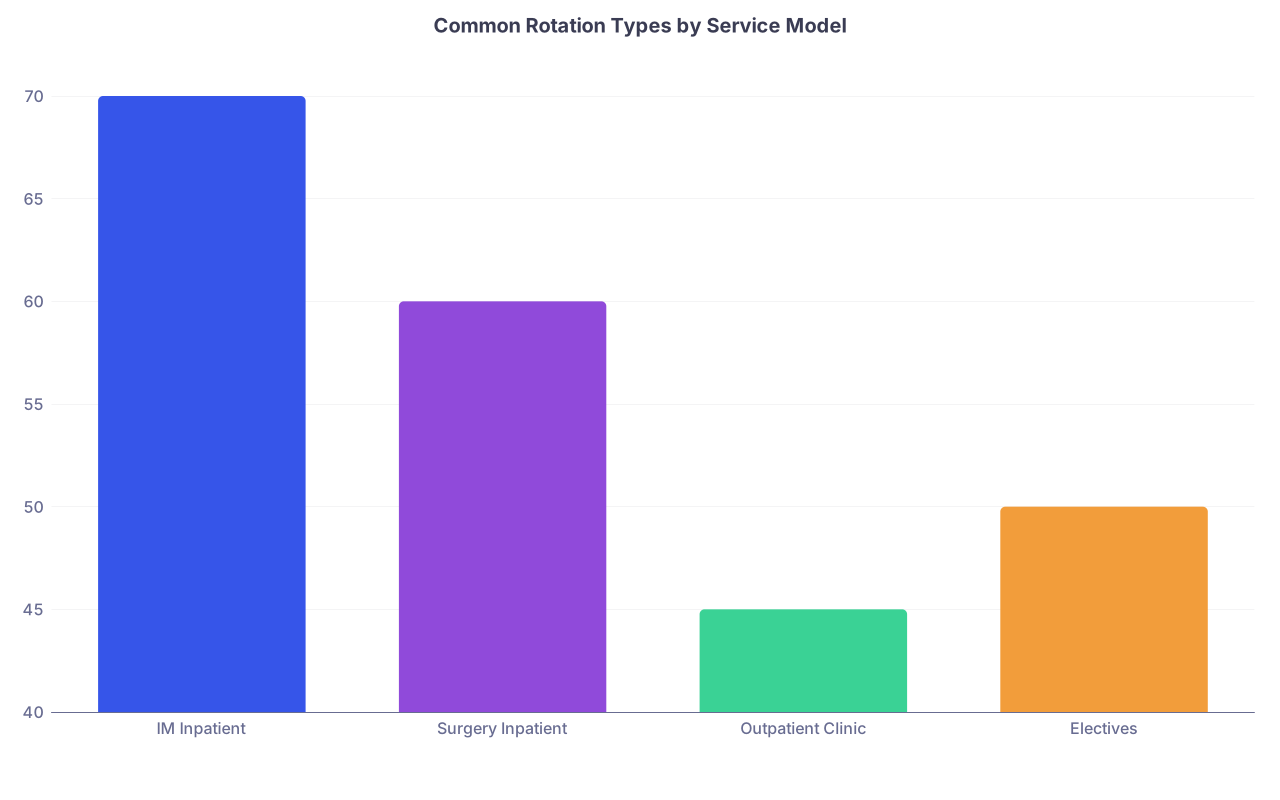
| Category | Value |
|---|---|
| IM Inpatient | 70 |
| Surgery Inpatient | 60 |
| Outpatient Clinic | 45 |
| Electives | 50 |
Here is the basic distinction, stripped of school brochure language.
Clinical teaching service usually means:
- Team-based, with residents and often interns.
- Explicit educational structure: work rounds + teaching rounds, chalk talks, pre-planned teaching.
- Patients often admitted under a “hospitalist” or teaching attending, sometimes with capped census.
- Students with defined roles—presentations, notes, checklists, specific evaluation forms.
- Attending is accustomed to writing formal evaluations and structured letters.
Think: medicine wards at academic centers, VA teaching services, resident-run surgery teams, OB/GYN labor and delivery teaching teams, peds ward teams, many sub-specialty inpatient consult teams at university hospitals.
Private or non-teaching service usually means:
- Attending or small group of attendings, often community-based or mixed academic–community.
- Fewer or no residents. Sometimes “student + attending + midlevel.”
- Work driven by clinical volume, not teaching curriculum.
- Autonomy can be higher for the student, but feedback is often informal.
- Evaluations and letters may be more narrative, less standardized, sometimes less aligned with residency expectations.
Think: private cardiology group rounding on their patients, community hospitalist groups not attached to a residency, subspecialty private clinics, ortho private practice elective, anesthesia private group OR month, dermatology private clinic, etc.
In your dean’s letter and MSPE, these are usually tagged as:
- “Core required clerkship, teaching service”
- “Sub-internship (acting internship)”
- “Elective, private practice / community-based site”
- “Away rotation, academic teaching service vs community”
Residency PDs notice those tags. They absolutely stratify them.
2. How program directors actually view these services

I will be blunt: not all clinical experiences are equal in the eyes of residency leadership.
Here is the hierarchy I see over and over when PDs and faculty skim applications:
- Core required clerkships on clinical teaching services at a known academic institution.
- Sub-internships / acting internships on teaching services in the same specialty.
- Away rotations on teaching services at other academic programs.
- Elective rotations on teaching services in related fields.
- Rotations on private / non-teaching services, especially if:
- Community-based,
- Short (2 weeks),
- Or outside the main specialty.
No one will say it out loud to students, but you are reading this for the unfiltered version.
From the PD perspective, teaching services:
- Have predictable evaluation standards.
- Use similar language and benchmarks.
- Are directly comparable across applicants.
Private services are more variable:
- One attending’s idea of “outstanding” may be another’s “solid.”
- Autonomy may be high, but supervision is variable.
- Letters can be passionate but light on specifics that PDs care about (comparative ranking, level of responsibility, direct observation).
So in the match game, your core clinical teaching service performance is your currency. Private service rotation performance is your bonus add-on. Helpful. Not foundational.
3. How each service type impacts different parts of your application
| Application Element | Teaching Service Impact | Private Service Impact |
|---|---|---|
| MSPE / Clerkship Grades | High | Low–Moderate |
| Standard LOR Strength | High | Variable |
| Narrative LOR Uniqueness | Moderate | High |
| Specialty-specific Signaling | High (for aligned field) | Moderate |
| Perceived Rigor | High | Variable |
Let us break out the main components PDs actually scan:
3.1. Clerkship grades and MSPE narrative
Your core clerkship grades—especially:
- Internal medicine,
- Surgery,
- Pediatrics,
- OB/GYN,
- Psychiatry,
- Family medicine,
are usually derived from teaching service evaluations plus shelf scores.
PDs use them as a quick litmus test:
- Honors in IM, Surgery, and your specialty → box checked.
- Straight Passes or mixed → more scrutiny; context matters.
Private service rotations rarely feed into your core grades. When they do, they are often weighted less or treated as adjunct experiences. The MSPE narrative might say something like:
“Student completed an additional 2-week elective with Dr. X in private cardiology practice, where she was noted to be enthusiastic and well-prepared.”
Nice. But that line will not offset a mediocre core IM evaluation on teaching wards.
If you have limited bandwidth, you protect your teaching service clerkships at all costs. Those grades are “sticky” on your transcript. Private electives are not.
3.2. Letters of recommendation (LORs)
This is where nuance matters.
On a teaching service, attendings and senior residents:
- See you presenting daily.
- Watch you on call, on busy days, on weekends.
- Compare you to other students and interns constantly.
- Are used to writing structured letters for residency.
A strong teaching-service letter often includes:
- Clear comparisons to peers (e.g., “top 10% of students I have worked with in 10 years”).
- Specific examples of clinical reasoning and responsibility.
- Commentary on work ethic and team dynamics in a high-volume environment.
- Direct phrases PDs look for: “ready to function as an intern,” “performed at intern level.”
Private service letters can be very different:
- More personal narrative: “I have known John for 10 years; he rotated with me in clinic and followed my panel closely.”
- Heavy on bedside manner, patient rapport, and maybe procedural aptitude.
- Less direct comparison across large cohorts of students.
They can be gold in certain contexts:
- ENT applicant with a glowing letter from a high-volume community otolaryngologist who knows the specialty well.
- Anesthesia applicant with a detailed letter from a private group that takes residents and understands what good anesthesia trainees look like.
- EM applicant with a letter from a community ED where the student effectively functioned as a sub-I.
But when PDs are forced to weigh letters against each other, a very strong letter from a core teaching service often edges out a glowing but more anecdotal letter from a private doc with no clear comparative context.
The exception: when that private attending is a known name in the specialty, regularly writes letters, and clearly understands the match process. Then that letter carries similar or even greater weight.
4. Specialty-specific differences: where private services can help or hurt
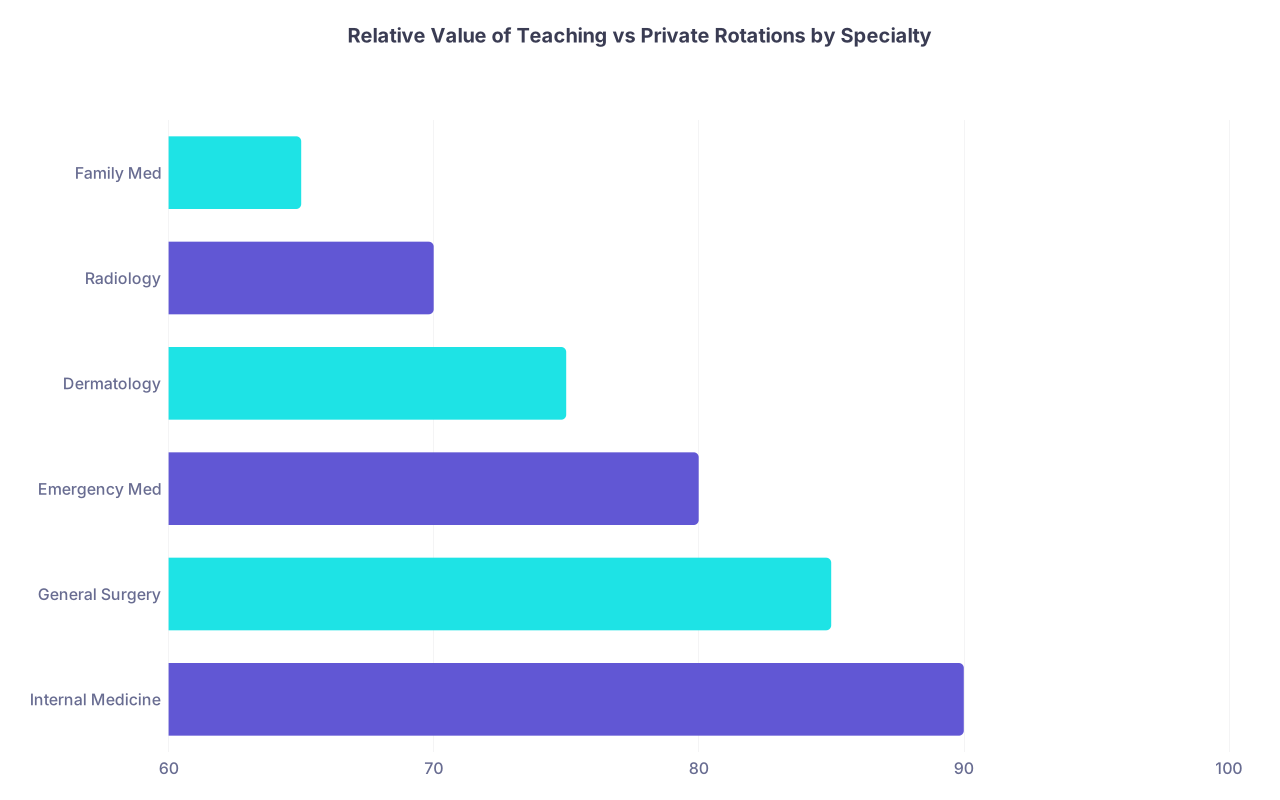
| Category | Value |
|---|---|
| Internal Medicine | 90 |
| General Surgery | 85 |
| Emergency Med | 80 |
| Dermatology | 75 |
| Radiology | 70 |
| Family Med | 65 |
Some specialties are obsessed with solid core-teaching-service performance. Others are more flexible and value niche, private experiences.
Here is a realistic breakdown.
4.1. Internal Medicine and Subspecialties (Cards, GI, Heme/Onc, etc.)
For IM and its subs, inpatient teaching wards and sub-Is dominate:
- Your IM core clerkship evaluation is non-negotiable.
- Your IM sub-I (on a teaching service) is where many PDs expect a letter from.
- Cardiology or GI private electives are fine “extras,” but they do not rescue a weak wards evaluation.
If you are IM-bound, prioritize:
- Medicine wards (teaching).
- Medicine sub-I (teaching).
- Possibly an away medicine sub-I (teaching).
You sprinkle in private subspecialty time after those boxes are secured.
4.2. General Surgery and Surgical Subspecialties
For general surgery, ortho, neurosurgery, etc., the story is similar but a touch more brutal.
- Surgical clerkship grade from a teaching team is critical.
- A strong sub-I (often on a busy teaching service with residents) is the second anchor.
- Private practice ortho / community surgery months can give you hands-on cases and relationships, but letters from them are variable in weight.
I have seen this pattern:
- Student gets average evals on academic surgical team (too quiet, slow notes, overwhelmed).
- Student goes to a community/private service, works like a lunatic, “first assist” all day, and gets an adoring letter from the doc.
- PDs appreciate the grit but still hesitate because the teaching service saw them as mid-pack.
If you want surgery, never sacrifice a good shot at teaching-service sub-I for yet another private elective.
4.3. Emergency Medicine
EM is more nuanced.
EM PDs care a lot about:
- EM-specific SLOEs (Standardized Letters of Evaluation).
- Performance in busy EDs, often academic but sometimes high-volume community sites.
Many EM programs use community EDs with residents that are technically “non-teaching hospital wards” but function as highly structured teaching environments. Those are not what I mean by “private service.”
Purely private/community ED shifts with no residents and minimal teaching infrastructure can produce letters, but:
- They rarely replace a true SLOE from an academic EM site.
- At best they are supplemental.
If you are EM-bound:
- You need at least 1–2 formal EM rotations that produce SLOEs. These may be at academic or very structured community sites, but they sit squarely in the “teaching” category.
- Extra private ED time is nice but not a substitute.
4.4. “Lifestyle” fields: Derm, Radiology, Anesthesia, PM&R, etc.
These specialties often rely heavily on:
- Field-specific letters,
- Demonstrated interest,
- Sometimes research.
Here private vs teaching service gets interesting.
Derm, for example:
- A month with a private dermatologist who knows the game and has placed multiple applicants can be extremely valuable, particularly if your home program is weak.
- However, a letter from a world-known academic dermatologist on a teaching elective usually carries more objective credibility.
Radiology and anesthesia:
- Private group rotations can show “real world” practice, give you procedural exposure, and lead to great letters if the attending understands what a good letter looks like.
- But if the writer clearly does not understand residency selection, the letter turns into “Juliet is great, patients love her, she is a hard worker,” with no comparative anchor. PDs skim and move on.
The net: for these fields, private rotations are useful if the attending is plugged into residency education. If not, you are investing time mainly for your own career clarity, not for direct match points.
4.5. Primary care fields: Family Medicine, Pediatrics, Psychiatry
These programs tend to be:
- More open to various sites contributing to their picture.
- More comfortable with community-based and private-service letters, especially in outpatient-heavy fields like FM and psych.
Still:
- A strong FM or peds inpatient/outpatient teaching service evaluation is your backbone.
- Private PCP clinic letters are icing.
5. Autonomy vs documentation: what matters more to PDs

Students love private services for a reason:
- More procedures.
- More 1:1 time with attendings.
- Less bureaucracy.
- Sometimes more “real doctor” work.
I have seen students do more procedures in one month with a private pulmonologist than in two medicine sub-Is on academic teaching wards. From your perspective, that feels huge.
From the PD’s perspective, though, three questions matter more than your sense of autonomy:
- Who observed you enough to reliably judge your readiness for internship?
- Who can compare you to dozens or hundreds of other students?
- Who can document this in language PDs trust?
Teaching services win that race most of the time.
You can combine both:
- Do your sub-I on a busy teaching service where your note-writing, signout, clinical reasoning, and reliability can be clearly documented.
- Then choose a targeted private elective where you get procedures, continuity, or niche exposure. Discuss it in your personal statement and interviews as evidence of depth.
Autonomy is powerful for your development. Documentation is powerful for your application. You want both, but if forced to choose, PDs care more about the latter.
6. Strategic scheduling: when to pick which (and for what signal)

| Step | Description |
|---|---|
| Step 1 | Planning Third Year |
| Step 2 | Prioritize Teaching Services |
| Step 3 | Protect IM, Surgery, Specialty |
| Step 4 | Choose Teaching Service Sub I |
| Step 5 | Add 1 Teaching Elective |
| Step 6 | Add Private Elective for Depth |
| Step 7 | Fix Scheduling First |
| Step 8 | Core Clerkships? |
| Step 9 | Sub I Timeframe? |
| Step 10 | Need Specialty Signal? |
Timing matters.
Third year
Your job:
- Crush core clerkships on teaching services.
- Build reputation with faculty who write strong, trusted evaluations.
- Identify attendings who could eventually write letters.
Avoid loading third year with random private electives at the expense of core experiences. Those extra letters are not worth a weaker IM or surgery evaluation.
Early fourth year (July–October)
This is where choices matter for the match.
Priorities:
- Sub-internship on a teaching service in your chosen specialty or in internal medicine (for many fields).
- One or two field-specific electives ideally on teaching services at your home or away institution.
- Then, and only then, consider targeted private service rotations that:
- Clarify career goals.
- Offer unique procedural or continuity experience.
- Connect you to someone who actually knows how to write a strong specialty LOR.
Do not fill July–September with private practice months if that means pushing your sub-I to November. PDs often read applications before that shows up in your MSPE.
Late fourth year (after rank lists)
This is the safest window for private experiences that are more for you than your application:
- Niche specialty you will not match into but want exposure to (sports ortho if you are going into FM).
- A community practice style similar to where you want to work eventually.
- High-procedure months for confidence before internship.
At that point, your file is basically locked.
7. Red flags and pitfalls I see repeatedly

Some patterns honestly frustrate me because they are predictable—and avoidable.
Over-electing in private practice early
Student loads third year with dermatology private clinic, ortho private office, cardio private consult month. They feel “specialized,” but wind up with:- Average IM/surgery clerkship evals,
- A thin MSPE narrative,
- And letters from people who barely know residency expectations.
Relying on a single, glowing private letter to rescue weak core performance
PDs almost never let one outlier letter override a pattern of mediocre teaching-service evals. They might invite you for an interview out of curiosity. They rarely rank you highly on that basis alone.Choosing private away rotations instead of academic ones in competitive specialties
In derm, ortho, ENT, neurosurgery, etc., away rotations are two things:- Extended job interviews.
- Sources of high-yield specialty letters.
Doing an away with a private group that has no residency program gives you neither.
Letters from attendings who do not understand LOR expectations
I have read letters that say essentially:
“I like this student. She is very nice. She will make a great doctor.”
That is useless to a PD. Clinical teaching service attendings at academic centers usually know better. Many private attendings do not.Using private practice autonomy as cover for deficits on teaching services
PDs can smell this. “I really thrived in a more independent environment in private practice” can read as, “I struggled with structure, hierarchy, and feedback.” Not good.
8. How to decide, rotation by rotation
Here is a practical decision approach you can actually use.
Ask yourself, for each potential rotation:
Is this a core clerkship or sub-I?
- If yes: choose teaching service whenever possible.
Will this rotation likely produce a letter for my chosen specialty?
- If yes:
- Teaching service at an academic site > private service, unless the private attending is a known quantity and writes many letters.
- If yes:
Does the attending or site have a track record of helping students match in this specialty?
- Ask older students. Ask advisors. Ask residents.
- If “no idea,” do not risk an essential letter on this rotation.
Does this add something meaningful to my story that I cannot get on teaching services?
- High-volume procedure exposure.
- Rural medicine in the exact setting you want long-term.
- Deep continuity with one mentor.
If yes and your core boxes are already checked, then a private rotation may be absolutely worth it.
You are not choosing “teaching good, private bad.” You are choosing sequencing and weighting.
Use teaching services to build your baseline credibility. Use private services strategically to add depth and differentiation once that credibility is secured.
FAQ (5 questions)
1. If I can get only one letter in my specialty, should it be from a teaching or private service?
If you have only one shot, choose a teaching service at an academic site where the attending writes letters regularly and knows how to rank you against prior students. A superb letter from such a site is almost always more predictable and more trusted than a random private practice letter. The only exception is a private attending who has a well-known track record in that specialty and is clearly embedded in residency education.
2. Do programs look down on community or private rotations on my transcript?
No, not inherently. Community and private rotations are common and often respected, especially in primary care, EM (when structured), and some lifestyle fields. What programs discount is over-reliance on those at the expense of strong performance on core teaching services. A couple of private rotations in context is fine. A transcript dominated by them, with thin teaching-service evaluations, raises concerns.
3. Can a stellar private-practice elective compensate for a mediocre internal medicine clerkship?
It can soften the blow a little, but it almost never fully compensates. PDs expect solid performance on core IM regardless of specialty. A strong private cardio or GI letter might convince them you have grown and can handle their field, but they will still view a weak IM ward evaluation as a real data point. You might still match, but you have made your path steeper.
4. For competitive specialties, is it ever smart to do an away rotation with a private group?
Only if that private group is deeply connected to the specialty’s training pipeline. For example, a large ortho private group that runs fellowships and co-runs an academic program, or a derm private practice that regularly hosts residents and is known nationally. Purely standalone private groups with no residency, no SLOE-equivalent, and no visibility usually do not help your application much, especially compared to an academic away.
5. How should I talk about private service experiences in my personal statement or interviews?
Frame them as complementary to your core training, not as an alternative. Emphasize concrete skills and insights you gained: independence in outpatient management, longitudinal patient relationships, procedural experience, exposure to real-world practice constraints. Tie these back to how you performed on teaching services (“I built my foundation on busy IM wards, then saw how those principles translate in community cardiology”) rather than implying private practice is the only place you truly functioned as a doctor.
With the difference between clinical teaching services and private services clear—and how each plays into letters, grades, and PD perception—you are now ready to design your fourth-year schedule with intention, not guesswork. The next step is even more granular: deciding which exact sub-Is and away rotations to prioritize for your specialty. But that is a story for another late-night planning session.


