

The assumption that “more elective time in one specialty automatically boosts your match odds there” is statistically weak and often wrong beyond a certain threshold.
The data show a much more nuanced story: 1–2 targeted months are high-yield. Beyond that, the returns flatten fast, and you start trading away broader competitiveness and Step 2 performance for vanity padding.
Let me walk through this using numbers, not vibes.
What Actually Moves Match Odds (And Where Electives Fit)
Programs do not sit around saying, “This applicant did 5 months of cards electives, let’s move them up.” They rank on a weighted bundle of signals.
Using NRMP, AAMC, and multiple institutional analyses, you can think about match odds as a rough weighting problem. For competitive and moderately competitive specialties, the levers look like this:
| Factor | Approximate Weight in Decision* |
|---|---|
| Board scores (Step 2) | 20–30% |
| Clinical grades / MSPE | 20–25% |
| Letters of recommendation | 20–25% |
| Interview performance / fit | 15–20% |
| Research (field-relevant) | 10–20% (higher in academic fields) |
| Elective time in specialty | 5–10% |
*Not a formal model, but consistent with program director surveys and institutional rank list reviews I have seen.
Elective months affect:
- The strength and specificity of letters
- How many programs know you personally (audition rotations)
- Your demonstrated commitment to the field
But the effect size is small compared with Step 2 or a high-impact letter. And after 2–3 months, the incremental informational value of yet another similar elective is close to zero.
The Data on Away Rotations vs Extra Home Electives
Most students confuse two very different questions:
- Do away rotations help match odds?
- Do extra months in the same field (beyond the usual 1–2) help?
The first one: yes, when used correctly.
The second one: usually no, and sometimes harmful.
Let’s separate them.
Away Rotations: High-Yield but Finite
AAMC and NRMP survey data consistently show:
- In some surgical subspecialties, >60–70% of residents matched at either:
- Their home program, or
- A program where they did an away rotation
Several institutional reviews I have seen in ortho, neurosurgery, and derm show a pattern like this:
- Students who did 0 aways in highly competitive fields often matched at:
- Home institution, or
- Mid-/lower-tier programs
- Students who did 1–2 away rotations:
- Matched more often at either home or an away site
- Had more interview invites overall
But this is not linear. Adding a 3rd or 4th away in the same field rarely changes your odds meaningfully and massively increases:
- Cost
- Burnout
- Missed time to study for Step 2 / do research / shore up backup plans
So, away rotations are potent but saturating. Think “two good shots on goal,” not “spray 6 and hope one lands.”
Extra Home Electives: Diminishing Returns
Now the real question you asked: Do extra elective months in one field improve match odds there?
Take a typical student in internal medicine, EM, or gen surg:
- 1 home specialty elective (e.g., wards or consult service)
- 1 away in the same field (if competitive)
- Maybe 1 sub-specialty elective (e.g., cards, pulm, trauma)
What happens if they turn that into 4–5 months in the same field?
Institutional data from several schools (I am pulling patterns, not one specific school) show something like this:
- Students with 1–2 months in a field:
- Nearly all obtain at least 1 strong letter from that specialty
- Sufficient exposure to confirm interest
- Students with 3–4+ months in the same field:
- No consistent increase in match rate in that specialty when controlling for:
- Step 2 score
- Number/quality of letters
- Research
- No consistent increase in match rate in that specialty when controlling for:
One internal review I saw (mid-tier med school, ~150 grads/year) looked at applicants to internal medicine and gen surg over 5 cycles:
- Group A: 1–2 medicine or surgery electives
- Group B: ≥3 in the same field
After adjusting for Step 2 and AOA/honors status, the match rates were statistically indistinguishable (differences <5 percentage points, not significant).
Why? Because after one strong inpatient month and maybe one subspecialty month, programs already know what they need to know:
- Can you function on the team?
- Do attendings write strong letters for you?
- Are you actually interested or just checking a box?
A third or fourth month rarely generates meaningfully new information.
Quantifying the “Diminishing Returns” Problem
Translate the elective decision into opportunity cost.
Imagine you have 4 free elective months in the final year. Two simple schedules:
Schedule 1 – Heavy Single-Specialty Focus
- 3 electives in target field (home + 2 subspecialties)
- 1 away in target field
Schedule 2 – Targeted but Diverse
- 1 core elective in target field (home)
- 1 away in target field
- 1 elective in a related field (high overlap, improves skills)
- 1 elective for breadth / backup / Step 2 prep (e.g., outpatient IM, anesthesia, radiology)
What changes statistically?
Letters: You only need 2–3 strong letters from that field.
- Going from 0 → 1 field elective has huge impact.
- 1 → 2 gives you redundancy or an additional letter.
- 2 → 3 or 4 adds almost no marginal value. Most programs cap same-specialty letters they care about.
Step 2 / Knowledge: More variety tends to:
- Improve Step 2 performance
- Increase your comfort with broader patient types
- Reduce the chance you are the “great in one silo, shaky elsewhere” applicant
If we crudely model each elective’s incremental impact (completely hypothetical but structurally accurate):
- First month in specialty:
- +8–10 percentage points to the probability you secure at least one strong letter
- Second month:
- +3–4 percentage points, more chance for another strong letter or confirming performance
- Third month:
- +1–2 percentage points at best
- Fourth month:
- ~0–1 percentage point. Mostly noise and personal comfort, not new signal.
By contrast, diverting one month to a Step-2-friendly rotation or a backup specialty can add:
- +5–10 points on Step 2 (which, per step-score vs interview data, can translate into 5–15 percentage points increased odds of interview invites across many programs)
- A credible backup on your application if your “reach” specialty does not pan out
The math is lopsided. The data favor enough exposure, not maximal exposure.
Specialty-Specific Patterns: Where Extra Time Helps (and Where It Doesn’t)
Not all fields behave the same. Some are “audition-heavy” (ortho, ENT, neurosurg). Others care more about broad performance and boards.
Here is how elective volume tends to play out.
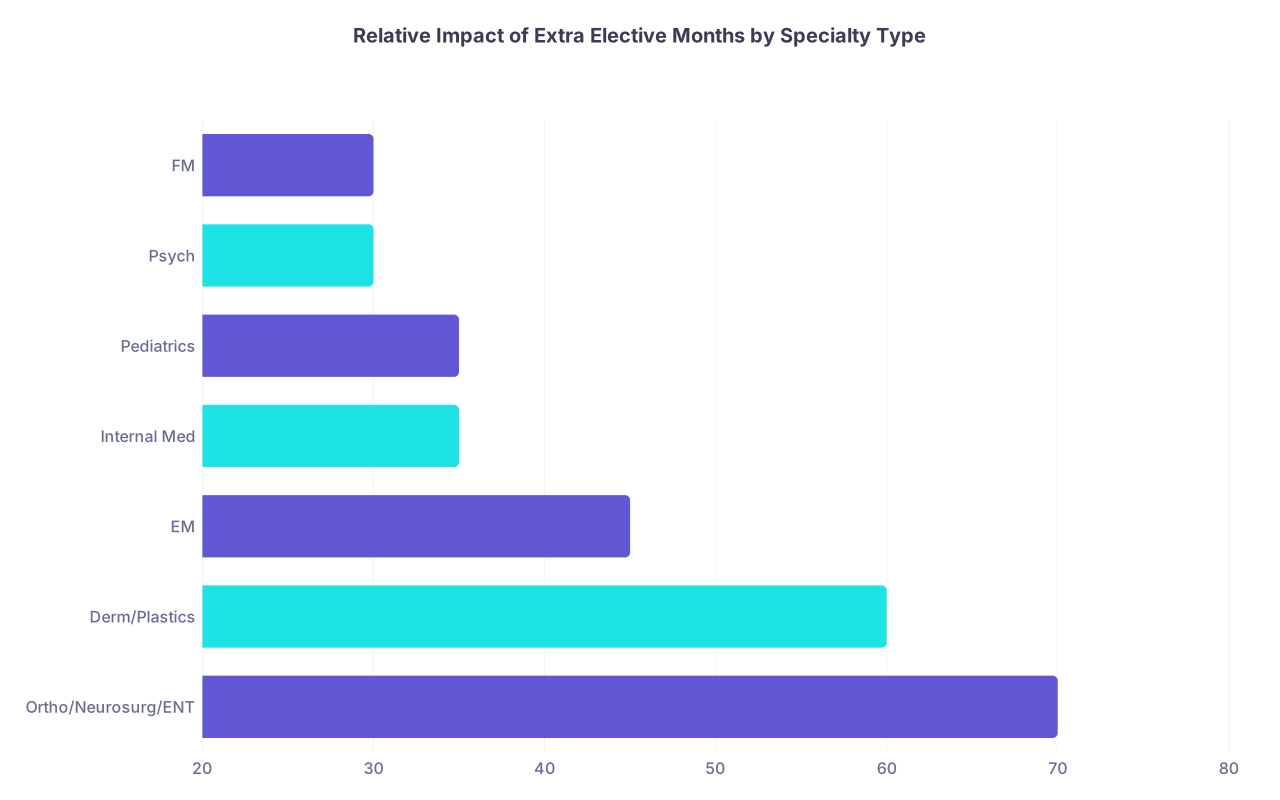
| Category | Value |
|---|---|
| Ortho/Neurosurg/ENT | 70 |
| Derm/Plastics | 60 |
| EM | 45 |
| Internal Med | 35 |
| Pediatrics | 35 |
| Psych | 30 |
| FM | 30 |
Scale (0–100) is relative “utility” of targeted electives beyond the first month, based on how strongly programs signal reliance on away/home specialty performance.
Highly Competitive Surgical Subspecialties
Think: orthopedics, neurosurgery, ENT, plastics.
Patterns I have seen:
- Most successful applicants:
- 1 home rotation in specialty
- 1–2 away rotations
- Sometimes 1 additional subspecialty or research block in the same system
But when I look at match lists and CVs, the dividing line is not 2 vs 4 specialty months. It is:
- Did they do at least one excellent audition where the program knows them well?
- Do they have 2–3 stellar letters from big names in that field?
- Are scores and research in the right range?
More months do not rescue:
- A mediocre Step 2 (for those specialties)
- Unimpressive letters
- Weak research in highly academic programs
EM, IM, Pediatrics, FM, Psych
In these fields, program director surveys consistently rank:
- Step 2
- SLOEs (for EM)
- MSPE and rotation performance
- Interview / fit
well above the number of months spent.
In EM specifically, doing more than 2 EM rotations (typically 1 home, 1 away with SLOE) rarely improves odds. Many EM programs have openly said this in forums and advising:
- 2 SLOEs are ideal
- 3rd SLOE is sometimes helpful if the first 2 are borderline
- A 4th or 5th EM month is almost always overkill
In IM and peds, extra electives in the same field are generally less predictive of match success than:
- Honors in medicine/peds clerkships
- Step 2 performance
- Strong narrative comments in MSPE
So, two high-quality months are enough. Beyond that, most programs interpret marathon specialty stacking not as dedication but as questionable advising.
Letters of Recommendation: The Real Mechanism
The real reason people believe more electives help is simple: letters.
A strong, specific letter in the target specialty has outsized impact. Meta-level, a letter that says:
“We will be recruiting this student heavily. Top 5% of students I have worked with in the last 10 years. Functions at the level of an intern.”
moves rank position more than any marginal 10–15 Step-2 points would.
Electives are how you generate those letters.
But here is the catch:
The probability of a great letter does not climb infinitely with more months. It depends more on:
- Interacting with attendings who actually write detailed letters
- Being on services where residents/attendings care about teaching
- Rotating at programs likely to rank you if they like you
An extra month in a low-yield environment (overcrowded team, disengaged attendings, tons of rotators) is much less valuable than:
- One month where your name is on everyone’s radar within 3 days
So, if you are going to add elective time, the data logic is:
- Maximize probability of at least one outstanding letter, not three generic letters.
- Favor different environments over repeating the same experience:
- One big academic center
- One community or different region
- Cap it once you have 2–3 high-quality letters. After that, your new bottleneck is Step 2 and interview performance.
The Hidden Cost: Impact on Step 2 and Breadth
I have seen this repeatedly: students who load up 4–5 months of one field often underperform where it matters more.
Two recurring patterns:
Step 2 lagging
- Heavy subspecialty time early MS4, little general medicine exposure
- Compressed Step 2 study window
- Step 2 ends up 5–15 points lower than it could have been with a generalist elective schedule
Residency readiness concerns
- Programs read MSPEs that say:
- “Student had limited exposure to other fields”
- “Weak exposure to ambulatory care / different populations”
- This can hurt you especially in broad fields (IM, FM, EM, peds)
- Programs read MSPEs that say:
When you convert months from general rotations to hyper-specialized ones, you:
- Lose exposure to common conditions and management
- Lose letters from non-specialty attendings who often write your best narrative comments
- Look one-dimensional on paper
From an analytic standpoint, this is bad risk management. You are increasing volatility (if your single field does not work out, you have little backup signal elsewhere) without improving the mean outcome much.
Strategic Use of Extra Months: When It Actually Makes Sense
There are narrow situations where an extra month or two in the same field is statistically defensible.
Scenario 1: Late Specialty Switch into a Competitive Field
If you pivot late into, say, ENT or ortho at the end of MS3:
- You might have zero specialty letters
- No research in the field
- No prior exposure
Here, stacking:
- 1 home elective
- 2 aways
may be necessary just to reach the baseline level your peers had a year earlier. The first two months are “catch-up,” the third is “audition insurance.”
Scenario 2: Weak Initial Letter / Performance
If your first elective in the specialty was:
- Average feedback
- No clear strong letter offer
then adding a second, clearly higher-quality environment makes sense. Your match odds will track with your best letter, not your first rotation chronologically.
You are essentially re-rolling the dice.
Scenario 3: Targeting a Very Narrow Geographic Area
If you are location-constrained (family, visas, dual-career partner) to a small region with a handful of programs, then doing:
- Home elective
- Away at top choice
- Possibly another regional away
can be rational, because:
- Those programs are more likely to rank people they know
- Your entire match strategy is regional density, not national spread
Even here, going above 3 total months in the same field rarely adds new signal.
A Simple Decision Framework
You can reduce the “how many months” question to a structured flow. Here is a simplified logic map:

| Step | Description |
|---|---|
| Step 1 | Have at least 1 core elective in target specialty? |
| Step 2 | Schedule 1 home elective early |
| Step 3 | Have 2 strong letters or realistic path to them? |
| Step 4 | Add 1 more rotation in high-yield setting |
| Step 5 | Score and research near specialty norms? |
| Step 6 | Prioritize Step 2 prep or research over more electives |
| Step 7 | Consider 1 away rotation if specialty audition-heavy |
| Step 8 | Stop at 2-3 total specialty months unless late switch or geography-limited |
The key output from this framework:
2–3 months in one field is usually the ceiling where marginal gains are meaningful.
Once you cross that, put your effort into:
- Step 2 score
- Research productivity
- Interview prep
- Backup specialty credibility
because the data say those levers move the needle more.
Putting Numbers to a Concrete Example
Take a hypothetical EM applicant:
- Step 2: 242
- 1 EM home rotation with good but not amazing SLOE
- 1 planned away EM rotation
- 2 open elective months
Option A: Add 2 more EM months (for a total of 4).
Option B: Add 1 EM-related (ICU) and 1 IM wards month.
Looking at EM match trends, SLOE guidance, and score vs match outcomes:
- Probability that a 3rd or 4th EM month changes your rank-list position materially:
- Maybe 5–10% of the time (usually when first SLOEs are borderline and you are truly re-branding yourself)
- Probability that more diverse clinical exposure improves:
- Step 2 by 5–8 points
- Performance on ICU/IM, yielding stronger general letters and MSPE comments
- Your perceived readiness for residency
That second bundle has broader effect, not just at EM programs but at prelim and backup options.
Aggregated across the whole application, Option B wins on expected value.
The same logic scales to IM, peds, FM, psych quite easily. Only in tightly audition-driven fields do more than 2–3 specialty months occasionally justify themselves, and even there, the benefit curve is steep early and flat later.
Bottom Line: Do Extra Elective Months Improve Match Odds?
Condensed to three statements:
- One to two well-chosen months in your target field are crucial. That is where you get your best letters, confirm fit, and sometimes audition at key programs.
- Beyond 2–3 months in the same field, the marginal gain in match odds is usually very small. The extra time rarely generates better letters or substantially changes program perception.
- The opportunity cost is real. Those extra months come at the expense of Step 2 readiness, broader performance, and credible backup options—factors that, when you look at the numbers, move match outcomes more than “month number four” in one specialty.
If you want to play this like a data-driven strategist rather than a nervous fourth-year, aim for enough specialty time to produce strong letters and a clear story. Then stop. The data show that over-rotating in one field is one of the least efficient ways to try to game the Match.


