

You have not wasted your clerkships. But I know it really, really feels like you did.
You’re sitting there with a transcript full of rotations tailored toward one specialty… and now your brain has decided, three-quarters of the way through medical school, “Actually, never mind, let’s do something else.”
And now the doom spiral starts.
“Did I just sabotage my own application?”
“Are programs going to think I’m flaky?”
“Did I screw my letters, my narrative, everything?”
Let’s walk through this like someone who has stayed up at 2 a.m. reading Reddit horror stories and FREIDA entries. Because I have.
The harsh truth first: programs aren’t building your life story from your MS3 schedule
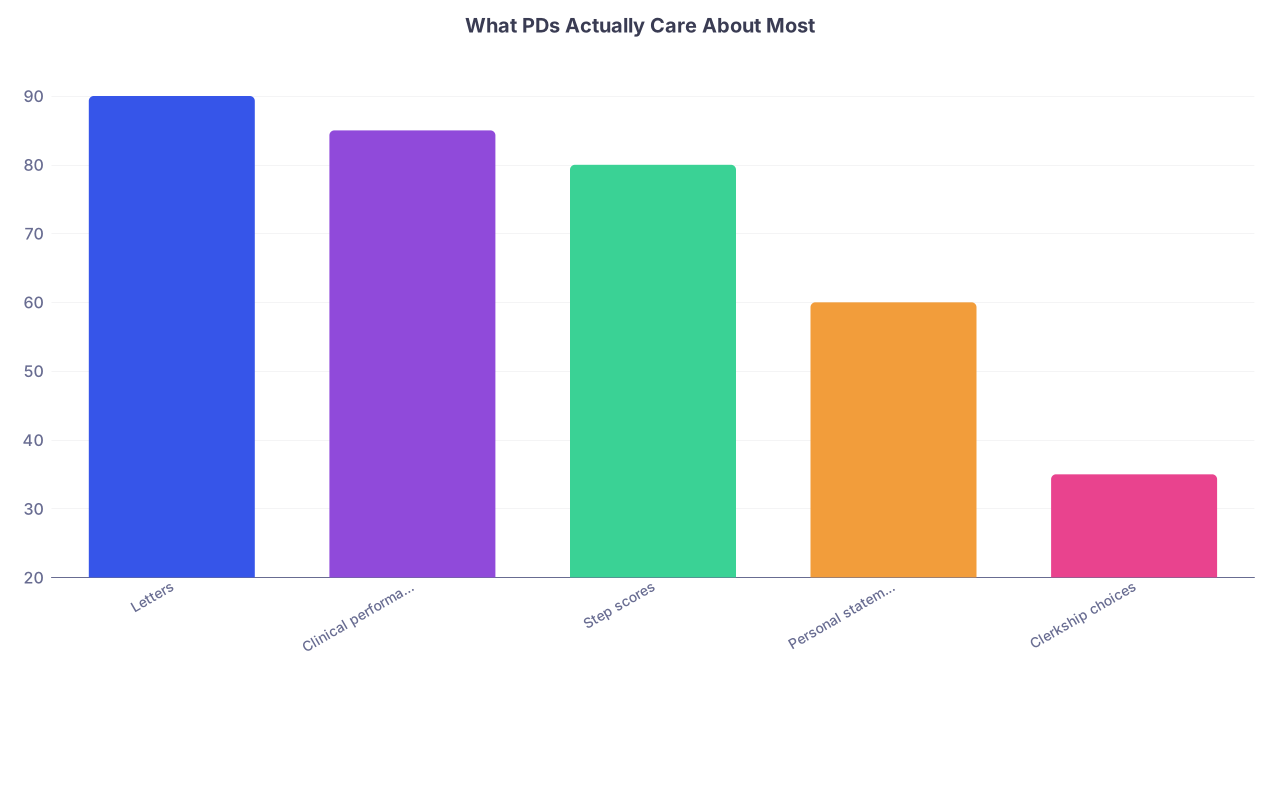
| Category | Value |
|---|---|
| Letters | 90 |
| Clinical performance | 85 |
| Step scores | 80 |
| Personal statement | 60 |
| Clerkship choices | 35 |
Residency program directors are not sitting there thinking, “Why did this person do an extra month of surgery if they’re applying to psych? Suspicious. Reject.”
They’re asking much more basic questions:
- Are you safe to put in front of patients?
- Do other physicians trust you and like working with you?
- Do you actually know what this specialty is like, beyond a TikTok and one shadowing day?
- Can you tell a coherent, believable story about why you’re here?
Your clerkships don’t have to be perfectly aligned for you to answer those questions well.
The ugly part no one says out loud: lots of us figure it out “late.” MS3 is not some magical deadline. I’ve seen people switch:
- From surgery → psych in August of MS4
- From peds → EM after audition rotations
- From OB/GYN → family med when they realized they hated the OR schedule
They still matched. Not because their path was perfect. Because they could explain it.
No, your clerkships aren’t wasted – here’s how they actually help you
The “wasted” feeling usually comes from this fantasy version of other applicants:
They knew they loved derm since birth, did derm research in utero, tailored every rotation to derm, and now they’re writing a personal statement about how every moment of medical school was intentional and linear.
Reality: that’s not how most people’s applications look.
Your clerkships matter in ways that don’t depend on perfect specialty alignment.
1. They prove you can function on a team
ICU, surgery, OB, psych, whatever — they all test your ability to:
- show up on time
- follow patients
- write notes
- not piss off the nurses
- present without completely falling apart
Every specialty wants that.
A neurology PD doesn’t care that your sub-I was gen surg as much as they care that:
- You got strong comments about owning your patients
- You have a letter saying you worked hard and improved
- You didn’t crumble when things got stressful
You can absolutely say:
“I thought I wanted X, so I pursued deeper experiences there. Those months taught me how to own patient care, communicate in high-stress situations, and manage complex [whatever]. Ultimately, I realized I’m more drawn to Y because [specific things].”
That’s not a red flag. That sounds like growth.
2. They give you stories and skills you can reframe
You’re worried about the mismatch. You should be mining it.
Example: You thought you wanted surgery. Now you want internal medicine.
You can say:
- “On surgery I realized I was more excited about untangling the patient’s complex CHF, DM, and CKD than I was about the case itself.”
- “I loved following patients post-op on the floor, adjusting meds, talking through long-term plans.”
Suddenly your “wrong” rotation is your origin story for why you switched.
Same with psych → family med:
“I loved understanding the psychiatric piece, but I kept wishing I could manage their diabetes and hypertension too, and be there long-term. That’s what pulled me to FM.”
Programs like that explanation way more than, “I always knew I wanted this and never doubted it.” Because that second one? Often sounds fake.
But what about letters, aways, and “not enough time”?
This is the part that really spikes anxiety:
“Did I figure this out too late to build a competitive application?”
Let’s break it down.

You don’t need your entire MS3 transcript to scream your specialty
For almost every field (except like super-competitive ones — think plastics, derm, maybe ENT), you mainly need:
- A couple of stronger-aligned experiences in your new interest
- At least one solid letter from that area
- A believable explanation for the pivot
You don’t need:
- 6 rotations in your new field
- A perfectly clean, hyper-specialized schedule
- To hide that you were interested in something else before
If you’re early MS4 or late MS3, here’s your damage-control-but-not-really-damage plan:
- Get one solid, recent clinical experience in your new field (sub-I, elective, AI, or at least a focused 2-4 week block).
- Get at least one letter from that experience.
- Make sure your personal statement and ERAS experiences clearly show why now this field makes sense.
- Use other letters that vouch for your work ethic and clinical skills, even if not perfectly aligned.
But my letters are from the “wrong” specialty
You’re imagining a PD reading your application and going:
“Hmm, a surgery letter for a psych applicant? Immediate trash.”
No. If the letter says:
- You work hard
- You care about patients
- You learned quickly
- You’re safe and reliable
That’s a good letter. Period.
I’ve seen surgery letters used for psych, peds letters used for EM, internal med letters used for anesthesia. As long as you also have one letter from your chosen field, the others are there to show consistent behavior across environments.
If your only letters are from your old interest and you’re early enough, prioritize getting one from the new field. Just one.
The narrative problem: “Won’t they think I’m indecisive or flaky?”
This is the part that lives rent-free in your head.
You picture the interview:
“So you did all these X rotations… why are you applying to Y now?”
And your brain: “Because I’m unstable and impulsive and will probably regret this next year too?”
Here’s the thing — programs see three kinds of “switch” stories:
- Mature pivot – “I thought I wanted A, I explored it thoroughly, realized B fit me better for concrete reasons, here’s how I know.”
- Vague drift – “I don’t know, I liked everything, so I just kind of went with this.”
- Panic switch – “I didn’t get interviews in A so now I’m applying to B without really knowing what it is.”
You’re terrified they’ll assume you’re #3. Your job is to show them you’re #1.
That means you:
- Name what you liked about the old specialty (shows you’re not just trashing it to justify yourself).
- Name what specifically pulled you to the new one (patient population, scope, tempo, procedures vs longitudinal care, etc.).
- Connect your prior experiences to strengths you’ll bring into the new field.
An honest response can sound like:
“I went into MS3 thinking I wanted surgery. I loved the acuity and the team atmosphere, and that’s why I did extra time on those services. But what surprised me was how much more engaged I was following patients on the floor, working through their medical issues, and discussing their long-term management with families. I realized I was more drawn to that continuous, diagnostic thinking. That’s when I started seeking out more internal medicine experiences, and once I did my sub-I in medicine, it clicked that this is where I actually fit.”
That’s not flaky. That’s self-awareness.
What if I’m switching into a competitive specialty?
This is the one exception where timing really does matter more.
If you’re switching into something like derm, ortho, ENT, plastics, rad onc, neurosurgery late in the game with:
- no research
- no letters
- no electives
- and it’s already late MS4
…then yeah, that’s rough. I’m not going to sugarcoat it.
But even then, your clerkships aren’t “wasted.” They’re either:
- A foundation for a more intentional re-application year, or
- Evidence to support a parallel plan (e.g., you pick a more attainable specialty you actually also like)
In competitive fields, the bigger issue isn’t the “wasted” rotations; it’s the missed time for building a portfolio in that specialty. That’s a different question than “did I ruin everything.”
If you’re in that boat, the grown-up move is to sit down with:
- A trusted advisor who actually knows match data (not just vibes), and
- A resident or fellow in that field at your school
Lay out your exact timeline, scores, experiences, and ask plainly:
“Is this realistic this year, or should I plan for research / transitional year / another path?”
That conversation will suck. But it’ll give you actual data instead of your brain’s catastrophe fanfiction.
The quiet truth: most clerkships feel “wrong” in hindsight and that’s normal
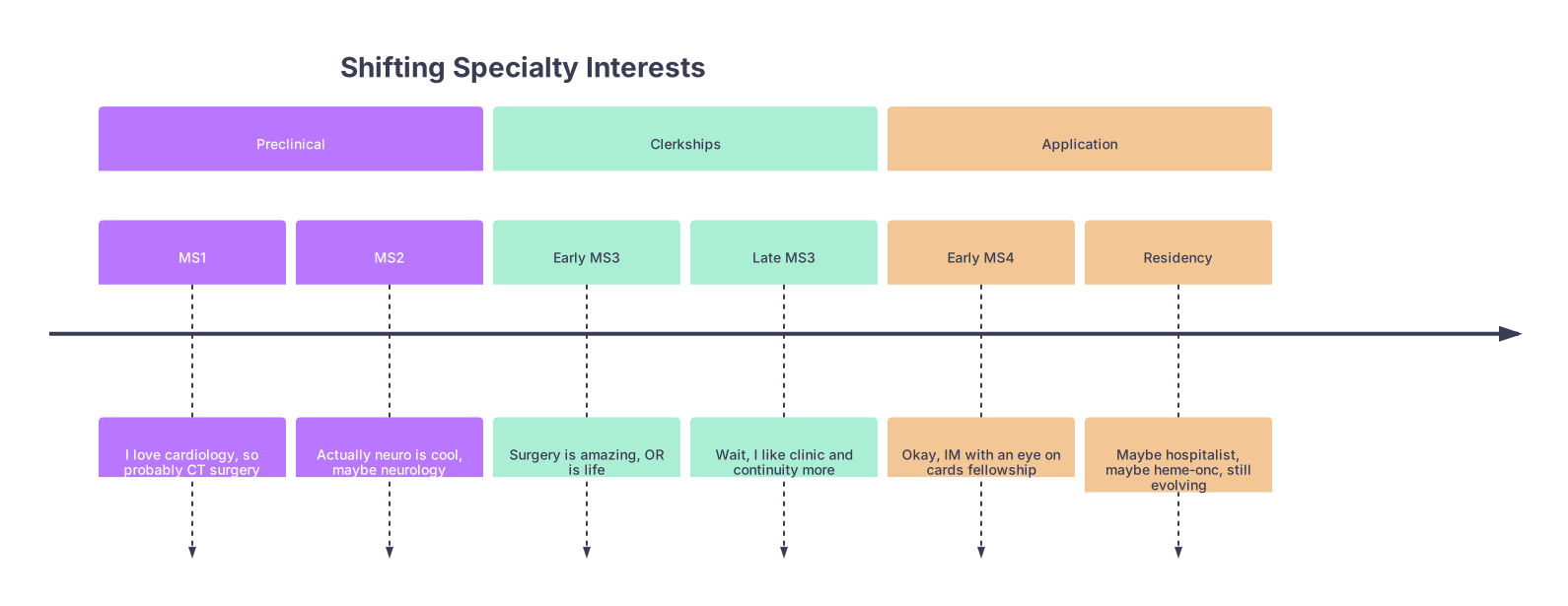
| Period | Event |
|---|---|
| Preclinical - MS1 | I love cardiology, so probably CT surgery |
| Preclinical - MS2 | Actually neuro is cool, maybe neurology |
| Clerkships - Early MS3 | Surgery is amazing, OR is life |
| Clerkships - Late MS3 | Wait, I like clinic and continuity more |
| Application - Early MS4 | Okay, IM with an eye on cards fellowship |
| Application - Residency | Maybe hospitalist, maybe heme-onc, still evolving |
Everyone rewrites their own history by the time they match.
The anesthesia resident who swears they “always loved physiology and pharmacology”?
Realistically, they probably flirted with EM, IM, even surgery at some point.
You’re just catching yourself mid-story, before you’ve retrofitted everything into a neat narrative. That’s why it feels chaotic.
What matters for the match is not that every rotation was “on brand.” What matters is:
- You can show you thrived in real clinical environments
- You can point to at least one or two concrete experiences that pulled you toward your chosen specialty
- You can show that you understand what you’re signing up for
Your clerkships helped you figure out who you are not as a future doctor, which is just as important as who you are.
That’s not wasted. That’s literally what MS3 is for.
How to use your “wrong” clerkships to strengthen your application
Here’s how you turn this from a liability into a flex:
- Mine your old-interest rotations for stories that highlight skills valued in your new specialty: communication, patience, resilience, working with certain populations, procedural comfort, or longitudinal follow-up.
- In your personal statement, don’t erase your original interest. Briefly acknowledge it, then show the pivot: what changed, what you noticed, what felt different in the new field.
- In your ERAS entries, frame those rotations in terms of your growth, not your indecision. “This experience clarified that I’m most energized by X, which I’ve pursued further through Y.”
- In interviews, answer the “Why this specialty now?” question calmly, like it’s not a big scandal. Because to them, it isn’t.
You’re not confessing a crime. You’re describing a decision.
A quick sanity check: when would clerkships actually hurt you?
There are only a few scenarios that consistently raise eyebrows, and they’re not about switching interests — they’re about behavior.
Red flags look more like:
- Repeated professionalism concerns on different rotations
- Pattern of poor evaluations without improvement
- Burning bridges in multiple departments
- Not being able to clearly describe any sustained interest in what you’re applying to
Notice how none of that is: “Did extra OB before realizing I wanted psych.”
Your brain is catastrophizing the wrong thing.
What you can do this week to feel less like everything is ruined
If you want something concrete:
Email someone in your chosen specialty at your school (clerkship director, advisor, friendly attending) and say:
“I was originally leaning toward X and did [these rotations], but over MS3 I’ve become increasingly drawn to Y for [reasons]. I’d love 15 minutes of your time to sanity check my plan for MS4 and letters.”Make a mini inventory of all your clerkships. For each one, write 1–2 sentences:
- What did I actually like here?
- What did I discover I don’t want long-term?
- What skill from this will help me in my chosen specialty?
Open your personal statement draft (or a blank doc) and write the “pivot paragraph”:
4–6 sentences explaining:- Old interest
- What you valued there
- The moment(s) that pulled you toward new interest
- How your previous experiences make you a better applicant for the new field
That exercise alone will calm a lot of the “I’ve wasted everything” panic, because you’ll literally see that you haven’t.
FAQ (Anxious Edition)
1. Will programs judge me for having multiple electives or a sub-I in a different specialty than the one I’m applying to?
No. They’ll judge you if you come off disorganized, unprepared, or unable to explain your path. A sub-I in another specialty can still be a strong positive if it shows you handled high responsibility, workload, and complex patients. Just make sure you also have some experience in the field you’re applying to and can articulate why you chose it over the other.
2. Should I hide my previous interest in my personal statement and just pretend I always wanted this specialty?
Don’t. That kind of revisionist history sounds fake and actually makes you look less self-aware. A concise, honest explanation (“I started out drawn to X for these reasons, but found myself increasingly fulfilled by Y because…”) is more compelling and believable. The key is not to dwell on the old interest — acknowledge it, then focus the majority on why you’re choosing this specialty now.
3. Are letters from other specialties weaker than letters from my chosen field?
Not automatically. A glowing letter from a non-aligned field that says you were one of the best students they’ve worked with is way better than a lukewarm letter from your chosen specialty. Ideal mix: at least one strong letter from your new field plus 1–2 excellent letters from anywhere that show consistent work ethic and clinical strength.
4. Is it better to take another year to realign everything (research, more rotations) or just apply now with what I have?
It depends on your specialty’s competitiveness, your Step scores, and how late you switched. For most core fields (IM, peds, FM, psych, anesthesia, OB, EM at many places), you can usually apply in your original year as long as you get at least one aligned rotation and letter. For very competitive specialties or if your application is already borderline, a research or additional clinical year might be smart — but decide that after talking to real advisors, not just based on your anxiety.
Open your ERAS activities list or CV right now and, next to each “misaligned” clerkship, write one sentence about how it made you a better future [your chosen specialty] resident. You’ll see pretty quickly: the story isn’t “I wasted everything.” It’s “I actually built more than I thought — I just need to tell it right.”


