

The way most schools run clerkships is brutal if you have a chronic health condition. You are not weak. The system is badly designed.
You’re in clinicals, your health flares, and suddenly you’re trying to decide between taking care of your body and not tanking your evaluations or your residency application. That’s the actual situation. So let’s talk about what to do, step by step, not in theory.
Step 1: Get Very Clear On Your Limits Before The Rotation Starts
Do this before you’re drowning on surgery weeks, not after.
Sit down, away from the chaos, and answer these concretely:
- How many hours can you realistically work in a day without triggering a flare the next day?
- What specific tasks are high-risk for you? (prolonged standing, lifting >20 lbs, N95 all day, overnight call, high sensory environments, frequent hand scrubbing, etc.)
- What happens when you push past your limits? (ER visit? 3-day crash? Migraine that wipes you out?)
- How much recovery time do you need if you do have a bad day?
Write this down in plain language. Example:
- “I can stand/walk for about 4–5 hours cumulatively; after that my pain spikes and the next day is mostly lost.”
- “I get migraines triggered by fluorescent lights and sleep deprivation; if I do an all-nighter, I’m usually useless for 24–48 hours.”
- “I have an autoimmune condition. When I get an infection (respiratory, GI, whatever), I’m often out for a week.”
Why this matters: When you talk to your school or clerkship directors, vague descriptions (“I get tired”) get brushed aside. Specific patterns and triggers get taken seriously. You’re not asking for pity—you’re describing functional limitations, which is what drives accommodations.
Do not skip this step. If you do not know your limits, you will overpromise and pay the price in health and evals.
Step 2: Decide Your Disclosure Strategy Now, Not in Crisis
You don’t have to tell everyone everything. But you do need a deliberate plan.
Think of three layers:
- Institutional disclosure (Disability/Student Affairs)
- Structural disclosure (Clerkship director / coordinator)
- Local disclosure (Residents/attendings you work with)
1. Institutional disclosure
If your condition meaningfully affects your ability to do standard rotations as written, you should talk to disability services or student affairs. Not because you want drama, but because:
- They can put formal accommodations in your file.
- They can quietly communicate with clerkship directors so you’re not renegotiating from scratch every time.
- They can help you reschedule or rearrange when things go sideways.
If you’re afraid of being labeled “difficult,” remind yourself: programs cannot legally discriminate against you for having a documented disability. They will discriminate against unexplained “unreliable behavior” (no-shows, frequent sick days, chronic lateness).
If your school’s disability office is useless (many are), still get something documented—emails, letters from your doctor, etc. It gives you leverage later if an eval is unfair.
2. Structural disclosure
This is the “I need certain conditions to safely complete this rotation” level. You do not owe anyone your full medical chart. You do need to describe functional limits.
Example script for a clerkship director:
“I have a chronic health condition that is being managed with my physician and the school’s disability office. I’m fully committed to meeting the core objectives of the clerkship. I do need a couple of predictable accommodations: specifically, I am unable to safely do 28-hour call, and I need one fixed afternoon a week for medical appointments. I’ve talked with student affairs and they said these are reasonable within school policy. Can we discuss how to structure my schedule so I can still meet your expectations?”
Keep it short. Calm. Practical. You are not asking for special treatment; you’re organizing your work so you can actually perform.
3. Local disclosure
Residents and attendings do not need your diagnosis. They need to know what they can count on and where they should not put you.
A resident-friendly version:
“Just a heads up so I don’t blindside you—I have a chronic medical issue that affects my stamina. I’m fully cleared to work, but I may need to sit occasionally or step out briefly when pain spikes. I’ll always let you know, and I’ll still take care of my patients and follow up on my work. If anything ever seems off, please tell me directly.”
If someone pries: “It’s something I’m already managing with my doctor and the school. Functionally it just means X, Y, Z for me on service.”
That’s it. You’re allowed to have boundaries.
Step 3: Choose Clerkships and Electives to Protect Your Health and Your Application
If you’re in 3rd year and early 4th, the question is: how do you survive required rotations and still build a strong residency story?
Let’s be blunt. Some rotations are more punishing than others, and some are easier to modify without destroying your eval.
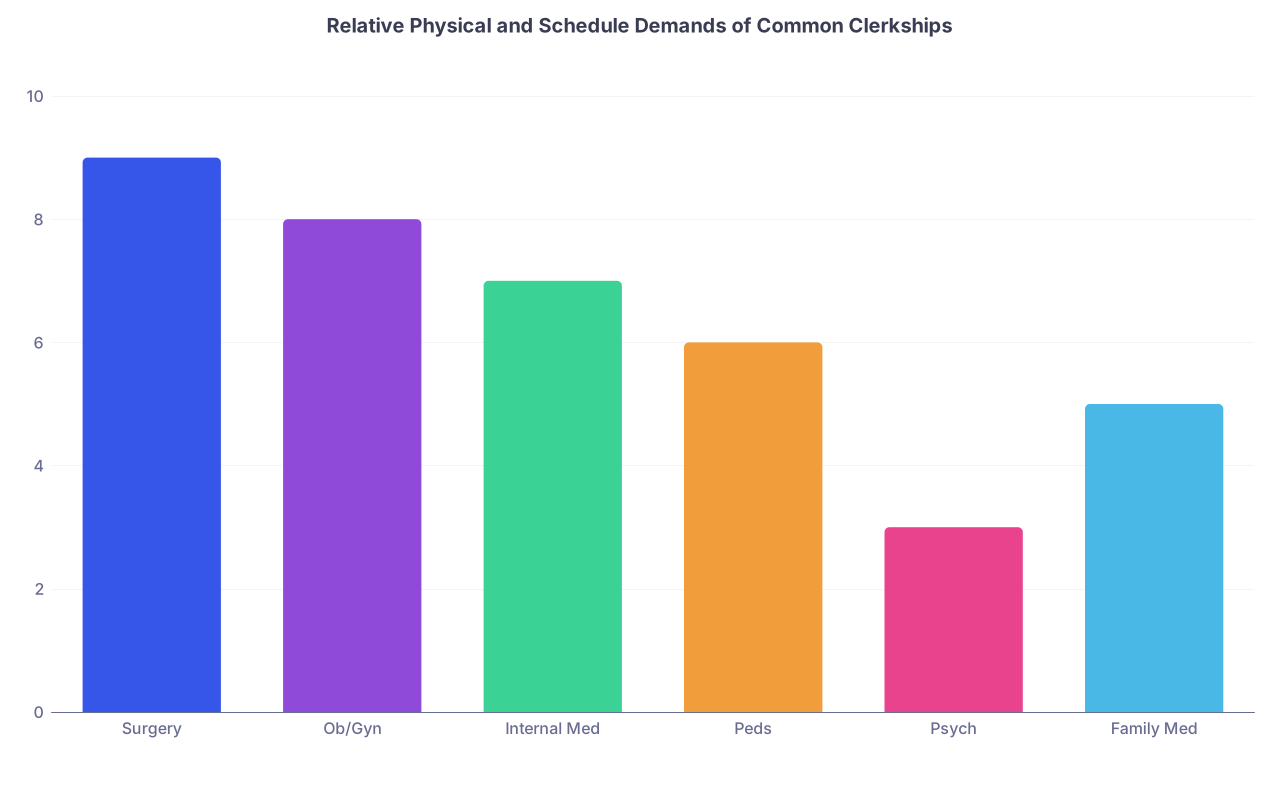
| Category | Value |
|---|---|
| Surgery | 9 |
| Ob/Gyn | 8 |
| Internal Med | 7 |
| Peds | 6 |
| Psych | 3 |
| Family Med | 5 |
(10 = most demanding schedule/physical intensity, 1 = least. Obviously your institution may vary, but this rough ranking holds in many places.)
Strategy for core clerkships
Schedule the worst ones when you’re medically most stable.
If your condition flares in winter, do not schedule surgery in January if you can avoid it. Trade with classmates. Beg the coordinator. This is not about gaming the system; it’s about reducing predictable harm.Cluster or space out?
- If your condition is “good until it isn’t” (occasional catastrophic flares): avoid back-to-back brutal rotations. You need buffer for recovery.
- If your baseline is low but steady: sometimes grouping heavy rotations while you’re in “grind mode” works, giving you lighter months later.
Plan rest and outpatient-heavy months before key application deadlines.
For residency applications, you need to be functional during:- Step 2 CK studying/taking
- Writing your personal statement
- Submitting ERAS
- Early away rotations (if you’re doing them)
Stack less physically demanding rotations (Psych, outpatient FM, Radiology electives) around these blocks.
Electives that help match and protect your body
You want electives that:
- Generate strong letters
- Show continuity in your chosen field
- Are not physically destructive for you
For example, if you’re aiming for Internal Medicine but can’t tolerate crazy call:
- Sub-I in Internal Medicine at your home institution (non-ICU if possible)
- Outpatient subspecialty elective (Rheumatology, Endocrinology, GI clinic-heavy rotation)
- Research elective where you’re working with a future letter writer
If you’re considering a competitive specialty but have physical limits (e.g., Ortho with back issues), you need a reality check conversation early with:
- A trusted attending in that specialty
- Your dean or advisor
- Your own physician (Are the physical demands of this specialty realistically sustainable?)
Sometimes the answer is “you can do it, but you’ll pay for it.” Sometimes it’s “you’ll destroy yourself by 40.” Better to know earlier while you still have options.
Step 4: Lock in Formal Accommodations Before Evaluations Get Ugly
Verbal “yeah that’s fine” from a clerkship director is not protection. Attendings forget. Residents rotate off. One salty evaluation can haunt you.
You want:
- Official letter or record from disability/student affairs describing your approved accommodations in functional terms (no diagnosis needed).
- Email to clerkship coordinator/director before the rotation starts confirming:
- Call limitations (no 28-hour calls, max 24 hours per week of call, no nights, etc.)
- Clinic schedule adjustments (fixed appointment times for treatments/dialysis/infusions)
- Physical limitations (cannot lift >20 lbs, must be able to sit intermittently, cannot scrub for >X hours, etc.)
Concrete example email:
“Per my standing accommodations with the school, I am approved for the following: no 28-hour call shifts; protected time Wednesday afternoons for medical appointments; the ability to sit intermittently during long OR cases. I’m committed to fulfilling all patient care and educational responsibilities within those parameters. Could you confirm this is okay from your end or let me know if we should adjust the schedule accordingly?”
That last sentence is key. You’re showing you’re trying to solve a logistics problem, not dodge work.
If a director pushes back with “everybody does 28-hour call in this rotation,” you respond with:
“I understand the standard structure. The accommodations were approved at the institutional level after review of my medical documentation. I’m asking for help figuring out how to meet the core objectives within these approved limits. If needed, I can loop in student affairs so we’re aligned.”
You are not arguing medical details. You’re asking them to coordinate with the people whose job it is to handle that.
Step 5: Day-to-Day Survival Tactics On Service
Here’s the unpolished reality of clerkships with a chronic condition.
Manage your energy like a scarce currency
You do not get to spend energy like your classmates. Pretending otherwise never ends well.
On a high-demand day, think in terms of “non-negotiables” and “optional extras”:
Non-negotiables:
- Seeing your assigned patients and writing your notes
- Following up on labs, imaging, and plans
- Being present and engaged on rounds
Optional extras (that help evals but can be dropped when you’re crashing):
- Scrubbing into that 4th add-on case
- Staying late just to “be seen”
- Volunteering for every presentation when you’re fading
On good days, do a bit more. On bad days, keep your core responsibilities solid and quietly drop the extras. Residents mostly care that they can trust you, not that you’re the most hyper-available student.
Use micro-breaks without looking disengaged
You can step out briefly without looking like you’re abandoning ship, if you frame it well.
Phrases that work:
- “I’m going to run to the restroom before the next case—do you need anything from me before I step away?”
- “I need to quickly sit and finish my note; I’ll be at the workroom computer if you need me.”
- “I’m starting to get lightheaded; I’m going to sit for a couple of minutes but I’ll keep following the labs on Mr. X.”
Then actually follow through. When you return, quick update: “Labs on Mr. X are back; creatinine improved.”
You’re training your team to see you as self-monitoring and responsible, not fragile and vanishing.
Have a flare protocol ready
You should not be deciding what to do in the middle of a 9/10 pain crisis.
Write your own “flare protocol” now:
- Symptoms that mean “keep working but throttle down”
- Symptoms that mean “tell the resident you need to step out for 15 minutes”
- Symptoms that mean “you’re done for the day, go home / urgent care / ER”
And decide in advance:
- Who do you tell first if you must leave? (Senior resident, chief, clerkship coordinator)
- What is your exact sentence?
Something like:
“I’m sorry—I’m having an acute flare of a chronic condition and I’m not safe to continue working. I need to leave and seek medical care. I’ve finished my notes on X and Y; Z is pending. How would you like me to hand off what’s left?”
Then you email the clerkship coordinator the same day (or next morning if you’re truly wrecked):
“Yesterday I had an acute flare of my chronic medical condition and had to leave service early after handing off my tasks to the senior resident. I’m following up with my physician. I’m documenting this absence and will keep you updated if it affects my ability to return.”
Paper trail. Calm tone. You’re controlling the narrative.
Step 6: Protecting Your Evaluations and Narrative for Residency
The constant fear: “My health will make my evals look bad, and that will kill my application.”
Let’s break this down.
Anticipate the common eval landmines
Students with chronic conditions often get dinged for:
- “Not always present”
- “Less stamina than peers”
- “Occasional lateness or absence”
- “Less time in the OR / on nights”
You want offsets in the narrative:
- Consistently strong knowledge base
- Strong communication with patients and team
- Reliable follow-through on assigned tasks
- Professionalism and insight about your own limits
Make it easy for attendings to write that about you. Spell it out in their language:
“One of the things I’m working hard on is making sure that even if I occasionally have to step away for medical reasons, my work is always complete and you can count on me for my patients. If you have any feedback on how I’m doing with that, I’d really appreciate it.”
Some will shrug. Some will actually notice and write it.
Do you put the condition in your personal statement?
This is tactical, not philosophical.
You should consider including it if:
- Your condition clearly shaped your path (career choice, advocacy, research).
- You can show resilience and professionalism without playing the “inspiration” card.
- It explains specific things in your record (medical leave, an extra year, delayed Step, scattered clerkships).
You should be cautious about including it if:
- You’re applying to a hyper-competitive field with limited interview spots and you have other red flags.
- You’re not ready to answer follow-up questions without getting emotional or defensive.
- Your main message would be “look how hard my life is,” instead of “here is how I function as a future resident.”
A strong framing sounds like:
“Living with a chronic autoimmune condition through medical school forced me to learn triage long before I set foot in the hospital—triage of energy, time, and expectations. I could not brute-force my way through 28-hour calls or ‘just push through’ recurrent flares without consequences. Instead, I learned to communicate early, protect patient care from my bad days, and design systems that worked even when I did not feel at my best. That same discipline shapes how I approach residency…”
Notice: it’s about how you work, not a request for sympathy.
Step 7: Matching Into Residency Without Destroying Yourself
You’re not just trying to match. You’re trying to match somewhere you can survive.
Here’s where you get ruthlessly honest.
Be strategic about specialty and program type
Harsh truth: some fields and some programs will be structurally hostile to your physiology. Others will not. You need to look at:
- Call structure (night float vs 28-hour call)
- Culture (machismo “we never call in sick” vs actual coverage systems)
- Outpatient vs inpatient balance
- Program size (larger programs can absorb your occasional absence more easily)
| Feature | Better For You |
|---|---|
| Call model | Night float vs 28-hour traditional |
| Program size | Medium–large (more coverage options) |
| Schedule transparency | Published, predictable rotations |
| Outpatient time | Significant clinic blocks |
| Culture signals | Wellness initiatives that actually exist |
Ask residents direct questions on interview day (or by email later):
- “How does the program handle residents who get sick or have a temporary medical issue?”
- “If someone needed an occasional half-day for a medical appointment, how is that usually handled?”
- “Have any residents trained here with a chronic health condition or disability? How did that go?”
If they dodge, or laugh it off, that tells you a lot.
How much to disclose to programs
Before you match:
- You are not obligated to disclose your condition unless it affects licensing or core requirements.
- You are allowed to ask questions that indirectly test whether they can accommodate you.
After you match:
- You’ll likely need to work with GME and occupational health to formalize any accommodations.
- The earlier you start that process (before July 1), the smoother your intern year will be.
A Realistic Mindset Shift
Let me be blunt: the system is not built for you. That does not mean you cannot thrive in it. It means you stop playing on “hard mode” voluntarily when you don’t have to.
You are not failing when you:
- Use official accommodations
- Ask to modify call schedules
- Build an application that leans into outpatient or research strength
- Choose a program partly because it will not wreck your body
That’s not weakness. That’s basic risk management.

| Step | Description |
|---|---|
| Step 1 | Chronic condition in clerkships |
| Step 2 | Clarify limits |
| Step 3 | Contact disability office |
| Step 4 | Plan clerkship schedule |
| Step 5 | Email clerkship directors |
| Step 6 | Use day to day tactics |
| Step 7 | Monitor evals and feedback |
| Step 8 | Shape residency narrative |
| Step 9 | Screen programs for fit |

FAQs
1. What if I’m scared accommodations will hurt my residency chances?
Here’s the reality: programs cannot legally access your disability files from med school. What they will see is your transcript, your grades, any leaves of absence, and your letters. Unexplained absences and poor professionalism comments hurt you more than quietly using formal accommodations that kept you functional and reliable. You’re trading invisible chaos for visible structure. That’s a good trade.
2. How do I handle a supervisor who clearly thinks I’m “faking it” or lazy?
Document and redirect. After a problematic interaction, email them (cc the clerkship coordinator if needed): “To clarify from today—I do have a chronic medical condition that the school has approved accommodations for, including [functional description]. I’m committed to meeting all clerkship requirements within these limits. If you have concerns about my performance, I’d appreciate it if you could share them so I can address them.” If the behavior continues, bring student affairs or disability services into the loop with specific examples. Do not argue about your symptoms directly with a hostile attending; use process and policy.
3. Should I avoid surgery and other physically intense rotations entirely?
You usually cannot skip core requirements, but you can be tactical. Do surgery when you’re most stable, shorten longer electives, choose services with less brutal call if your school allows choice (e.g., more outpatient-heavy subspecialties), and use accommodations (sitting during long cases, adjusted call). If your body absolutely cannot tolerate the baseline demands even with accommodations, that’s data about career fit that you should not ignore.
4. How do I explain gaps or a leave of absence in my residency application?
Keep it short, factual, and future-focused in your ERAS application or a brief program signals note: “I took a medical leave during my second year to manage a chronic health condition. During that time, I worked with my physicians to stabilize my treatment, and since returning I’ve completed my clinical rotations without further interruption.” You don’t need to give diagnoses. You do need to show that the problem has been addressed and you can handle residency demands.
5. What if my condition worsens in 4th year—do I still apply this cycle?
You need an honest assessment from three people: your treating physician, a trusted faculty advisor, and yourself. If your condition is unstable enough that you’re missing big chunks of rotations or barely making it through days, it’s often smarter to delay your application, stabilize, and build a stronger, more consistent record. Yes, it feels awful to wait. It feels worse to start residency already drowning and then wash out. One extra year is nothing compared to a 30–40 year career.
Key points:
- Get crystal clear on your functional limits and lock in formal accommodations early—verbal “understandings” are fragile.
- Build your clerkship and elective schedule around both your health realities and your residency goals; you’re allowed to prioritize survivability.
- Protect your narrative: handle flares with a plan, communicate like a professional, and choose programs where your body and career both have a fighting chance.


