
What actually matters more for your residency application: crushing your medicine clerkship or nailing your surgery rotation?
Let me be direct: for most students, the internal medicine clerkship has more downstream impact on your residency application than the surgery clerkship. But that’s not the full story—and if you’re even considering surgery or any procedure-heavy field, your priorities shift fast.
Let’s break this down like someone who has watched way too many rank lists and dean’s letters come together.
The Real Question: What Are You Aiming To Match Into?
You cannot answer “medicine vs surgery first” without answering “what specialty am I actually targeting (or realistically considering)?”
Here’s the rule of thumb:
If you’re leaning toward:
- Internal Medicine (and subspecialties)
- Family Medicine
- Pediatrics
- Neurology
- Psych
- EM (most places)
→ Prioritize doing well on Internal Medicine and, if possible, scheduling it earlier than later.
If you’re leaning toward:
- General Surgery
- Ortho
- ENT
- Plastics
- Urology
- Neurosurgery
- OB/GYN (borderline but more procedural culture)
→ Your surgical performance and surgical letters matter more. That might mean pushing surgery earlier, and making sure you’re ready to perform at a high level when you hit it.
But that’s the specialty-focused answer. You also care about Step 2, MSPE, and letters. And those are where medicine often quietly wins.
How Medicine vs Surgery Affect Your Match “Profile”
Think about your application as four big pillars: scores, narrative, letters, and specialty fit.
| Factor | Medicine Clerkship | Surgery Clerkship |
|---|---|---|
| Step 2 CK prep | High | Moderate |
| MSPE narrative weight | Very High | High |
| LOR usefulness (non-surg) | Strong | Moderate |
| LOR usefulness (surg) | Moderate | Critical |
| Breadth of evals | Broad | Narrower |
1. Step 2 CK Impact
Internal medicine is the exam clerkship. The way attendings think, the way problems are framed, the way you’re forced to integrate path, pharm, and management—that’s Step 2 in real life.
If you need:
- A strong Step 2 to compensate for a weaker Step 1 or MCAT
- To boost your app for semi-competitive fields (EM, anesthesia, neuro, etc.)
Then having Internal Medicine before Step 2 is smart. It gives you:
- Better clinical reasoning reps
- Repeated exposure to bread-and-butter: CHF, COPD, DKA, sepsis, ACS, cirrhosis, etc.
Surgery? You’ll see plenty of peri-op medicine, but the day-to-day focus is not the Step 2 blueprint.
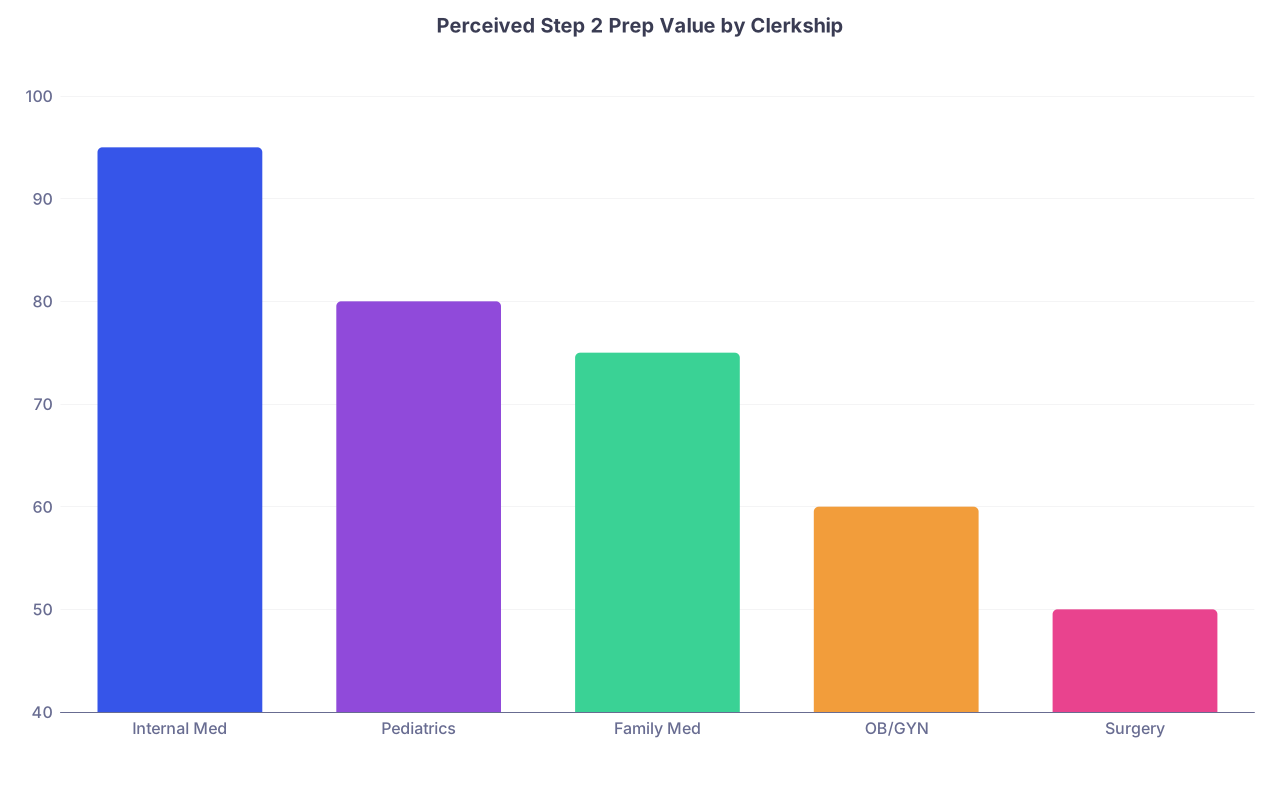
| Category | Value |
|---|---|
| Internal Med | 95 |
| Pediatrics | 80 |
| Family Med | 75 |
| OB/GYN | 60 |
| Surgery | 50 |
2. MSPE (Dean’s Letter) and Narrative Comments
Most schools give extra weight to core rotations like medicine and surgery in the MSPE. But the tone differs:
Medicine notes:
- Clinical reasoning
- Reliability
- Teamwork
- Independence with patient care
Programs read these very carefully for ANY cognitive specialty.
Surgery notes:
- Work ethic
- Grit
- Time management
- Response to hierarchy and stress
For non-surgical fields, a great medicine write-up tends to carry more narrative weight than a great surgery write-up. If your medicine comments say “functions at intern level, outstanding clinical reasoning, team repeatedly praised…”—that helps across almost every non-surgical specialty.
Timing Strategy: Which One Should Be Earlier?
You don’t just care which one is “more important.” You care which to do when.
Here’s the reality:
- Early rotations shape your Step 2 prep and your early letters.
- Later rotations may be too late for ERAS if your school has a slow letter pipeline.
If You’re Undecided
If you truly don’t know your specialty yet (and you’re not secretly set on ortho or neurosurg):
- Aim to do Internal Medicine early-ish (within your first 3 core rotations if you can).
- Put Surgery somewhere in the middle, not dead last.
- Avoid stacking your first three rotations with the highest-intensity blocks (like Surgery + OB/GYN back to back) unless you thrive on chaos.
This way:
- You boost Step 2 with early medicine.
- You leave room to recover and improve after an early tough rotation.
- You get feedback and clarity before audition/sub-I season.
If You’re Leaning Medicine or a Cognitive Field
Then the answer is simple:
- Try to get Internal Medicine as early as you can handle it without drowning.
- Use it as a foundation for:
- Step 2 success
- Strong medicine letter
- A solid “anchor” evaluation in your MSPE.
Surgery still matters—especially if your school/department writes detailed evaluations—but it becomes secondary for match impact.
If You’re Leaning Surgery or a Surgical Subspecialty
Now everything flips.
You want:
- Surgery earlier in the year
- Time afterward for:
- Away rotations/sub-Is
- Second surgical experience
- Improved performance once you “learn the culture”
Why earlier?
- Your surgical letter often comes from your core surgery clerkship or a very early sub-I.
- Programs in surg fields care a lot about:
- Work ethic
- Grit
- Operating room behavior
- How you handle feedback and hierarchy
A late surgery clerkship means any issues or missed growth don’t have time to be corrected before you need letters.
Letters of Recommendation: Which Clerkship Helps More?
This is where people screw up their thinking.
For Non-Surgical Specialties
Most of the time:
- A strong medicine letter is more reusable and widely respected than a surgery letter.
If you’re applying to:
- Internal Medicine: obviously medicine letter is king.
- EM: they care a lot about EM letters, but a medicine letter is often more informative than a surgery one.
- Psych, Neuro, FM, Peds: a good medicine letter helps. A generic surgery letter is… fine, but often fluffier.
Typical medicine letter phrases that help:
- “Outstanding clinical reasoning”
- “Always knew her patients in detail”
- “Trusted to preround and present accurately”
- “Sought feedback and incorporated it quickly”
Typical generic surgery letter phrases:
- “Hard worker”
- “Shows up early and stays late”
- “Well liked by team”
- “Great attitude in the OR”
You see the difference.
For Surgical Specialties
Here, surgical letters are everything.
You need:
- At least 1–2 strong letters from:
- Core surgery attendings
- Sub-I / away rotation attendings
Medicine letters help as secondary support: “not just a workhorse, also smart and safe.” But if you’re serious about surgery, you do not sacrifice your core surgery performance for a slightly better medicine grade.
Grades and Honors: Where Does It Move the Needle Most?
If your school has tiered evaluations (Honors/High Pass/Pass), you’re probably wondering which one “matters more to honor.”
Reality check:
Programs look at:
- Pattern: Are you consistently strong, or is it all over the place?
- Key blocks: Medicine, Surgery, OB/GYN, EM (for some), Sub-Is.
For non-surgical fields:
- Honors in Medicine + strong comments = big win.
- Honors in Surgery = nice, but less predictive of your specialty’s performance (unless you’re going into EM or anesthesia, where procedural skills matter too).
For surgical fields:
- Honors in Surgery is almost expected at strong programs.
- A Pass in Surgery with “okay” comments can really hurt at the top-tier programs, even with a great medicine grade.
Bottom line: if you can only “max out” one (because of energy, timing, Step studying), bias toward medicine unless you’re in the surgical lane.
How Each Rotation Shapes Your Clinical Identity
This part people underestimate.
Medicine rotation:
- Teaches you to be “the doctor who knows the whole patient.”
- Heavy emphasis on notes, presentations, problem lists, diagnostic thinking.
- You learn to live with uncertainty and time.
Surgery rotation:
- Teaches you to prioritize fast, actionable thinking: sick vs not sick, OR vs no OR.
- You learn discipline, time management, and how to operate (both literally and figuratively) in high-intensity environments.
Both shape how attendings talk about you later—on committees, in letters, on the phone.
I’ve seen this enough: a student described as “excellent on medicine, dependable and thoughtful, borderline on surgery because of pace and hierarchy discomfort” does fine in IM/psych/FM/EM matches.
The reverse—“nonchalant on medicine, less thorough, but decent in the OR”—is a bigger problem unless they’re saved by very strong surgical mentors.
How to Decide: A Simple Framework
If you’re stuck:
Ask yourself, honestly:
“If I had to submit my rank list tomorrow, would it be mostly medicine-like or surgery-like fields?”If medicine-like:
- Try to place Internal Medicine in your first half of the year.
- Protect that block with:
- Reasonable life stress
- No huge external exams immediately before/after if possible.
If surgery-like:
- Get Surgery in the first half, with at least one block after it before away rotations.
- Plan to:
- Crush it.
- Get to know attendings early.
- Ask for letters before the rotation ends.
If totally lost:
- Lean medicine earlier; it’s more generalizable.
- Be fully present on surgery; it might surprise you and open another path.

| Step | Description |
|---|---|
| Step 1 | Start |
| Step 2 | Schedule Surgery early |
| Step 3 | Schedule Medicine early |
| Step 4 | Undecided |
| Step 5 | Medicine in first half |
| Step 6 | Surgery mid year |
| Step 7 | Secure surgical letters |
| Step 8 | Use Med for Step 2 prep |
| Step 9 | Leaning surgical field |
| Step 10 | Leaning cognitive field |
Practical Scheduling Tips (No Fluff)
A few hard-earned pointers:
- Don’t put Surgery as your first ever clerkship if:
- Your school has a steep “hidden expectations” culture.
- You’re not great at adapting cold to a new environment.
- Don’t bury Medicine as your very last core before ERAS. You want time to:
- Get the eval summarized in your MSPE
- Request a letter
- Avoid taking Step 2 right before Surgery if you know you’ll be exhausted. Surgery needs stamina.
- If your school offers “prelim style” wards (heavy inpatient medicine): take them before Step 2 if you need score improvement.
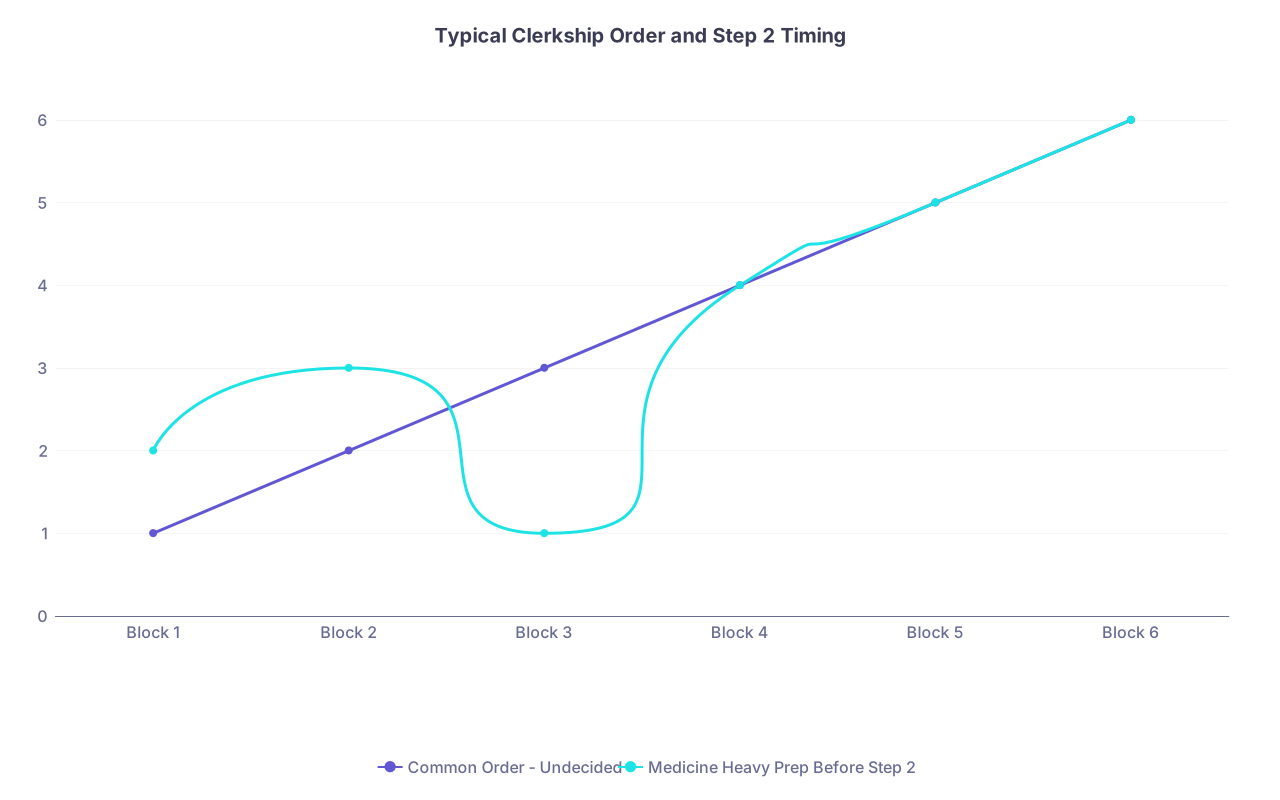
| Category | Common Order - Undecided | Medicine Heavy Prep Before Step 2 |
|---|---|---|
| Block 1 | 1 | 2 |
| Block 2 | 2 | 3 |
| Block 3 | 3 | 1 |
| Block 4 | 4 | 4 |
| Block 5 | 5 | 5 |
| Block 6 | 6 | 6 |
(Here “1” = Surgery, “2” = OB, “3” = Peds, “4” = Psych, “5” = FM, “6” = Medicine in a hypothetical scheme—point is: medicine drifts earlier when Step 2 matters.)
So, Should You Prioritize Medicine or Surgery?
Direct answer:
If you’re aiming for non-surgical fields:
Prioritize Internal Medicine—earlier if possible, and treat it like your flagship rotation.If you’re aiming for surgical fields:
Prioritize Surgery—earlier in the year, and orient your letters and sub-Is around it.If you’re truly undecided:
Slight bias toward an earlier Medicine rotation for Step 2 and broadly useful narrative, with Surgery not dead last and taken seriously.
FAQ (Exactly 5 Questions)
1. If I’m applying EM, should I prioritize medicine or surgery?
EM programs usually want strong EM letters plus evidence that you can handle acute care and complex decision-making. A strong medicine rotation helps your Step 2 and shows you can manage complex inpatients. Surgery shows you can work hard in high-acuity environments. If forced to choose, I’d prioritize medicine earlier for exam prep, then EM rotations and letters, with surgery kept solid but secondary.
2. Will a mediocre surgery grade hurt my match in non-surgical fields?
If the narrative is still decent and the rest of your transcript is strong, it usually won’t sink you. A Pass in Surgery with reasonably positive comments is not a death sentence for IM, psych, FM, peds, or neuro. It becomes concerning only if it’s part of a pattern: multiple core passes with lukewarm narratives.
3. How early is “too early” to schedule Internal Medicine?
If it’s literally your first clerkship and you’ve never presented a patient, it can be a steep climb. I like medicine as 2nd or 3rd rotation for most students: you’ve learned basic workflow, but it’s still early enough to shape your Step 2 prep and overall clinical identity.
4. Do residency programs actually compare my medicine vs surgery grades directly?
They look at the pattern. For non-surgical programs, a strong medicine grade with compelling comments carries more weight than your surgery grade. Surgical programs, especially competitive ones, pay very close attention to the surgery grade and letters and may care less if medicine is slightly weaker as long as it is not concerning.
5. If I had a rough medicine rotation, can a great surgery rotation “cancel it out”?
Not exactly, but it can rebalance the narrative. Committees read context. If comments show growth, improved performance on later rotations, and strong letters, they won’t fixate on one early medicine misstep. For surgical fields, a standout surgery clerkship and sub-I can outweigh a mediocre medicine performance. For non-surgical fields, you may need to prove yourself with later inpatient-heavy rotations or a strong Sub-I in that specialty.
Key points to leave with:
- For most non-surgical paths, an early, strong Internal Medicine clerkship does more for your Step 2, letters, and narrative than surgery does.
- For surgical paths, your Surgery rotation (and letters from it) is critical—get it early enough to learn, improve, and secure strong support.
- If you’re undecided, lean toward medicine earlier but treat both rotations as high-stakes; they anchor how programs see you as a future resident.