
It’s July. You just opened your final evaluation from core clerkship and your stomach drops. “Below expectations” in professionalism. A few “needs improvement” comments. Maybe even a pass when everyone around you seems to be getting honors. And now you’re asking the right (painful) question:
Should you repeat this clerkship to fix it, or accept the hit and move on?
Let me be direct: repeating a clerkship is a big move. It can help in very specific situations, and it can backfire if you do it for the wrong reasons or without a plan. The real decision is not just “repeat vs move on” – it’s “what gives you the best shot at your residency goals with the least collateral damage?”
Here’s how to think about it like an adult, not a panicked MS3.
Step 1: Figure Out How Bad the Damage Actually Is
Do not decide anything until you understand the real impact of that evaluation.
You need answers to three questions:
- Is this a pattern or a one-off?
- Does this block graduation or promotion?
- Will this obviously threaten residency applications in your target specialty?
Talk to three people as soon as possible:
- Your clerkship director
- Your student affairs / dean of students
- If you know it already, your specialty advisor (e.g., IM faculty if you’re aiming for IM)
Go into those meetings with specific questions, not vague “How bad is this?” anxiety. Ask:
- “How is this recorded on my transcript and MSPE?”
- “Will programs see ‘repeat’ or ‘remediation’ explicitly?”
- “How often do students with a similar evaluation successfully match?”
- “In prior years, what have students in this situation done – repeat or not?”
You are trying to sort your situation into one of four buckets:
| Impact Level | Description | Typical Risk |
|---|---|---|
| Cosmetic | Slightly weaker narrative, still passing | Low |
| Concerning | Clear weakness but no fail | Moderate |
| Structural | Triggers remediation/probation | High |
| Career-Threatening | Fail in core, professionalism concerns | Very high |
If it’s “cosmetic,” you almost never repeat. If it’s “career-threatening,” you almost never just move on without a formal fix.
Step 2: Understand When Repeating a Clerkship Actually Makes Sense
Repeating a clerkship is most useful in three narrow situations:
1. You Failed or Were Required to Remediate
If you failed the clerkship or were flagged for serious professionalism issues, you usually do not have a choice. The school will require a repeat or remediation.
In that case, the question changes from “repeat vs move on” to:
- “How do I make this repetition a narrative asset instead of a permanent red flag?”
Programs care less that you failed once, and more about what happened next. I’ve seen this play out multiple times:
- Student fails surgery for repeated lateness and missed notes
- Required to repeat; meets weekly with a faculty mentor, documents improvement
- Second rotation eval: “Dramatic improvement. On time, prepared, actively solicits feedback”
- MSPE explicitly describes the growth arc
That student matched into a solid community general surgery program. Not because the failure vanished, but because the repetition provided clear evidence of change.
If your school is already requiring a repeat, you lean in and treat it like a performance rehab, not a box-check.
2. The Clerkship Is Critical for Your Chosen Specialty
Example: You want ortho, and the bad evaluation is in surgery. Or you want OB/GYN, and you got a weak OB/GYN clerkship with professionalism comments.
In those cases, consider a repeat if:
- The evaluation will clearly scare PDs in that specialty
- You have time to repeat without gutting your ability to do aways, research, or Step 2
- Your deans agree that a strong repeat will substantially improve your application
But do not kid yourself: repeating surgery in December when ERAS is already in won’t rescue an ortho application for that same cycle. Here, timing matters.
If you are early in MS3 and genuinely planning that specialty, a strong repeat can:
- Give you a better home department reputation
- Help you earn a better letter from someone who’s seen you after the “low point”
- Provide a concrete “I fixed it” story for interviews
If you are late MS3 or already in MS4 when this hits, you’re more likely to:
- Move on
- Double down with strong sub‑Is and letters
- Address the issue directly in your dean’s letter and interviews
3. The Evaluation Suggests a Core Professionalism Problem
If your eval has words like:
- “Dishonest”
- “Unreliable”
- “Unprofessional behavior”
- “Concerns about patient safety”
That is not a “just move on” situation. That follows you.
Here, repeating the clerkship can be the controlled environment where you:
- Demonstrate consistent professionalism
- Show that whatever triggered the issue is now fixed (e.g., you addressed a mental health issue, fixed time management, etc.)
- Generate explicit positive professionalism comments to counterbalance the prior ones
Programs forgive clinical weakness more easily than professionalism. A repeat that produces strong professionalism language can be worth more than another elective in whatever shiny field you like.
Step 3: When You Should NOT Repeat – Even If You’re Tempted
Here are situations where repeating is usually a bad idea.
1. You’re Chasing Honors / Perfectionism
Scenario: You got “Pass” in Medicine but you wanted Honors. Comments are fine, maybe “a bit quiet on rounds,” “could read more,” nothing toxic.
Do not repeat for this.
Residency PDs don’t care that you got one Pass instead of Honors. They care about trends, pattern of behavior, and obvious red flags. Trading months of time and schedule flexibility just to raise a grade from Pass to Honors is almost always a losing trade.
Use that time for:
- A strong sub‑I with an outstanding letter
- Dedicated Step 2 CK prep
- Targeted electives in your specialty that lead to real advocacy
2. It Delays Graduation or Compresses Your Application Year Too Much
If repeating means:
- Pushing graduation back a year, and
- Your deans say that’s not actually necessary for graduation or accreditation issues
Then you think very hard before agreeing.
Residency programs don’t automatically love delayed graduation without a very strong, explainable reason (serious health, family responsibilities, research year, etc.). “I repeated a clerkship to try to upgrade my grade” is not compelling.
The hidden costs of delaying or compressing:
- Less time for aways or sub‑Is in your chosen specialty
- Less flexibility if something else goes wrong (another bad eval, life event, illness)
- Increased burnout heading into ERAS, when you should be sharp
3. The Problem Is Not Fixable by Repeating
If your poor evaluation was driven mostly by:
- Personality clash with one attending
- Chaotic site with bad teaching structure
- Weird one‑off situation (e.g., family crisis mid‑rotation)
Repeating the same clerkship may not fix anything. In that case, the better move is:
- Get really strong evaluations on subsequent rotations
- Collect letters that clearly contradict the bad narrative
- Have your dean explicitly contextualize that one clerkship in the MSPE
Residency PDs know some rotations are dysfunctional. They don’t expect a perfect record.
Step 4: How This Looks to Residency Programs
Programs see three main things related to this:
- Transcript / grade trend – P vs HP vs Honors, any “repeat” notations
- MSPE narrative – What your school writes about that clerkship and any remediation
- Letters and later performance – Do later evaluations agree or clearly show improvement?
Broad rules:
- One weak clerkship in an unrelated field, surrounded by solid performance → usually fine, no repeat needed.
- One poor core clerkship in your target specialty, with no later evidence of improvement → problem.
- A failure or professionalism issue with a clearly successful repeat and strong later performance → concerning but survivable, especially outside hyper‑competitive fields.
Programs think in patterns. Your job is to engineer a pattern that says: “Had a rough rotation. Took it seriously. Improved. Stable since.”
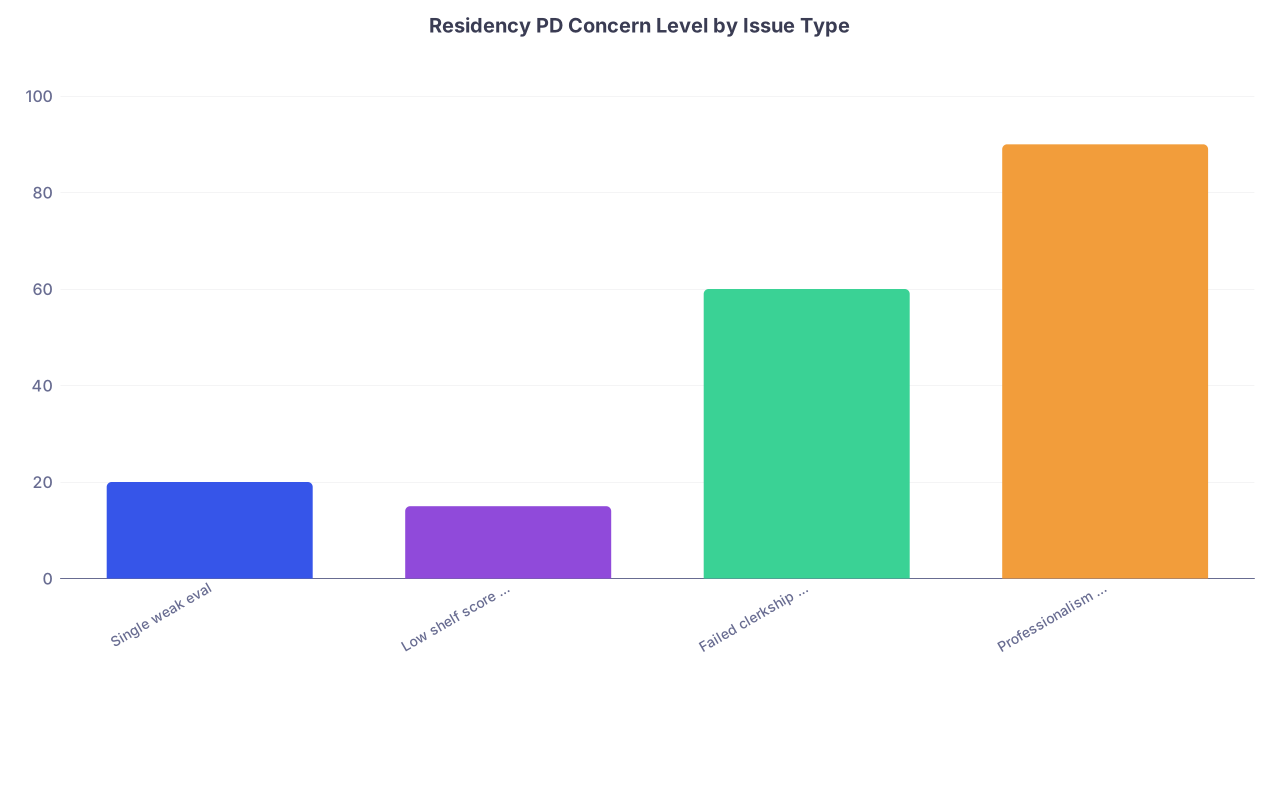
| Category | Value |
|---|---|
| Single weak eval | 20 |
| Low shelf score only | 15 |
| Failed clerkship remediated | 60 |
| Professionalism concern unaddressed | 90 |
Step 5: A Simple Decision Framework
Use this as a fast sanity check.

| Step | Description |
|---|---|
| Step 1 | Poor Clerkship Evaluation |
| Step 2 | Repeat or remediate as required |
| Step 3 | Strongly consider repeat with plan |
| Step 4 | Move on - build strength with subI and letters |
| Step 5 | Fail or required remediation? |
| Step 6 | Target specialty core? |
| Step 7 | Early enough to repeat without delaying or compressing? |
| Step 8 | Serious professionalism concerns? |
If you land in the “consider repeat” box, that’s when you sit with your dean and specialty advisor and get specific about timing, sites, and goals.
Step 6: If You Do Repeat – How to Make It Actually Help You
If you’re going to repeat, then it has to change the story, not just the grade.
You need:
- A written plan with your dean or advisor
- A faculty mentor on that clerkship who knows your history and is invested in your improvement
- Clear targets based on prior eval (“less defensive with feedback,” “improve note quality,” “be more proactive with patient ownership”)
Do three concrete things:
- Meet with the clerkship director before day 1 and say, “Here’s what went wrong last time; here’s what I’m actively working on.” That shows maturity.
- Ask for mid-rotation feedback and write it down. Then visibly act on it.
- At the end, ask one senior person, “Would you feel comfortable writing in my record that you’ve seen specific improvement in X, Y, Z?” You want that language.
Then you make sure your dean knows the details, so the MSPE doesn’t just say “Student repeated clerkship and passed,” but “Student repeated clerkship and showed clear improvement in reliability and communication, as documented by faculty.”
Step 7: If You Don’t Repeat – How to Contain the Damage
Say you decide to move on. Fine. Then you need a containment plan.
Here’s what that looks like:
Crush the next 2–3 core rotations.
No more “meh” evals. You show up early, know your patients cold, read nightly, ask for feedback.Choose sub‑Is strategically.
Do at least one sub‑I in your target specialty at your home program. Aim for a letter from someone who can say, “I would trust this student as an intern.”Address the issue head-on with your dean.
Tell them exactly what happened, what you’ve changed, and what evidence proves it. You want them comfortable advocating for you when PDs call.Have a 20-second explanation ready for interviews.
You don’t lead with it. But if asked, you say something like: “On my [X] clerkship, my evaluation reflected real issues with [specific thing]. I was defensive with feedback and not great at time management. I worked on those by [concrete actions]. On my later rotations, you’ll see comments like [quote from later eval]. It was a painful but important learning point.”
That answer is honest, concise, and shows growth. No rambling. No blaming.
Comparing Your Options: Repeat vs Move On
| Option | Pros | Cons |
|---|---|---|
| Repeat Clerkship | Chance to show clear improvement; can repair narrative in core/target specialty; may satisfy remediation requirement | Time cost; possible delay; another chance to underperform; repeat notation visible |
| Move On | Preserve schedule flexibility; more time for sub‑Is, aways, Step 2; no extra tuition/time | Bad eval remains; less formal “proof” of improvement; harder if issue was in target specialty or professionalism |
Neither option is automatically right. The context decides.
What You Should Do Today
Right now, do three things:
- Schedule a same-week meeting with your clerkship director or student affairs dean. Bring the evaluation and ask specifically, “Would you recommend repeating, given my goals?”
- Pull out your full rotation record so far. Look for patterns. Is this truly an outlier?
- Write a short, brutal self-assessment: 3 bullet points on what you actually did poorly, and 3 bullet points on what you’ll do differently on the very next rotation.
You are not the first person to get a bad clerkship evaluation. The students who recover are the ones who treat it like a turning point, not a verdict.
Open your evaluation right now and highlight every sentence that describes a behavior you can change. That list is your playbook for the next rotation—repeat or not.
FAQ (Exactly 5 Questions)
1. Will repeating a clerkship erase the original bad evaluation from my record?
No. The original evaluation and grade usually remain in your internal record, and often the fact of a repeat or remediation appears on your transcript or MSPE. What the repeat does is give you a counterweight: a strong second evaluation plus a narrative of improvement. Programs see the whole picture, not just the repeat.
2. Is a single bad clerkship enough to keep me from matching?
On its own, usually not. A lone weak or even bad clerkship in an otherwise solid record is rarely what sinks someone. The real problems come from patterns: multiple weak rotations, recurring professionalism flags, or poor performance in your target specialty without any offsetting strengths (like strong sub‑Is, letters, or Step 2). One bad clerkship is a yellow flag, not an automatic red.
3. How does this affect competitive specialties like derm, ortho, or plastics?
In highly competitive fields, every piece of your application is under more scrutiny. A poor eval in the directly relevant core (e.g., surgery for ortho/plastics) is more damaging there than it would be in, say, family medicine. For those fields, you mitigate by: maximizing Step 2, stacking outstanding letters from sub‑Is, and, if early enough, strongly considering a repeat if your advisors think it will materially help. You do not try to “hide” it—they will see it.
4. Should I mention the bad clerkship in my personal statement?
Usually no. The personal statement should sell your strengths and fit for a specialty, not lead with your worst moment. The exception: if the clerkship ties into a larger, clear growth story that’s central to who you are now—and your advisors agree it reads as mature, not self-flagellating. More often, the better venue is the dean’s letter, and then a brief, direct answer if it comes up in an interview.
5. What if my school recommends not repeating, but I still feel ashamed of the evaluation?
Then you need to separate emotions from strategy. Feeling ashamed is human, but residency decisions are made on evidence and patterns, not your internal narrative. If your dean and specialty advisor—who’ve seen many cycles—tell you a repeat won’t materially help your application, believe them. Channel the discomfort into over-preparing for your next rotations, seeking frequent feedback, and building a track record that makes this one clerkship look like what it is: a rough patch, not your whole story.