What actually moves the needle more for residency—spending that precious 4th-year time on away rotations, or stacking more research electives on your CV?
Let me be direct: for most students, away rotations help more than extra research electives for matching at specific programs. Research helps more for matching into certain specialties or tiers. If you confuse those two, you’ll waste time and probably lose options.
Here’s how to think about it, without the usual hand-wavy “it depends” nonsense.
1. What Away Rotations Really Do (When They Work)
An away rotation is basically a 4-week, in-person audition. Programs pretend it’s an “educational experience,” but you and I both know the real deal: they’re asking, “Would I want this person as a resident at 3 a.m. on a bad call?”
When done right, an away rotation gets you:
- A strong “we know this person” signal
- A high-yield letter of recommendation
- A real shot at an interview even if your paper stats aren’t top tier
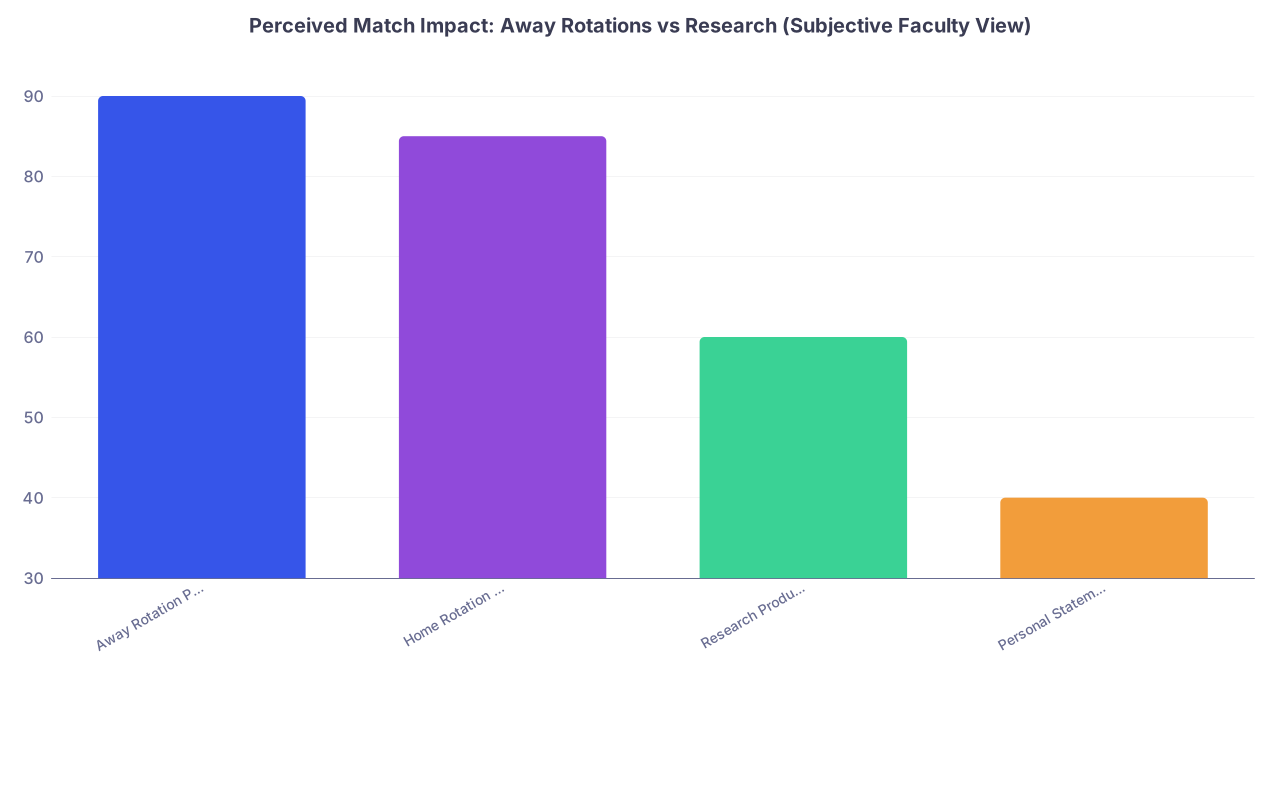
| Category | Value |
|---|---|
| Away Rotation Performance | 90 |
| Home Rotation Performance | 85 |
| Research Productivity | 60 |
| Personal Statement | 40 |
Those numbers aren’t from a randomized trial—they reflect what I consistently hear in ranking meetings and from PDs:
“Who did we actually work with?” usually beats “Who has one more abstract?”
When Away Rotations Help A Lot
Away rotations are especially powerful if:
- You’re targeting a geographic region where you have no home ties
- Your home program is weak or nonexistent in that specialty (think neurosurgery, derm, ENT at some schools)
- You’re applying to moderately or highly competitive specialties:
- Ortho, ENT, derm, plastics, neurosurg, rad onc, EM, some competitive IM programs
- You need to prove you’re better than your Step score or class rank suggests
In these cases, a strong away where residents vouch for you + an enthusiastic letter can push you from “maybe” to “interview invite” and from “mid list” to “ranked to match.”
When Away Rotations Don’t Do Much
Away rotations are overrated if:
- You’re applying to a less competitive field and already solid on paper (FM, psych, peds at many programs)
- You’re only doing them because “everyone else is” and have no specific program targets
- You treat it like a vacation month or “just another elective”
I’ve seen students blow an away by being “fine” instead of outstanding. That can actually hurt you: being forgettable is one thing; being remembered as mediocre is worse.
2. What Extra Research Electives Actually Buy You
Research electives are different. They help your application globally but often less powerfully at a single target program.
What extra research really does:
- Boosts your overall competitiveness for research-heavy specialties and academic programs
- Shows longitudinal commitment to a field (especially if multiple projects in the same area)
- Can offset a weaker Step 2 or class rank a bit in some academic places
- Helps for future fellowship applications and academic careers
Where research shines:
- Derm, rad onc, neurosurg, plastics, ENT, ortho at major academic centers
- Top-tier IM, pediatrics, anesthesia aiming for subspecialty fellowships
- When you have actual output:
- Publications
- Posters at recognizable conferences
- Abstracts you can succinctly explain without sounding lost
Where extra research electives are basically padding:
- You already have a couple of solid projects and at least 1–2 outputs
- You’re taking “research time” but the PI isn’t really hands-on and nothing will be submitted before ERAS
- You’re using research as an avoidance tactic because clinical work makes you anxious
Programs see right through the “7 research electives, 0 publications, 0 meaningful outputs” profile. It looks like delay and drift, not drive.
3. Direct Comparison: Away Rotations vs Extra Research Electives
Here’s the simple framework you actually need.
| Factor | Away Rotations | Extra Research Electives |
|---|---|---|
| Impact on specific program | Very high | Low–moderate |
| Impact across all programs | Moderate | Moderate–high (in right specialties) |
| Letters of recommendation | Very strong potential | Variable, depends on mentor |
| Importance in competitive fields | Very high | High |
| Importance in less competitive | Low–moderate | Low |
If your question is:
“Will doing an away rotation at Program X help me more at Program X than one more research elective?”
Answer: Almost always yes. Because they see you. They watch you pre-round, present, struggle, improve. You become a person, not a PDF.
If your question is:
“Will more research help me more than an away rotation for improving my chances across the whole specialty?”
Answer: For competitive specialties, often yes, especially at top academic centers—if that research is substantial and visible.
So you’re not choosing “which is universally better.” You’re choosing what you need more:
- Program-specific love → away rotation
- Specialty-wide/big-name program credibility → strong research output
4. Specialty-Specific Real Talk
Here’s where people get confused. Different fields care differently.
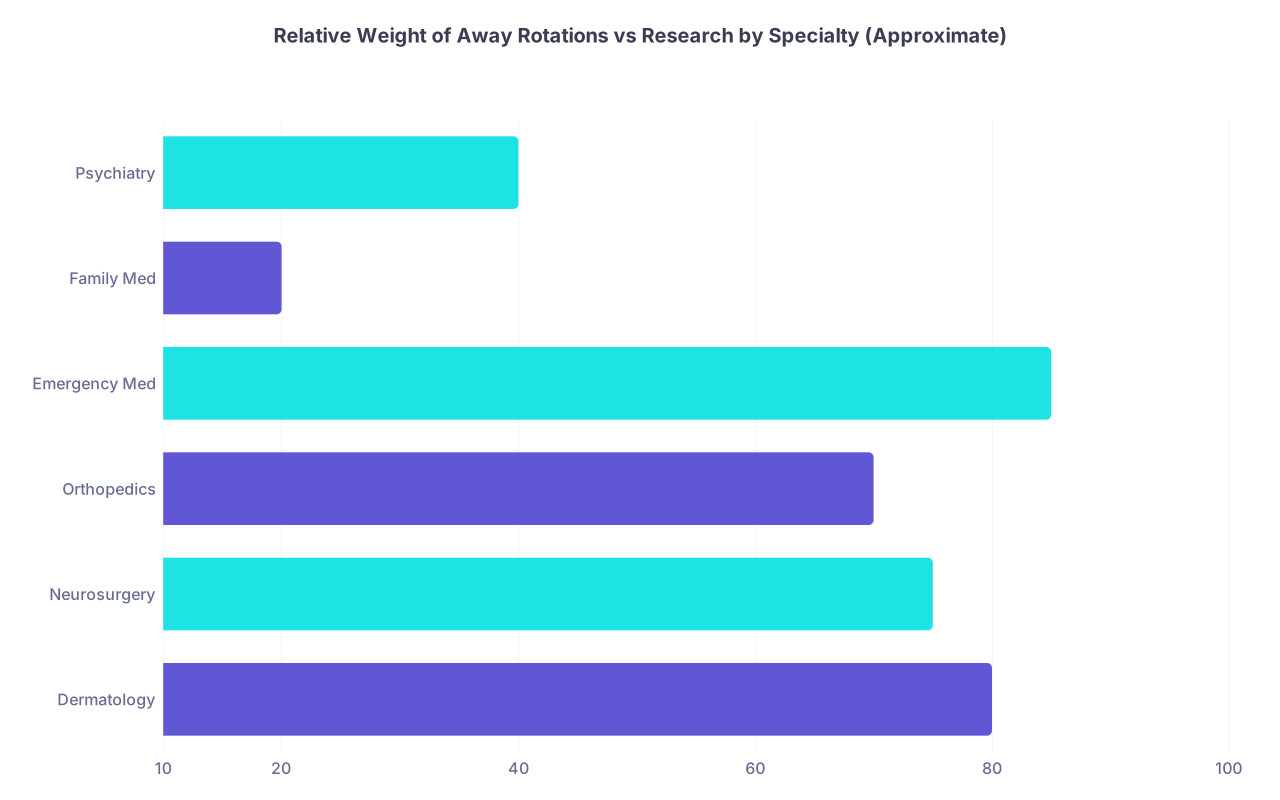
| Category | Value |
|---|---|
| Dermatology | 80 |
| Neurosurgery | 75 |
| Orthopedics | 70 |
| Emergency Med | 85 |
| Family Med | 20 |
| Psychiatry | 40 |
Explanation: higher number here = combined importance of away + research, as perceived by PDs in competitive contexts.
Now, how the balance usually plays out:
Dermatology
- Research: extremely important (papers, derm-specific work, name-brand mentors)
- Away rotations: useful, but research usually carries more weight
- Trade-off: If you already have solid derm research, an away at a target program can still be huge
Neurosurgery / Plastics / ENT / Ortho
- Research: big advantage, especially multi-year projects
- Away rotations: extremely influential; these fields are tight-knit, and “we liked working with them” goes far
- I’d rarely recommend skipping aways if you want a top or non-home program
Emergency Medicine
- Historically: aways & SLOEs (standardized letters) are king
- Research: nice but far secondary unless you’re targeting academic EM powerhouses
- If EM is your field, and you don’t have at least one away with strong SLOEs, you’re playing on hard mode
Internal Medicine / Pediatrics / Psych / FM
- Research: matters mainly for competitive academic or fellowship-focused paths
- Away rotations: helpful for geographic shifts or specific big-name programs, but not mandatory everywhere
- For most in these fields: one strategically chosen away (if at all) + some measured research beats going all-in on either extreme
Bottom line: In very competitive, small fields, you usually need both, but if forced to choose:
- To impress a specific program → away rotation
- To look good everywhere → significant research
5. How To Decide What You Should Do
Let’s make this less abstract. Use this checklist.
Choose an Away Rotation if:
- You’re switching regions and have no local connections
- Your home program in that specialty is weak or nonexistent
- Your Step 2 or grades are a bit under your target tier, but you’re strong clinically and can shine in person
- You already have:
- At least 1–2 projects
- Or 1–2 pubs/posters
- Or you’re not applying to one of the ultra-research-heavy specialties
Choose Extra Research Electives if:
- You’re targeting top-10 academic programs or highly academic careers
- You’re applying to derm, rad onc, neurosurg, plastics, ENT, or similar and your research is currently thin
- You have a concrete path to:
- A submission before ERAS
- A national poster
- Or an ongoing, clearly defined project you can talk about intelligently
Don’t Waste Time On Either If:
- The away site is a bad fit or low-yield (community hospital with no real say in your specialty)
- The research elective is loosely structured, with no realistic chance of output before applications
- You’re adding them just because you think “more is always better”
That last one is common and dumb. More entries in ERAS are not the goal. Stronger signals are.
6. How Programs Actually Use This Information
Here’s roughly how programs weigh things in real life.
You at Program X’s rank meeting, if you did an away there and performed well:
“Yeah, they were with us in August. Hard worker, good with patients, no drama, residents liked them. Let’s interview and probably rank mid-to-high depending how the interview goes.”
You with an extra research elective and no away:
“Good research profile… but we do not know them. Plenty of similar applicants. Sure, maybe interview, but they’re in the middle of the pack unless they blow us away.”
Now flip to an academic derm or neurosurg program:
Strong away, very weak research:
“Great on service, but limited research for someone who says they want academics. Might be better for a different type of program.”
Solid research, no away:
“Strong research, looks serious about academic track. If letters check out, definitely interview; rank depends on fit.”
So, do away rotations help more than extra research electives?
For getting love from a specific program: yes, nearly always.
For getting into the highest-research, most academic programs across the map: no, research often beats one extra away.
7. A Simple Decision Flow You Can Actually Use

| Step | Description |
|---|---|
| Step 1 | Choose between away or research |
| Step 2 | Prioritize away rotation |
| Step 3 | Prioritize research elective |
| Step 4 | Either is fine - 1 strategic away recommended |
| Step 5 | Competitive specialty? |
| Step 6 | Strong research already? |
| Step 7 | Need specific region or program? |
| Step 8 | Any research at all? |
That’s the logic most PDs are effectively using, even if they never write it down.
8. Practical Scheduling Advice
Rough template for a competitive applicant:
- 1–2 away rotations at realistic target programs
- 1–2 research electives only if:
- You’re behind on research
- Or you can convert that time into actual submissions or posters
- Keep at least a couple of true clinical electives where you can relax a little, but still learn and get letters if needed
For a less competitive specialty:
- 0–1 away rotation (target region or dream program)
- 0–1 targeted research block if you want academics or a future fellowship
- More time on strong, solid clinical electives where you look competent and reliable
FAQ (Exactly 5 Questions)
1. If I can only do one away rotation, is it still worth it?
Yes. One well-chosen away at a realistic, high-interest program is absolutely worth it. You don’t need three. Pick a place where your stats are within range and you’d genuinely go if they ranked you.
2. Is an away rotation risky if I underperform?
Yes, and that’s the point. A bad away can hurt more than no away. If you’re exhausted, burned out, or weak clinically, fix that first. Do not “practice” on your dream program. Use a home or earlier rotation to get your act together.
3. How much research is “enough” before I stop adding more electives?
For most competitive fields: a couple of meaningful projects and at least 1–2 tangible outputs (submitted paper, accepted poster, etc.). Once you can talk comfortably about your work on interview day and it looks coherent on ERAS, extra “filler” research electives rarely move the needle.
4. Does doing an away guarantee an interview at that program?
No. But if you’re at least within their usual academic range and you performed well, it strongly tilts things in your favor. If you weren’t offered an interview after an away, that’s usually a quiet “no, thanks.”
5. If I’m undecided on specialty, should I still do away rotations?
Usually no. Away rotations are too valuable (and too political) to use while you’re still uncertain. Use that time on home rotations and maybe some light research; once you lock in your specialty, then plan aways with intention.
Key points:
- Away rotations help more than extra research at specific programs where you rotate, especially in competitive fields.
- Extra research electives help more across the board in research-heavy specialties and at top academic centers—if the research is real and productive.
- Do not chase quantity. Chase strong, clear signals: one targeted away, and research that actually leads to output.