
You’re a few weeks out from hitting “submit” on ERAS. You’ve got one letter from your target specialty, maybe a chair letter if you’re lucky, and then… that great Internal Medicine attending who loved you on wards. Problem: you’re applying to Emergency Medicine. Or Surgery. Or Psych.
So you’re staring at your documents list thinking:
“Is this IM core clerkship letter even worth uploading? Or does it just make my app look weak?”
Here’s the answer you’re looking for.
The Short Answer: Yes, It’s Still Valuable — If It Does These 3 Things
Non‑specialty‑matched core clerkship letters absolutely can help you. I’ve seen applicants match just fine with:
- 1–2 letters in‑specialty
- 1–2 strong core clerkship letters outside the specialty
Programs are not sitting there saying, “Reject. This letter is from Pediatrics.”
They’re asking three things about every LOR, regardless of specialty:
- Does this letter come from someone credible?
- Does it tell me this person can function as an intern?
- Does it give me concrete evidence, not fluff?
If your non‑specialty‑matched core letter checks those boxes, it’s worth including. If it doesn’t, I don’t care what specialty it’s from — it’s dead weight.
So the real question isn’t “specialty‑matched vs not.”
The real question is “strong vs generic.”
What Programs Actually Want from LORs (Regardless of Specialty)
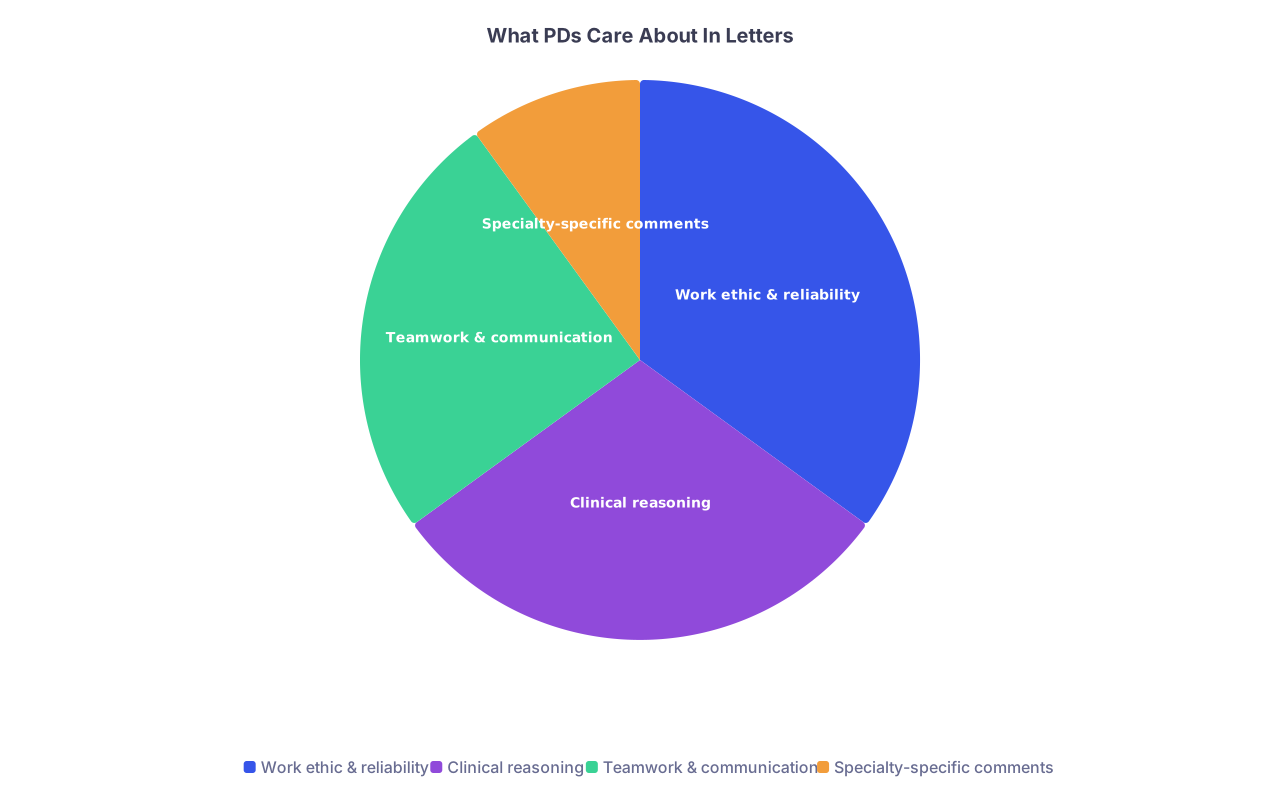
| Category | Value |
|---|---|
| Work ethic & reliability | 35 |
| Clinical reasoning | 30 |
| Teamwork & communication | 25 |
| Specialty-specific comments | 10 |
Program directors pull the same themes over and over when they talk about letters. They care about:
- Work ethic and reliability: Do you show up, follow through, own your patients?
- Clinical reasoning: Can you think, synthesize, and not be a hazard at 3 a.m.?
- Teamwork: Are you pleasant to work with or a walking HR problem?
- Professionalism: Do I have to worry about you with nurses/patients/charting?
Notice what’s not at the top of that list: “This letter must be from my specialty.”
Do they prefer some in‑specialty letters? Of course. Especially for more competitive fields. But they’d rather read a killer IM letter than a lukewarm same‑specialty letter that says nothing specific.
Typical PD thought process when reading an “off‑specialty” core letter:
- “This Peds attending says you were the best student they’ve worked with in 5 years, handled complex family meetings, and wrote notes like a PGY‑2.” → Big plus.
- “This Surg letter says you showed up and were ‘a pleasure to work with’ but gives zero concrete examples.” → Adds very little, even if you’re applying to Surgery.
When a Non‑Specialty Core Letter Helps You (And When It Hurts)
Let’s be blunt: not all core letters are created equal.
Strong situations where a non‑specialty core letter is valuable
Use that letter if:
The writer knows you well and supervised you directly
- They worked with you for a full 4–8 weeks
- They saw you with patients, on call, in different situations
- They can write, “I directly observed…”
The letter is specific and comparative
Look for phrases like:- “Top 10% of students I’ve worked with in the last 5 years”
- “Functions at the level of an intern”
- “Required minimal supervision by the end of the rotation”
- “I expect them to excel in any residency program”
It hits intern‑readiness skills
Especially valuable if it shows:- Ownership of patients
- Reliability and follow‑through
- Clear communication with nurses and consultants
- Mature handling of difficult situations (angry patient, dying child, etc.)
The specialty is relevant to your target field’s skill set
Examples:- Applying to EM: Strong IM, Surgery, or Peds letters are all directly helpful
- Applying to Surgery: IM letter that highlights your work on surgical co‑management still makes sense
- Applying to Psych: IM or Peds letter that emphasizes communication, empathy, and rapport building is highly relevant
Situations where a non‑specialty letter is basically a waste
I’d think twice (or just skip it entirely) if:
- The attending barely knows you (“worked with this student for a few days on service”)
- The letter is generic: “hardworking, pleasant, will make a fine physician” and nothing else
- The grade/honors on that clerkship was mediocre and the letter doesn’t clearly redeem it
- It’s from a very junior faculty or someone with little direct eval experience and it’s short/vague
A weak in‑specialty letter is bad.
A weak off‑specialty letter is pointless. Delete it from your list.
How Many Non‑Specialty Letters Are “Safe” to Use?
Here’s how this usually shakes out by specialty, assuming standard ERAS caps (often 3–4 letters allowed, with 3 read by many programs):
| Target Specialty Type | In-Specialty LORs | Core Non-Specialty LORs | Other (Research/Dean) |
|---|---|---|---|
| Highly competitive (Derm, Ortho, ENT, Plastics) | 2–3 | 0–1 | 0–1 |
| Moderately competitive (EM, Gen Surg, Radiology, Anesthesia) | 2 | 1–2 | 0–1 |
| Broad entry (IM, FM, Peds, Psych) | 1–2 | 1–2 | 0–1 |
Rules of thumb:
- Aim for: At least 2 letters in your specialty if possible
- Fill remaining slots with: best overall letters, even if off‑specialty
- Don’t sacrifice quality for “label matching”
Example: You’re applying to EM, allowed 4 letters.
- EM SLOE from a busy academic ED → definitely
- EM letter from community elective → likely
- IM core letter from a well‑known ward attending who adored you → very good
- Peds core letter that’s generic and short → probably skip it
I’ve seen EM programs rank someone highly with 1 SLOE + 2 strong IM/Surg letters, because the core letters screamed “this person will crush an intern year.”
How to Decide Between Two Letters: A Simple Decision Framework
You’re torn: non‑specialty core letter vs weaker in‑specialty one. Use this.

| Step | Description |
|---|---|
| Step 1 | Need letter |
| Step 2 | Use strongest core letters available |
| Step 3 | Use 2 in-specialty letters first |
| Step 4 | Use stronger core letter and 1 in-specialty |
| Step 5 | Use in-specialty despite being average |
| Step 6 | Is there at least 1 strong in-specialty letter? |
| Step 7 | Is second in-specialty letter strong and specific? |
| Step 8 | Is core letter clearly stronger? |
Blunt advice:
- One strong in‑specialty letter is better than two mediocre ones
- A truly outstanding core letter can absolutely be your second or third letter, even for competitive specialties
- If you have 3 “okay” letters and 1 “wow” core IM letter, you upload the “wow” letter. Every time.
How to Frame a Non‑Specialty Core Letter So It Helps You
You can’t control every word your attending writes. But you can guide them.
When you ask for the letter, be explicit:
“I’m applying to [specialty], but I’d really value a letter from you because you saw me in a high‑volume inpatient setting. Programs in [specialty] care a lot about clinical reasoning, teamwork under pressure, and reliability. If you feel you can comment specifically on those, your letter would be extremely helpful.”
Then provide:
- Your CV
- Your personal statement (even a draft)
- A short bullet list of 3–5 things you did on that rotation that you’re proud of:
- “Led the family meeting for the patient with new metastatic cancer”
- “Developed the workup plan for a complex sepsis patient that was adopted by the team”
- “Covered 12+ patients on call with minimal supervision”
You’re not scripting their letter; you’re jogging their memory. Good attendings appreciate that.
If your school lets you assign letters strategically, you can:
- Send your strongest generic core letters to all programs
- Reserve niche or marginal letters for fewer programs or not use them at all
Special Cases: EM SLOEs, Chair Letters, and Research Letters
Some specialties treat certain letter types almost like currency. You still need to play that game.
Emergency Medicine
SLOEs (Standardized Letters of Evaluation) matter more than almost any other letter type in any specialty. For EM:
- 1–2 SLOEs from EM rotations = gold
- After that, strong IM/Surg/core letters are very acceptable
- A great IM core letter can be your 3rd or 4th letter and still help a lot
Surgery
Surg programs like:
- Department or chair letter (if your school does them)
- At least 1 letter from a surgeon who actually worked with you in the OR/wards
- Then, strong IM core or ICU letters that show you can handle sick patients help you more than random fluff Surg letters
Research‑heavy specialties (Derm, Rad Onc, some IM subs)
Here, research mentors matter more:
- A research PI who can say you’re productive, smart, and independent can be more valuable than an off‑specialty core letter
- Don’t load your app with 3 generic core letters and no research voice if you’re trying to match Derm
How Core Clerkships Quietly Help Your Application Anyway
Even when you don’t use every letter, core clerkships shape:
- Your MSPE narrative (Dean’s letter) — programs read those comments closely
- Your pattern of performance — consistent High Pass/Honors across cores matters a lot
- Your overall “story”: eg, you loved your IM patients but gravitated toward procedures and acute care → EM or Anesthesia makes sense
So no, your time on IM or Peds wasn’t “wasted” just because you’re not going into those fields. Those attendings are your best witnesses for what you’re like on the front lines.

How to Prioritize Letters When You Have Too Many
You’ve got 5–6 potential letters and only 3–4 upload slots. Rank them like this:
- Strength and specificity of content
- Direct observation of your clinical work
- Match to your target specialty
- Seniority/reputation of the writer
If a core clerkship letter is:
- Glowing, detailed, clearly based on real observation
- From a respected core director or well‑known clinician
- Even slightly tied to skills in your specialty
…it probably belongs in your top tier.
If you’re unsure, ask someone who reads a lot of applications: specialty advisor, PD at your home program, or trusted upper‑level resident who’s been on the selection committee. Show them the text (if you have access) and your specialty target. Ask them to be brutally honest: “Top 3 or not?”
FAQs
1. If I only have one letter from my chosen specialty, should I still apply this year?
Usually yes, if:
- That one in‑specialty letter is strong
- You can back it up with 1–2 excellent core clerkship letters
- The rest of your app is reasonably competitive for that specialty
Programs know not every student can snag 3 letters in a niche specialty, especially if your school has limited faculty in that area. But don’t try this in hyper‑competitive fields like Ortho or Derm without talking to an advisor first.
2. Is a strong IM core letter better than a mediocre letter from a community elective in my specialty?
Most of the time, yes.
If the community specialty letter is vague (“pleasant, punctual, will do well”) and the IM core letter is packed with specifics and comparisons, use the IM letter. Programs are good at smelling courtesy letters that say nothing.
3. Does the clerkship grade need to be Honors for the letter to be useful?
No. Honors helps, but I’ve seen excellent letters from High Pass students where the attending explicitly explains why the grade wasn’t Honors (strict curve, institution policy, etc.). A strong letter explaining “this student is better than their grade suggests” can actually cushion a non‑Honors mark.
4. What if my only really strong letter is from a non‑core elective not in my specialty?
That’s still usable. A strong letter from an elective (say, Cardiology for an IM applicant, or ICU for an EM applicant) can be very valuable, especially if it involved high responsibility and direct observation. You just don’t want all your letters from light, low‑acuity electives with no real patient ownership.
5. What’s one thing I can do right now to make a future core letter more valuable?
Open your rotation evaluations and pick one attending who clearly liked working with you. Email them today:
- Thank them for teaching you
- Tell them your planned specialty
- Ask if they’d be comfortable writing a strong letter commenting on your clinical performance, work ethic, and readiness for intern year
If they say yes, lock that in early. Your future self, staring at ERAS, will be very glad you did.