
It’s January. You’re staring at the scheduling portal for fourth year. The clerkship coordinator just emailed: “You need to submit your preferences for medicine sub-I, surgery, and audition rotations by Friday.”
You know the reputations. The malignant but famous medicine service where people say, “You will be destroyed but you’ll learn a ton.” The chill community site where everyone gets honors. And this is what’s running through your head:
“If I pick the hard one and get a pass, I’m screwed for residency.”
“If I pick the easy one and get honors, programs will think I took the easy route.”
Here’s the answer: You should not blindly choose “hard” or “safe.” You should choose strategically hard.
Let’s break that down.
The Real Question: What Are You Optimizing For?
You’re not actually choosing between “suffering vs comfort.” You’re choosing between:
- Strong letters vs guaranteed grades
- Real preparation vs grade protection
- Reputation within your school vs your sanity and bandwidth
You need to be honest about your goals. For key rotations that impact residency match—sub-internships, audition rotations, core clerkships that are still on your transcript—you’re really trying to maximize three things:
- A killer letter of recommendation from someone credible in your target specialty
- A transcript that doesn’t raise red flags (too many low grades, clear downward trend, failures)
- Demonstrated readiness for intern year (especially for competitive fields)
Grades matter. But a strong letter from a respected attending who watched you work hard on a demanding service is often worth more than a slightly higher grade on a fluff rotation.
How Program Directors Actually Think About “Hard” vs “Safe”
Program directors are not stupid. They know:
- Some services are grade-inflated
- Some sites are glorified vacations
- Some rotations are brutal but produce excellent training
The nuance is this: they rarely have full context. They’re not memorizing which of your school’s services are malignant. They’re seeing patterns:
- Does this student handle complexity?
- Are the letters specific, or generic fluff?
- Do the grades line up with the narrative in the dean’s letter/MSPE?
Where “hard” really pays off is in your letters and your MSPE comments. That’s where your evaluator writes things like:
“On one of our toughest services, where even interns struggle, this student consistently functioned at the level of a first-year resident.”
That single sentence is gold.
But here’s the trap: if you choose a legendary hard service and then:
- You check out
- You barely pass
- Your evaluations mention poor reliability or weak knowledge
You just paid pain for no benefit. That’s a bad trade.
So the real framework is: Hard enough to show you can swim, not so hard that you drown.
Step 1: Decide Which Rotations Actually Need to Be “Hard”
Not every rotation needs to be a hero run.
Prioritize difficulty for:
- Your primary sub-internship in the specialty you’re applying to
- At least one rotation at your home institution where internal faculty can write for you
- Away/audition rotations in your target specialty (these are inherently “hard” in a different way—performance pressure, travel, new system)
You can safely choose somewhat “safer” options for:
- Rotations unrelated to your specialty that are still required
- Redundant electives where you already have strong grades and letters
- A second sub-I if your first one already yielded a strong letter and you’re burned out
Think of your schedule as a portfolio. You need:
- A few high-yield, respectable, challenging rotations to showcase your ceiling
- Enough reasonable, sustainable blocks so you do not collapse right before interview season or Step 2
Step 2: Know What Actually Makes a Rotation “Hard”
People conflate a lot of things here. There are different types of “hard”:
Time-and-workload hard
- 12–14 hour days
- High patient volume
- Lots of notes, scut, or cross-cover
- Example: busy inpatient medicine or trauma service
Expectation hard
- Attendings expect residents-level knowledge
- Constant pimping
- Tight grading; very few honors
- Example: flagship academic team known as the “honors killer”
Toxic hard
- Disorganized, no teaching
- Humiliating culture, unfair grading
- People say: “Just survive.”
- This is not the kind of “hard” you want.
For the rotations that matter for residency:
- Workload hard + expectation hard + good teaching = usually a good bet
- Toxic hard with random grading = avoid unless you absolutely have to rotate there
You’re looking for rigorous but fair.
Step 3: Match Rotation Choice to Your Current Strengths
Different students should choose differently.
Here’s how I’d call it:
| Student Profile | Better Choice for Key Rotations |
|---|---|
| Strong clinically, average test scores | Harder services to shine in person |
| Strong test-taker, weaker on the wards | Slightly safer but teaching-heavy services |
| Burned out, borderline on Step 2 timeline | Safer, predictable rotations around exam time |
| Aiming for very competitive specialties | At least one well-known hard service in that field |
If you’re:
- Great in person, average on exams: lean into harder, visible services where people see you think, hustle, and lead. Those letters will rescue a slightly lower Step 2.
- Great test taker, shaky clinically: choose teaching-heavy, fair rotations where you can safely grow without being annihilated daily.
- Dragging, exhausted, delaying Step 2: absolutely do not stack your hardest rotation right before your exam. That is how people end up with mediocre scores and mediocre evals.
Hard vs Safe for Sub-Internships: What I Actually Recommend
This is one of the few places I’ll be blunt.
If you are applying to that specialty, your main sub-I should not be the easiest service in the department. It looks timid and often leads to generic letters.
Better plan:
- Pick a respected, busy but teaching-oriented service for your sub-I in your chosen field.
- Protect the month before or after with a lighter rotation or elective.
Example:
You’re applying IM. At your school you have:
- General Medicine A – high volume, lots of teaching, long days, fair grading
- General Medicine B – slower, great lifestyle, notorious for everyone getting honors
- Cardiology consults – cushy, low patient load, mixed teaching
I’d tell you: do General Medicine A as your main sub-I. That’s where “This student functioned like an intern” letters come from.
Then, if you want a lighter block later, schedule consults or Medicine B after your ERAS is submitted.
What About Audition / Away Rotations?
Different game.
Audition rotations are performance stages, not primarily learning experiences. Programs use them to ask:
- Do I actually want this person in my program?
- Are they coachable, responsible, safe?
- Will they fit with the team?
So for away rotations:
- You don’t need the single hardest, most malignant rotation in the region.
- You do need a legit rotation where residents and attendings see you consistently.
Aim for:
- Services with high faculty interaction
- Places where students historically get letters
- Teams where your role isn’t just shadowing in the back
On away rotations, your goals are:
- Strong, specific letter from someone they trust
- A positive reputation that survives to their rank meeting
- No unforced errors (lateness, attitude, unprofessional behavior)
“Medium-hard but visible” beats “hardest but you’re invisible and miserable.”
How This Shows Up in Your Application
People overestimate how closely PDs inspect exactly which service you were on. They do pay attention to:
- Who wrote your letters
- The tone and specificity of those letters
- Narrative comments in your MSPE/dean’s letter
- Any mention of thriving on a tough service vs struggling on an easy one
The best combo looks like:
- One or two letters basically saying:
“On one of our most challenging services, this student consistently performed at or above the level of our interns…” - Grade profile that’s mostly solid, with no obvious collapses on supposedly “easy” rotations
- Narrative comments that echo: reliable, prepared, team player, handles stress
If instead they see:
- All high grades on services known (within your school) to be cake
- Mediocre or neutral letters from unknown people
- A note in your MSPE about “difficulty accepting feedback” on a core service
…then it doesn’t matter that you technically “played it safe.” You just look soft.
Practical Decision Tool: How to Choose for Each Key Block
For each upcoming key rotation (sub-I, audition, last big core), ask yourself:
What is the main goal of this month?
- Letter? Grade? Skill-building? Rest before exam season?
Who can write for me if I perform well here?
- Known name in the specialty? PD? Clerkship director?
What is the realistic risk?
- Hard but fair: I might get a high pass instead of honors, but I’ll learn and still get a good letter.
- Hard and chaotic: lots of stories of unfair fails or bad evals. That’s not smart.
What is the timing relative to Step 2 / ERAS / interviews?
- Don’t stack brutal months right before a high-stakes exam.
- Don’t do a joke rotation as your only recent clinical experience before interviews.
If a rotation scores:
- High on “letter potential”
- High on “rigorous but fair”
- Reasonable on “timing with my life and exams”
Then yes, even if it’s harder, you should seriously consider it.
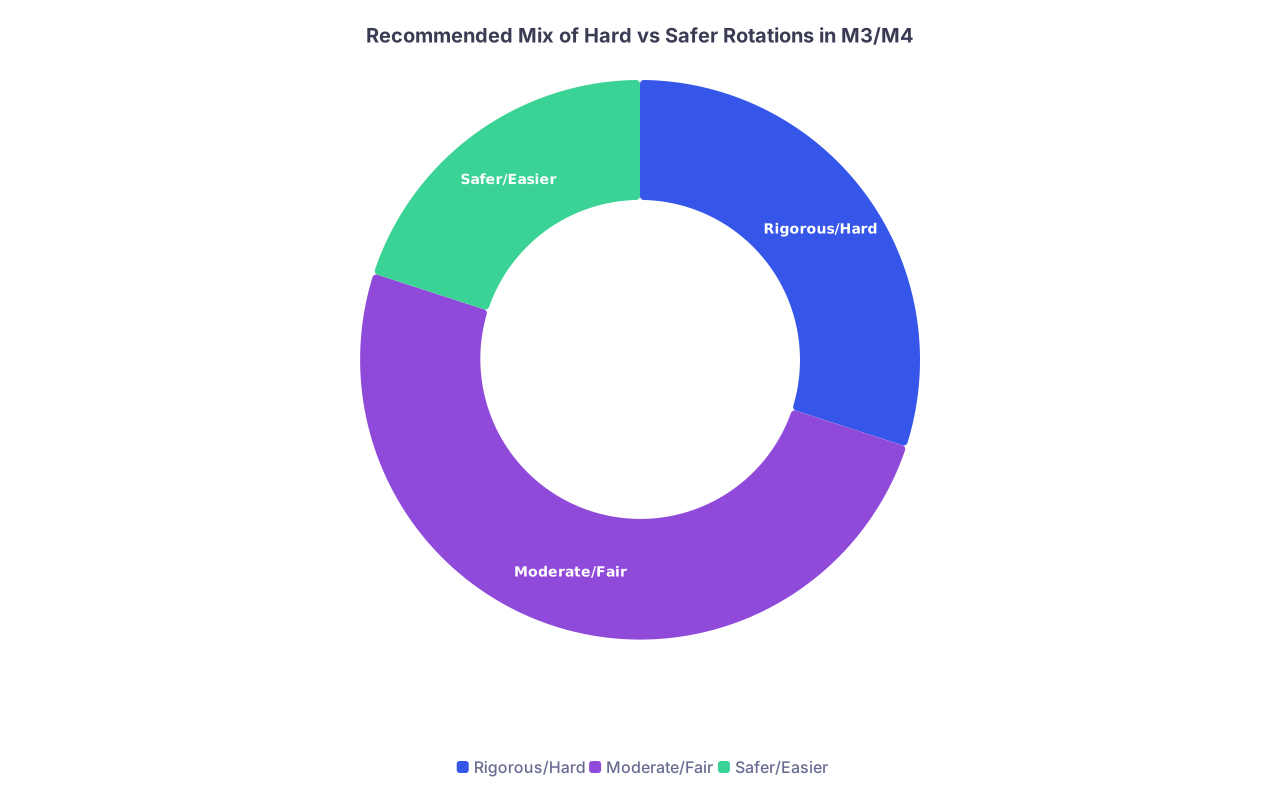
Visual: How Many “Hard” vs “Safe” Rotations?
| Category | Value |
|---|---|
| Rigorous/Hard | 30 |
| Moderate/Fair | 50 |
| Safer/Easier | 20 |
That’s roughly what I’d aim for across late M3 and M4: a minority of true grinders, a majority of fair, solid rotations, and a few safer ones as buffers.
Common Bad Strategies You Should Avoid
I’ve watched people sabotage themselves with these:
All easy, all the time
They chase honors on the easiest teams and end up with vanilla letters from mid-tier attendings. Looks timid. Reads as “avoids challenge.”Martyr schedule
They stack back-to-back nightmare rotations, get sick or burned out, and then underperform exactly when they needed to shine.Hero away rotation only
They do only one hard audition rotation and bomb it, with no strong home letters to fall back on. Now they’re sunk for that program and looking average elsewhere.Ignoring timing
They put their hardest inpatient sub-I right before Step 2, under-prepare for the exam, and then spend months explaining a mediocre score.
Don’t do any of that.
Example Schedules: Smart vs Risky
Internal Medicine Applicant – Better Plan
| Block | Rotation Type | Difficulty | Rationale |
|---|---|---|---|
| Apr | IM Sub-I (busy teaching team) | Hard | Strong letter, real prep for intern year |
| May | Light elective (outpatient) | Safe | Study and take Step 2 |
| Jun | Away #1 (IM, medium-hard) | Moderate | Showcase, get letter |
| Jul | Away #2 or consult service | Moderate | Second look or backup letter |
This student strategically uses one hard home sub-I, a lighter month around Step 2, and moderate away rotations where they can be visible and functional.
Quick Decision Flow
When in doubt, run this in your head:

| Step | Description |
|---|---|
| Step 1 | Is this rotation key for my specialty? |
| Step 2 | Choose fair, teaching-heavy site |
| Step 3 | Can I realistically perform well on a harder service? |
| Step 4 | Choose moderate difficulty with good teaching |
| Step 5 | Is the service hard but fair, not toxic? |
| Step 6 | Avoid - pick different team/site |
| Step 7 | Choose the harder, respected service |
| Step 8 | Yes or No |
If you walk through that honestly, you’ll avoid 90% of the dumb scheduling mistakes I’ve seen.
One More Thing: Your Reputation Inside Your Own School
You’re not just building an ERAS packet. You’re building a reputation. Inside your home institution, people absolutely know which students:
- Volunteered for challenging teams and still showed up
- Hid on soft rotations for a year
- Complained constantly vs quietly did the work
That reputation follows you into:
- Ranking discussions if you apply to your home program
- PD-to-PD phone calls behind the scenes
- Informal “Would you take this person again?” conversations
Choosing at least some legit hard rotations signals: “I’m willing to be stressed and stretched. I want to train.”
That matters.
Bottom Line Answer
For key rotations that matter for residency match, you generally should:
- Pick at least one truly rigorous, respected service in your chosen specialty (ideally for your sub-I).
- Avoid toxic, chaotic services where grading and support are random.
- Use moderate, fair rotations for many other blocks where you need strong teaching and decent grades.
- Sprinkle in a few truly “safe” months for Step 2 studying and recovery, but don’t hide there all year.
Strategically hard. Not masochistic. Not cowardly.
FAQ (Exactly 7 Questions)
1. Will a single pass on a hard service kill my chances at a competitive specialty?
Usually no. One pass on a legitimately tough service surrounded by mostly high passes/honors is rarely fatal, especially if you get a strong letter from that service. What hurts more is a pattern: multiple passes or low grades on services where most people honor, or a downward trend late in third year.
2. Is it better to get honors on an easy rotation or a high pass on a hard one?
If it’s a key rotation for your specialty, I’d rather see a high pass + excellent letter from a hard, respected service than an empty honors from a fluff site with a generic letter. Programs care about performance in context, but context mainly comes through your letters and the MSPE narrative, not the raw grade.
3. How do I know if a service is “toxic hard” vs “rigorous but fair”?
Ask three groups: current M4s, recent interns from your school, and chief residents. Red flags: no teaching, frequent public humiliation, wildly inconsistent evaluations, reputation that “the grade is random.” Good “hard” services are busy, demanding, but students consistently say, “It was brutal, but I learned a ton and the grading made sense.”
4. Should my away/audition rotation be the hardest service at that program?
Not necessarily. It should be real and substantial—you’re actually part of the team—but you don’t win points for choosing the most malignant rotation. Your priorities are: access to faculty, enough responsibility to show your skills, and a program culture where students actually get letters and fair feedback.
5. If I already have one great letter from a hard sub-I, do I need another hard rotation?
Not always. Once you have at least one strong letter confirming you can function at intern level in your specialty, you can be more selective. Use later blocks to round out your skillset, do research, or avoid burnout. Two hard rotations with great letters is nice; three that break you is pointless.
6. How should I balance Step 2 studying with hard rotations?
Do not sandwich Step 2 between your two hardest inpatient months. Smart pattern: hard sub-I → lighter elective + Step 2 → moderate/audition rotation. You need at least one relatively predictable, low-call month to prep properly for Step 2 and still sleep.
7. Will programs know which rotations at my school are easy vs hard?
They rarely know the granular details. They do know reputations of schools and sometimes specific flagship services or departments. But the real “tell” is in your letters and MSPE. If your dean’s letter says you thrived on a known hard service and your letter writer backs that up, that carries weight—whether or not the PD knows the internal gossip about your rotation sites.
Open your draft schedule right now and label each upcoming block with one word: hard, moderate, or safe. Then adjust so you have at least one hard, respected rotation in your target specialty, enough moderate ones to get strong teaching and letters, and just a couple truly safe months to protect your Step 2 and your sanity.