
The biggest mistake unmatched applicants make is pretending SOAP is a last‑minute problem. It is not. SOAP success is built in January, not Tuesday of Match Week.
You prepare for SOAP the way you prepare for the Match itself: early, systematically, and with a ruthless timeline. Let me walk you month by month, then week by week, then hour by hour on Match Week. At each point, what you should be doing is very clear.
January: Quietly Building Your Safety Net
At this point you should assume one uncomfortable thing: you might need SOAP. Even if you are a strong applicant. Especially if you are in a competitive specialty.
Week 1–2 of January – Reality Check and Risk Assessment
Your job in early January is to decide how serious your SOAP planning needs to be.
At this point you should:
- List all specialties you applied to and rank their competitiveness.
- Look honestly at:
- Step/COMLEX scores
- Number and quality of interviews
- Any red flags (exam failures, gaps, professionalism issues)
- Classify yourself:
- Low risk (10+ solid interviews in a less competitive field)
- Moderate risk (6–9 interviews, or mid-competitiveness)
- High risk (≤5 interviews, competitive specialty, or any exam failure)
If you are moderate or high risk, you plan for SOAP as if you will need it. That mental shift is non‑negotiable.
| Risk Level | Interview Count | Specialty Type | SOAP Planning Intensity |
|---|---|---|---|
| Low | ≥ 10 | Less competitive (IM, FM, Peds at community programs) | Light |
| Moderate | 6–9 | Mixed or mid-competitive | Full |
| High | ≤ 5 | Highly competitive or with red flags | Aggressive |
Week 3–4 of January – Define Your SOAP Targets
Now you design your Plan B (and C).
At this point you should:
Pick backup specialties.
Realistic examples:- From: Ortho → To: Prelim surgery, Prelim medicine, Transitional year
- From: Derm → To: Internal medicine, Family medicine, Prelim medicine
- From: EM → To: IM, FM, TY, Prelim surgery
- From: Radiology/path → To: IM, FM, Prelim/TY
Identify programs likely to have SOAP positions.
You cannot see the actual SOAP list yet, but patterns repeat:- Community programs
- Newer programs
- Less popular locations (rural or smaller cities)
- Programs that had SOAP spots in prior years
Draft a preliminary SOAP program list.
Aim for:- 40–60+ programs if you are high‑risk
- 25–40 if moderate risk
You are building a scaffold. You will plug in real programs once the unfilled list drops, but you want your strategy defined now.
February: Documents, Messages, and Messaging
February is paperwork and narrative month. By March, you will not have time to think deeply about wording. You will be in survival mode.
First Half of February – Fix Your Paper Trail
At this point you should be upgrading your ERAS profile and supporting documents.
Update your CV and ERAS experiences.
- Add new rotations, presentations, publications.
- Clean up typos and weak descriptions.
- Remove clutter and non‑meaningful fluff.
Write a SOAP‑specific personal statement for each backup path.
Not generic. Not lazy. Focused.Examples:
- Backup specialty statement – Why internal medicine or family medicine truly fits you now, not as a consolation prize.
- Prelim/TY statement – Emphasize:
- Desire for broad clinical exposure
- Strong work ethic, team focus
- Willingness to take on busy, service‑heavy roles
Have these ready as separate files labeled clearly:
- “IM_SOAP_PS”
- “FM_SOAP_PS”
- “PrelimMed_SOAP_PS”
- “TY_SOAP_PS”
- Review and, if needed, replace letters.
- Identify at least 2 letters that are universally strong and non‑specialty‑specific (medicine sub‑I, core IM, surgery, etc.).
- If your letters are weak or hyper‑specialized (e.g., only derm research letters), line up at least one broad clinical letter now.
Second Half of February – Communication Prep
At this point you should be planning your conversations and support network.
- Quietly inform key mentors you might need SOAP.
- Program director at your home institution
- Core clerkship directors
- Trusted faculty in your applied specialty
Script it simply:
“I hope to match into X, but my interview numbers are on the low side. I want to be prepared in case I need to participate in SOAP. Would you be willing to help me identify programs or make calls if that happens?”
- Clarify your school’s SOAP support structure.
Ask your Dean’s office:
- Who is the SOAP point person?
- How will they communicate with you on Monday of Match Week?
- Where will you be allowed to sit during SOAP (office space, computers, phone access)?
- What internal deadlines will they impose before SOAP starts?
Write these down. You will not remember details under stress in March.
Early March (Weeks –2 and –1): Rehearse the Worst‑Case Scenario
You are now within two weeks of Match Week. This is simulation time.
Week –2: Scenario Planning
At this point you should be walking through both paths:
Path A: You match.
Celebrate, move on.Path B: You do not match.
What exactly happens from 11:00 a.m. Monday to Thursday 5:00 p.m.?
Sit down and map it. I will outline it below, but you should personalize it.
Key tasks now:
Finalize personal statements and CV.
Lock final versions in a folder labeled “SOAP – FINAL.”Draft email templates.
You will need fast, professional boilerplates:- “Introduction to program director after application submitted”
- “Follow‑up expressing interest after interview” These should be 3–5 sentences, max.
Clarify your priorities.
Rank your potential SOAP paths:- Categorical position in backup specialty
- Transitional year or prelim medicine at strong institution
- Any prelim to stay clinically active and reapply
You cannot debate this on Wednesday at 3 p.m. with the clock running.
Week –1: Logistics and Tech
At this point you should be making sure nothing stupid derails you.
- Confirm your ERAS login, phone, and email access.
- Turn on two‑factor authentication where required.
- Ensure:
- Reliable internet
- Quiet workspace for Match Week
- Headset or earbuds ready for calls
- Block Match Week entirely. No flights. No elective that will not give you instant time off.
This week you also tell close family / partner the truth:
“If I do not match, this is going to be a very intense four days. I may not be available to talk much from Monday noon to Thursday evening.”
Set expectations now, so you do not have to manage other people’s panic when you are dealing with your own.
Match Week: Day‑by‑Day, Hour‑by‑Hour SOAP Timeline
Now the real timeline begins. This is where precision matters.
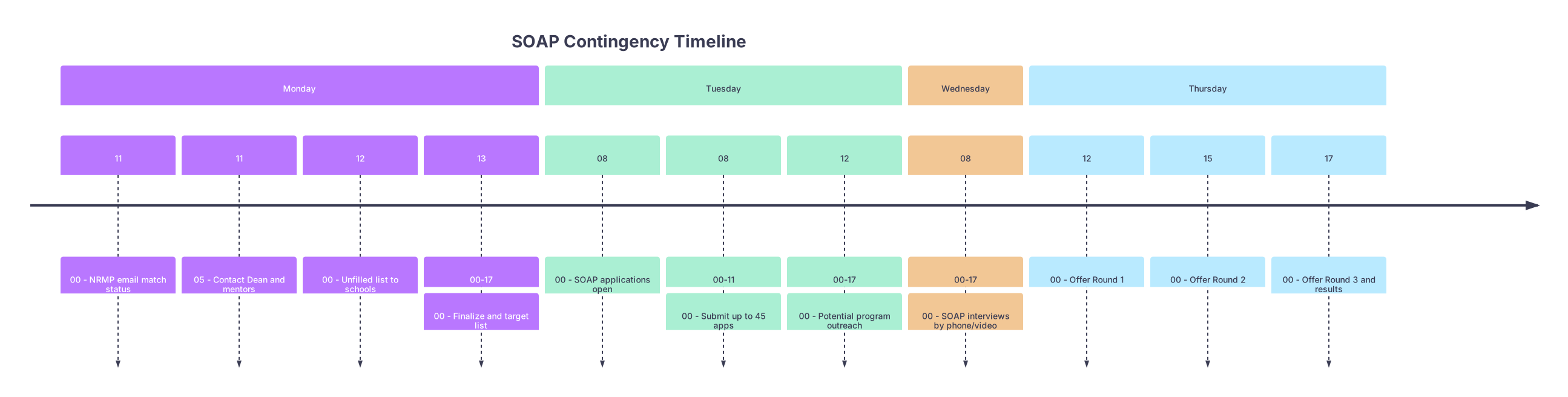
| Period | Event |
|---|---|
| Monday - 11 | 00 - NRMP email match status |
| Monday - 11 | 05 - Contact Dean and mentors |
| Monday - 12 | 00 - Unfilled list to schools |
| Monday - 13 | 00-17 |
| Tuesday - 08 | 00 - SOAP applications open |
| Tuesday - 08 | 00-11 |
| Tuesday - 12 | 00-17 |
| Wednesday - 08 | 00-17 |
| Thursday - 12 | 00 - Offer Round 1 |
| Thursday - 15 | 00 - Offer Round 2 |
| Thursday - 17 | 00 - Offer Round 3 and results |
Monday of Match Week – Shock, Then Strategy
11:00 a.m. ET – You Learn You Are Unmatched / Partially Matched
At this point you should:
- Take 10–15 minutes. Walk. Breathe. Cry in a bathroom stall if you need to. Then sit back down.
- Immediately contact:
- Your Dean / Student Affairs
- Your primary faculty advisor / PD
- Confirm:
- Are you fully unmatched or partially matched (e.g., advanced position but no prelim, or vice versa)?
- Will your school assign you a SOAP advisor?
Do not start randomly emailing programs. That is not allowed before they contact you in SOAP.
12:00–1:00 p.m. – Unfilled List to Schools
You will not see the unfilled list directly at noon; your school gets it first.
At this point you should:
- Sit with your advisor and:
- Filter the unfilled list to your chosen backup fields.
- Exclude any programs you truly could not live with (but be brutally realistic; this is not the time for pickiness).
- Start building your ranked target list:
- 1–15: High‑priority categorical spots in your backup specialty
- 16–30: Strong prelim / TY at academic centers
- 31–45: Community prelims / categorical in very broad‑based specialties (IM, FM, Peds depending on your situation)
Remember: You are limited to 45 programs total in SOAP. Every slot counts.
1:00–5:00 p.m. – Application Targeting and Document Assignment
At this point you should be aligning your earlier prep with the actual unfilled list.
Tasks:
Assign personal statements per specialty.
- IM programs → IM SOAP PS
- FM programs → FM SOAP PS
- Prelim/TY programs → Prelim/TY SOAP PS
Assign letters wisely. In general:
- 1 strong IM / core medicine or surgery letter
- 1 other strong clinical letter
- 1 letter from your advanced specialty if relevant (for prelim spots)
Cross‑check for red flags.
- Any program that explicitly requires USMLE if you only have COMLEX.
- Any program where you do not meet Step cutoffs. These might still be worth applying to in SOAP, but prioritize realistic fits first.
You should end Monday with:
- A finalized list of up to 45 programs
- Clear PS and LoR assignments per specialty
Tuesday: Application Submission and Initial Contacts
8:00 a.m. ET – SOAP Applications Open
At this point you should not be “deciding.” You should be executing.
From 8:00–11:00 a.m.:
- Submit your applications.
- Double‑check for:
- Correct personal statement attached
- Correct letters assigned
- No blank fields or obvious errors
By late morning, your applications should be in. SOAP is not rolling in the traditional sense, but you do not want to be that person submitting at 4:59 p.m. with a frozen browser.
Midday–Afternoon Tuesday – Strategic Follow‑Through
Now you move to controlled outreach. Remember: you still cannot cold‑call or pester programs before they reach out in SOAP. But there are legitimate moves:
At this point you should:
Coordinate behind‑the‑scenes advocacy.
- Ask your Dean / PD:
- “Are there specific programs where your call would matter?”
- They can reach out to PDs or institutions where they have personal contacts to flag your application.
- Ask your Dean / PD:
Prepare for potential interviews.
- Keep your phone volume up and ringer on.
- Have:
- A quiet room
- Your CV on screen
- Programs list printed or open
- Review your key talking points:
- Why this specialty or prelim year makes sense for you
- Why you went unmatched (succinct, non‑defensive)
- What you bring to a busy service
No gaming, no theatrics. Just a clear, practiced story.
Wednesday: SOAP Interview Day
Wednesday is phone‑call and video‑interview chaos. You live by your schedule and your notes.
At this point you should:
Treat every contact like a formal interview.
- Answer unknown numbers professionally: “Hello, this is [Name].”
- Have a one‑page “program quick sheet” to jot:
- Program name
- Interviewer name and role
- Key facts and your impression
- Level of interest (1–5)
Use a consistent answer framework. You will be asked these three in some form over and over:
- “Why are you interested in [our specialty / a prelim year]?”
- “Why did you go unmatched?”
- “Why our program?”
Build 30–60 second answers, not rambling monologues.
Maintain professionalism all day.
- No complaining about the Match.
- No long stories about unfairness.
- Focus on:
- Work ethic
- Coachability
- Reliability
- Ability to handle volume and nights
The goal: by end of Wednesday, you have made a strong impression at as many realistic programs as possible.
Thursday: Offer Rounds and Last‑Minute Decisions
SOAP offers are released in several rounds on Thursday (timing has varied slightly by year, your Dean will have the precise schedule).
At this point you should:
Know your priorities cold.
- If you get multiple offers across rounds (rare but possible), you will have minutes to decide.
- Ranking principles:
- Categorical > prelim, in a field you can tolerate
- Strong institution prelim > very weak categorical in a field you will hate and possibly fail in
- Geographic needs (family, visa, etc.) secondarily
Respond to offers promptly.
- Accept or reject quickly and decisively.
- Once you accept, you are done. That is binding.
If you do not receive offers.
- Debrief with your Dean and mentors by late Thursday.
- Begin planning:
- Supplemental year (research, MPH, etc.)
- Reapplication strategy
- Possible off‑cycle or outside‑Match spots
This is brutal. But having this next‑step plan outlined before Thursday will keep you from spiraling.
After SOAP: 2–4 Week Recovery and Rebuild
Whether you matched through SOAP or not, the weeks after are for regrouping.
If You Matched in SOAP
At this point you should:
- Confirm onboarding steps with your new program:
- Credentialing paperwork
- Occupational health
- Housing timeline
- Send short, gracious thank‑you notes to:
- Dean / student affairs
- Faculty who made calls or coached you
- Emotionally reset:
- Many SOAPed residents thrive and go on to fellowships and leadership. The route was different. Not doomed.
If You Did Not Match at All
Your timeline shifts, but it is still structured.
Weeks 1–2 post‑SOAP:
- Meet with:
- Dean
- Specialty advisors (original and backup)
- Build a 12‑month plan that includes:
- Clinical engagement (observer/extern roles, possibly research assistant positions)
- Demonstrated improvement (new Step 2 score if not taken or if low, publications, additional letters)
- Clear reapplication game plan:
- Specialty choice
- Number and type of programs
- Early ERAS readiness
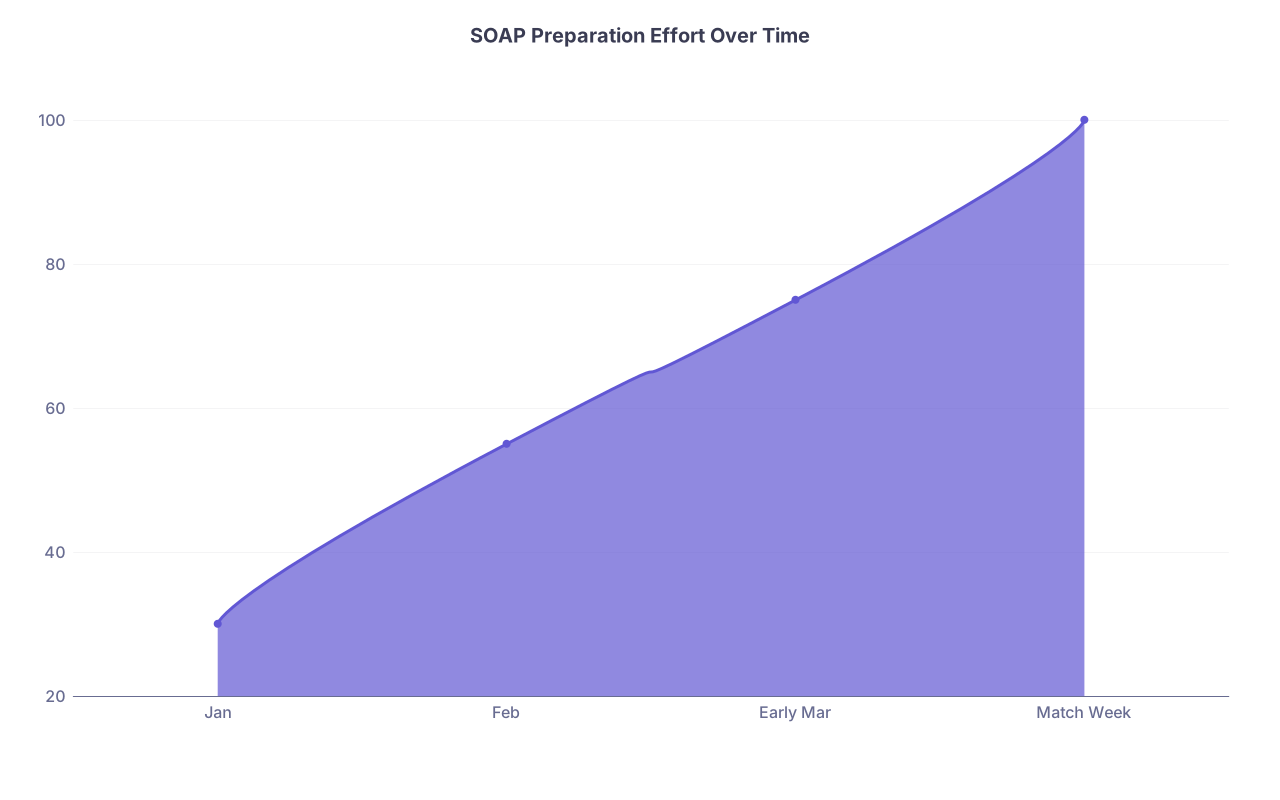
| Category | Value |
|---|---|
| Jan | 30 |
| Feb | 55 |
| Early Mar | 75 |
| Match Week | 100 |
Core Takeaways: How to Actually Be Ready for SOAP
Three points, and then you can go back to your calendar.
You build SOAP success in January and February. Backup specialties chosen, personal statements written, letters aligned, mentors briefed. Match Week is execution, not planning.
Match Week requires a strict, almost hour‑by‑hour plan. Monday: target list. Tuesday: applications. Wednesday: interviews. Thursday: rapid‑fire decisions. If you are improvising, you are losing.
SOAP is not a personal failure; it is a logistics and preparation test. The applicants who do best are not always the “best” on paper. They are the ones who had a contingency timeline, followed it, and did not fall apart when the NRMP email hit at 11:00 a.m.