
You’re sitting there on Monday of Match Week. Email just hit: “We are sorry to inform you…” You did not match. Your heart is in your shoes and your phone starts buzzing with classmates’ screenshots from happy emails.
And then it hits you: SOAP starts in hours. You have no real plan. Just a vague idea that you “apply again” and hope someone calls.
Let me stop you right there. SOAP is not “hope.” SOAP is a four‑day, hyper‑structured, brutally rigid process. People who treat it like a sprint with a playbook get offers. People who “wing it” get crushed.
Here’s your day‑by‑day SOAP Week timeline—from the moment you see that “did not match” email to the moment you (hopefully) accept an offer.
Big Picture: The 4‑Day SOAP Structure
First, zoom out. The week has a spine. If you don’t understand this spine, the details will feel random.
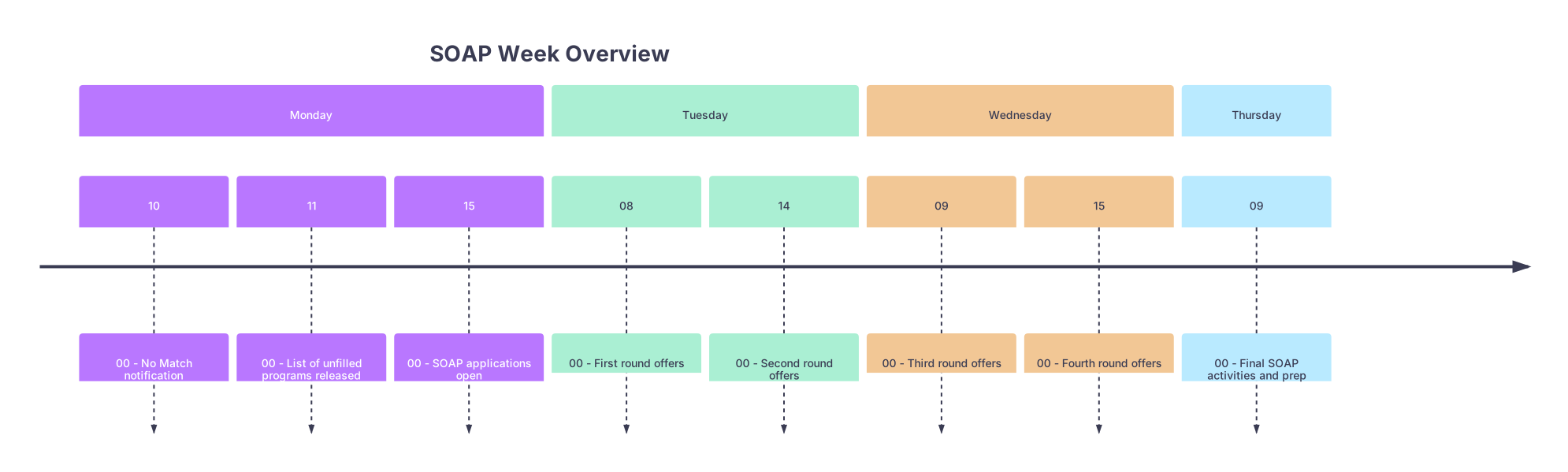
| Period | Event |
|---|---|
| Monday - 10 | 00 - No Match notification |
| Monday - 11 | 00 - List of unfilled programs released |
| Monday - 15 | 00 - SOAP applications open |
| Tuesday - 08 | 00 - First round offers |
| Tuesday - 14 | 00 - Second round offers |
| Wednesday - 09 | 00 - Third round offers |
| Wednesday - 15 | 00 - Fourth round offers |
| Thursday - 09 | 00 - Final SOAP activities and prep |
Exact times vary a bit by year and time zone, but the pattern holds:
Monday:
- Morning: Find out you didn’t match. List of unfilled positions appears.
- Afternoon: You submit up to 45 SOAP applications (through ERAS).
Tuesday/Wednesday:
- Four offer rounds. Programs call or email, you get offers via NRMP, you have short windows to accept/decline.
Thursday:
- SOAP wraps. Any unfilled spots after SOAP become open season (post‑SOAP scramble).
Now let’s go through it the way your brain actually needs it: hour‑by‑hour for Monday, then round‑by‑round through Wednesday, and clean‑up on Thursday.
Monday Morning: The Hit (No Match → Regroup → Intel)
Timeframe: 10:00 a.m. – ~1:00 p.m. (local)
At this point you should be:
1. Containing the emotional explosion (30–60 minutes)
You just got bad news. You are not a robot. But you have about three hours before the unfilled list and then only a few more before applications open.
Do this fast:
- Step away from your email for 10–15 minutes.
- Call one person who’s steady (advisor, mentor, partner).
- Cry, swear, punch a pillow, walk around the block. Whatever.
- Set a hard time limit: “By 11:00 I’m back at my desk.”
2. Getting your team assembled (by 11:00–11:30)
You should not SOAP in a vacuum. At minimum, loop in:
- Your dean or student affairs office
- Your specialty advisor (or an internal medicine / prelim year advisor if your specialty blew up)
- If you’re an IMG: your home program director or the physician who knows your application best
Send a short, direct email:
“I did not match into [specialty]. I plan to enter SOAP. Can we talk this morning about a target list and strategy? I’m available all day and can come in person or Zoom.”
Most schools have a SOAP protocol. The good ones already have a meeting block set up. If your school is disorganized, you’ll need to push harder and be the one driving.
3. Understanding your realistic SOAP lanes (before list release)
You do not have time for a full career counseling journey. You do have time for triage reality.
In your first advisor meeting, answer:
- What is your USMLE/COMLEX profile? (e.g., Step 1 pass / Step 2 223)
- Any red flags? (failed exam, failed rotation, professionalism issue)
- What specialty did you apply to originally? How competitive?
- Are you willing to pivot to:
- Categorical IM
- Prelim IM / Surgery
- Transitional year
- Family med, psych, peds, etc.
Your advisor should give you a brutally honest range like:
- “Categorical IM and FM are realistic. Prelim medicine is almost certain. Psych is a stretch.”
- Or: “You need to hit every prelim IM and any FM that lists IMGs, plus a few categorical if available.”
Write this down. This is the filter you’ll use the moment the unfilled list drops.
Monday Midday: The List Drops (Sort, Target, Prepare)
Timeframe: ~11:00 – 3:00 p.m.
Exact release time can vary; double‑check the current NRMP schedule. But assume late morning.
At this point you should be:
4. Pulling the unfilled list and categorizing fast
Once you have the list, you do not leisurely browse.
You immediately run it through three filters:
Specialty fit
- Green: Core backup specialties you’re willing to do (IM, FM, peds, psych, TY, prelim IM).
- Yellow: “Would consider” but not ideal.
- Red: Hard no. Do not waste an application.
Eligibility
- US vs IMG friendly
- Visa requirements (if relevant)
- Step/COMLEX cutoffs (if listed)
- Any clear disqualifier? Move on.
Geography / dealbreakers
- You don’t have the luxury to be picky, but if there are true non‑options (visa issues, family constraints), mark them.
Use a simple spreadsheet with columns:
- Program Name
- Specialty (e.g., Categorical IM, Prelim IM)
- Positions Open
- IMG Friendly (Y/N)
- Visa (Y/N)
- Step 2 cutoff
- Priority (1–3)
You are trying to build a ranked target list of up to 45 programs.
| Priority | Program Type | Slots Open | IMG Friendly | Visa Sponsor |
|---|---|---|---|---|
| 1 | Categorical IM | 5 | Yes | Yes |
| 1 | Prelim IM | 3 | Yes | No |
| 2 | FM | 4 | Yes | Yes |
| 2 | TY | 2 | No | No |
| 3 | Psych | 1 | Yes | Yes |
5. Locking your SOAP strategy (by ~12:30–1:00 p.m.)
You have 45 total applications. Not per specialty. Total.
Typical effective patterns:
If you’re reasonably competitive for a backup categorical:
- 20–25 categorical IM/FM/peds/psych
- 15–20 prelim IM / TY
- A few stretch programs if you have a strong geographic or connection reason
If you’re lower‑stat or with red flags:
- 5–10 categorical in community‑heavy or IMG‑friendly programs
- 25–30 prelim IM / TY
- The rest in FM or transitional programs that historically fill through SOAP
Bad pattern: 10 programs in 4 different specialties with no focus. That screams desperation and lack of direction.
Refine this list with your advisor. Then freeze it. Over‑tweaking at 2:45 p.m. is how people mis‑click and waste apps.
6. Preparing specialty‑specific SOAP statements (1:00–3:00 p.m.)
You are not rewriting your personal statement 10 times. You do not have that kind of day.
You need:
- 1–2 concise, updated personal statements tailored to:
- Your main SOAP specialty (e.g., categorical IM)
- Backup lane (e.g., prelim IM / TY, or FM)
Focus on:
- Owning the no‑match briefly (if you address it at all): one line, not an essay
- Why you genuinely fit the specialty
- What you bring that’s useful on July 1, not 10 years from now
Example skeleton:
- 1 paragraph: who you are and why this specialty
- 1–2 paragraphs: concrete clinical experiences, strengths, and the type of program you’ll thrive in
- 1 short paragraph: what you’ll contribute as an intern
- If you mention SOAP or no match: a single, direct sentence like
“Although I did not initially match, I remain committed to a career in internal medicine and am eager to contribute fully as a PGY‑1 resident.”
Monday Afternoon: Application Window (3:00 p.m. → Submit)
Timeframe: ~3:00 – 6:00 p.m.
At this point you should be:
7. Finalizing and submitting your 45 apps early
ERAS SOAP opens. The site will be a traffic jam.
Your job:
- Double‑check:
- Correct programs selected
- Correct personal statement mapped to each specialty
- Letters of recommendation appropriately assigned (IM letter to IM, etc.)
Submit as early as possible while staying accurate. You don’t get extra points for hitting “submit” at 3:01 p.m., but you do lose if you’re still editing at 6 p.m. and miss something.
8. Setting up your communication command center
Once apps are in, you pivot from “builder” to “receiver.”
By Monday evening you should have:
- A quiet physical base for Tues/Wed (study room, home office, or dean’s conference room)
- Reliable:
- Phone (ringer on, Do Not Disturb off for unknown numbers)
- Laptop with ERAS and NRMP logins tested
- Charger, backup battery, headphones
And you set clear boundaries:
- Tell family/friends:
- “Please do not call/text me during business hours Tues/Wed unless it’s urgent. I might be on the phone with programs.”
- Arrange coverage for any obligations (work, kids) if you can. SOAP offers are time‑sensitive.
Tuesday: Offer Rounds 1 & 2 – Live Fire
Timeframe: All day, with two main offer windows
Check the official NRMP schedule for exact times; historically, something like morning and early afternoon rounds.
At this point you should be:
9. 30–60 minutes before Round 1: Rehearsed and reachable
Before the first round starts:
- Open NRMP and ERAS; confirm you can log in.
- Pull up your spreadsheet with your 45 programs, sorted by priority.
- Highlight:
- Absolute yes programs
- Programs you’d take only if nothing else comes
Practice a 15‑second intro out loud:
“Hi, this is [Name]. I’m a fourth‑year at [School]. Thank you so much for calling. I applied to your [IM / TY / etc.] program and I’m very interested.”
Expect calls to come from:
- Program directors
- Coordinators
- Sometimes chief residents
They may or may not call before submitting an offer through NRMP. Some will ask a few questions; some just say “we’re planning to rank you.”
10. Handling calls during Round 1
Calls may come before, during, and between offer windows. When the phone rings:
- Answer every unknown number during business hours. Every. Single. One.
- If you absolutely have to miss one, call back immediately. Do not wait.
When you’re on the call:
- Be concise, awake, and professional.
- Have 2–3 specific talking points per program type (IM vs FM, etc.)
- Don’t lie. If it’s not your top choice but you’d go there, say something like:
“I’d be very happy to train there and would strongly consider an offer.”
Programs are making a snap judgment: “Can I picture this person on my team in July?” Sound like someone they can trust.
11. Responding to actual offers (NRMP system)
Offers come through NRMP, not by phone, even if the phone call “warns” you.
When you see an offer:
- You usually get a short window (a couple of hours) to accept, reject, or let it expire.
- If you accept: You are done with SOAP. That’s your contract.
- If you reject or let it expire: It will not return in a later round.
This is where your priority list matters.
You MUST be clear beforehand:
- What’s your “floor”? The lowest‑priority program you’d still accept immediately?
- Would you ever decline an offer in Round 1 hoping for something in Round 2? That’s a gamble. For most applicants, if you get a categorical or good prelim offer you’d be okay with, you take it.
Tuesday Afternoon: Round 2 and Debrief
At this point you should be:
12. Adjusting expectations between rounds
Between Round 1 and Round 2, look at what happened:
- Did you get any calls but no offers?
- Any offers from very low‑priority programs?
- Radio silence?
Call your advisor again, even for 5–10 minutes:
- If you got an offer that you let go (or are thinking of letting go) — sanity check that decision.
- If you got nothing — discuss whether your target list is too ambitious.
You cannot change your applications mid‑SOAP, but you can change your mindset:
- After Round 1 with no bites, be more willing to accept solid prelim/TY options in Round 2.
- Do not suddenly decide in Round 2 that you “only” want categorical when you’d planned for prelim as backup. That’s denial, not strategy.
13. Repeat: Calls, offers, decisions
Round 2 runs just like Round 1, only with fewer open positions. Same rules:
- Answer everything
- Stay near your base
- Check NRMP obsessively during the offer window (but don’t crash your brain)
By Tuesday evening, one of three things is true:
- You accepted an offer → SOAP over for you. Shift to “okay, how do I prepare for this specialty/location?”
- You had offers but declined them → You’re rolling the dice for Wednesday. You’d better have very good reasons.
- You had no offers → You’re going into Wednesday in a weaker position. Not impossible, but harder.
Wednesday: Last Shot – Rounds 3 & 4
This is where people start to crack. You cannot afford to.
At this point you should be:
14. Morning: Tactical reality check
Before Round 3:
- Re‑review your list. Remind yourself which programs are still likely open (your dean’s office may have intel; some slots get filled in each round).
- Mentally lower your “floor” if you’ve had zero offers so far.
I’ve seen strong applicants end up unmatched because they held out for a “better” categorical when they had a decent prelim in hand. Unless your application is stellar and you have multiple programs courting you, that’s usually a mistake.
15. Rounds 3 and 4: All‑in on any viable offer
Wednesday rounds are not about ideal fit. They’re about:
- Securing a position, especially a PGY‑1 year that keeps you moving forward
- Avoiding a gap year if at all possible
The rules are the same:
- Answer calls.
- Respond to offers within the window.
- Accept the first offer you’d be willing to honor in real life, not fantasy life.
For many, that will be:
- Prelim IM at a smaller community program
- Transitional year in a place you’d never thought about
- FM or psych after a failed attempt at a very competitive specialty
That’s not failure. That’s your route back into the system. You can reapply later from inside U.S. training. That’s infinitely easier than reapplying unmatched from the outside.
Thursday: Post‑SOAP Reality and Next Steps
By Thursday morning, SOAP is effectively over for you in one of two ways:
- You matched into a SOAP position.
- You did not receive or accept any SOAP offers.
At this point you should be:
16. If you matched through SOAP
Your priorities for Thursday/Friday:
- Confirm details with the program:
- Start date
- Orientation schedule
- Any paperwork needed urgently
- Update your dean’s office and LCME / ECFMG personnel.
- Mentally switch from “panic SOAP mode” to “new specialty/new city mode.”
You’ll have months to wrestle with how you feel about the specialty pivot. Today is about logistics and some relief.
17. If you did not match through SOAP
This is brutal. No sugarcoating. But you still have moves.
Thursday:
- Quietly check for post‑SOAP open positions. After SOAP concludes, programs can openly list remaining vacancies online (FREIDA, program websites, etc.). That’s the post‑SOAP scramble.
- Work with your advisor to:
- Email/call PDs of unfilled programs directly
- Package a concise “interest email” + CV + ERAS ID
- Start building a 12‑month plan if nothing hits:
- Research fellowship
- Preliminary or non‑ACGME year
- MPH or similar (less ideal, but sometimes used strategically)
- Reworking your application (exams, letters, research, remediation)
The next few weeks, not just Thursday, determine how you rebound. But Thursday is when you stop refreshing NRMP and start planning deliberately.
A Quick Look at Where Your Time Actually Goes
Here’s a rough breakdown of how your SOAP week time should be allocated if you’re doing this right:
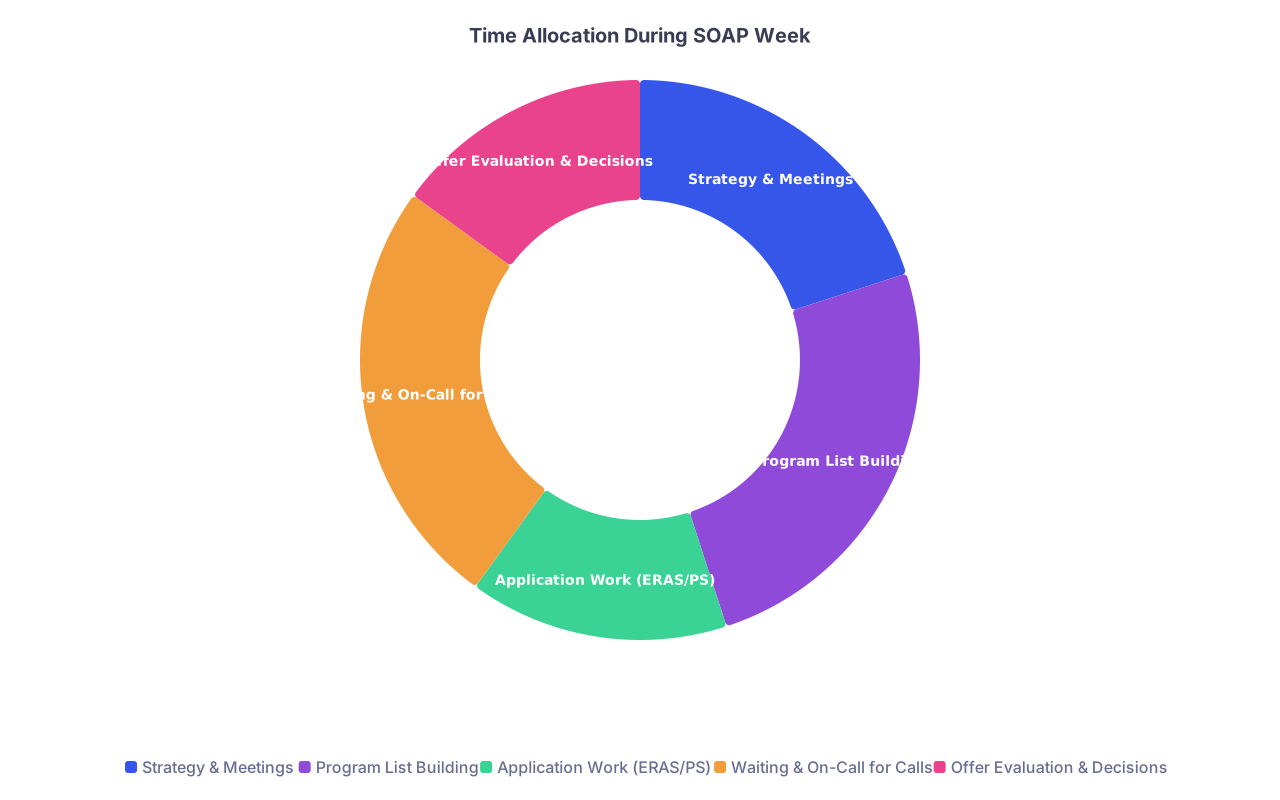
| Category | Value |
|---|---|
| Strategy & Meetings | 20 |
| Program List Building | 25 |
| Application Work (ERAS/PS) | 15 |
| Waiting & On-Call for Calls | 25 |
| Offer Evaluation & Decisions | 15 |
The mistake people make? They shove 60% into “panic scrolling and texting friends” and wonder why things go sideways.
Common SOAP Week Missteps (And When They Happen)
Quick landmine map, so you can avoid the stuff I’ve watched torpedo people:
- Monday a.m. – Freezing for 4–5 hours after the no‑match email.
- Monday p.m. –
- Over‑targeting only categorical spots in the original specialty or closely related ones when numbers clearly don’t support it.
- Forgetting to assign letters/personal statements correctly in ERAS.
- Tuesday –
- Ignoring unknown caller IDs because “I thought it was spam.”
- Rejecting a solid prelim or TY in Round 1 with no Plan B.
- Wednesday –
- Clinging to pride: “I’d rather go unmatched than do prelim anywhere.” Then regretting it for a full year.
- Mentally checking out after two silent rounds and missing a late call.
Your Immediate Next Step Today
Open a blank document and label it: “SOAP Command Sheet – [Your Name].”
Create four sections:
- Stats & red flags (Step scores, attempts, any issues)
- Willing specialties (Yes / Maybe / No)
- Absolute “yes” program types (what you’d accept immediately)
- “Floor” options (what you’d still take on Wednesday if it’s your only offer)
Fill those four sections in honestly. No aspirational nonsense. This becomes your anchor when SOAP chaos hits and emotions spike.
Then save it somewhere obvious. Because when that Monday email comes, you won’t have time to figure yourself out from scratch.