
You’re in that awful in‑between space.
It’s Monday of Match Week. NRMP email: “We are sorry… you did not match.” Or maybe: “You partially matched.” Your stomach drops. You open the list of unfilled programs and your worst fear hits immediately:
Almost nothing is in the one region you can actually live in.
You’ve got a spouse locked into a non‑remote job. Kids in school with an IEP that took years to set up. A sick parent who needs you nearby. Or maybe you’re on a visa and literally cannot leave a specific state or system.
Everyone around you is yelling “SOAP EVERYWHERE, CAST A WIDE NET!” and you’re sitting there thinking, “I can’t. I physically and logistically can’t.”
This is for that situation. You are a geographically tied applicant going into SOAP with basically no flexibility. Here’s how to play a bad hand as well as possible.
1. Get Clear On Your Actual Constraints (Not the Vague Story in Your Head)
Before you do anything in SOAP, you need to be brutally specific about what “I can’t relocate” actually means. Vague constraints lead to dumb choices.
Break it down:
Geographic radius
- Can you do a 60–90 minute commute each way for a couple of years if it means having a residency versus no residency?
- Are there neighboring states/cities that, while not ideal, are still realistic?
- Is it truly “this zip code only,” or “this metro area,” or “this 3–4 hour drive radius”?
Legal/visa constraints
- Are you locked into a specific state license or J‑1 waiver site?
- Are you tied to a particular employer or health system?
- Are there visa‑friendly states or systems you must stick to?
Family/medical constraints
- Is there a custodial order that legally restricts where the kids can live?
- Does a parent’s care literally depend on you being within X distance?
- Is your partner’s job tied to a specific region with no transfer option?
Write this out. Not just in your head. A simple grid works:
| Constraint Type | Hard Limit | Flexible Zone |
|---|---|---|
| Commute Time | 60 min | 60–90 min |
| State/Region | State A | Neighboring metro in State B |
| Family Needs | Within 30 min of parent | 45 min with reliable backup care |
| Visa/Legal | Employer X only | Any site under Employer X in state |
Why this matters: your brain will scream “I can’t move” and treat a 45‑minute drive and a 4‑hour flight as the same. They’re not. SOAP is about finding any real option that keeps you in the game.
2. Reality Check: How SOAP Actually Works Against You Here
You need to understand the structural problem you’re facing so you don’t waste time.
SOAP doesn’t care about your geographic constraints. Programs don’t see: “This applicant can’t leave because of a medically complex child.” They just see: “Applicant who applied to only these limited places” or “Last‑minute email explaining why they can’t move.”
Key realities:
- You get a limited number of applications per SOAP round (and a cap overall).
- Programs with unfilled spots are often not in the cushy big metro you’re tied to.
- Highly desirable locations in SOAP fill fast and are more competitive than you think.
- Programs are not obligated to care about your family situation.
So the default advice—“Just apply everywhere, you only need one yes”—does not apply to you. Your strategy is different:
- You are trying to find any viable option inside a small map.
- You must decide early: is it better to SOAP narrowly into almost nothing, or to accept that you may have to delay a year rather than blow all your spots on impossible choices?
Let me be blunt: if there are literally zero programs within your real radius, your main SOAP strategy is not “trick SOAP into giving you something close.” It’s: maximize your odds at the 1–2 borderline options, then plan immediately for the post‑SOAP gap year.
We’ll talk about both.
3. Pre‑SOAP Prep: 24–48 Hours That Actually Matter
If you’re reading this before Match Week or early Monday, use that time well. You don’t get the luxury of flailing.
Build your geographic map and program list
Pull up Google Maps and the NRMP/ERAS program list. Make a shortlist of:
- Every program in your specialty within your true radius
- Every close‑enough specialty you’d realistically do (FM vs IM, prelim IM vs categorical, TY year, psych vs neuro, etc.)
- Any program in related specialties that’s in your region and might be unfilled (e.g., prelim surgery, TY at community hospitals, smaller IM/FM programs)
Label them:
- “Tier A” – I would absolutely go here; fits radius.
- “Tier B” – Commute is rough or specialty is less ideal, but still acceptable.
- “Tier C” – Only if the alternative is complete failure to start residency this year.
You’re going to check the SOAP unfilled list against this prebuilt map. That saves precious time.
Line up your support people
You need 2–3 humans on standby for SOAP days:
- Someone to help you scan unfilled lists and cross‑match to your map.
- Someone to read your emails and PS edits at high speed.
- Someone who knows your personal situation and can sanity‑check decisions.
If your school has a dean of students / Match advisor who actually responds, loop them in now and be explicit: “I am geographically constrained because of X. If I don’t match, I need help prioritizing SOAP apps.”
4. Monday: The “Did Not Match” Email and First Pass Strategy
The unfilled list drops. Now what?
Step 1: Rapid triage of the list
You’re not browsing; you’re scanning with a mission.
Within the first 30–60 minutes:
- Filter by state/region that fits your radius.
- Within that, filter by:
- Specialty you applied to
- Adjacent specialties you’re willing to consider
- Prelim/TY spots that are geographically acceptable
If you see only 1–3 programs in anything geographically acceptable, your plan is crystal:
- Those go straight to the top.
- Then you decide how far outside your ideal region you’re actually willing to stretch.
If you see zero programs within your radius: don’t panic yet. Look for:
- Prelim/TY positions within extended commute
- Programs in neighboring cities with reliable transportation where you could realistically be home on some weekends or where your family might relocate later
If it’s still zero? Mentally shift: SOAP becomes “lottery ticket with long odds,” and you must start parallel‑planning a gap year early, not Thursday afternoon.
Step 2: Decide your specialty flexibility early
If your region has a small community FM or IM program unfilled, but you originally applied neurology or EM, you have to decide fast: will you actually go do FM or IM there? Or are you lying to yourself?
I’ve seen people torpedo themselves here. They SOAP into a specialty they low‑key hate, in a location they don’t want, then they’re miserable and trying to reapply PGY‑1. Be honest now, not in July.
If you’re open to adjacent specialties:
- Rewrite your personal statement to match that specialty before SOAP submissions open. Have a version ready for each realistic path:
- “Region‑tied FM PS”
- “Region‑tied prelim IM PS”
- “Region‑tied TY PS”
5. How To Frame Your Geographic Tie Without Sounding High‑Maintenance
Programs don’t want drama. They want people who will show up and stay.
You have to walk a line: explain your geographic tie enough that they believe you will definitely come if offered, but not so heavily that you look like a logistical nightmare.
General rules
Do:
- Be brief and concrete: “My spouse is active duty stationed in X until 20XX.”
- Emphasize stability: “I have long‑term housing and family support in this city, which will allow me to focus fully on residency.”
- Tie it to them: “Your program is one of the few within reach of my fixed obligations, which is why it’s at the top of my list.”
Don’t:
- Dump your entire family saga in an email.
- Threaten or guilt trip (“I have to match near here or everything falls apart”).
- Sound like everything is conditional and fragile.
Sample email language (short, SOAP‑style)
Subject: SOAP Applicant – Strong Regional Ties to [City/Region]
“Dear Dr. [PD Name],
My name is [Name], and I am an unmatched applicant participating in SOAP for [Specialty]. I am writing to express my strong interest in your program.
I have deep, long‑term ties to [City/Region]: my spouse works as a [job] here and our support system is fully based in [city]. Because of this, I am committed to building my career in this area, and your program is one of the very few that would allow me to do so.
I would be genuinely excited to train at [Program Name] and would be ready to accept an offer if extended. I’ve attached my CV and would be happy to speak by phone if helpful.
Thank you for your consideration,
[Name]
[Phone]”
That’s it. Clean, not desperate, and with a clear signal: “I will come if you offer.”
6. Tactical SOAP Application Choices When You Have Limited Spots
You get a hard cap on SOAP applications. For a geographically constrained applicant, every slot is more important.
Here’s how to think about allocation:
- Fill all your Tier A local programs in your applied specialty and any acceptable adjacent specialties.
- Then consider Tier B within a wider commute or less‑ideal specialty that you’d truly accept.
- Only if you still have capacity do you throw Hail Marys at far‑away places you’d almost certainly decline anyway.
You must avoid two traps:
- Trap 1: Wasting applications on programs you would never actually go to. That’s just self‑deception.
- Trap 2: Being so rigid you leave easy local prelim/TY spots untouched because they’re “not perfect.”
If your long‑term goal is to eventually be in that same geographic area as an attending, sometimes the best move is:
- Take an acceptable prelim/TY in your region.
- Build local connections.
- Reapply with stronger regional letters.
Not glamorous. But better than sitting out completely.
7. How Aggressive Should You Be With Outreach?
SOAP rules limit direct contact in certain ways, and some schools are more conservative than others. You don’t want to get in trouble.
Still, within the rules, you can:
- Have your dean or advisor email/call PDs at local programs where you’re a realistic candidate and say:
- “This student has strong ties to [region] and would absolutely come if you offer.”
- Send concise, targeted emails to PDs/PCs at your few realistic local options, as above.
- If you have prior connection (sub‑I, research, home rotation), mention it clearly:
- “I completed a sub‑internship at your hospital in [month/year] and greatly valued the experience…”
Do not:
- Send long, emotional essays about your hardship.
- Spam every program in the country with the same “I’m very interested” email. They can smell it.
- Harass coordinators with repeated phone calls.
Your geographic tie is your only “hook”; use it carefully. “I grew up in this state” is weaker than “my spouse and kids are here with a stable setup and I own a house 15 minutes from your hospital.” Be specific about anchoring factors.
8. If the SOAP List Has Almost Nothing in Your Region
Let’s imagine the worst: the list drops, and within your realistic radius you see:
- 1 prelim IM program
- 1 transitional year in a community hospital
- 0 categorical spots in your desired specialty
This is where most people spiral. Do not.
Here’s the structured approach:
Apply to those few local options immediately.
Decide your stance on specialty vs location:
- If location is truly non‑negotiable, you apply to those local prelim/TY spots and maybe a small number of slightly‑further programs where you could manage.
- If you can flex location just a bit—e.g., family could temporarily relocate or you can commute weekly—expand to those next‑tier cities.
Simultaneously (yes, during SOAP week), start assembling your “If I don’t match in SOAP” plan:
- How will you stay clinically active (research position, prelim year outside SOAP, local hospitalist scribe, etc.)?
- Who locally can help you improve your application for next cycle?
- How will you explain your geographic tie more clearly next year so you’re not in this position again?
This feels emotionally like “giving up.” It isn’t. It’s handling reality on two tracks at once: taking every rational SOAP shot you have, and not wasting a year if it doesn’t work.
9. Money, Logistics, and Family Conversations You Can’t Avoid
SOAP decisions are not just academic. They’re financial and logistical.
You must sit down with the people involved and ask ugly questions:
- If I match 90 minutes away, can we handle that commute financially and practically?
- Can my partner realistically keep their job if we shift slightly outside our current area?
- Are we prioritizing year 1–3 pain (commute, time apart) for long‑term gain (I become board‑eligible and then work locally)?
Sometimes, when families say “we absolutely can’t move,” what they really mean is “we really don’t want to deal with the disruption.” That’s valid emotionally. But it’s not the same as impossible.
You need a shared, adult‑level decision:
Is it better to:
- Take a less‑ideal, somewhat further spot this year, become a physician, then move your career home later, or
- Hold out for the perfect local categorical position next year and risk never getting one?
There isn’t a universal right answer. But punting the conversation until after SOAP is the wrong move.
10. If You End Up Unmatched After SOAP: How To Use Your Geographic Tie Next Cycle
If SOAP doesn’t work, your geographic tie becomes central to your next application cycle. You can either let it sink you again or use it strategically.
Here’s how to use it well:
Focus your next applications almost exclusively on programs within your real geographic zone. Stop carpet‑bombing the country; it wastes money and weakens your story.
Make your geographic tie explicit and rational in your personal statement:
- “My long‑term professional and family goals are anchored in [region]. Because of [spouse career, extended family support, established home], I am committed to training and practicing here.”
- Show this as a positive: stable support, less burnout risk, deep community engagement.
Build actual ties this year:
- Work in local clinics or hospitals, even if not in a glamorous research role.
- Get letters from local attendings saying: “This applicant is rooted here and committed to serving this community.”
- Volunteer or moonlight in settings that show you’re serious about this region, not just saying words.
Have your dean or advisor directly call PDs in your region before interview season and say:
- “This applicant is tied to your area and will come if you offer. They are not using your program as a backup.”
Programs hate feeling like everyone is using them as a geographic safety. If you only apply in your geographic area, your actions finally match your story.
11. A Quick Visual: SOAP Outcomes for Geographically Flexible vs Constrained Applicants
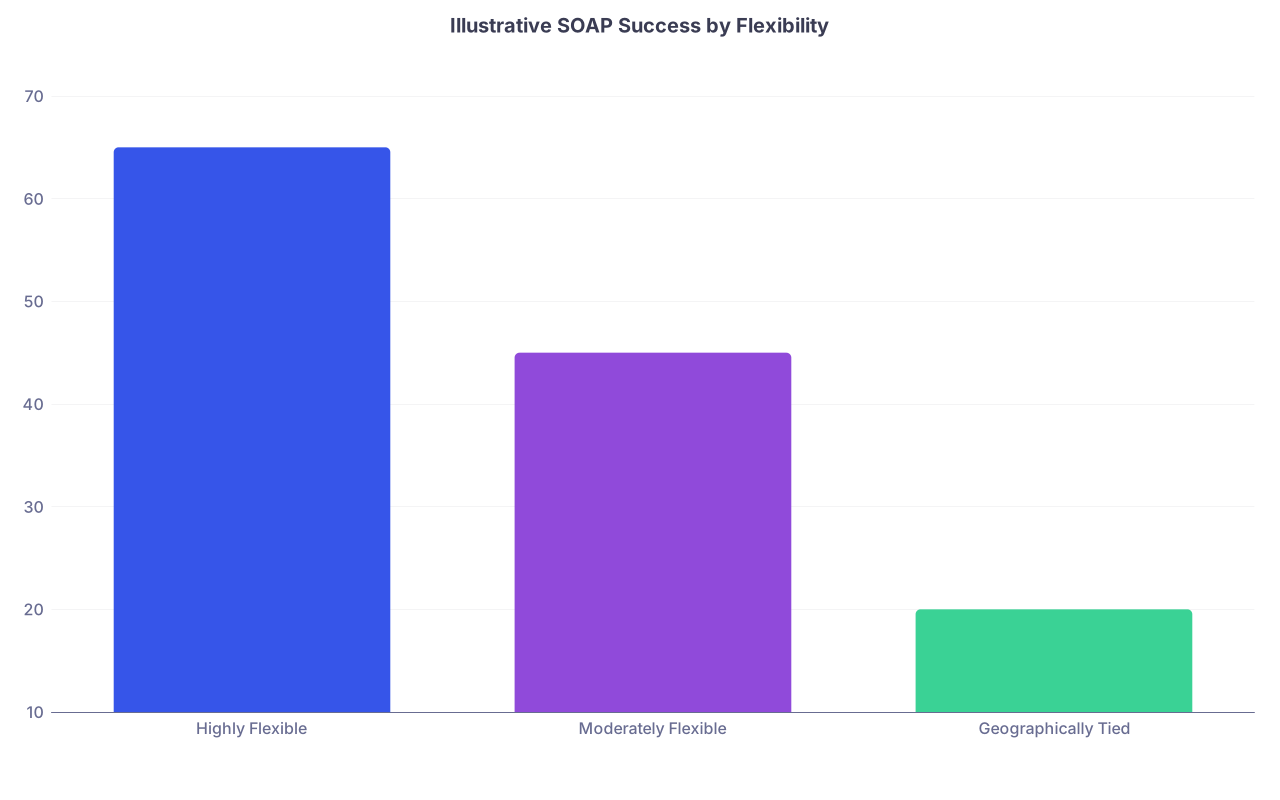
Just to set expectations, here’s a conceptual view of match chances in SOAP depending on flexibility (numbers are illustrative, not exact):
| Category | Value |
|---|---|
| Highly Flexible | 65 |
| Moderately Flexible | 45 |
| Geographically Tied | 20 |
Point being: your starting odds are lower. You’re playing a harder game. You survive by being more focused and more honest, not more frantic.
12. A Concrete Mini‑Plan for SOAP Week If You Can't Relocate
Let me lay this out as a simple timeline so you’re not guessing.

| Step | Description |
|---|---|
| Step 1 | Monday - No Match Email |
| Step 2 | Define true geographic radius |
| Step 3 | Cross check unfilled list with radius |
| Step 4 | Rank Tier A/B programs and specialties |
| Step 5 | Identify extended commute or neighboring cities |
| Step 6 | Prepare targeted PS and emails |
| Step 7 | Submit SOAP apps to realistic options |
| Step 8 | Advisor/dean outreach to local PDs |
| Step 9 | Accept if fits location plan |
| Step 10 | Execute gap year and reapply strategy |
| Step 11 | Any local programs? |
| Step 12 | SOAP offer? |
While all this is happening, you keep an open document where you’re drafting your “if I don’t SOAP match” plan. Because transparency with yourself beats magical thinking.
13. One More Thing: Don’t Apologize for Having a Life
You’re going to be tempted to feel guilty for being geographically constrained. As though you’ve failed some purity test of “maximum flexibility.”
Ignore that.
You’re allowed to have a spouse, kids, sick parents, or a visa. You’re allowed to factor them into your career. The system just isn’t built to be kind about it.
Your job is not to apologize for having constraints. Your job is to be:
- Clear about them
- Strategic with them
- Honest about what you will and won’t do
Programs will either have room for that or they won’t. Many won’t. You don’t need all of them. You need one that fits your real life.
Key Takeaways
Define your geographic limits in concrete terms (drive time, states, legal/visa issues) before SOAP starts, and build a specific list of realistic programs and specialties within that zone.
Use your geographic tie as a focused advantage: targeted SOAP applications, concise emails, and dean outreach to a small number of realistic programs, rather than spraying apps across the country.
Run two tracks at once: take every rational SOAP shot that fits your constraints, and in parallel build a clear, local plan for the next year in case SOAP does not work—so this isn’t a lost year but a strategically used one.