
You’re in the worst kind of limbo.
It’s Monday of Match Week, 10:59 a.m. Eastern. You’re on the NRMP page, stomach in your throat. The clock flips to 11:00.
“You did not match to any position.”
Your email pings with the generic “We are here for you” message from your school. You wait for a call. Nothing. You email your Dean’s office: “What’s the SOAP process for our school?” You get… a mass PDF from 2019 and some vague line about “We recommend you work with your advisor.”
Except your advisor is on vacation. Or they’ve never done SOAP. Or they reply, “Let me know what you need” — but they clearly have no plan.
So you’re supposed to SOAP. In 72 hours. Into a residency. With no real institutional support.
Here’s what you do: you build your own SOAP team. Fast.
Step 1: Accept What Your Dean’s Office Is (And Is Not) Going To Do
You cannot fix your school this week. You also cannot sit there waiting for them to suddenly turn into UCSF-level match support.
Be blunt with yourself:
- Some schools are phenomenal during SOAP: designated war rooms, real-time edits, call scripts, faculty assigned per specialty.
- Some schools are invisible: you get a link to the NRMP handbook and good wishes.
- Most are in the middle: they’ll sign what’s needed, maybe look at one or two documents, and that’s it.
You’re in the “not very helpful” category. So assume:
- They’ll handle official tasks if you explicitly ask:
- Certifying your updated MSPE in ERAS (if needed)
- Uploading any school-required documents
- Verifying graduation eligibility if a program calls
- They will not:
- Strategize your SOAP list
- Aggressively edit your new personal statements today
- Call programs on your behalf in a coordinated fashion
Once you emotionally stop expecting them to “take care of it,” your brain has room to do what matters: build your own system.
Your job this hour: act like your own program director. No one is coming to rescue you. But you can absolutely salvage a match.
Step 2: Know the Actual SOAP Timeline and Pressure Points
You cannot afford to be fuzzy on timing. SOAP has very rigid phases. Your team exists to hit these windows cleanly.
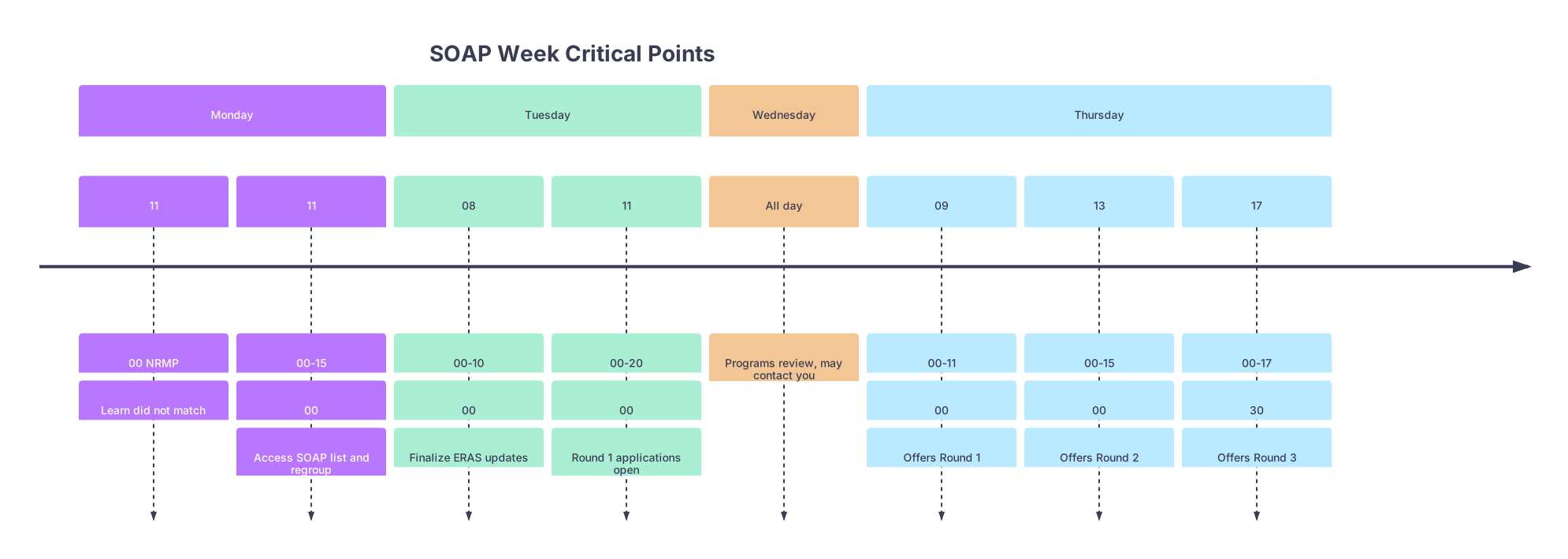
| Period | Event |
|---|---|
| Monday - 11 | 00 NRMP |
| Monday - 11 | 00-15 |
| Tuesday - 08 | 00-10 |
| Tuesday - 11 | 00-20 |
| Wednesday - All day | Programs review, may contact you |
| Thursday - 09 | 00-11 |
| Thursday - 13 | 00-15 |
| Thursday - 17 | 00-17 |
Your “team” has to be functional before applications open. Realistically:
- Monday 11:00–5:00 p.m.: shock, triage, quick outreach to build your team.
- Monday night: draft/edit new personal statements, update CV, rough SOAP list strategy.
- Tuesday early morning: finalize documents and application list, be ready to submit as soon as the system allows.
If your Dean’s office is weak, that Monday afternoon window is where you either spin in panic or you assemble people.
Pick the second.
Step 3: Who Goes On Your SOAP Team (When Your School Is Useless)
You’re not building a theoretical support network. You’re building a 72-hour strike team with very specific roles.
You need four types of people:
- Strategy Brain – helps pick realistic programs/specialties
- Document Surgeon – shreds and rebuilds your personal statement and CV fast
- Communications Runner – helps with emails, call scripts, scheduling, calming you down
- Institutional Keyholder – the bare minimum person at your school who can click official buttons
Sometimes one person fills multiple roles. But do not try to be all four yourself.
3.1 Strategy Brain
You want someone who actually understands how PDs think and how SOAP really works.
Good options:
- A recent graduate who SOAPed successfully (especially in your target specialty or a backup like IM or FM)
- A resident you know who helped SOAP candidates from their program side
- A brutally honest mentor (clinical attending, research PI) who understands your file and competitiveness
How to reach them fast:
- Text: “Didn’t match, going into SOAP. I need 20–30 min in next 6 hours to decide where/what to apply. Can you help me think strategically?”
- Be clear: you’re not asking them to fix your life, just to help you choose a direction.
3.2 Document Surgeon
This is someone who’s good with words and has seen residency applications.
- Could be: senior resident, writing-savvy friend, partner with editing chops, alumnus you found on alumni directory.
- Their job: make your SOAP personal statement and CV aligned with your revised target. No fluff. No long life story. Just “Here’s why I’m a safe, trainable, motivated candidate for [specialty/program type].”
You send:
- Old personal statement
- Updated specialty target(s)
- 3–4 bullet points of what changed / what you want to emphasize
You say:
- “Can you help me cut this down and retarget it to prelim medicine and TY by tonight?”
- Give them a deadline: “I need this back by 10 p.m. tonight latest.”
3.3 Communications Runner
During SOAP you will be:
- Writing emails to program coordinators
- Taking and returning calls
- Managing a spreadsheet of programs and offers
- Possibly contacting letter writers or faculty for last-minute support
You will be sleep-deprived and anxious. Mistakes multiply fast in that state.
Your runner can be:
- A trusted classmate who did match and wants to help
- Partner, sibling, or roommate who can follow instructions and keep a log
- Non-med friend who is organized and calm
Their tasks:
- Maintain a live list: program, contact number, person spoken to, what was said, follow-up needed
- Watch your email and text for important program communication when you’re on the phone
- Prompt you: “You said you’d email Dr. X your updated PS. Do it now.”
3.4 Institutional Keyholder
Even if your Dean’s office is lame, you still need exactly one person who can:
- Confirm: “Yes, we will release updated MSPE” (if that happens)
- Answer if a PD calls: “Is this student in good standing / cleared to graduate?”
- Sign anything required (rare during SOAP, but possible)
If your Dean is unresponsive, go down the food chain:
- Student affairs coordinator
- Registrar who deals with ERAS
- Clerkship director who actually replies to emails
Your email should be direct and specific:
Subject: URGENT – SOAP Support I Will Need (Minimal Time Commitment)
I learned I did not match and will be entering SOAP. I know this is a very busy week for you.
To make this manageable, here’s exactly what I may need from the school:
- Confirmation to programs that I am on track to graduate.
- Rapid response if a program director or coordinator calls or emails to verify my status.
I will handle my own document edits, program list, and outreach. I just need to know:
- Who should programs contact for verification?
- Is there anything the school requires me to do on my end today?
Thank you for any help you can provide.
You’re not asking them to solve SOAP. You’re telling them you’re low-maintenance and need them for exactly two things. That increases your odds of them actually doing it.
Step 4: Assign Clear Roles and Channels
Once you have names, turn this into a literal mini-team. Not vibes. Structure.
- Create a group chat (Signal, WhatsApp, text) with the core 2–4 people.
- Rename it to something obvious: “SOAP Team – [YourName].”
- Post your timeline and current target specialty.
Then explicitly assign:
- “[Name], you’re my Strategy Brain. I’ll send you my current application and the unmatched list when it drops. I need 30–45 min with you this evening.”
- “[Name], you’re my Editor. I’ll send you my PS and CV in an hour with notes; I need returns by 10 p.m.”
- “[Name], you’re my Communications. You keep the spreadsheet and nudge me if I’m forgetting follow-ups.”
People help more when they know exactly what their job is.
Step 5: Build Your Live SOAP Command Center
You need one central place where your brain doesn’t have to remember everything. That’s your command center.
Set up:
- One spreadsheet (Google Sheets works for collaboration)
- One folder for documents (Drive/Dropbox/OneDrive)
Your spreadsheet needs, at minimum:
| Column | Purpose |
|---|---|
| Program Name | Exact program name as listed in SOAP |
| Specialty / Track | IM categorical, IM prelim, TY, FM, etc. |
| State | For geographic realities and licensure issues |
| Applied? (Y/N) | Track where your ERAS application actually went |
| Contact Info | Coordinator email/phone, PD email if known |
| Status | No response / Interested / Interview / Offer / Rejected |
Have your Communications Runner maintain this while you think and talk.
In your documents folder, keep only what you’ll truly use:
- PDF of your CV
- Final SOAP personal statement(s) labeled clearly (e.g., “PS_IM_Prelim_SOAP_FINAL”)
- Any additional letters (if uploaded in ERAS; you will not be manually sending most of these)
Step 6: Tighten Your Story – Why You Didn’t Match and Why You’re Still A Good Bet
You will be asked, explicitly or implicitly: “Why are you in SOAP?”
You and your team need a clean, honest, non-dramatic answer. It has to be the same core story in:
- Your personal statement
- Any emails to programs
- Phone calls with PDs or residents
- Conversations with your own faculty who might advocate for you
Bad answers are defensive or vague:
“I don’t know, I thought I was competitive.”
“I guess the match is random.”
Good answers are targeted and accountable. For example:
- “I applied narrowly to highly competitive programs in [Specialty] in one region because of family reasons. I received several interviews but ultimately did not match. I’m fully committed to completing a strong prelim medicine year and re-applying, and I know I can contribute from day one.”
- “My Step 1 failure earlier in medical school limited my interview offers. Since then I’ve passed all exams on first attempt, done well on rotations, and I’m ready to work hard in an IM prelim/TY spot to prove I’m a reliable resident.”
Have your Strategy Brain sanity-check this story. Have your Document Surgeon make sure your PS aligns with it.
Step 7: Decide Your SOAP Target – With or Without Your Dean
If your Dean’s office isn’t helping, someone has to be the adult in the room. That’s you + your Strategy Brain.
You must answer:
- Are you still going for the same specialty, via:
- Categorical spots in SOAP (rare but possible in FM, IM, peds, psych)
- Prelim/TY spots as a bridge year?
- Are you open to pivoting entirely to a less competitive specialty this week?
- What are your geographic non-negotiables? (If any.)
Be brutally realistic. If you applied Ortho with a 230 Step 2 and mediocre research, you are not SOAPing into Ortho. You may be SOAPing into:
- TY
- Prelim Surgery/IM
- Possibly categorical IM/FM if available and if you’re willing
You should sketch 2–3 scenarios with your Strategy Brain:
- Plan A: Still attempt some categorical positions in [X] if present, plus broad prelim/TY.
- Plan B: No categorical options; aim for best prelim IM / TY with re-application plan.
- Plan C: If flexible and positions exist, pivot to FM or IM categorical and commit.
Put it in writing in your team chat so everyone stops guessing.
Step 8: Use External Resources Like a Realist, Not a Victim
Your Dean’s office isn’t great. That does not mean you’re alone.
Places you can pull support from, quickly:
Alumni from your school on LinkedIn:
- Filter by specialty and graduation year.
- Cold-message: “Hi Dr. X, I’m a current MS4 at [School]. I did not match and will be entering SOAP. You’re in [specialty/program] and I’d value 10–15 minutes of your perspective on realistic SOAP targets with my stats. I know this week is insane; if now is bad, I understand.”
Specialty organizations:
- Some have student/resident sections with mentorship Slack/Discord (e.g., EMRA for EM, ACP for IM).
- Drop one concise post: “In SOAP, need quick perspective on [specific question].”
Online communities:
- Reddit r/Residency, r/medicalschool, SDN, etc. Use with caution. Ask specific questions, not “What are my chances?”
- Example: “Unmatched IM applicant, 7 interviews, no red flags. SOAP list shows X categorical IM positions in [regions]. Would it be reasonable to apply to all categorical + broad prelim IM/TY, or should I pivot toward FM categorical given timeline?”
These strangers aren’t your primary team. They’re “consults.” They can spot blind spots you and your friends might miss.
Step 9: Manage Contact With Programs Without School Hand-Holding
Programs may reach out during SOAP by email or phone. They may also ignore you completely. Both are normal.
You need a basic phone/email playbook.
Phone script (for when a program calls)
You: “Hello, this is [Your Name].”
Program: “Hi, this is [Name] from [Program]. Is now a good time?”
You: “Yes, absolutely. Thank you for calling.”
They’ll usually ask some combination of:
- Why you’re in SOAP
- Why their program / that specialty
- What you’re looking for in a prelim/TY/categorical spot
- Clarify any red flag
Keep a 2–3 sentence answer ready for each. Your team can help you rehearse.
After the call:
- Immediately message your Communications Runner: “Call from [Program X], seemed [interested/neutral], asked about X, I emphasized Y.”
- Update the spreadsheet status.
Emailing a program (if appropriate)
Do not spam 100 programs with generic emails. Target ones where you have:
- A real connection (you rotated there, you interviewed there, an attending knows them)
- A very specific reason why you fit (e.g., strong interest in community IM, rural health, etc.)
Template:
Subject: SOAP Applicant – [Your Name], [Specialty/Track]
Dear Dr. [PD Last Name] and Residency Team,
My name is [Name], a fourth-year medical student at [School]. I applied to [Specialty] this cycle and, unfortunately, did not match. I am entering SOAP and saw that your program currently has open [track, e.g., prelim IM] positions.
I am very interested in your program because [1–2 concrete reasons tied to training style, patient population, or your background]. I have attached my CV for quick reference; my full ERAS application is available in the SOAP system.
If you are reviewing applications for these positions, I would be grateful for your consideration. I would gladly speak by phone at your convenience. I can be reached at [phone] or [email].
Sincerely,
[Name]
AAMC ID: [ID]
Your Document Surgeon can refine this once, then you lightly customize for 3–10 programs max.
Step 10: Emotional Containment – Your Team Is Also Your Brake Pedal
This week isn’t just logistics. It’s grief, shame, anger, and fear packed into 4 days.
You are more likely to:
- Over-apply chaotically (“I’ll just SOAP into anything anywhere!”)
- Under-apply out of pride (“I refuse to do FM or prelim anything”)
- Ghost communication because you’re embarrassed
Give your team explicit permission to check your worst impulses.
Say something like:
- “If I start panicking and saying I’ll withdraw from SOAP completely, remind me of our Plan A/B.”
- “If I refuse to apply to prelim/TY even though we agreed that’s realistic, push back.”
And tell them what not to do:
- “Please don’t feed me toxic positivity. I don’t need to hear ‘it will all work out.’ I need you to help me make clean decisions.”
Step 11: Day-By-Day Focus With Your DIY SOAP Team
Let’s break down what you and your team should aim for each key day when your school isn’t guiding you.
Monday (Unmatched Day)
Your focus:
- Assemble team (Strategy Brain, Editor, Runner, Keyholder)
- Get your story straight
- Decide on specialty targets and broad plan
Team tasks:
- Strategy Brain: 30–60 min call to set Plan A/B/C
- Editor: first pass at revised PS by late evening
- Runner: sets up spreadsheet, shares with group, starts pre-populating once SOAP list is viewable
Tuesday (Applications Open)
Your focus:
- Finalize application list with Strategy Brain
- Upload correct PS version to each specialty/track in ERAS
- Submit applications early in the window
Team tasks:
- Editor: final tweaks to PS and any short text fields
- Runner: checks off “Applied?” in spreadsheet as you submit, tracks any early responses
- Keyholder: on stand-by in case any ERAS/verification issues arise
Wednesday (Quiet Review Day)
Your focus:
- Be available for emails/calls
- Targeted emails to a small number of programs (not a spam blast)
- Sleep more than 3 hours if possible
Team tasks:
- Runner: logs all contact, flags anything that needs follow-up
- Strategy Brain: helps you decide which programs to prioritize if multiple show interest
Thursday (Offer Rounds)
Your focus:
- Answer calls/emails immediately
- Make decisions on offers within the window (they expire fast)
- Do not commit to something you absolutely cannot live with, but be realistic
Team tasks:
- Runner: tracks offers, deadlines, and your accept/decline decisions
- Strategy Brain: quick consults between rounds if you have multiple offers or none
Step 12: After the Dust Settles – Debrief With Your Team, Not Your Dean
Whether you match in SOAP or not, you’ll have a lot to process. Your Dean’s office may or may not ever give you a serious debrief.
Your team can.
Within a week:
- Schedule a 30–45 min call or Zoom with them.
- Walk through:
- What worked (strategy, communications, targeting)
- What didn’t (overly narrow choices, late edits, lack of earlier backup planning)
- What you’d do differently if you re-apply
Then, document it for yourself. One page. Bullets. No emotions, just facts and lessons.
This will matter if you re-enter the match. It also closes the loop so you do not carry this week as a vague trauma without structure.
Your Next Step Today
Open a blank note on your laptop or phone and write three headings:
- Strategy Brain
- Document Surgeon
- Communications Runner
Under each, list 3 real names you could contact in the next 2 hours. Then send one concise message to each top choice asking for exactly the help you need.
You do not control your Dean’s office. You do control who’s on your side when SOAP starts.