The idea that IMGs and DOs “can’t win” in SOAP is lazy, defeatist, and wrong. The numbers do not support it. The problem isn’t that you cannot match in SOAP—it’s that most people, including advisors, fundamentally misunderstand how SOAP actually works and keep giving you terrible strategy.
Let’s fix that.
What the Data Actually Shows About SOAP
SOAP is not some hidden back door only for US MDs. It’s a structured, data-driven process that disproportionately bails out people who know how to play it—and buries those who treat it like a panic button.
Here’s the first thing people get wrong: SOAP is not one market. It’s multiple overlapping micro-markets—by specialty, program type, geography, and applicant profile. And IMGs/DOs do better in some of those markets than US MDs who walk in with ego and no plan.
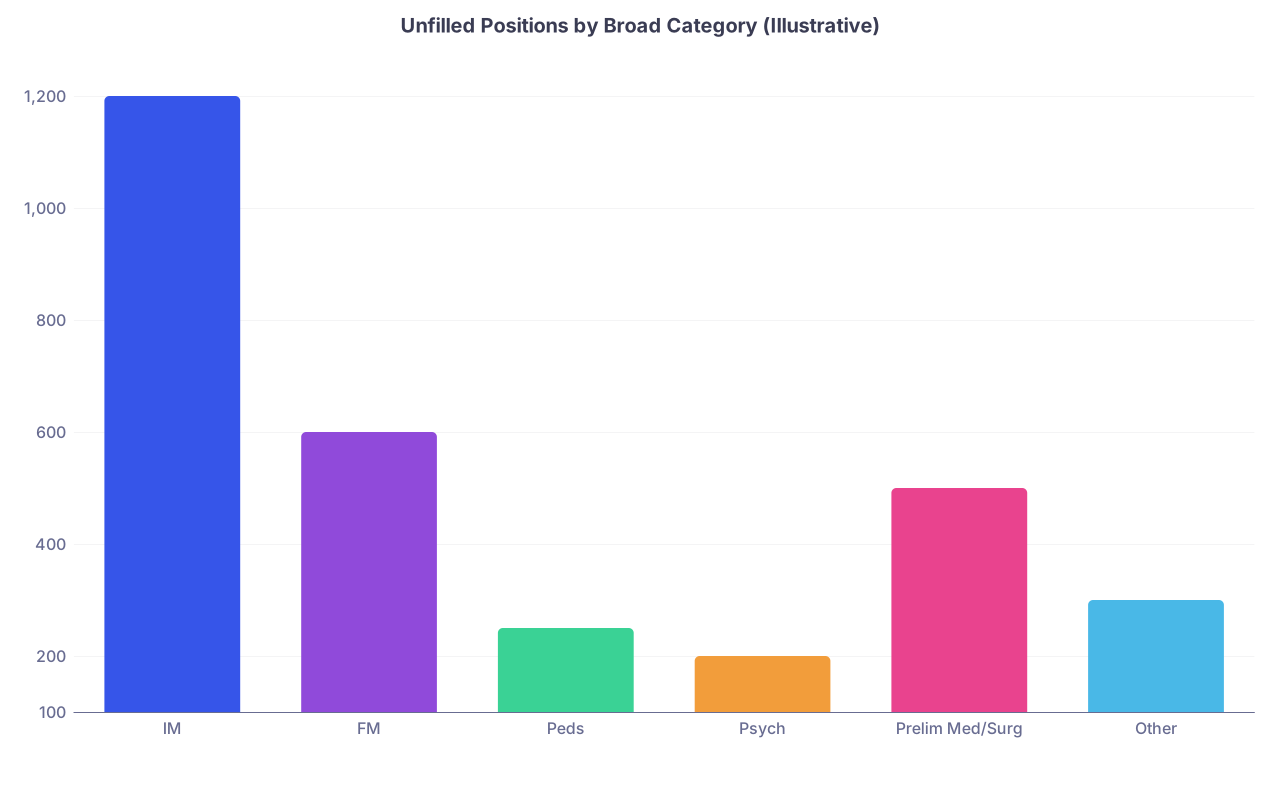
The NRMP publishes SOAP outcomes by applicant type and specialty every year. When you look at unfilled positions and who actually gets them, a few things become obvious:
- SOAP is dominated by a handful of specialties: internal medicine, family medicine, pediatrics, psych, prelim medicine, prelim surgery, and transitional year.
- Those specialties have historically taken huge numbers of IMGs and DOs in the main Match.
- Many of the programs that go unfilled are exactly the programs that already accept IMGs and DOs in their regular class.
Translation: the belief that “SOAP is just for US MDs who slipped” is fiction. The pipeline that feeds unfilled positions is heavily IMG/DO-friendly to begin with.
| Category | Value |
|---|---|
| IM | 1200 |
| FM | 600 |
| Peds | 250 |
| Psych | 200 |
| Prelim Med/Surg | 500 |
| Other | 300 |
Are these exact numbers? No. But the pattern is correct: SOAP is driven by core, primary-care–heavy specialties, where IMGs and DOs have always had a real shot.
The real divide in SOAP is not US MD vs DO vs IMG.
It’s:
- Applicants who understand program behavior, timing, and communication rules
vs. - Applicants who submit 45 low-yield applications and then sit there refreshing their email.
You know which group usually loses.
Myth Breakdown: “Programs Don’t Want IMGs/DOs in SOAP”
This is probably the most common line I hear from demoralized applicants and, depressingly, from some attendings who haven’t opened an NRMP report in a decade.
Let’s be clear:
Programs in SOAP do not suddenly become “too good” for the same applicant types they routinely accept in the main Match.
Here’s what’s actually going on in many unfilled programs that IMGs/DOs see:
- Community internal medicine in the Midwest that already has 40–60% IMG residents: they didn’t magically turn anti-IMG on Monday of SOAP week.
- Osteopathic-friendly family medicine that historically fills with 50–70% DOs: they don’t secretly pivot to “US MD only” just because it’s SOAP.
- Prelim medicine spots at mid-tier academic centers that already have DO interns every year: same story.
I’ve seen program directors literally say on SOAP calls, “We like IMGs, but we don’t like chaos.” They don’t want incomplete applications, sloppy documents, or someone who clearly applied to 40 neurosurgery programs and 1 prelim med as a panic backup. They’re not rejecting your degree; they’re rejecting the red flags.
Here’s what does shift in SOAP:
- Time pressure: Programs have hours to decide, not months.
- Risk tolerance: They’re less inclined to “take a chance” if your file is confusing, poorly targeted, or missing key elements (like Step 2, US clinical experience, or any evidence you actually want them).
- Signal clarity: They favor applicants whose documents scream, “I am built for this type of program and this specialty,” not “I’m an unmatched neurosurgery applicant trying to survive.”
The IMGs and DOs who win in SOAP are the ones whose applications are already aligned with SOAP-relevant specialties and who stop assuming the system is rigged against them.

Where IMGs and DOs Actually Have Leverage in SOAP
SOAP is not symmetric. There are places where IMGs/DOs are swimming upstream (categorical surgery, radiology, derm, etc.), and there are places where they have very real leverage. You need to know which is which.
Here’s the pattern I’ve seen over multiple cycles—paired with what NRMP trend data supports.
Higher-Opportunity Zones for IMGs and DOs in SOAP
Categorical Internal Medicine (Community/University-affiliated)
The bread and butter of SOAP. Many of these programs already have high IMG representation. They care about:- Passing USMLE/COMLEX on first attempt
- Some US clinical experience
- A believable narrative for primary care / hospital medicine
Not perfection.
Family Medicine (Community-heavy, non-urban)
Plenty of DOs, plenty of IMGs in their regular classes. They often go unfilled in less popular locations. They care a lot about:- Genuine interest in outpatient primary care
- Geographic commitment (or at least plausible story)
- Ability to communicate clearly (they notice awkwardness fast on SOAP calls)
Pediatrics (Non-elite programs)
Not as many unfilled as IM/FM, but when they appear, IMGs and DOs are not rare in their resident lists. Especially in less coastal, less “brand-name” institutions.Psychiatry (Some community / newer programs)
Historically fewer SOAP spots, but when they do show up, US-IMGs and DOs with decent scores and good communication skills absolutely get traction.Prelim Medicine / Transitional Year
The lifeboats. Heavily populated with DOs and IMGs in many institutions. If you’re willing to pivot, these are rescue options that can reset your trajectory.
Lower-Opportunity Zones (Where the “Myth” is Actually a Half-Truth)
- Categorical surgery (especially big academic)
- Radiology, anesthesia, EM (when they even show up in SOAP)
- Anything with “top 20” name recognition
Could an IMG or DO SOAP into those? Very rarely, yes. But building your whole SOAP strategy around that fantasy is suicidal. You’re better off securing a real position in a more IMG/DO-favorable specialty than playing “maybe they’ll pick me” roulette while your competitors snap up IM/FM/TY/Prelim slots.
| Specialty Type | IMG/DO SOAP Opportunity |
|---|---|
| Community Internal Medicine | High |
| Community Family Medicine | High |
| Non-elite Pediatrics | Moderate |
| Psychiatry (community/newer) | Moderate |
| Prelim Med / TY | High |
| Categorical Surgery | Very Low |
Why IMGs and DOs Lose in SOAP (It’s Usually Not Bias)
When an IMG or DO tells me they “never had a chance” in SOAP, and I dig into their behavior, the pattern is painfully predictable.
Here’s where people actually blow it:
1. They Treat SOAP Like a Second ERAS
SOAP is not a second full-cycle Match. You do not have months. You have hours to:
- Decide your specialty targets
- Rank program types by realism
- Send out applications that actually match your stated goals
Weak strategy I keep seeing:
The unmatched neurosurgery or ortho applicant who sends 45 SOAP applications to categorical IM programs with a personal statement still talking about “my dream of being a surgeon” and zero IM letters.
Programs see that and think:
“This person will leave the second they get a research year or PGY2 surgery. Hard pass.”
SOAP favors brutal clarity: “I am now fully committed to internal medicine/family/peds/psych.” If your documents betray ambivalence, you just lost the tie-break against the IMG/DO who sounds all-in.
2. They Don’t Pre-Build a SOAP Playbook
US MDs often have advisers shoving SOAP checklists in their faces in January. IMGs and DOs often get: “You’ll be fine; just apply broadly.”
That’s malpractice.
You need a pre-built SOAP playbook before Rank Day:
- A short list of realistic specialties you’d pursue if unmatched
- Drafted, specialty-specific personal statements (yes, multiple versions)
- An updated CV that doesn’t scream “I only care about one ultra-competitive specialty”
- A realistic willingness hierarchy:
- “I’d go anywhere for IM” vs
- “Only in these 10 states” vs
- “I cannot move due to family/visa”
The IMGs and DOs who match in SOAP look like they were already aligned with these specialties, not like they smashed the panic button at 11:01 a.m. Monday.

| Step | Description |
|---|---|
| Step 1 | Before Rank Day |
| Step 2 | Define backup specialties |
| Step 3 | Draft specialty PS |
| Step 4 | Update CV and LoRs |
| Step 5 | Research IMG/DO-friendly programs |
| Step 6 | Unmatched on Monday |
| Step 7 | Review unfilled list quickly |
| Step 8 | Target realistic programs first |
| Step 9 | Submit SOAP applications |
| Step 10 | Prepare for calls and interviews |
3. They Misjudge “Fit” Based on Ego, Not Evidence
I’ve watched applicants filter the SOAP list and dismiss half of their best options in 60 seconds:
- “That’s in the Midwest, I’m from NYC, they won’t like me.”
- “Community program, not academic enough.”
- “Too small a town.”
- “Not prestigious.”
Then they complain there were “no opportunities” for IMGs/DOs.
The programs that are most open to IMGs/DOs in SOAP are often:
- Outside big coastal metros
- Heavily community-based but with solid training
- Less fancy names, more service-heavy populations
The question is not: “Would my classmates be impressed if I matched here?”
The question is: “Will this program train me, sponsor my visa if needed, and get me board-eligible so I can build the career I want?”
If you filter based on pride, SOAP will punish you. Hard.
4. They Fumble Communication Once Programs Call
SOAP communication rules are strict (no unsolicited outreach to programs). But once programs contact you, it’s game on.
What kills IMGs/DOs here isn’t their degree. It’s poor, unstructured communication:
- Rambling answers that never clearly say, “Yes, I would absolutely come here if you rank me.”
- Conflicting signals about specialty commitment: “Well, I still dream of surgery…” during an IM SOAP call.
- Vague geographic answers: “I’m open to anywhere” said in a way that sounds fake and hesitant.
Programs have 10–15 minutes to figure out:
“Will this person show up in July, work hard, and not cause drama or leave immediately?”
You do not need to be dazzling. You need to be clear, consistent, and concrete.

High-Yield SOAP Strategy for IMGs and DOs
Let me strip this down into what actually moves the needle.
1. Build a SOAP-Ready Application Before You Need It
If you’re an IMG/DO applying in a competitive specialty—or with any risk factors (low scores, late exams, limited US experience)—you should:
- Write at least one strong, generic internal medicine or family medicine personal statement months before Match Week.
- Have at least 2–3 letters that would make sense in IM/FM/Peds/Psych, not only in your dream specialty.
- Clean up your CV so it reads like a physician-in-training, not a future Nobel laureate who stumbled into residency as an afterthought.
You’re not “being negative.” You’re respecting the math.
2. Treat the Unfilled List Like a Data Problem, Not an Emotional One
When the unfilled list drops:
- Sort quickly by specialty and state.
- Identify IM/FM/Peds/Psych/Prelim/TY programs that:
- Historically take IMGs/DOs (check current residents on program websites)
- Are not obviously out of your league in score profile
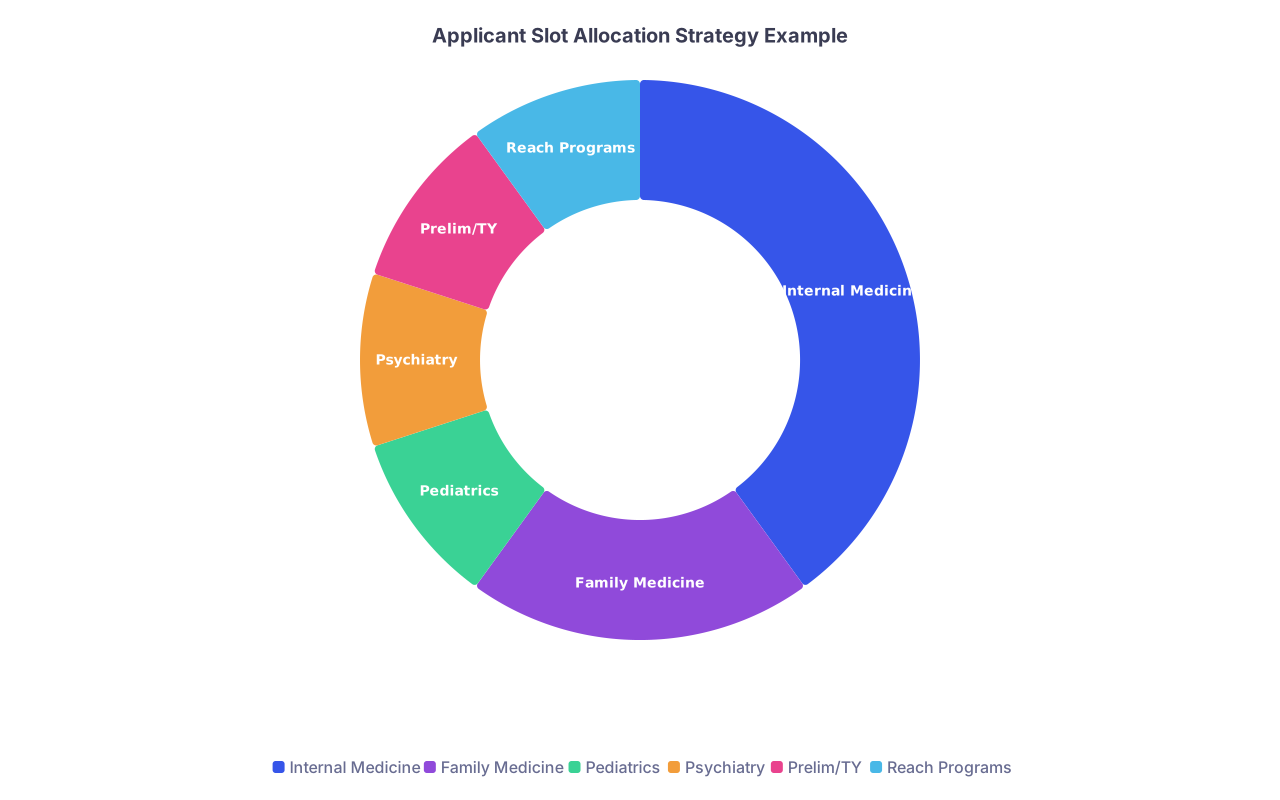
Prioritize those for your first-wave applications. Don’t waste your limited slots trying to SOAP into a program that didn’t even rank applicants like you in the main Match.
| Category | Value |
|---|---|
| Internal Medicine | 20 |
| Family Medicine | 10 |
| Pediatrics | 5 |
| Psychiatry | 5 |
| Prelim/TY | 5 |
| Reach Programs | 5 |
That kind of distribution is far smarter than “25 random IM + 20 reach-y programs I emotionally like.”
3. Make Your Documents Scream “I Belong Here Now”
For each SOAP-targeted specialty:
- Use a specialty-specific personal statement. One page. Tight. No fluff about a completely different field.
- Emphasize:
- Bread-and-butter clinical experiences
- Teamwork
- Reliability and resilience
- Any prior exposure to similar patient populations or practice settings
SOAP programs don’t want to be your consolation prize. On paper, they want to look like your logical and deliberate path.
4. On Calls: Be Bluntly Clear About Commitment
When a program calls or interviews you during SOAP:
Say things like:
- “Yes, Doctor, I would absolutely come if offered a position here.”
- “I’ve thought a lot about this, and I’m now fully committed to internal medicine as my long-term path.”
- “Your program’s strength in community-based training actually matches my long-term goal of working in similar settings.”
Don’t say:
- “I’m open to anything.”
- “I guess I could see myself in IM, maybe.”
- “I still hope to do neurosurgery later, but for now…”
You’re not auditioning for creativity. You’re auditioning for reliability.

The Real Myth: “SOAP Is Rigged Against You”
SOAP is not fair. But it’s not uniquely unfair to IMGs and DOs. It’s brutal to anyone who shows up unprepared, inflexible, or in denial.
Here’s what the numbers and real-world behavior actually show:
There are plenty of SOAP positions in specialties that routinely accept IMGs and DOs. Internal medicine, family medicine, and prelim/TY remain realistic pathways if you plan for them.
Programs do not suddenly stop liking IMGs/DOs in SOAP. They just become more risk-averse and time-pressured. If your file looks misaligned or desperate, they’ll skip you—regardless of degree.
The IMGs and DOs who win in SOAP are the ones who treat it as a strategic process, not an emergency button. They pre-build backup narratives, target the right programs, and communicate clear commitment when it counts.
You cannot control your degree. You can control your preparation, your targets, and your behavior in the most chaotic week of the year. That is where IMGs and DOs stop being victims of a myth and start winning in SOAP.