
The match does not care about your high scores. SOAP programs care about what you can fix in 48 hours.
You are not in a normal application cycle anymore. You are in crisis triage. And if you have strong scores but still went unmatched, you’re in a very specific, very solvable situation—if you play it right.
This is the playbook for that situation.
1. Accept the Reality Fast, Then Flip the Script
You woke up on Monday of Match Week, opened your email, and saw it: “We are sorry to inform you…”
High Step scores. Strong clerkship comments. Maybe even solid research. And still: unmatched.
Here is the blunt truth:
Programs already told you what they thought of your initial package. SOAP is not about convincing the same programs they were “wrong.” SOAP is about:
- Repositioning yourself for a different tier or type of program
- Fixing the obvious red flags or mismatches in your application narrative
- Leaning hard on your strengths (especially your scores) where they actually matter
You do not have time for grief + analysis + complete reinvention. You have hours, not months.
So the mental reframe is simple:
“I am not a failed applicant trying to salvage anything. I am a strong candidate who targeted the wrong set of programs, and now I’m pivoting hard to the ones that will actually take me.”
That mindset changes how you write, how you email, and how you speak on calls.
2. Diagnose Why You Really Went Unmatched (In One Hour)
You will be tempted to spiral into a multi-week postmortem. You do not have that luxury. You need a 90% accurate diagnosis in under an hour so you can tailor your SOAP strategy.
Set a timer for 60 minutes. No more.
Step 1: Compare yourself to matched peers
Open your list of classmates / co-applicants. Look at:
- Where they matched
- Their board scores (rough estimates if you know), school reputation, extra things (research, home program, away rotations, visa status, etc.)
You’re asking one question:
“Why might a program feel safer ranking them than me, despite my high scores?”
Common actual reasons I keep seeing:
- No home program in your specialty, so no strong “inside” advocate
- Weak or generic letters compared to peers who had powerful advocates
- Significant gap year(s) without clear explanation or productivity
- IMG/DO applying heavily to super competitive specialties or university-heavy lists
- Applied too top-heavy (too many academic / big-name programs, not enough community)
Step 2: Identify your application’s obvious “don’t rank” triggers
You know these when you see them:
- Failed Step/COMLEX attempt (even with high final score)
- Major professionalism incident (even “resolved”)
- Multiple low clerkship grades in core rotations
- Personal statement that screamed “I will reapply to a different specialty”
If you’re thinking, “None of those apply,” then your problem is usually:
- Strategy mismatch (too competitive programs)
- Not enough programs (common in competitive specialties)
- Weak narrative / poor interviews
Your SOAP angle depends on which bucket you’re in. But your high scores are a constant: they’re leverage. They just weren’t enough the first time.
Write down in one sentence:
“I went unmatched primarily because ________.”
You will use that sentence to guide what you emphasize or downplay in SOAP documents and calls.
3. Re-Target: Where High Scores Suddenly Matter a Lot
SOAP is not just “apply to whatever is open.” That is a rookie mistake and I’ve watched people repeat it year after year.
You need to apply where your high scores transform you from ‘maybe’ to ‘obvious yes’.
Let’s be concrete.
| Program Type | How High Scores Help You |
|---|---|
| Community Internal Medicine | Signal low remediation risk, ease of passing boards, help with accreditation data |
| Community Pediatrics | Make you a safer bet in a smaller resident class |
| Transitional Year | Very score-sensitive for board pass rates and specialty pipelines |
| Preliminary Medicine/Surgery | Programs want residents who can handle heavy workload and pass boards |
| Lower/mid-tier University Programs | High boards can offset weaker school name or lack of connections |
If you originally applied:
- Derm, Ortho, ENT, Urology, Plastics, Rad Onc, Neurosurgery
and you’re unmatched with a 250+ / 650+, then your move in SOAP is not “wait for a miracle spot in your dream specialty.”
Your move is:
- Identify core specialties with SOAP spots (IM, Peds, FM, Psych, TY, Prelim)
- Decide:
- Am I willing to fully pivot to a new specialty this year?
- Or do I want a prelim/TY year and reapply later?
Your high scores make you:
- Very attractive for prelim internal medicine or surgery
- Strong for transitional years linked to larger institutions
- Overqualified (in a good way) for many community FM/IM programs that just want reliable, low-drama residents
Do not let pride trap you. A solid community IM or TY year is far better than a “reapply with a gap and no U.S. experience” plan.
4. Rewrite Your Personal Statement for SOAP (Fast and Targeted)
Your old personal statement is almost certainly wrong for SOAP. It was written for broad, ideal scenarios. SOAP is specific.
You need a SOAP-specific personal statement that:
- Aligns clearly with the program type you’re applying to
- Uses your high scores strategically, not as bragging rights
- Sounds committed, not “I’m just here until my real specialty calls”
Template for SOAP Personal Statement (Internal Medicine example)
Paragraph 1 – Immediate, honest, grounded:
1–3 sentences about where you are right now.
Example:
“I am an unmatched applicant with strong exam performance (Step 1 pass, Step 2 CK 255) and robust clinical evaluations, now seeking a categorical internal medicine position where I can contribute immediately on the wards while growing into a reliable, high-performing resident.”
Paragraph 2 – Clinical strength and work ethic:
Use specific anecdotes from IM rotations, sub-I, night float, ICU, hospitalist shadowing.
Paragraph 3 – Use your scores correctly:
One short line: “My board scores reflect the same habits I bring to patient care: disciplined preparation, attention to detail, and resilience under pressure.”
Then pivot to:
“…but what has mattered more to me than exam performance has been the feedback I receive from residents and attendings about my reliability on call and my calmness in difficult moments.”
Paragraph 4 – Explicit commitment:
Say clearly: you are fully committed to internal medicine as a career (unless this is a prelim-only letter, in which you’re honest but respectful).
Do not write: “I hope to eventually pursue dermatology after a year in medicine.”
That will kill you in SOAP.
For prelim/TY statements, you can say something like:
“I intend to pursue [specialty] in the future, but I recognize that success in any advanced field is built on the foundation of strong clinical training in [medicine/surgery] and commitment to team-based care.”
Tone: humble, direct, committed.
5. How to Talk About Being Unmatched Without Sounding Toxic
Programs are wary during SOAP. They know they’re getting:
- People with red flags
- People who overshot and are still in denial
- People who will leave as soon as something “better” appears
You must sound like none of those.
Script for “Why do you think you went unmatched?”
Use this basic structure:
- Ownership (not blame)
- Specific reason
- What you’ve learned / changed
- Why you’re genuinely interested in them now
Example for a competitive specialty re-applicant:
“I applied broadly in dermatology this cycle, and while my scores were strong, my application was not competitive enough in terms of research or home program support. I recognize now that I built my list too top-heavy and did not apply to enough backup specialties. What I’ve always enjoyed most has been inpatient and longitudinal adult care, and I’m now fully focused on building a career in internal medicine, starting with a program like yours where I can work hard, take care of complex patients, and contribute from day one.”
Straight. Clean. No whining.
If your issue was late exam or CS/Level 2 failed attempt:
“I had a failed attempt on [exam] due to [brief, neutral explanation], and I passed comfortably on my second attempt after restructuring how I studied and using faculty support. That experience actually improved how I prepare and how I manage stress, and I’ve carried that into my clinical work.”
Do not over-explain. If they want details, they’ll ask.
6. Tactical SOAP Strategy: What To Do Hour-by-Hour
Here’s the rough flow when SOAP opens and unfilled positions are released.

| Step | Description |
|---|---|
| Step 1 | Unmatched Email |
| Step 2 | 60 min root cause analysis |
| Step 3 | Decide target - categorical vs prelim/TY |
| Step 4 | Rewrite personal statement for target |
| Step 5 | Update CV and ERAS filters |
| Step 6 | Select and prioritize 45-60 programs |
| Step 7 | Submit applications as early as possible |
| Step 8 | Prepare 3 talking points and red flag script |
| Step 9 | Phone and email follow up to key programs |
| Step 10 | Answer calls professionally and promptly |
| Step 11 | Reassess targets if no bites by mid-SOAP |
Let’s break that into concrete moves.
Before the list of unfilled positions drops
- Create 2–3 versions of your personal statement:
- One for IM/FM/Peds
- One for prelim/TY (medicine-leaning)
- One for prelim (surgery-leaning) if relevant
- Draft a tight, updated CV (ERAS already has most of it, but have your talking points ready).
- Write a 3–4 line email template you can customize to PDs (we’ll get to that).
Once positions are released
- Filter programs by:
- Specialty
- Visa requirements (if IMG)
- US grad vs IMG friendliness
- State/location you can realistically move to
- Mark 10–15 top priority programs where your high scores give you a clear advantage over their usual range.
Example: Your Step 2 is 255. Program’s typical range on FREIDA is 220–235 → gold.
- Apply early. SOAP is not “first come = only come,” but earlier apps are read more calmly. Later, PDs are just scanning.
7. Using Email and Phone Without Being Annoying
You are going to feel desperate. Desperation leads to spam. Spam leads to trash.
You want targeted, respectful outreach, not a mass email blast.
When to email a PD or coordinator
- Program is a top choice for you
- Your scores are clearly above their usual range
- You have either a geographic tie, language advantage, or genuine fit reason
Sample email (short):
“Subject: SOAP Applicant – [Your Name], [Specialty] – Step 2 254
Dear Dr. Smith,
I am an unmatched applicant participating in SOAP this week, very interested in your [Program Name] internal medicine program. I have strong exam performance (Step 1 pass, Step 2 CK 254) and solid clinical evaluations from my medicine rotations and sub-internship.
I have applied to your program in SOAP and would be grateful for any consideration. I grew up in [region] and hope to train and serve this community long term.
Thank you for your time during this busy week.
Best regards,
[Name], [Med School], AAMC ID [ID]”
Do not attach a bunch of files. They have ERAS.
Phone etiquette
If they list a number for questions, fine. Keep it surgical:
- Confirm they received your ERAS application
- Ask if they are still reviewing SOAP applications
- Express brief, clear interest
Not: “Can I speak to the program director?”
Try: “I just wanted to confirm my application is complete and express that your program is a top choice for me.”
One call per program. Not multiple.
8. How to Present Your High Scores Without Being Obnoxious
You’re proud of your numbers. But you do not want to come off as the person who thinks a 260 entitles them to derm at a top 5.
You frame scores as:
- Evidence you can handle boards and exams
- Proof of discipline, not of “genius”
- A benefit to the program (accreditation, pass rates, reputation)
Talking point examples:
- “I’ve consistently performed well on standardized exams, and I’d leverage the same habits to prepare for in-training and ABIM exams. I know pass rates matter for programs.”
- “My scores are a reflection of detailed preparation and a willingness to put in the hours, which is the same approach I bring to patient care.”
You never say:
- “I was surprised I didn’t match with my Step 2 of 255.”
- “I feel I was overqualified for some programs.”
That energy is poison during SOAP.
9. Decision Point: Categorical vs Prelim/TY for Reapplication
If your heart is still set on a highly competitive specialty (derm, ortho, etc.), you have a fork in the road:
- Take a categorical spot in a core specialty and realistically pivot your career
- Or accept a prelim/TY year with a solid plan to reapply
High scores help significantly with landing those prelim/TY spots.
Ask yourself:
- If I do a full year of medicine/surgery, will I be okay if I never leave this specialty?
- Am I ready to do the work needed in that field, not just use it as a bridge?
If the answer to #1 is “absolutely not,” then prelim/TY is the more honest route. But understand: reapplying as a PGY-1 is exhausting. Interviews on golden weekends, letters during residency, limited flexibility.
Many people start a categorical in IM/FM and discover they actually like it and stay. There is no shame in that. It is a good life.
10. After SOAP: Use Your Strengths Even If You Still Don’t Match
Worst-case scenario: SOAP ends and you still do not have a position.
If that happens and you have high scores, you still have leverage—just in a different time frame.
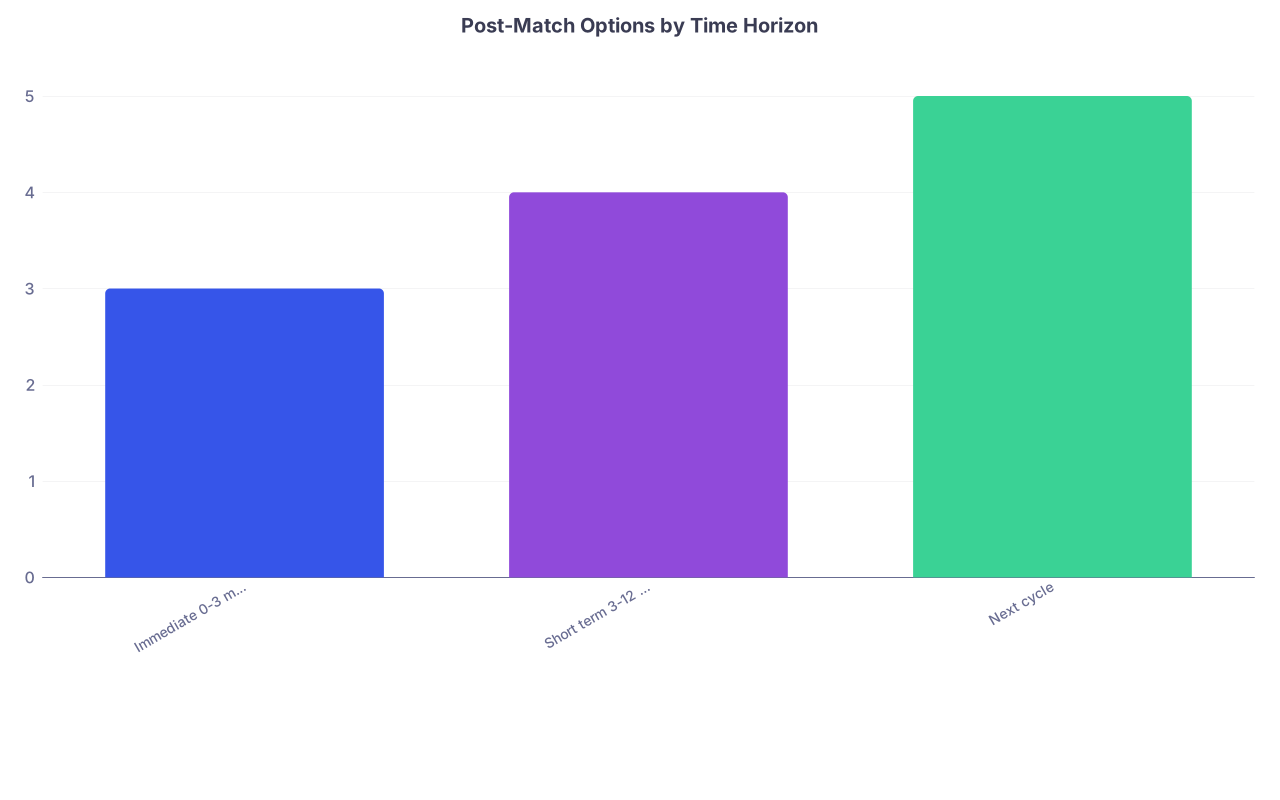
| Category | Value |
|---|---|
| Immediate 0-3 months | 3 |
| Short term 3-12 months | 4 |
| Next cycle | 5 |
Concrete moves:
- Get a clinical position: research fellow, hospital scribe, clinical instructor, or prelim spot off-cycle (this happens quietly).
- Stay exam-current: help teach Step prep, write question banks, tutor. It keeps your knowledge sharp and demonstrates engagement.
- Fix your weaknesses:
- If letters were weak, get new ones from your current clinical work
- If interviews were bad, work with someone who will actually mock-interview you harshly
- If your application was unfocused, rebuild the narrative around the specialty you’re actually going for
Reapply early and do not repeat the same list-building mistake. High scores + U.S. clinical experience + realistic program list usually gets traction.

FAQs
1. Should I pivot specialties in SOAP if I was originally applying to something competitive?
If you’re unmatched with high scores and your original specialty was highly competitive, yes, you should strongly consider pivoting in SOAP. A categorical spot in IM, FM, pediatrics, or psych gives you a real career and still leaves doors open for fellowship and subspecialization. A prelim/TY year is reasonable if you are absolutely committed to reapplying, but do not take it lightly—it means another full year of stress and uncertainty. When in doubt, pick the path that gives you stable training and a board certification.
2. How many SOAP programs should I contact directly outside of ERAS?
Keep it focused. Apply broadly through ERAS, but direct emails/calls should be limited to 10–20 genuinely high-priority programs where you can clearly articulate why you fit. More than that, and you sound generic and desperate. Your energy is better spent tightening your narrative, practicing interview answers, and being immediately reachable rather than blasting out 100 nearly identical emails.
3. Will programs think I’m “too good” and just leave for a better specialty later?
Some will worry about that—especially if your application screams “I still want derm/ortho/etc.” Your job is to remove that fear. In your personal statement and on the phone, be explicit: you’re committed to their specialty and can see a long-term path there. You do not have to erase your past interests, but you must make a clean, believable case for why this specialty is now your actual plan, not just a one-year parking lot.
Open your SOAP personal statement draft right now and read the first paragraph out loud. Does it sound like a person who knows exactly why they went unmatched and exactly why they’re now committed to this specialty—or like someone still hoping their original plan magically revives? Rewrite that first paragraph until it sounds like the former. Then move.