
You’re sitting in a call room or your apartment. The email just confirmed it: you didn’t match into the competitive specialty you spent the last 2–3 years chasing. It’s Monday of Match Week, the SOAP list is open, and your dream field (ortho, derm, ENT, ophtho, rads, EM, whatever it was) has exactly zero unfilled spots.
But there are a lot of unfilled internal medicine, family medicine, peds, maybe psych and prelim IM spots.
Your dean/advisor is saying, “You should strongly consider SOAPing into primary care.” Your group chat is split between “take any guaranteed spot” and “take a research year and reapply.” Your brain is spinning.
This is the situation: you aimed for a competitive field and now you might be pivoting into primary care during SOAP. You have hours, not weeks, to decide and execute.
Here’s how to handle it—step by step, no fluff.
Step 1: Get Clear on Your Realistic Options (Fast)
You do not have days to soul-search. You have hours. So you need a brutally honest snapshot of your situation.
There are four big variables that actually matter right now:
- Your scores and academic record
- Visa status (if relevant)
- Graduation year (fresh vs older grad)
- What’s realistically on the SOAP list
Take 20–30 minutes and write this out on paper or in a doc:
- USMD / DO / IMG
- Step 1 (P/F or 3-digit), Step 2 CK score, any fails
- Any red flags: LOA, professionalism issues, remediation
- Graduation year
- Visa needs? (J-1/H-1B/no visa)
- The field you just tried to match in
Then, look at the SOAP list with that lens. What’s actually open for:
- Categorical Internal Medicine
- Family Medicine
- Pediatrics
- Psychiatry
- Prelim IM / Prelim Surgery (only if you have a clear plan)
If you’re a USMD or DO with passing scores and you did not match in a competitive field, the odds that you could match into primary care via SOAP are usually good—if you do not sabotage your application with denial or half‑hearted materials.
If you’re an IMG or have Step failures, the calculus is different, but primary care in SOAP may still be your best (or only) path to any residency.
You need to answer one question first:
Do you want to be in any residency this July, even if it’s not your original specialty?
If your answer is “yes,” then primary care in SOAP is not a failure. It’s your path forward. Operate from that assumption while you work.
Step 2: Decide: Primary Care Now vs Reapply Later
Before you start rewriting everything, commit to a direction.
Here’s the blunt reality:
- Reapplying next year to the same competitive field after going unmatched is significantly harder, especially without a very strong improvement plan (research year with publications, powerful home department support, etc.).
- There is no guarantee next year will be better. In some fields it’s often worse.
- SOAP is the only time programs are actively looking to fill empty seats under time pressure. That benefits you.
Ask yourself:
- Do you have a guaranteed, high-quality research year or prelim year set up that genuinely moves the needle for your competitive field?
- Do you have strong, committed letters from big names in that field who will go to bat for you?
- Are you emotionally and financially able to tolerate another uncertain year?
If the answer to most of that is “no,” then switching to primary care in SOAP is not giving up. It’s choosing a stable path where you actually train as a physician instead of sitting on the sidelines.
Also: many people who do IM/FM/peds/psych find niches that still scratch their procedural/academic itch—hospitalist with procedures, sports med, cards, GI, heme/onc, peds subspecialties, consult-liaison psych, etc.
You do not need to solve your entire 30‑year career this week. You need to secure a solid PGY‑1 spot.
Step 3: Reframe Your Narrative for Primary Care (Without Sounding Fake)
Your biggest fear: “They’ll see I applied ortho/derm/EM and think I’m only using them as a backup.”
You’d be right—if you handle it poorly.
There are two keys here:
- Own the pivot honestly (without whining).
- Highlight the parts of your story that already fit primary care.
Think about what you’ve already done:
- Sub‑Is in medicine/peds/IM floors, ED, or ICU
- Longitudinal clinics, community health, student-run clinics
- Any primary care rotations you actually enjoyed
- Research or QI that touches general medicine, outcomes, disparities, education, etc.
- Teaching/mentorship roles
You’re not inventing a new identity in 24 hours. You’re re‑centering your application around a different but very real side of who you are.
Your core message should sound like this:
“I was initially drawn to [competitive field] for [specific reason]. Through my core rotations and sub‑Is, I realized the aspects of medicine I valued most—longitudinal relationships, complex multi‑morbid care, patient communication, and team-based management—are central to primary care. Although I applied to [field], going unmatched has given me the opportunity to reevaluate, and I’m now seeking a residency in internal medicine/family medicine/pediatrics where I can build a broad clinical foundation and pursue [X interest that fits primary care].”
That’s it. Direct. Mature. Not groveling, not pretending you loved FM since age 5.
Step 4: Rewrite Your Personal Statement for Primary Care in One Evening
Yes, you need a new statement. No, it doesn’t need to be a masterpiece. It needs to be:
- Coherent
- Honest
- Clearly oriented toward IM/FM/Peds/Psych
- Ready for upload quickly
Structure that works under time pressure:
Opening anecdote or moment that reflects a primary-care appropriate theme:
- Complex multimorbidity on wards
- Longitudinal clinic patient
- Breaking down a complicated plan for a family
- Psych patient stabilized over several visits
Bridge paragraph acknowledging your original path:
- “I entered fourth year planning a career in [field]. Through rotations in [medicine/peds/FM/psych], I recognized that my greatest satisfaction came from…”
Body: three pillars of why you’re a good fit:
- Breadth of clinical interest
- Communication and teamwork
- Commitment to continuity, underserved populations, or systems improvement
Closing: clear forward vision in that field:
- Hospitalist with teaching role
- Outpatient primary care with focus on [rural, immigrant health, addiction, etc.]
- Peds primary care with interest in behavioral health
- Psych with interest in integrated care
Keep it to one page. Do not include bitter commentary about the Match, the competitive field, or “politics.” Programs smell that from a mile away.
Step 5: Fix Your ERAS Experiences and CV to Match the Pivot
The content is the same. The emphasis changes.
Log into ERAS (or whatever system you’re using) and do a targeted tune‑up:
Reorder experiences
Move primary-care‑relevant clinical and volunteer experiences to the top:- Student-run free clinic
- Longitudinal primary care clinic
- Hospice, addiction, community health, refugee clinic
- Wards/medicine sub‑I leadership roles
Retitle and reframe where appropriate
“Ortho summer research” can stay. But your description should emphasize:- Outcomes, communication, systems, multidisciplinary work
Less “I scrubbed 400 cases,” more “I investigated post‑op mobilization to reduce complications.”
- Outcomes, communication, systems, multidisciplinary work
Add 1–2 targeted new entries if you have them
If you did extra clinics or telehealth work that never made it into ERAS, now’s the time. You don’t need ten new entries. One or two legitimate primary-care‑type experiences can help tip the narrative.Letters of recommendation
If all your letters are from your original specialty, that’s a problem but not fatal. Under SOAP, you likely can’t get new signed letters in time, but you can:- Ask your medicine / FM / peds attendings for a short email or “informal letter” to programs you’re especially serious about, if they know you well. Some PDs will read an email favorably even if it’s not a formal ERAS upload.
- At minimum, in your PS and any communication, reference specific positive feedback you received on medicine/FM/peds rotations (“My internal medicine sub‑I attending noted my thoroughness in managing complex patients…”). Do not fabricate; use real comments.
Step 6: Choose Primary Care Programs Strategically in SOAP
You can’t shotgun 100 applications. SOAP limits are real. You must be strategic.
Here’s how to prioritize:
Categorical beats prelim
Unless you have a crystal-clear and realistic plan how a prelim year will lead to your competitive specialty (and strong backing in that field), prioritize:- Categorical IM
- Categorical FM
- Categorical Peds
- Categorical Psych
Know your competitiveness tier quickly
| Profile Type | Best Targets |
|---|---|
| USMD, no fails | Most IM/FM/Peds/Psych |
| DO, no fails | Community IM/FM/Peds |
| US IMG | Community FM/IM |
| Non-US IMG | FM, some IM |
This is rough, but you get the idea: don’t waste half your slots on top university IM programs if you’re an IMG with a Step fail. You can throw one or two Hail Marys, not 20.
- Study program websites for 10–15 minutes each
Even in SOAP, fit matters. Which programs:
- Advertise strong outpatient/continuity clinics
- Serve populations you have real experience with (rural, urban underserved, immigrants)
- Have evidence of supporting fellowships or career development that could appeal to a former “competitive field” applicant (e.g., strong cards/GI/hemeonc from IM; sports med from FM; child psych from psych; etc.)
Those should go higher on your list.
- Pay attention to visas and IMG friendliness if relevant
Do not apply to 15 programs that don’t sponsor visas if you need one. Check their websites or FREIDA entries as much as possible before burning a slot.
Step 7: Prepare for SOAP Interviews With a Clean Story
You will be asked, in some form:
- “So you originally applied to [field]. Why the change?”
- “If you matched into [field] next year, would you leave?”
- “Why primary care now?”
You cannot waffle here. Programs hate the sense they’re just a layover.
Your answer needs three components:
Acknowledgment of the original plan
“Yes, I applied in orthopedic surgery this cycle.”Reflection plus pivot
“Through my medicine and family medicine rotations, I realized the parts of ortho I liked most were actually the longitudinal care, managing complex medical issues before and after surgery, and building patient relationships over time. Going unmatched forced me to really reexamine what I want long-term.”Commitment to the new field
“I’ve decided I want to build my career in internal medicine. I’m excited by the diagnostic challenge, by managing chronic disease over years, and by the flexibility to subspecialize later. I’m not planning to reapply to ortho; I’m looking for a program where I can commit fully and grow within internal medicine.”
If you’re genuinely still unsure about future fellowship plans, that’s fine. But you cannot sound like you’re already plotting an exit next year. That’s how you get ranked low or not at all.
Step 8: Own Your Strengths from the Competitive Field—But Translate Them
One of the biggest mistakes switching applicants make is pretending the original field never happened. Programs can see your ERAS. Hiding it looks dishonest.
Instead, you say something like:
- “My time pursuing [field] trained me to be meticulous, comfortable with sick patients, and strongly team-oriented.”
- “The research I did in [field] taught me to evaluate evidence, think about outcomes, and practice data-driven medicine—skills I’ll carry into primary care.”
- “The procedural exposure I had strengthened my comfort with performing procedures that are common in primary care/hospital medicine (arthrocentesis, joint injections, bedside procedures, etc.).”
You’re not apologizing for wanting something ambitious. You’re showing you can bring that intensity and rigor into a field that now better matches your long-term goals.
Step 9: Keep Your Head Straight During SOAP Chaos
SOAP week is chaos. Nonstop calls, emails, rumors, group chat hysteria, advisors contradicting each other. A few rules to keep yourself sane and effective:
Limit the committee in your head
Ask 1–2 people you trust (advisor + one mentor) for input. That’s it. Ten opinions will paralyze you.Stop comparing to classmates on Instagram
Someone matching early into derm has nothing to do with your decision today. Close those apps during business hours.Protect the basics
Eat actual food. Drink water. Sleep at least 5–6 hours. You’re going to be on video calls and phone calls; looking and sounding wrecked will not help.Don’t vent to programs
Do not complain about your competitive field, the Match, the system, other applicants. Ever. Vent to a friend or therapist later.
SOAP is a pressure test. Programs are watching how you handle disappointment and pivot. Show them you’re resilient and adult about it.
Step 10: Think Beyond July – How a Primary Care Spot Can Still Get You Where You Want to Go
You’re afraid this is the end of your dreams. Let’s be precise.
There are a few real scenarios I’ve seen:
Student aimed for ortho, SOAPed into categorical internal medicine at a solid community program, crushed residency, did great on Step 3, built relationships with cardiology, matched into cardiology fellowship, now does structural interventions. High-acuity, procedure-heavy, respected field.
Student aimed for EM, SOAPed into family medicine, then did sports medicine fellowship and works as team doctor and urgent care/ED hybrid. Very similar day-to-day to what they originally wanted.
Student aimed for radiology, SOAPed into internal medicine, realized they loved ICU and pulmonary, went into pulm/crit and now places chest tubes and runs an ICU. Still very procedural.
Primary care fields are gateways, not dead ends.
If after a year or two you still burn for a particular aspect of your original dream—procedures, imaging, acute care—you can:
- Aim for specific fellowships (cards, GI, pulm/crit, sports med, pain, addiction, etc.).
- Get more involved in ED coverage, urgent care, hospitalist work, or procedural clinics.
- Shape your career inside that specialty in a way that honors what drew you originally.
But none of that happens if you don’t match anywhere.
A Quick Visual: What Often Happens After a SOAP Switch
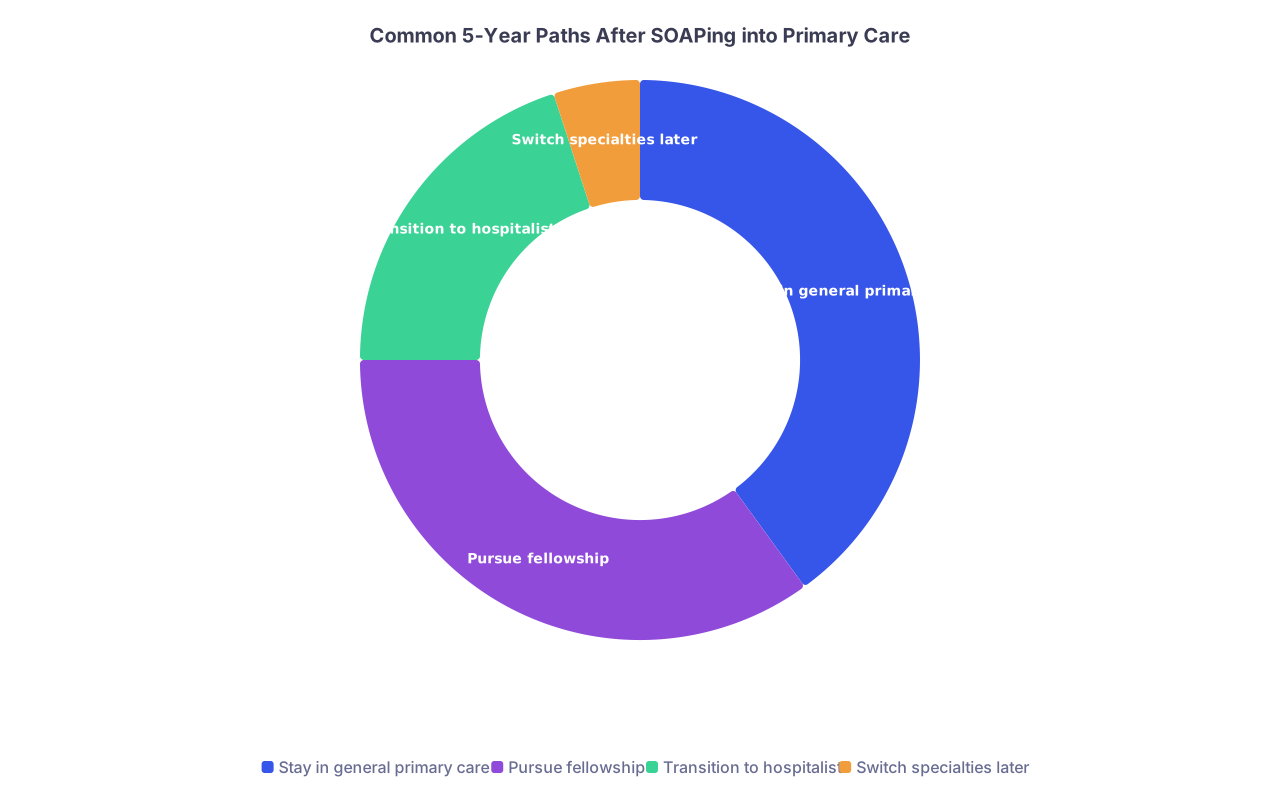
| Category | Value |
|---|---|
| Stay in general primary care | 40 |
| Pursue fellowship | 35 |
| Transition to hospitalist | 20 |
| Switch specialties later | 5 |
These numbers aren’t from a published paper; they reflect what I’ve actually seen among applicants and colleagues over time. The point: most people do just fine. Many build impressive, fulfilling careers from a SOAP primary care start.
What To Do Today — Concrete Next Step
You don’t need to “figure out your life” tonight. You need to move one critical piece forward.
Here’s your assignment for the next 60–90 minutes:
- Open your existing personal statement.
- Create a copy titled “SOAP Primary Care PS – [Field].”
- In that copy:
- Delete every paragraph that’s specifically about your competitive field.
- Write a new opening about a primary-care‑appropriate clinical moment.
- Add one paragraph that honestly explains your shift and commits to the new field.
- Add one paragraph describing how your past experiences (including the competitive field) make you a strong primary care resident.
Stop when it’s one page and coherent. It doesn’t have to be perfect. It has to be real and done.
Once that’s drafted, you’ll be ready to plug it into ERAS, adjust your experiences, and start making focused SOAP applications to primary care programs that can actually train you into the physician you still want to become—even if the route looks different than you planned.